
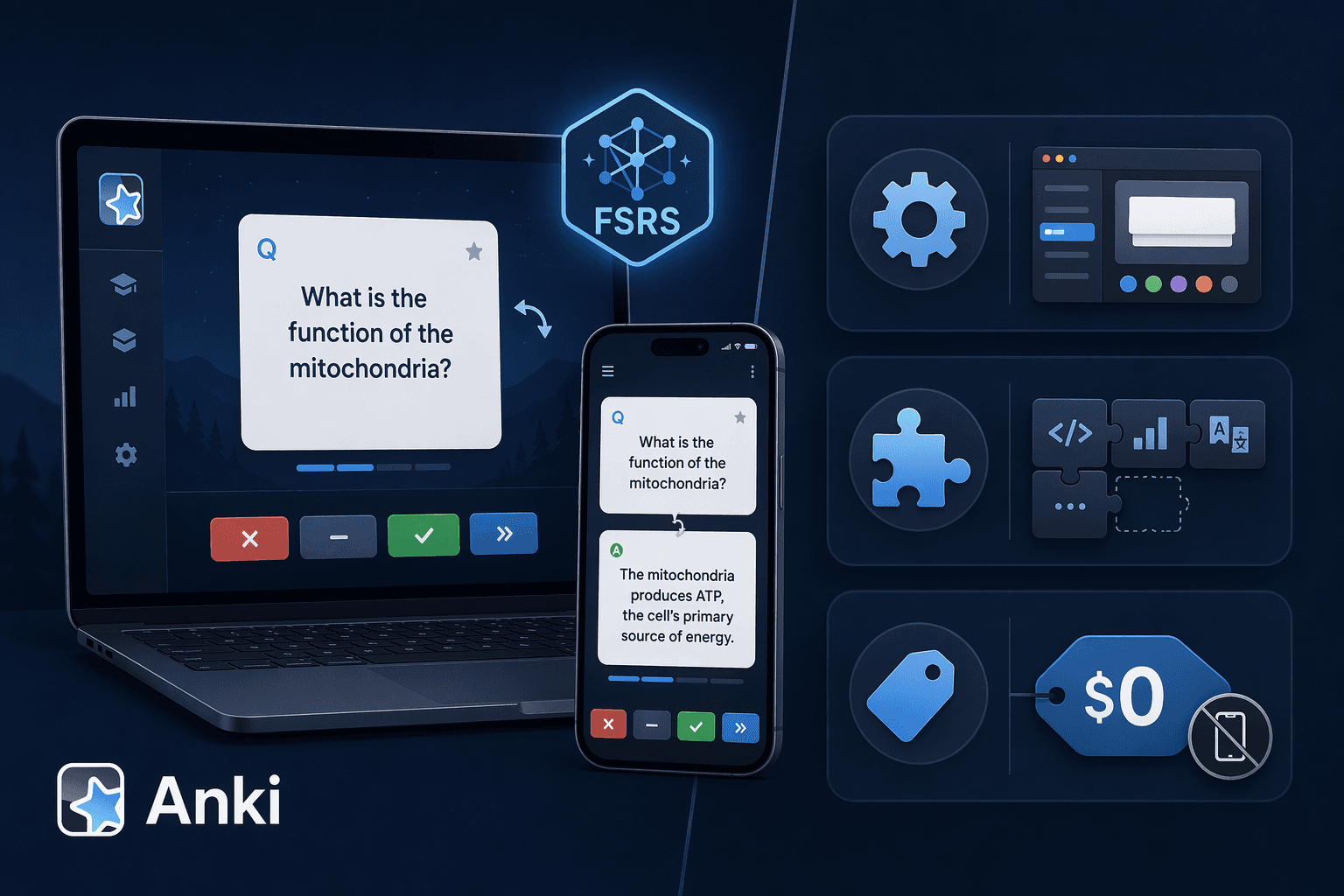
Anki Flashcard App — Complete Profile: Features, Pricing, Platforms, and Best Use Cases
A comprehensive profile of Anki for students evaluating it as their primary flashcard tool. Covers the FSRS algorithm, platform-by-platform pricing, the add-ons ecosystem, best use cases for medical students and language learners, and a comparison snapshot against Quizlet, Brainscape, and RemNote.
Updated:
What Is Anki?
Anki is an open-source flashcard application built around the principle of spaced repetition. It was first released in 2006 by developer Damien Elmes, who created it as a personal project to help with language learning. What started as a simple online flashcard website has since grown into the most widely used and extensively customizable spaced repetition system (SRS) in the world.
The name "Anki" comes from the Japanese word for "memorization" (暗記), which reflects the tool's singular focus: helping users move information from short-term recall into long-term memory as efficiently as possible. Unlike many modern study apps that bundle flashcards with social features, gamification, or AI writing assistants, Anki remains a dedicated memorization engine. It does one thing, and it does that one thing with a level of depth and control that no other flashcard app has matched.
Anki's reputation among serious students — particularly in medical school, language learning, and exam prep — is built on three pillars: a scientifically grounded scheduling algorithm, an open architecture that supports community add-ons and shared decks, and complete cross-platform availability. But that power comes with a cost. The interface is functional rather than polished, the learning curve is the steepest among major flashcard apps, and the official iOS app requires a one-time purchase that surprises many new users.
Core Features: SRS, Card Types, and the Note System
At its heart, Anki is a scheduling engine. Every card you review is tracked individually, and the algorithm determines when you will see it again based on how well you remembered it. This is the core of spaced repetition: by showing you a card right at the moment you are about to forget it, Anki strengthens the memory trace with minimal effort per review.
The Spaced Repetition System
Anki originally used a modified version of the SM-2 algorithm, which was created by Piotr Wozniak in 1987 based on a relatively small set of experimental data. SM-2 worked well for decades, but it had known limitations: it treated all cards as having the same difficulty, it could not adapt to individual user memory patterns, and it was prone to a phenomenon users called "ease hell" where intervals would gradually shrink for cards that were slightly difficult.
Starting with Anki 23.10, released in late 2023, the application added native support for a new algorithm called FSRS (Free Spaced Repetition Scheduler). FSRS represents a fundamental upgrade. Instead of using fixed rules for interval calculation, it uses machine learning trained on a dataset of over 700 million reviews from 20,000 real users to predict the optimal time to show each card. The result, according to data from the FSRS project, is a 20-30% reduction in daily reviews while maintaining the same retention rate.
For readers who want a deeper technical comparison of FSRS versus SM-2, including step-by-step migration instructions and performance benchmarks, our dedicated article The Algorithm Divide: Why FSRS Is Making SM-2 Obsolete covers the full details.
Card Types and the Note System
Anki's flexibility starts with its data model. Instead of treating each flashcard as a single question-and-answer pair, Anki separates notes (the information you want to learn) from cards (the way that information is presented). A single note can generate multiple cards. For example, a note containing a French word and its English translation can produce two cards: one showing French and asking for English, and one showing English and asking for French.
Anki supports several built-in note types, and you can create custom ones using HTML and CSS templates:
- Basic: A straightforward front-and-back card. One field on the front, one on the back.
- Basic (with reversed): Automatically creates two cards — one in each direction.
- Cloze: A sentence with one or more words hidden. You must recall the missing word. Ideal for learning definitions, formulas, and language patterns.
- Image Occlusion: A card type that hides parts of an image. You must recall what is under the hidden area. Essential for anatomy diagrams, maps, charts, and any visual material.
Decks in Anki are organized hierarchically using double colons. A deck named "Biology::Cell Division::Mitosis" creates a nested structure where the Mitosis deck sits inside Cell Division, which sits inside Biology. Each deck can have its own settings for new cards per day, maximum reviews, and learning steps.
Platforms and Pricing Breakdown
Anki's pricing model is unusual in the modern app landscape. There is no subscription. No monthly fee. No tiered plans. Instead, the pricing depends entirely on which platform you use:
| Platform | Price | Notes |
|---|---|---|
| Desktop (Windows, macOS, Linux) | Free | Full-featured. Supports all add-ons, card types, and deck options. |
| AnkiDroid (Android) | Free | Open-source Android port. Nearly all desktop features available. |
| AnkiMobile (iOS) | $24.99 one-time | Official iOS app. One-time purchase, no subscription. Funds ongoing development. |
| AnkiWeb (Browser) | Free | Sync service and basic review interface. Not a full replacement for the desktop app. |
Comments
Join the discussion with an anonymous comment.