
SAT, ACT Planner
UC Doesn't Require SAT or ACT. Where Do Prep Hours Go?
As of August 25, 2026, UC does not require the SAT or ACT, and the scores do not get read for admission decisions or scholarships. UC’s first-year requirements page is blunt: if a student submits scores, UC may use them for course placement after enrollment or for a narrow alternate method of meeting minimum eligibility, but not to decide admission or scholarships. [1]
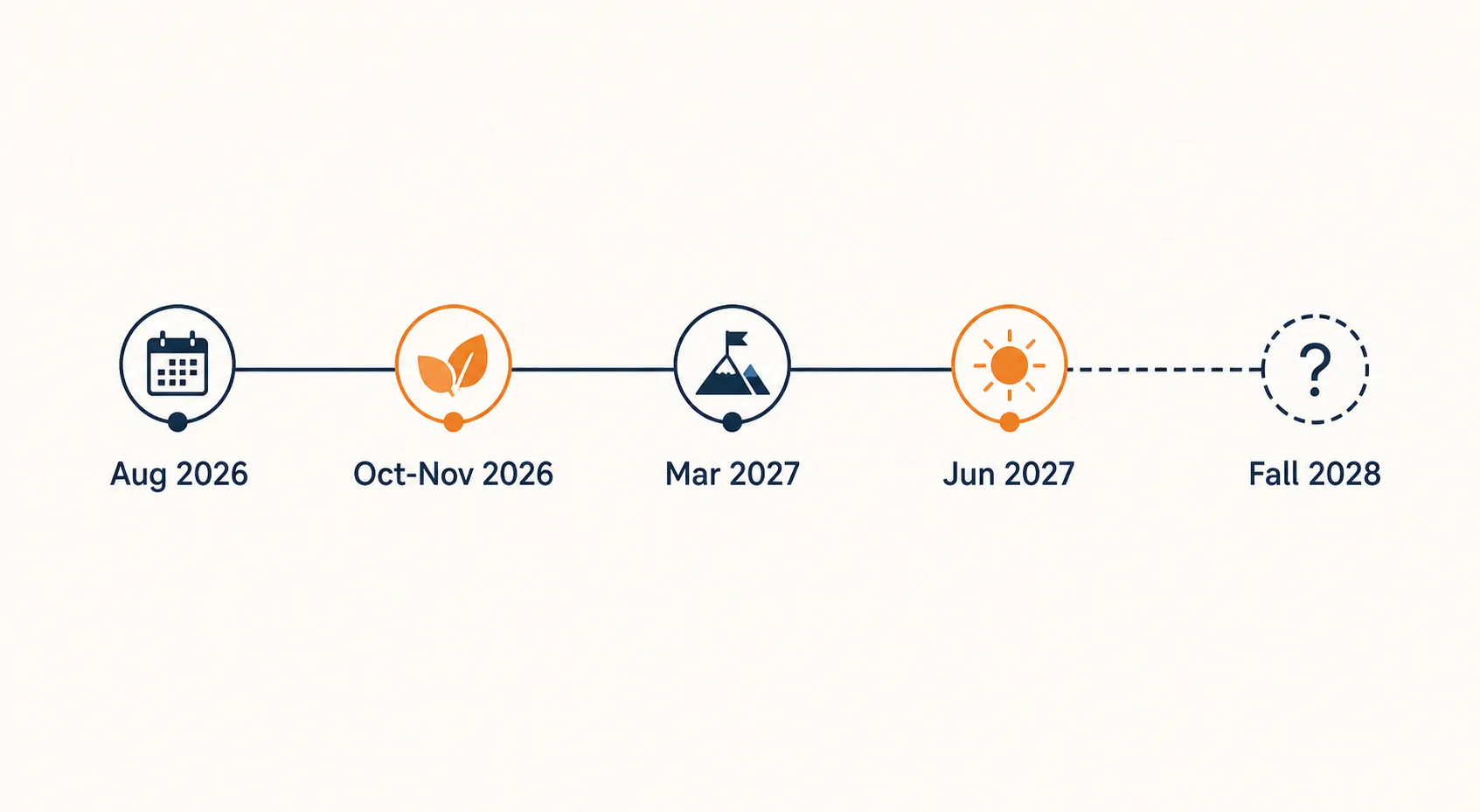
That means an admissions study plan for UC SAT/ACT requirements starts with a negative answer: for UC-only fall 2027 applicants, SAT/ACT prep is not an admissions activity. The current UC application calendar opens August 1, 2026, with filing from October 1 through November 30, 2026; decisions are posted March 1–31, the Statement of Intent to Register deadline is May 1, and official AP/IB results are due July 15. [2]

Use UC’s official November 30 filing deadline. If an outside article or calendar gives a conflicting date, do not build the senior-year schedule around the outside date; UC’s own dates page is the controlling planning source. [2]
The study-hours decision, before anyone buys prep
| Applicant situation | SAT/ACT study decision | Where the hours go |
|---|---|---|
| Fall 2027 UC-only list | Do not prep for UC admission. | A-G completion, UC GPA protection, course rigor, senior-year schedule, activities, and written application materials. |
| Mixed UC + private/out-of-state list | Prep only if a non-UC school rewards or requires scores. | Build score goals from those schools, not from UC. |
| Likely fall 2028 applicant | Keep any hedge cheap until UC completes the 2027 review. | Maintain math readiness, run a light diagnostic if useful, and re-check UC after the June 2027 review. |
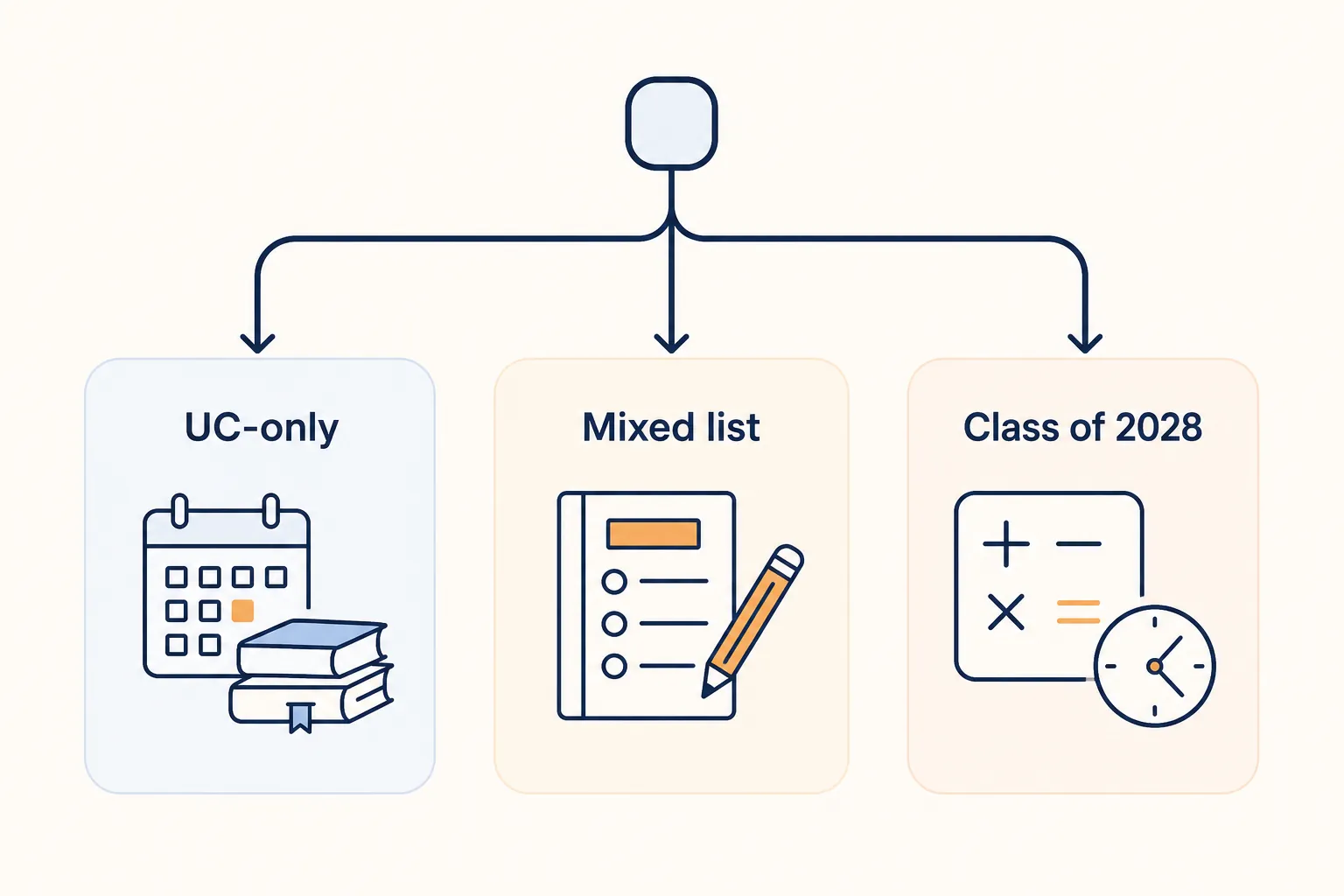
The wrong move is treating those three situations as if they all deserve the same test-prep package. A junior applying only to UC campuses has a different problem from a junior applying to UC plus Stanford, and both have a different problem from a sophomore who may be the first class affected if UC changes course.
For UC-only juniors, skip SAT/ACT prep and protect the file UC will actually read
For a fall 2027 applicant whose list is only UC campuses, a Saturday spent chasing a higher SAT math score is not a hidden admissions advantage. UC will review the record through its comprehensive review process, including A-G coursework, UC-calculated GPA, courses completed and in progress, honors/AP/IB or other advanced coursework, senior-year program quality, academic performance in context, achievements, special circumstances, and the rest of the application record. [3]
That does not make the fall easy. It makes the tradeoff clearer. If there are ten hours available in September, the UC-only question is not “SAT or ACT?” It is which UC-visible weakness those ten hours can reduce.
- Audit A-G requirements before the filing period. Confirm that the student has the required pattern, that senior-year courses are entered correctly, and that no course is being assumed to count when it does not.
- Protect grades in the courses currently on the transcript. UC will not see an SAT rescue score, so a weaker academic term cannot be counterbalanced by a submitted 1500 or 34.
- Check senior-year rigor with consequences in mind. Dropping a demanding course may free time, but it can also change the academic picture UC sees. Keeping an overloaded schedule that damages grades has its own cost.
- Give the activities section enough time to be accurate. The problem is usually not that a student did nothing; it is that the entry is vague, inflated, or missing the part where the student’s responsibility is visible.
- Draft, revise, and reality-check the personal insight responses. The PIQs do not need to sound like a brochure, but they do need to give the reader usable evidence about choices, constraints, initiative, or growth.
That redirection is not anti-testing. It is accounting. UC has removed SAT/ACT scores from the admission and scholarship calculation, so the hours have to earn their place somewhere else.
A practical UC-only week does not need to look like a test-prep week
Some students need a course audit. Some need two quiet afternoons to repair a calculus or English grade before the quarter closes. Some need to stop rewriting the same PIQ opening and instead make sure the activities list has dates, roles, and scope. A universal UC-only schedule would be fake precision.
A useful rule is to sort tasks by whether UC can see the result. UC can see the courses chosen, the grades earned, the application entries, the PIQ responses, and the context the student reports. UC cannot use an SAT or ACT score to admit the student or award a scholarship.
Mixed school lists are different: let the non-UC schools set the test plan
A student applying to UC plus private or out-of-state colleges should not hear “UC is test-blind” as “testing is useless.” It means UC is not the reason to prep. Stanford, test-optional privates, public universities outside California, and test-required schools can still make testing rational.
This is where the school list has to stop being a vibe and become a spreadsheet. Mark each non-UC college as test-required, test-optional, test-free/test-blind, or unclear. Then add whether the student would submit a score only if it is strong for that college. Vendor guidance is not policy, but it can be useful for framing ambition: Dewey Smart, for example, describes Stanford as test-optional and gives a 1500–1570 SAT working target for Stanford in its 2026 score guide. [4]
For this branch, prep can be worth calendar space because the same score that UC ignores may matter somewhere else. The prep goal should be tied to the non-UC targets: a required-testing college, a scholarship program outside UC, or a test-optional college where a strong score would add useful evidence.
- If no non-UC college requires or rewards scores, do not invent a prep plan out of habit.
- If one or two non-UC colleges make testing useful, prep narrowly for those targets and stop when the score is no longer the limiting factor.
- If the list is heavy with test-required or highly score-sensitive schools, testing becomes a real admissions workstream, separate from the UC application.
Students in the mixed-list branch can use a broader SAT prep guide, a 90-day digital SAT schedule, or a score-gap method to keep prep targeted. If the student is still deciding between tests, compare SAT and ACT fit before buying a course.
The June 2027 review matters, but it does not secretly change fall 2027 admissions
The policy watch is real. UC’s Academic Senate announced on July 13, 2026, that it would conduct an admissions review and report to the Regents, after confusion over whether a review had been scrapped. [5] CalMatters reported that Regents Chair Maria Anguiano said the Academic Senate review is due by June 2027 and that the earliest possible policy change would affect fall 2028 applicants. [6] Inside Higher Ed reported an expedited timeline with a BOARS report due February 12, 2027. [7]
The debate is not imaginary. Reports describe more than 3,000 faculty signatories urging UC to reconsider testing, including more than 2,300 STEM faculty and a separate group of about 900 focused on verbal reasoning. Supporters have pointed to a UC San Diego math-readiness claim that below-middle-school math skills rose nearly 30-fold since 2020. Opponents, including groups such as EdTrust-West, the UC Student Association, and the Campaign for College Opportunity, have argued against reinstatement and pointed to stable retention and rising graduation rates. [6][7]
Those facts explain why sophomores should watch the review. They do not mean UC is quietly reading SAT or ACT scores now. They also do not turn fall 2028 into a settled requirement. The strongest planning language available right now is “earliest possible,” not “definitely returning.”
For likely fall 2028 applicants, keep the hedge cheap and math-focused
Sophomores are in the awkward group. If UC changes policy after the June 2027 review, fall 2028 is the first cycle that could be affected. If UC keeps the current rule, paid test prep bought in panic during sophomore year may have no UC admissions value.
A reasonable hedge is small: preserve the math sequence, do not let foundational algebra weaken, and run one low-cost diagnostic path if the student is STEM-intending or likely to apply to non-UC schools that value scores. The digital SAT is 2 hours and 14 minutes with 98 questions total; the Math section has 44 questions over 70 minutes across two adaptive 35-minute modules. [8]
That is enough structure for a hedge without turning sophomore year into a prep contract. A student can use Khan Academy SAT practice with Bluebook to see whether math gaps are real, then put most of the effort back into school math. If UC reinstates testing, there will be a reason to build a fuller SAT or ACT plan. If UC does not, the student still benefits from stronger math readiness.
What not to do while waiting
- Do not buy a long prep package only because UC is reviewing policy.
- Do not assume the UCSD math-readiness claim proves a systemwide admissions requirement will return.
- Do not ignore testing entirely if the student’s eventual list may include test-required or score-sensitive non-UC colleges.
- Do not let “maybe” consume the time needed for grades, course choices, reading, writing, and actual learning.
Where the prep hours go instead
For UC-only juniors, the replacement for test prep is not one giant task. It is a set of admissions-visible decisions and records. Some are academic, some are administrative, and some are writing work that gets worse when it is rushed.
| Instead of SAT/ACT prep | Use the time for | Why it matters for UC |
|---|---|---|
| Weekend practice tests | A-G and course-entry audit | A preventable course or reporting mistake can damage an otherwise strong application. |
| Generic vocabulary or grammar drills | PIQ drafting and revision | UC reads the written responses; it does not read a submitted ACT English score for admission. |
| Paid score-chasing after a decent diagnostic | Current-course grade protection | Grades and coursework remain central parts of the UC academic record. |
| Trying both SAT and ACT “just in case” | Non-UC policy check | Testing only deserves time if another college on the list gives it value. |
| Sophomore-year panic prep | Math foundation maintenance | A cheap hedge preserves options without pretending the fall 2028 decision has already been made. |
There is one more useful test: who is waiting on the work? If a counselor needs the final senior-year course list, if a teacher needs an activities résumé for a recommendation outside UC, if a parent needs access to comment on PIQ drafts, or if the student needs a cleaner way to share drafts, those are immediate bottlenecks. SAT/ACT prep for a UC-only list is not.
For fall 2027 UC-only applicants, SAT/ACT prep is the wrong default. For mixed lists, prep follows the non-UC target schools. For likely fall 2028 applicants, keep the hedge cheap, math-focused, and temporary until UC’s June 2027 review produces an actual decision.
References
- First-year requirements - UC Admissions, UC Admissions
- Dates & deadlines | UC Admissions, UC Admissions
- How applications are reviewed | UC Admissions, UC Admissions
- What SAT Score Gets You Into UC Berkeley, Stanford, or UCLA in 2026?, Dewey Smart
- Statement from UC Academic Senate on admissions review, University of California, July 13, 2026
- A new review of the SAT at UC is coming by June 2027, CalMatters
- UC Expedites Timeline for Determining Whether to Restore Testing Requirement, Inside Higher Ed, July 16, 2026
- How the SAT Is Structured, College Board
Fill in this timeline
This is a skeleton schedule, not a performance claim — for section-by-section strategy to fill in each slot, read the exam hub. For evidence that a similar timeline worked, compare against real outcome logs.