
SAT, ACT Planner
Build a Study Plan for Unexpected School Closure Days
The closure notice lands before breakfast: school is closed. For an SAT or ACT student with a fixed test date, the first decision is not whether the day “counts.” It is what kind of day the district just created.

Start with the announcement language. Omaha Public Schools’ 2025–26 weather procedures, for example, distinguish a “School Closure” day, when “there will be no remote learning or assigned activities,” from e-learning days, when students receive remote instruction and assignments from school staff.[1] That definition belongs to Omaha, not the entire country, but it shows the fork every closure-day study plan has to handle.
| If the notice says... | Your study-plan response |
|---|---|
| School is closed, with no remote learning or assigned activities | Run the full closure-day study protocol. You own the usable study blocks. |
| School is closed, but it is an e-learning or remote instruction day | Finish required school assignments first. Then run the shortened version of the protocol. |
| The notice is unclear | Check the district page, school message, and learning-management system before you schedule test prep. |
This distinction matters more now because remote-learning rules vary. A 2022–23 policy review in The Conversation reported that e-learning days were allowed in most snowy states, while emphasizing that rules depended on the state and could change.[2] So the protocol below is built around a local-policy check, not a national assumption about what a “snow day” means.
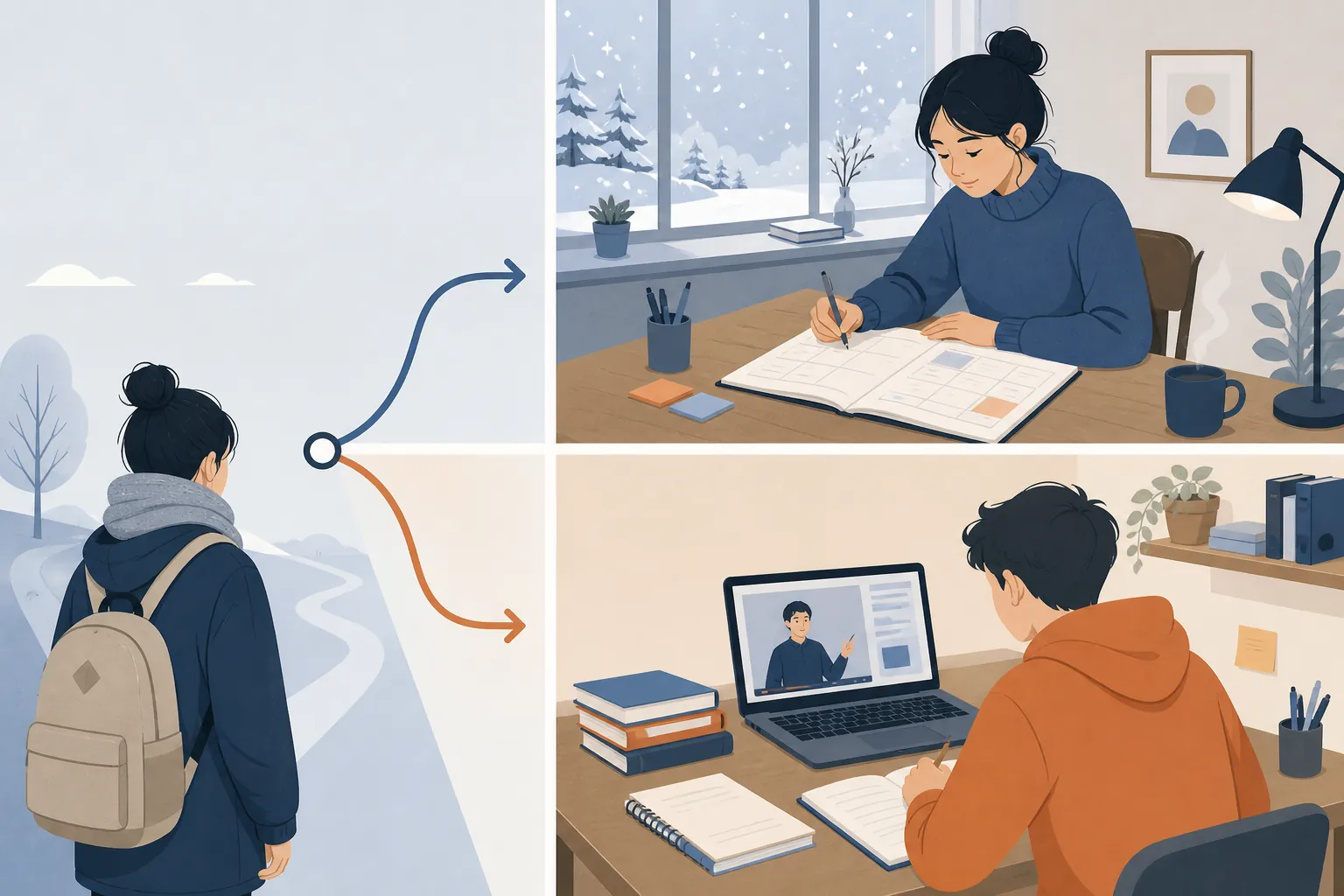
Why a closure day is different from drifting attendance
A coordinated closure is not the same educational problem as one student missing school while everyone else keeps moving. Joshua Goodman’s Massachusetts research found no measurable test-score impact from weather-driven school closures, while a one-day increase in the student absence rate reduced math achievement by up to 5% of a standard deviation.[3][4] In the same line of evidence, Massachusetts students averaged about 2 weather-closure days per year but about 8 individual absence days per year, rising to about 10 for low-income students.[3][4]
For a test-prep student, that finding is useful because it points away from panic. When everyone is out, teachers can adjust pacing, districts may have calendar slack, and no one classmate is secretly getting ahead in the same room. But it does not mean the day is automatically helpful. A closure day becomes recoverable only if the student has already decided what to do with it.
It is also worth keeping rough “lost learning” language in its place. In a 2026 NPR discussion, Goodman framed a missed school day as roughly 1% of a school year’s learning, but that was a broad rule of thumb, not a measurement that can be applied cleanly to every district, subject, or student.[5] For SAT and ACT prep, the practical question is smaller and more controllable: did the closure day become a planned block, or did it disappear into half-rest, half-guilt?
Build the protocol before the forecast turns serious
The morning of a closure is a bad time to design a study plan. Someone is checking road conditions, someone is asking whether assignments have been posted, and the student is trying to decide whether “studying” means a full practice test, five vocabulary words, or opening a laptop and wandering.
The closure-proof version is a one-page protocol attached to the student’s main SAT or ACT plan. It should already answer these questions:
- Which exam are you preparing for, and what is the test date?
- What is the current weekly study plan, and which part is most behind?
- Which official practice materials are ready to use without searching?
- Which two subjects or skill areas get priority on a surprise free day?
- How many study blocks are realistic if the day is a true closure?
- What is the shortened version if the school assigns e-learning work?
- What device, charger, calculator, paper, login, and quiet space are needed?
- Where will the student record what was finished and what moves to the next study day?
That list is not busywork. The first closure day is often the cleanest chance to use the plan. In a Japanese online-tutoring dataset studied by Ikeda and Yamaguchi, student study time rose sharply in the first weeks of school closure and then faded back toward pre-closure levels within a couple of months; students who already had home-study setups were positioned to gain more from the shift.[6] The context is Japan and an online tutoring service, not U.S. SAT or ACT prep, so the finding should not be stretched into a score promise. It does support a very practical choice: front-load the best work into the first usable closure day instead of assuming motivation will be stronger later.
The one-page closure-day protocol
| Protocol field | Fill it in before the closure |
|---|---|
| Exam and date | SAT or ACT; official test date; registration deadline if still pending |
| Current prep target | The next score goal, section goal, or skill target already in the main plan |
| Priority 1 | The subject or question type that most affects the next practice score |
| Priority 2 | The second subject or task if the first block goes well |
| Full-day plan | Two to four study blocks for a true closure day |
| E-learning version | One shorter block after required schoolwork |
| Ready materials | Practice test, answer explanations, calculator, scratch paper, timer, login, notebook |
| Stop rule | The point when the day becomes rest instead of pretending to study |
| Carry-forward note | The exact next task for the next normal study session |
The stop rule is important. A closure day does not need to become a punishment day. The problem is the false middle: the student is not really resting because a parent keeps asking about test prep, and not really studying because no task has been chosen. A written stop rule lets the day have both a real study block and a real ending.
Run the day by decision branch
Once the closure notice is official, do not redesign the plan. Open the protocol and follow the branch.
If it is a true closure day
Use the first serious block for the task that is hardest to start on a regular school night. That usually means a timed section, a set of mixed practice questions, or a concentrated review of the weakest tested skill. Do not begin with organizing folders, choosing pens, rewriting the whole plan, or watching general strategy videos unless the protocol specifically says that is the priority.
| Block | What to do | What counts as finished |
|---|---|---|
| Opening check, 10–15 minutes | Confirm there is no remote schoolwork. Put the protocol, materials, timer, and answer sheet in one place. | The student knows which branch is active and which first task starts. |
| Block 1, 60–90 minutes | Timed section, mixed question set, or the highest-priority skill from the main plan. | Answers are completed under a timer, not just read. |
| Review block, 45–75 minutes | Check answers, label errors, and write the correction for the most important misses. | At least three mistakes have a clear reason and a next action. |
| Block 2, 45–75 minutes | Targeted practice based on the review block, or the second priority if Block 1 went well. | The student can say what improved or what still needs attention. |
| Closeout, 10 minutes | Update the main SAT or ACT plan and write the next task for the next study day. | Nothing depends on remembering later. |
A student who has enough energy for only one real block should choose Block 1 and the closeout. A student who is rested and has a quiet house can add the review block and targeted practice. The protocol is useful because it scales without requiring a new decision every hour.
If it is an e-learning day
Required schoolwork goes first. That is not a moral rule; it is a sequencing rule. If remote assignments are due by the end of the day, test prep should not compete with them from the first minute of the morning.
After the school assignments are done, run the shortened protocol: one focused block and one short closeout. The best e-learning add-on is usually not a full practice test. It is a contained task: review yesterday’s missed math questions, complete one timed reading passage, drill a grammar rule, or update the error log so the next full study session is sharper.
| Available time after schoolwork | Use this version |
|---|---|
| 20–30 minutes | Error-log cleanup, formula review, vocabulary review, or one small targeted set |
| 45–60 minutes | One timed passage or one compact math set, followed by answer review |
| 75–90 minutes | A timed section plus a short review of the biggest misses |
Scale it for one day, scattered days, or a long disruption
There is no safe national average closure-day number to build around. Even within one state, closure experience can vary sharply. CalMatters’ Disaster Days database found California districts ranging from under 1 to more than 20 closure days per school per year from 2002 to 2019, and those were all-cause closures, including wildfires and power outages, not weather-only snow days.[7] That range is a reason to build a flexible protocol, not a reason to assume California patterns apply to every student.
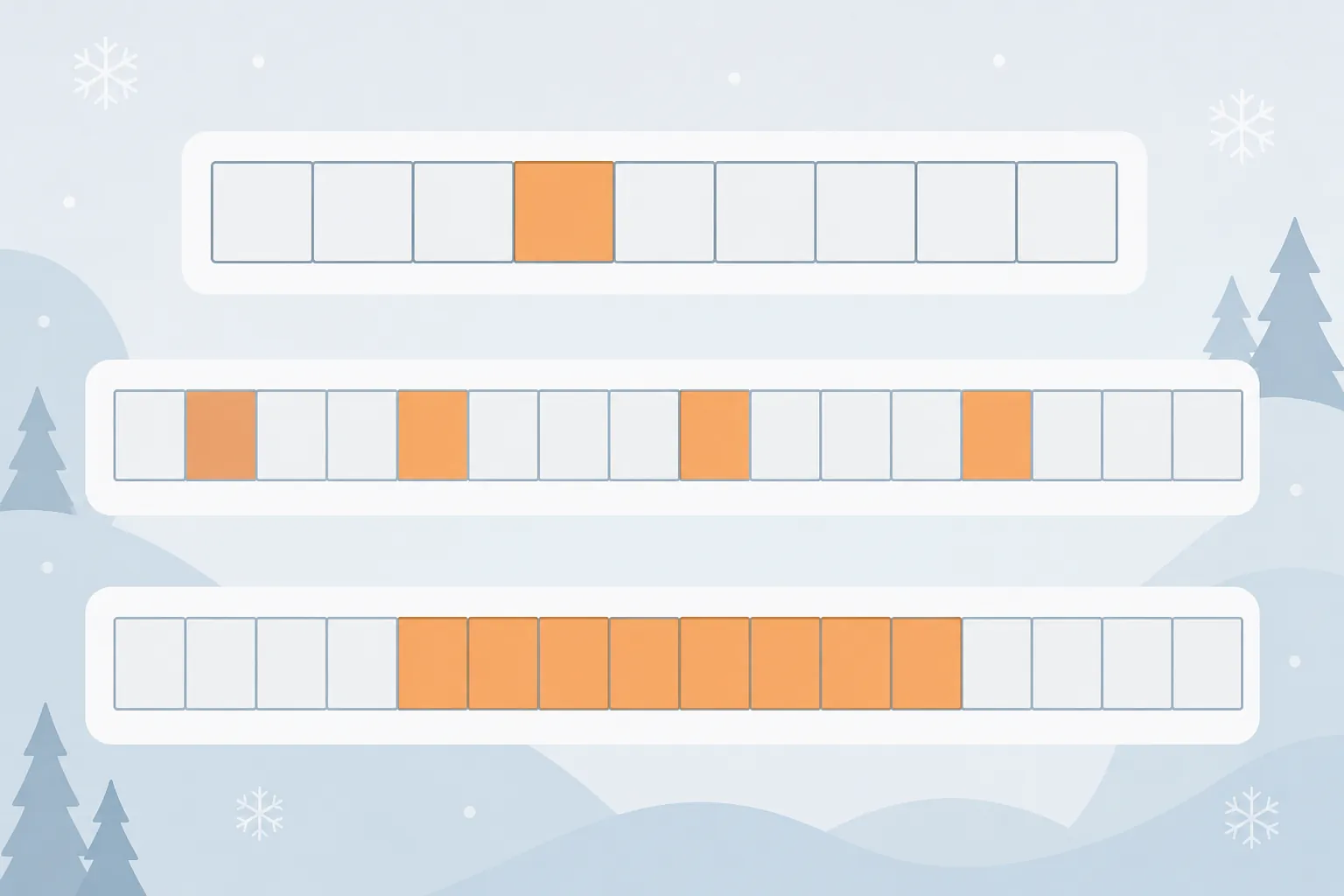
For one unexpected day
Treat the first closure as the highest-value block. Use it on the task that has been hardest to protect during normal school weeks: a timed section, a full review of recent misses, or the weakest skill in the current plan. Do not spend the day “getting set up.” Setup should already be done.
For several scattered closure days
Do not restart from scratch each time. Keep one running closure-day log with three columns: date, task completed, next task. Rotate priorities only when the evidence in the error log says to rotate. If the first closure day was math-heavy, the second might be reading or English; if the math misses are still the biggest score drag, the second day may need to stay with math.
| Closure day | Best use |
|---|---|
| First closure | Highest-priority timed work plus review |
| Second closure | Targeted practice from the first day’s misses, or the next weakest section |
| Third closure and beyond | Alternate timed work, review, and plan updates so the main SAT or ACT schedule stays current |
For 10+ disruption days
A long disruption needs a weekly rhythm, not a heroic daily schedule. Keep school obligations first on e-learning days. On true closure days, preserve two kinds of blocks: one timed practice block and one review or correction block. If those are the only two blocks that survive a messy week, the prep plan is still alive.
For longer closures, the danger shifts from “What should I do today?” to “Where did my main plan go?” Put a recurring plan-check on the same day each week. The check is short: compare completed work with the test date, move unfinished tasks, and decide whether the next closure block should be timed practice, content review, or error correction.
What to prepare physically, not just mentally
A closure-day study plan fails quickly when the student has to hunt for materials. Before winter weather, storms, or local emergency closures are likely, assemble a small study kit. It does not need to be elaborate.
- Printed or bookmarked official practice materials for the next two study blocks
- Calculator, charger, pencils, scratch paper, and timer
- Login information for any approved practice platform
- A current error log or notebook
- The one-page closure-day protocol
- A visible copy of the main SAT or ACT study calendar
Parents can help most by asking for the protocol before the closure, not by inventing one during the closure. A useful question is, “Which branch are you running today?” That is clearer than “Are you studying?” and it gives the student an answer that can be acted on.
Copy this into your planner
Save or download this as your Closure-Day Protocol and attach it to the SAT or ACT plan you already use. If your school closes with no assigned work, run the full version. If your school posts e-learning assignments, complete those first and run the shortened version. If the notice is unclear, verify the district’s definition before you spend the morning guessing.
| Closure-Day Protocol | Your entry |
|---|---|
| Exam | |
| Test date | |
| Current weekly plan location | |
| Priority 1 for a true closure day | |
| Priority 2 if time remains | |
| Full-day first block | |
| Full-day review block | |
| Shortened e-learning block | |
| Materials already ready | |
| Stop rule | |
| Next-task note after the day ends |
After you fill it in, keep it with your SAT or ACT calendar and the rest of your Study Templates & Planners. The useful plan is the one that exists before the closure notice appears.
References
- Weather Procedures — Omaha Public Schools, 2025–26.
- Are snow days about to get buried by remote learning? Not quite – but it depends on where you live — The Conversation.
- In Defense of Snow Days — Education Next.
- The effect of snow days on student performance — Harvard Kennedy School.
- Are snow days bad for students? — NPR, January 26, 2026.
- Online learning during school closure due to COVID-19 — Japanese Economic Review / PMC.
- Disaster Days — CalMatters.
Fill in this timeline
This is a skeleton schedule, not a performance claim — for section-by-section strategy to fill in each slot, read the exam hub. For evidence that a similar timeline worked, compare against real outcome logs.