
A Spaced Repetition Schedule for Finals Week: 3 Templates That Work
This article provides three day-by-day spaced repetition schedule templates for finals week—whether you have two weeks, one week, or just a few days—and explains why compressed intervals and active recall still beat massed cramming.
Best for: cumulative finals, multiple chapters
Get the template for this method →If finals are close enough that your calendar feels loud, use the timeline you actually have. With 14 days, use the two-week rotation. With 7 days, use the compressed 1-2-4-7 plan. With 3 to 5 days, use the micro-interval recovery plan. The point is not to build a perfect semester-long system right now; it is to stop treating review as one giant event and start giving your brain repeated chances to pull information back before the exam.
| Time left | Use this schedule | Best for | Core pattern |
|---|---|---|---|
| About 2 weeks | Schedule A | Cumulative finals, multiple chapters, classes where you still have new material to learn | Introduce material, then review it after roughly 1, 3, 7, and 14 days |
| About 1 week | Schedule B | A final next week, several topics partly learned, not enough time for a full long cycle | Review on Days 1, 2, 4, and 7 |
| 3-5 days | Schedule C | Emergency recovery when you are behind but still have study blocks available | Hour 0, Hour 4, Hour 12, Day 1, and Day 3 |
These templates draw from common spaced repetition schedules such as reverse 2-3-5-7 planning, 1-3-7-14 review cycles, weekly spaced templates, and compressed cramming-recovery intervals.[1][2][3][4] Treat them as a starting grid, not a moral test. If you have a lab shift, a commute, a family obligation, or another exam eating the same day, slide the review block earlier or later. Just do not delete the repeat exposure unless something truly has to give.
Before You Start: Separate New Material From Review Material
A spaced repetition schedule for finals week only works if “study” stops meaning everything at once. Each day has two different jobs: learning material you cannot yet explain, and reviewing material you have already touched.
- New material is anything you cannot summarize without looking, cannot use in a problem, or do not recognize in a practice question.
- Review material is anything you have already learned once and now need to retrieve, apply, or correct.
- High-risk material is review material that keeps failing: missed practice problems, flashcards you keep blanking on, essay themes you cannot organize, formulas you confuse.
That distinction matters because finals week is where students accidentally spend three hours “reviewing” a chapter they never learned, or three hours rereading a chapter they could have tested themselves on in 25 minutes. For each course, make a rough topic list first: chapters, units, lecture themes, problem types, lab concepts, essay prompts, or case studies. Then mark each one N for new, R for review, or H for high-risk.
The schedules below assume study sessions are active. That can mean flashcards, blurting from memory, past-paper questions, closed-notes problem sets, teaching the concept out loud, or writing an essay outline without your notes. If your “review” block is mostly highlighting, copying, or watching solution videos without pausing, it is not doing the job these schedules need it to do. For a deeper comparison, see Retrieval Practice vs Rereading Notes.
Schedule A: The 2-Week Finals Plan
Use this if your final is about 14 days away. This is the most forgiving version because it gives you enough room to introduce weak material and still bring it back several times before the exam. It compresses the logic of 1-3-7-14 review cycles into a finals window: learn something, test it soon, test it again after a few days, then return to it near the end.[2]
| Day | Main job | Review job |
|---|---|---|
| Day 14 | Map the exam. Sort all topics into new, review, and high-risk. | Do a 20-minute diagnostic: closed-notes quiz, practice set, or blank-page recall. |
| Day 13 | Learn Topic Set A. | Quick recall of anything missed in the diagnostic. |
| Day 12 | Learn Topic Set B. | Review Topic Set A. |
| Day 11 | Learn Topic Set C. | Review Topic Set B and high-risk items from A. |
| Day 10 | Learn Topic Set D or finish remaining new material. | Review Topic Set C. |
| Day 9 | Start mixed practice for A and B. | Review Topic Set D. |
| Day 8 | Patch weak areas from the first week. | Review Topic Set A again. |
| Day 7 | Take a timed section, past paper, or mixed problem set. | Review Topic Sets B and C. |
| Day 6 | Correct the timed work. Relearn only what the mistakes reveal. | Review Topic Set D and high-risk cards. |
| Day 5 | Mixed active recall across all topics. | Return to Topic Set A and any repeated misses. |
| Day 4 | Practice under exam-like conditions. | Review Topic Set B. |
| Day 3 | Target the top 3 weak zones. | Review Topic Sets C and D. |
| Day 2 | Light full-course recall: formulas, themes, processes, essay plans. | Final high-risk pass. |
| Day 1 | Short confidence review only. No all-night rebuild. | One final closed-notes pass over the items most likely to appear. |
The first four or five days are allowed to include new learning. That does not mean slowly rereading every chapter from the beginning. It means choosing the material most likely to affect your score and forcing it into a usable form: a solved problem, a diagram from memory, a comparison chart, a flashcard set, a thesis-and-evidence outline, or a spoken explanation.
A good two-week day might look like this: 60 to 90 minutes learning or repairing one topic set, 25 to 40 minutes of active recall on yesterday’s topic, and 10 to 20 minutes logging misses. The log can be plain: “confused meiosis I vs II,” “forgot chain rule setup,” “cannot explain judicial review,” “mixing up authors.” That list becomes tomorrow’s review, which is why it is more valuable than a beautifully rewritten page of notes.
The middle of the plan is where many students drift because the panic has dipped but the exam is not close enough to sharpen everything. Do not let Days 8 through 5 become decorative studying. Start mixing topics. Finals rarely ask questions in the same order as your binder. A biology final may move from cell signaling to genetics to experimental design; a history exam may ask you to connect two units you studied a month apart. Mixed recall exposes that earlier than the exam room does.
By the last three days, new learning should shrink unless you discover a topic that is both likely to appear and completely missing. Most of your energy should go to retrieval, correction, and another retrieval attempt. Read the explanation after you miss a question, then close it and redo the question. Look at the formula after you forget it, then cover it and rebuild the setup. If you cannot explain an essay argument, check your notes, then write the outline again from memory.
Schedule B: The 1-Week 1-2-4-7 Plan
Use this when the exam is next week. The pattern is simple: anything you learn today gets recalled tomorrow, again two days later, again around Day 4, and again on exam eve or exam day. This is a compressed version of longer spaced schedules, closer to the weekly templates used for short preparation windows.[1][3]
| Day | What to do | What must come back |
|---|---|---|
| Day 7 | Triage the syllabus. Learn the highest-value weak material first. | Baseline diagnostic misses. |
| Day 6 | Learn the next highest-value topic set. | Day 7 material. |
| Day 5 | Learn or repair the next topic set. Begin mixed questions. | Day 6 material plus hard Day 7 misses. |
| Day 4 | Timed practice on the most exam-like tasks. | Day 7 material again and Day 5 material. |
| Day 3 | Patch only what practice exposed. | Day 6 material again and all high-risk items. |
| Day 2 | Mixed active recall across the whole exam. | Day 5 and Day 4 material again. |
| Day 1 | Short, closed-notes final pass. Sleep matters more than one more messy chapter. | All high-risk items, especially anything missed twice. |
The one-week plan is where prioritizing becomes uncomfortable. You probably cannot give every topic equal treatment. Start with the intersection of three things: material that is likely to appear, material worth a meaningful number of points, and material you currently cannot retrieve. A small topic you already know does not need a 90-minute block just because it appears early in the textbook.
If you have two hours today, do not spend the first hour making the schedule beautiful. Spend 10 minutes choosing the topic set, 60 to 75 minutes learning or repairing it, 20 minutes testing yourself, and 10 minutes writing the exact misses that must return tomorrow. If you have only 45 minutes, do the same shape in miniature: choose, recall, correct, log.
Here is the difference between passive and active review inside this plan. Passive review says, “I looked over lecture 6 again.” Active review says, “I closed the notes and listed the five causes, then checked which two I forgot.” Passive review says, “I watched the calculus solution.” Active review says, “I paused before each step, wrote the next line myself, then redid the problem from a blank page.” The schedule gives you the spacing; retrieval gives the spacing something to strengthen.
The last day is not for discovering whole untouched units unless there is no alternative. It is for short, sharp passes: formulas from memory, definitions without looking, one more missed-problem redo, one essay outline, one concept map, one round of flashcards filtered to the cards you failed. If you use an app, keep the setup minimal. Finals week is not the ideal moment to compare every feature in every tool; if you need that later, use the 2026 spaced repetition flashcard app guide.
Schedule C: The 3- to 5-Day Recovery Plan
This plan is for the student who is not early anymore. It is not equal to starting two weeks out, and it should not be sold that way. But it is still better than turning all remaining time into one long, blurry cram. The compressed interval is: Hour 0, Hour 4, Hour 12, Day 1, and Day 3, adapted from cramming-recovery spaced schedules and short compressed plans.[4][2]
| When | Action | Keep it active |
|---|---|---|
| Hour 0 | Pick the highest-value topic and learn the minimum usable version. | Create 10-20 questions, flashcards, or prompts from it. |
| Hour 4 | First recall sprint. | Answer without notes, then correct quickly. |
| Hour 12 | Second recall sprint. | Redo missed items only, then add one mixed question. |
| Day 1 | Return after sleep or a longer gap. | Closed-notes recall, practice problems, or essay outline. |
| Day 3 | Final recovery pass if the exam timing allows. | High-risk items plus one exam-like task. |
A 3-day version might look like this: on Day 3, build the emergency list and run Hour 0, Hour 4, and Hour 12 reviews for the first topic set. On Day 2, repeat that pattern for the next topic set while doing a Day 1 review of the first. On Day 1, stop expanding aggressively and cycle through the highest-risk misses from both days. If the exam is tomorrow, compress the same idea into morning, afternoon, evening, and next-morning recall blocks.
The emergency rule is brutal but helpful: every block must produce something you can be tested on. A page of highlighted notes does not count. A set of answered practice questions counts. A blank-page list of causes, steps, formulas, or cases counts. A one-page essay plan from memory counts. A corrected problem redone without looking counts.
If you are choosing between “read all chapters once” and “test the most likely chapters three times,” choose the second. That does leave gaps. But a final taken with several retrievable, usable topic clusters is usually less fragile than a final taken with a broad feeling of familiarity and no practice pulling the material out.
Why Compressed Spacing Still Helps
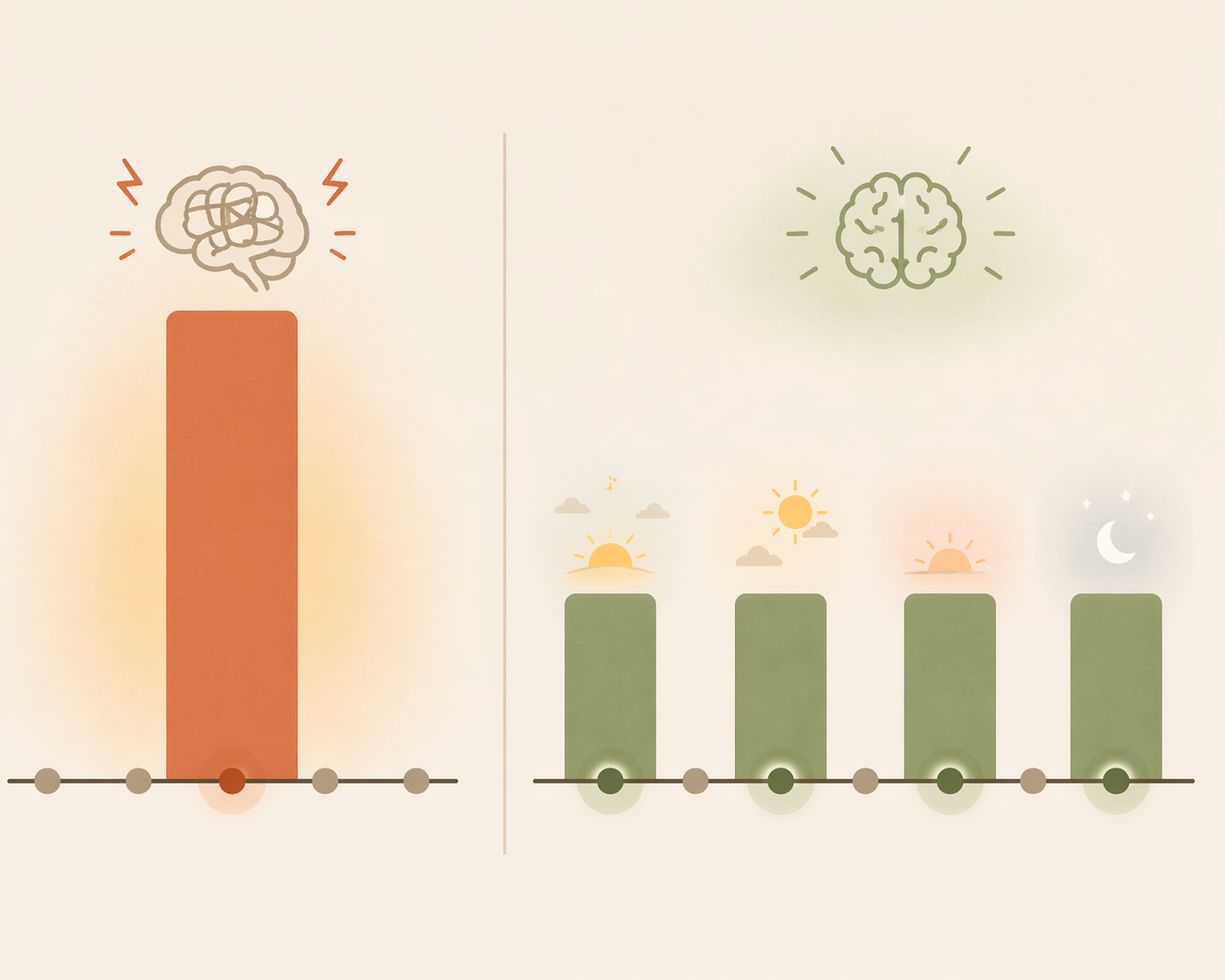
Forgetting is not a personal failure; it is the default setting. Summaries of the Ebbinghaus forgetting curve commonly report that without review, roughly 70% of newly learned information can be lost within 24 hours.[2][4] The exact percentage will not be the same for every student, subject, or test format, but the direction is the part that matters for finals week: waiting until the night before asks your memory to hold too much with too few returns.
Spaced practice has stronger evidence than the tidy calendar boxes make it look. Cepeda and colleagues’ 2006 meta-analysis found that spaced practice produced about 200% better retention than massed practice at a one-week delay.[5] That does not mean your score will triple if you follow a template. It means that, across studied memory tasks, distributing practice beat packing equivalent practice into one session.
UC San Diego’s study guidance makes the same practical point: multiple practice sessions spread over time are more effective than spending the same total time in one session.[6] That is the reason a 20-minute recall pass today and another one tomorrow can be worth more than adding 40 exhausted minutes to a midnight cram.
Save My Exams and MindLifeUp both present the useful finals-week version of this idea: even 15 to 20 minutes of daily spaced review can outperform a single 3-hour cram session.[7][3] The claim is best used as directional guidance, not as a guarantee for every exam. A 20-minute review of vague notes will not beat three hours of hard practice. A 20-minute closed-notes recall session, repeated across days, has a much better chance.
Bananote’s synthesis also reports a 60-70% retention estimate after two weeks for a particular spaced schedule, but that should be read as a site-level synthesis rather than a universal retention law.[4] Different material fades differently. A vocabulary list, an organic chemistry mechanism, and a comparative politics essay prompt do not behave exactly the same way. Use the number as encouragement to space reviews, not as a promise that the template controls the outcome.
Make Each Review Session Count
A review session should feel slightly uncomfortable. That discomfort is the moment you find out whether the material is available without the page in front of you. Keep the session short enough that you will actually do it, but demanding enough that it reveals misses.
- For fact-heavy courses: use flashcards, but say the answer before flipping. Delete or suspend cards that are too easy.
- For problem-based courses: redo missed problems from a blank page, then change one number or condition and try again.
- For essay exams: write thesis statements, outlines, comparison grids, and evidence lists without notes.
- For process-heavy courses: draw the pathway, timeline, proof, diagram, or sequence from memory, then mark the missing steps.
- For mixed finals: alternate quick recall with exam-like questions so you do not only memorize isolated facts.
The smallest useful review loop is: retrieve, check, correct, retrieve again. If you miss a flashcard, do not just nod at the answer and move on. Cover it and answer again. If you miss a problem, do not only read the solution. Redo the setup. If you blank on an essay theme, do not reread the entire chapter. Build the outline again with the missing piece included.
If you want the full method after finals, the broader spaced repetition study guide can help you build a calmer system. For this week, keep the machinery simple. A notebook, a timer, a folder of past papers, and a small flashcard deck are enough.
How to Split the Schedule Across Multiple Finals
Real finals rarely arrive one at a time. If you have three exams, do not make three perfect schedules that each assume you have the whole day. Start with exam dates, then weight by difficulty and point value. The earlier exam gets the first claim on your time; the hardest or highest-stakes exam gets extra active recall; every other course gets at least a short keep-alive review so it does not disappear completely.
| Situation | What to prioritize | What not to drop |
|---|---|---|
| One exam is in 3 days, another in 10 | Use Schedule C for the 3-day exam first. | Do a 15-20 minute recall pass for the later exam each day. |
| Two exams are on back-to-back days | Front-load the second exam earlier than feels natural. | Keep the first exam’s high-risk list short enough to review the night before. |
| One class is much harder | Give it longer active recall blocks. | Still schedule brief reviews for easier classes so familiarity does not fade. |
| One final is cumulative | Rotate old units into every mixed practice block. | Do not spend all week only on the newest unit. |
One workable daily structure is a primary block, a secondary block, and a maintenance block. The primary block goes to the next or hardest exam. The secondary block goes to the other serious contender. The maintenance block is short active recall for a course you cannot afford to ignore. Maintenance does not mean pretending to study. It means 15 minutes of real retrieval: a formula sheet from memory, 10 flashcards, one paragraph plan, three practice questions.
When two schedules collide, protect the review interval for the material most likely to fade before the exam. If you learned a topic yesterday and it is already shaky, it needs a short recall pass more than your favorite chapter needs another reread. The pass can be ugly and brief. The pattern survives because you return.
Start Today
Choose the schedule that matches your actual exam date. Write the topic list. Mark each topic new, review, or high-risk. Put today’s first active recall block on the calendar before you reorganize your desk, rename your files, or search for a better app.
If you have 14 days, begin the map and diagnostic. If you have 7 days, choose the highest-value weak topic and set its Day 2, Day 4, and Day 7 reviews now. If you have 3 to 5 days, run Hour 0 today and schedule Hour 4 before the day gets away from you.
References
- Best ways to revise: Spaced repetition, Birmingham City University.
- Spaced Repetition Study Method, Lexie.
- Spaced Repetition Schedule: Weekly Guide, MindLifeUp.
- The Complete Spaced Repetition Schedule for Long-Term Retention, Bananote.
- Distributed practice in verbal recall tasks: A review and quantitative synthesis, Cepeda et al., 2006.
- Spaced Practice, UC San Diego Psychology.
- Create a spaced repetition schedule to boost memory, Save My Exams.
Apply This Method
Related Methods
- Form vs. Format: How to Match Your Note-Taking Method to Paper, Laptop, or Tablet for Every Class
Stop debating whether handwriting or typing is better. This guide helps college students choose the right note-taking form (Cornell, outline, mapping, charting) for the right medium (paper, laptop, tablet) based on their specific course type and cognitive style.
- 7 Active Recall Mistakes That Are Wasting Your Study Time (and How to Fix Them)
Struggling to see grade improvements despite using active recall? This troubleshooting guide identifies seven common execution errors—like passive flashcard flipping, testing too soon, and using the wrong technique for the subject—and provides practical fixes to make your study time count.
- AVID Focused Notes vs. Cornell Notes: What's the Difference?
Many students and teachers use 'Cornell Notes' and 'Focused Notes' interchangeably, but they are not the same thing. This article explains AVID's evolution from exclusively using Cornell Notes to the broader Focused Note-Taking framework, clarifies the conceptual distinction between a format and a process, and helps you decide which approach fits your learning goals.
Comments
Join the discussion with an anonymous comment.