
Planner
How to Apply for the UNC and Virginia Tech Military Fellowship Program
The newly approved Senior Service College Fellowship at UNC Chapel Hill and Virginia Tech offers a new pathway for MEL-1 credit, but officers must apply through their service branch's existing SSCF assignment system, not directly to the universities. This guide explains the application pipeline, timelines, and what to expect for the 2027-28 cohort.
Scope panel
- Target exam
- not specified
- Timeline length
- 52 weeks
- Format
- not specified
- Last reviewed
For officers looking for an application guide to the UNC and Virginia Tech military fellowship program, the first answer is the one that prevents wasted effort: UNC Chapel Hill and Virginia Tech were approved by the Department of War as Senior Service College Fellowship host sites on July 22, 2026, but no UNC- or Virginia Tech-specific application page, form, or deadline has been published as of July 23, 2026.[1] The practical move is not to email a university admissions office or build a civilian graduate-school packet. Watch your service branch’s Senior Service College or fellowship assignment process.
That distinction matters because the fellowship is a professional military education placement, not a normal campus admission. The Army’s existing Senior Service College Fellowship guidance, for example, points officers toward an application cycle that runs through the Army’s career and assignment machinery, with a typical window opening in November, closing in January, selections in the spring, and program start in late July.[2] Those dates are useful planning guardrails for the 2027-28 cohort, not a published UNC or Virginia Tech calendar.
What Was Actually Approved
The July 22 announcement does one important thing: it confirms UNC Chapel Hill and Virginia Tech as approved Senior Service College Fellowship host sites after the February cancellation of 93 fellowships at 22 institutions.[1] It does not, by itself, publish a service-by-service application packet, identify billet counts by branch, or tell an officer to apply through a university portal.
Three separate items are easy to blur together:
- Host approval: the Department of War has approved UNC and Virginia Tech as fellowship partners.[1]
- University participation: UNC has publicly described the kinds of research areas fellows may encounter on campus, including AI, public policy, global security, and public health.[3]
- Officer selection: existing SSCF placement normally runs through service-specific Senior Service College processes, not through direct university admission. The clearest public procedural example available is the Army pipeline.[2]
The safe working assumption is that UNC and Virginia Tech will appear, if offered to a given officer population, as fellowship or assignment options inside the normal branch system. If a future official notice changes that, follow the notice. Until then, direct application to UNC or Virginia Tech is not supported by the published materials.
The Likely Application Path for 2027-28
The best public model is the Army Senior Service College Fellowship process. USAASC describes an application cycle for Army Acquisition Corps officers with applications generally accepted from November through January, selections in the spring, and attendance beginning in late July.[2] That does not guarantee the same dates for every branch or for the new UNC and Virginia Tech placements, but it gives officers a realistic planning window.
| Planning Stage | What the Officer Should Do | What Is Known |
|---|---|---|
| Now through fall 2026 | Confirm eligibility and watch branch-level SSC, SSCF, or equivalent announcements. | UNC and Virginia Tech are approved hosts; site-specific application instructions have not been published. |
| Typical November-January window | Be ready to submit through the service or branch process if the cycle follows the Army pattern. | The Army SSCF model uses this window, but UNC/VT-specific dates remain unpublished.[2] |
| Spring 2027 planning point | Expect selection or assignment-board results only if the service follows the usual pattern. | Army SSCF selections are typically made in spring.[2] |
| Late July 2027 planning point | Prepare for a possible program start aligned with the normal SSCF rhythm. | Army SSCF attendance normally begins in late July.[2] |
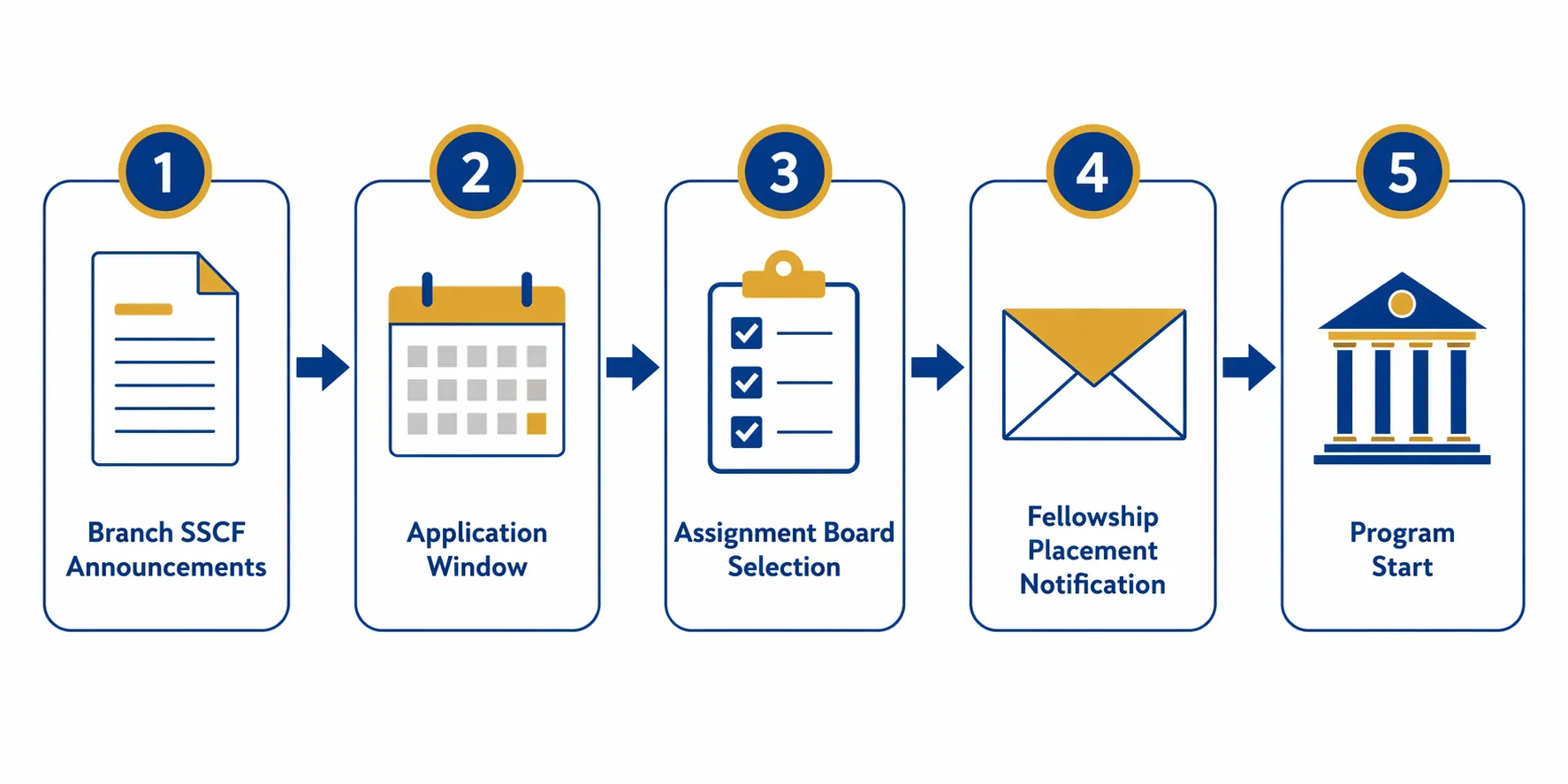
For an Army officer, that means watching the same channels that govern senior service college and fellowship assignment processes: branch messages, HRC-facing assignment guidance, career manager communications, and any posted SSCF instructions. For other services, the equivalent is the service’s own senior-level education or fellowship selection process. The public material available now does not justify saying that the Air Force, Navy, Marine Corps, Space Force, or Coast Guard will use the Army’s exact paperwork or dates.
The officer’s sequence should be plain:
- Verify that Senior Service College Fellowship attendance would satisfy the officer’s PME or MEL-1 requirement for the relevant service and career field.
- Monitor the branch or service-level SSCF announcement, not a university admissions page.
- Prepare the documents normally required by that service’s SSC or fellowship process, without inventing UNC- or Virginia Tech-specific essays or admissions supplements.
- List UNC Chapel Hill or Virginia Tech only if the official service system makes those locations available as preferences or assignment options.
- Wait for assignment or selection notification through the official military channel before treating either campus as a confirmed destination.
Why the University Website May Not Tell You What You Need
A university press release can confirm participation and describe the host environment. It usually cannot replace the military assignment process. UNC’s announcement says fellows will be able to tap into research in areas such as artificial intelligence, public policy, global security, and public health, and notes that the university has about 1,200 military students and was ranked No. 7 among Military Friendly Schools.[3] That is useful context for judging the campus. It is not an admissions checklist.
The Army War College Fellows Program gives a better sense of what a Senior Service College Fellowship normally is. It describes more than 90 U.S. Army War College fellows each year across about 55 programs at roughly 49 locations, with a senior Army mentor program, a research paper, and outreach requirements.[4] That structure is closer to the question an officer actually has: what kind of PME assignment is this, and what will the fellow be expected to do after selection?
The fellowship is not being described in the public reporting as a master’s degree program. The Hill reported that the Senior Service College Fellowship is a 10-month program that provides MEL-1 credit without a master’s degree.[5] Officers who need a degree-granting program, a particular JPME outcome, or a service-specific education milestone should confirm equivalency through their chain, branch manager, or education office before ranking any fellowship option.
What to Watch Next
The next useful information will probably not be a glossy campus feature. It will be an assignment instruction, a preference list, a MILPER-style message, a service education board notice, or a Department of War update that tells officers how the new host sites are being allocated.
- Branch or career-field SSCF announcements: these matter most because they tell eligible officers when and how to compete.
- HRC or service-equivalent assignment channels: these are where preference rules, eligibility notes, and board instructions are most likely to affect an individual officer.
- Department of War releases: these may clarify host-site approvals, implementation timing, or changes to the replacement fellowship program.
- UNC or Virginia Tech host details: these may help a selected officer understand the academic environment, but they should not be treated as application authority unless they explicitly point back to an official military process.
Keep a dated file of what has actually been published. If the only thing in hand is a university article saying the school is a partner, that is not enough to submit anything. If the branch message says the officer may rank approved fellowship sites, then UNC or Virginia Tech can be handled inside that preference process.
The February Cancellation Explains the Confusion
Interest in UNC and Virginia Tech makes sense because the July approval followed a sharp February disruption. The Department of War announcement says the two schools are the first replacement host sites after 93 fellowships at 22 institutions were canceled.[1] The Hill reported that the canceled institutions included schools such as Harvard, Yale, Princeton, Columbia, Brown, MIT, Carnegie Mellon, and William & Mary.[5]
That history should not be stretched beyond what it proves. Inside Higher Ed reported that 93 individuals were enrolled across the 22 canceled programs and that the Feb. 27 rollout plan said ROTC, tuition assistance, professional degree programs, and research grants were not affected.[6] In other words, the cancellation and replacement process concerns a narrow fellowship population, not every military-connected student program at the affected universities.
The earlier schools also should not be treated as administratively identical to the new placements. The useful lesson for an applicant is narrower: when fellowship hosts change, the officer still needs instructions from the military selection system before taking action.
How to Prepare Without Inventing Requirements
Preparation is still possible before the official 2027-28 instructions appear. The trick is to prepare for the known military process, not for a hypothetical university admissions process.
- Confirm eligibility: grade, career field, time-on-station, PME status, command requirements, and service-specific board rules are the first gates.
- Update official records: evaluation history, education data, assignment preferences, and any required officer record brief or service equivalent should be current before the application window opens.
- Ask the right office: career managers, branch assignment officers, and education-board points of contact are better sources than campus admissions staff.
- Separate preference from eligibility: wanting UNC or Virginia Tech does not mean the branch will offer those sites to every eligible officer population.
- Do not create extra paperwork: unless the official instructions ask for a campus statement, faculty contact, research proposal, or university application, adding one may only distract from the required packet.
For readers earlier in the military pipeline rather than near Senior Service College eligibility, the long path starts much sooner than fellowship preference lists. Foundational testing and accession planning belong in resources such as the ASVAB Exam Prep Guide, while this article is aimed at officers already approaching senior-level PME decisions.
What UNC and Virginia Tech May Offer as Host Environments
The host environment still matters after selection. UNC’s public statement points to research strengths in AI, public policy, global security, and public health, which are plausible areas of value for senior officers whose fellowship work must connect academic study to defense problems.[3] Those areas may help an officer rank preferences if the branch system offers a choice.
Virginia Tech’s military identity also makes it a logical host to watch, but the public record is thinner. As of the research date, no official Virginia Tech press release was found. That means applicants should rely on the Department of War approval for confirmation of the host site and wait for service-level instructions before drawing conclusions about campus-specific fellowship mechanics.[1]
The operating posture is simple: confirm eligibility through your service, prepare for the normal Senior Service College Fellowship cycle, monitor the official assignment channels, and list UNC or Virginia Tech only when your branch system makes those options available.
References
- Department of War Announces University of North Carolina and Virginia Tech as Senior Service College Fellowship Partners, Department of War, July 22, 2026
- Senior Service College Fellowship, USAASC
- UNC-Chapel Hill named Department of War fellowship partner, UNC News, July 22, 2026
- Army War College Fellows Program, U.S. Army War College
- UNC, Virginia Tech to host military fellowship partnerships after Pentagon cancels Ivy League programs, The Hill, July 22, 2026
- Hegseth Is Waging War on Colleges. His Targets Are Unclear., Inside Higher Ed, March 6, 2026
Referenced in this schedule
- Best Places to Watch the 2026 Perseid Meteor Shower in the US
- 2026 Perseid Meteor Shower Peak Date and Viewing Tips
- How the Pentagon Fellowship Split Changes UNC vs Harvard for Military Students
Check this against the exam hub
Target exam not specified — see all exam hubs.
Comments
Join the discussion with an anonymous comment.