
Method
Why Is Spain's Prime Minister Called President?
Many students wonder why Spain's leader is called "president" when the country has a king. This explainer shows that the official title "President of the Government" is historically accurate, while "prime minister" is the correct English equivalent for its parliamentary role.
Evidence panel
- Evidence level
- pending review
- Primary citation
- citation pending review
The short answer is: Spain's leader is officially the President of the Government because that is the constitutional Spanish title, but English speakers usually call him the prime minister because that is the job he performs.
That distinction matters. Spain is not using "president" in the American sense. Spain is a parliamentary monarchy: King Felipe VI is the head of state, while the President of the Government leads the national government day to day through parliamentary confidence.[1]
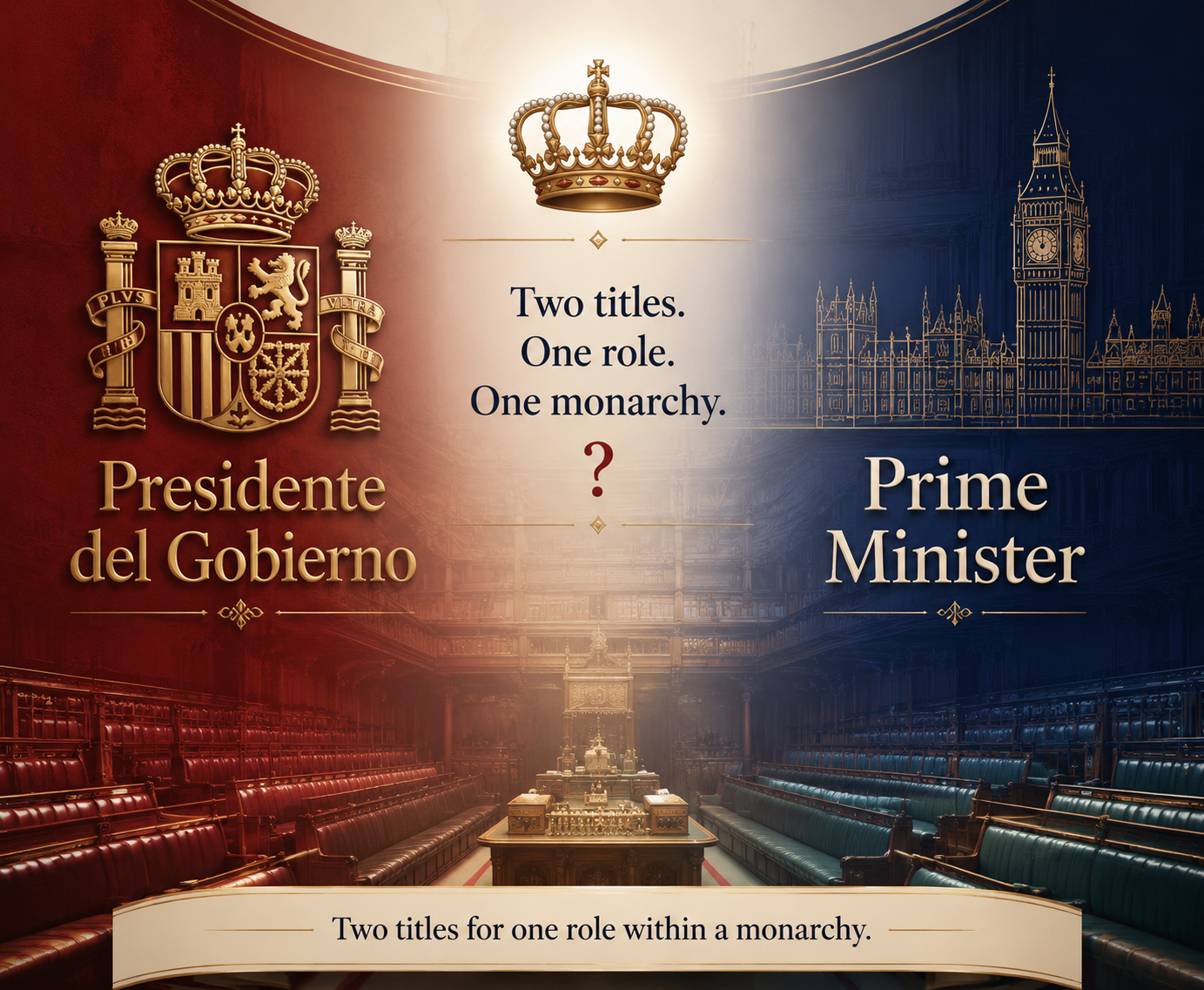
So if a test asks for the head of government of Spain, "prime minister" is usually the safest English answer. If it asks for the official title, "President of the Government" is correct. Those are not two different offices. They are two ways of naming the same office from two different angles: legal title and political function.
The King Is Head of State; the President of the Government Runs the Government
The easiest way to keep the terms straight is to ask what each person actually does in the constitutional system.
| Office | Spanish system role | Closest English classroom label |
|---|---|---|
| King Felipe VI | Head of state; represents the state and performs constitutional functions | Monarch / head of state |
| Presidente del Gobierno | Head of government; leads the cabinet and depends on parliamentary support | Prime minister |
In Spain, the monarch does not become the country's elected executive in the way a U.S. president does. The Spanish government is formed through parliament. After elections and consultations, the King proposes a candidate for President of the Government. The Congress of Deputies then votes on that candidate. A candidate needs an absolute majority on the first ballot, which means 176 of the 350 deputies; if that fails, a second vote can succeed by simple majority.[2]
That process is the key to the English word "prime minister." The Spanish leader is not directly elected by voters as a separate national president. He must be able to command support in the Congress of Deputies. The government can also be removed by a constructive vote of no confidence, meaning Congress must name a replacement rather than simply vote the sitting government out.[2]
Those are parliamentary features. They make Spain's head of government much closer to the British prime minister or the German chancellor than to the president of the United States. The title says "President of the Government," but the political relationship is cabinet-to-parliament, not president-to-electorate.
Why the Official Title Says "President"
The word "president" did not appear because someone mistranslated "prime minister." It comes from Spain's own constitutional and administrative tradition.
The older Spanish title was "President of the Council of Ministers." It was created by royal decree in 1834 during the regency of Maria Christina, and it followed the model of the French system under the July Monarchy.[3] In that older European usage, the person who "presided" over the council or cabinet could be called its president without meaning a separately elected republican president.
That pattern was not unique to Spain. Other European systems used similar titles, including France's Third Republic, Italy, and the Irish Free State, where the head of government could be called a "President of the Council" or a closely related title.[3] The wording sounds odd if the U.S. presidency is the only model in mind. It sounds much less odd once "president" is understood in its older sense: the person presiding over a council of ministers.
Spain's current title, "President of the Government," dates from January 1938 and was retained in the democratic Constitution of 1978.[3] Article 98 of the Constitution identifies the Government as consisting of the President, vice presidents where applicable, ministers, and other members established by law.[1] In other words, "President of the Government" is not an informal nickname. It is the constitutional title of the office.
Why English News Usually Says "Prime Minister"
English-language news outlets usually choose "prime minister" because they are translating the office by function, not word by word. That choice helps readers avoid the wrong mental picture.
A literal translation gives "President of the Government." That is accurate, and it appears in diplomatic or formal contexts. But for an English-speaking audience, especially in the United States, the word "president" often suggests a head of state, a separate national election, and a presidential system. Spain's office does not work that way.
This is why both terms can be defensible. "President of the Government" respects the official Spanish title. "Prime minister" tells English readers what role the office plays in a parliamentary monarchy. The important mistake is not choosing one term over the other; the mistake is assuming that "president" must mean "U.S.-style president."
The Confusion Is Common, Even in Public Diplomacy
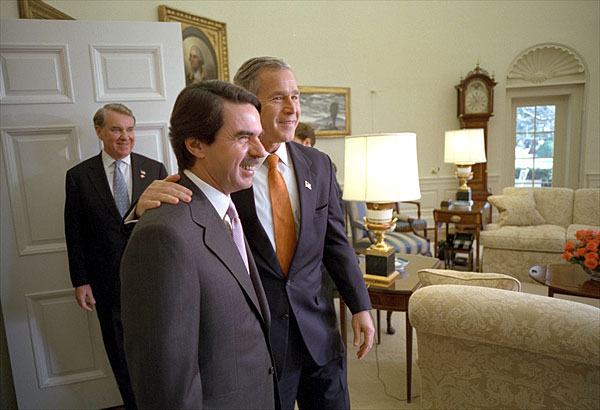
This is not just a student problem. English-speaking officials and audiences have stumbled over the same wording. During a 2001 White House visit, George W. Bush referred to Spanish leader José María Aznar as "President." A Slate explainer from that period noted that both the U.S. State Department and the Spanish Embassy treated "President of the Government" and "prime minister" as acceptable, while recognizing that "prime minister" is the standard English rendering.[4]
The same kind of wording appeared again when Donald Trump reportedly addressed Mariano Rajoy as "Mr. President" in a 2017 phone call.[4] The interesting point is not that these are dramatic errors. It is that the literal title makes the slip understandable. If someone sees Presidente del Gobierno and translates only the first word, "president" looks natural. The confusion starts when that word is carried into a different constitutional system without the rest of the title attached.
One More Spanish Usage: Regional Presidents
Spain also uses "president" for the leaders of its autonomous communities. Spain has 17 autonomous communities, and each has its own regional head of government.[2] That can add another layer of confusion for English readers, because a news story might mention the president of Catalonia, Andalusia, or Madrid without talking about Spain's national head of government at all.
The same rule helps there too: ask what level of government is being discussed and what the office does. A regional president is not the national prime minister. The national President of the Government is the person English-language civics materials normally call Spain's prime minister.
What to Write on a Test
For most English-language government classes, write that Spain has a parliamentary monarchy. The King is the head of state. The prime minister is the head of government. If your teacher or source uses the formal title, add that the Spanish prime minister's official title is "President of the Government".
- Use "prime minister" when describing the role in English.
- Recognize "President of the Government" as the official constitutional title.
- Do not treat the Spanish office as an American-style presidency.
- Remember that the Spanish leader governs through parliamentary confidence, while the King serves as head of state.
A clean exam sentence would be: Spain's head of government is commonly called the prime minister in English, although the official Spanish constitutional title is President of the Government, because Spain is a parliamentary monarchy with the King as head of state.
References
- La Moncloa — State Organisation
- Wikipedia — Politics of Spain
- Wikipedia — Prime Minister of Spain
- Slate — Is the Prime Minister of Spain Really Its President?
Applies to
Exam applicability isn't specified for this technique yet. See all exam hubs.
Comments
Join the discussion with an anonymous comment.