
Method
What Can Fields Medalist Jacob Tsimerman Teach About Exam Prep?
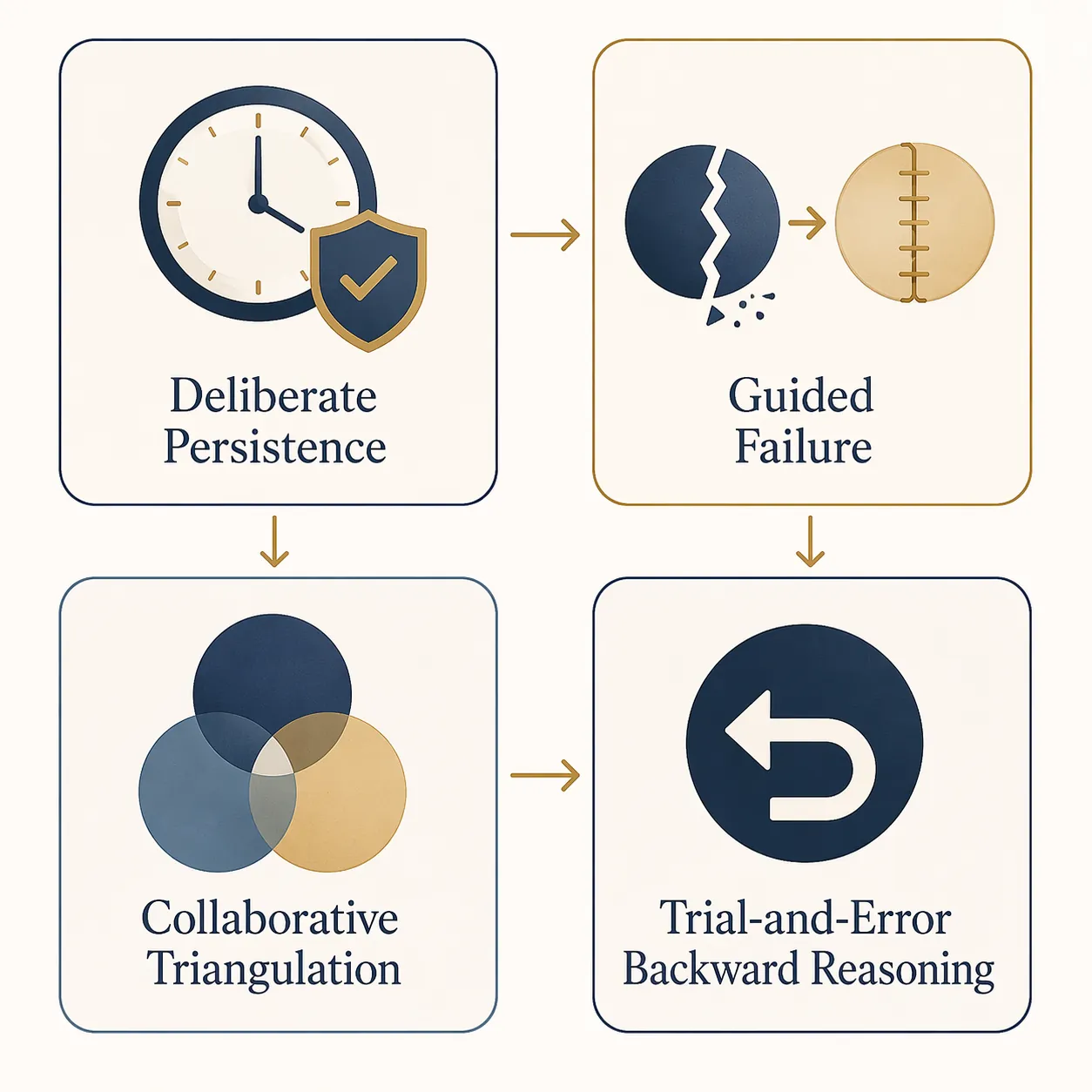
The deliberate persistence, failure-first learning, collaborative triangulation, and backward reasoning methods that drove Jacob Tsimerman's Fields Medal–winning proof of the André-Oort conjecture are directly transferable to exam prep. This article explains each method and how to apply it to GRE, MCAT, SAT, or ACT study sessions, with evidence drawn from biographical interviews.
Evidence panel
- Evidence level
- Limited
- Primary citation
- Be Giant interview (July 2026)
A Fields Medal proof of the André-Oort conjecture sounds about as far from GRE, MCAT, SAT, or ACT prep as schoolwork can get. Jacob Tsimerman spent years inside a research problem whose final proof depended on tools most test-takers will never need. Still, the useful part of the story is not the medal, and it is not the technical content of the conjecture. It is the working behavior: how he stayed with hard problems, learned from misses, used other people’s reasoning, and sometimes worked backward from a guessed answer.
That distinction matters. The evidence here is biographical and journalistic, drawn from profiles and interviews, not controlled studies showing that copying Tsimerman’s habits raises test scores. The transfer has to be scaled. Tsimerman could spend 12 years on André-Oort; an exam student may have 45 minutes before dinner, eight weeks before a test date, and a very real need to move on. The point is not to imitate mathematical research. The point is to borrow the parts of serious problem-solving that still work when time is bounded.

Persistence Only Helps When It Changes Shape
Tsimerman’s Fields Medal was awarded in 2026 for work tied to the André-Oort conjecture, and Quanta described a 12-year arc behind the result.[1] DongA Science reported that as a student preparing for Olympiad mathematics, he spent five hours a day after school working on problems.[2] Those facts are impressive, but they are also dangerous if translated lazily. “Try harder” is not a method. It is often just a way for strong students to waste another hour proving that the first approach still does not work.
The more useful version appears in Tsimerman’s own wording. In a Be Giant profile, he described competition math as training in “sitting for several hours, repeatedly banging your head against the wall, trying new things while stuck.”[3] The last phrase does the work. Persistence is not the repeated application of one failing move. It is the willingness to keep the problem open while changing the attack.
For exam prep, that means a hard problem deserves a time box and a scratch record. A GRE quant student might spend 12 minutes on a difficult rates problem during review, not because the actual exam will allow that much time, but because review time is where strategy gets built. During that window, the student should mark each attempted route: equation setup, units, plug-in numbers, answer-choice elimination, diagram, or re-reading the wording. If the clock expires and the page shows only the same algebra rewritten three times, the session has produced very little. If the page shows three distinct attempts and where each broke, the miss has become data.
This is where many ambitious test-takers need restraint. A student who already gets 90% of medium algebra questions right does not need another clean win in that category. The useful discomfort is usually narrower: the one sentence in an MCAT CARS passage that keeps getting misread, the SAT geometry diagram that hides a ratio, the ACT science table where the student keeps comparing the wrong variables. Deliberate persistence begins when the student stays with that ugly spot long enough to name the failure.
Guided Failure Is Not the Same as Flailing
The strongest tutoring lesson in Tsimerman’s story is not that he solved hard problems. It is that Peter Sarnak, his PhD adviser, gave him problems he could not solve. Tsimerman told Quanta that Sarnak used impossible problems to help him develop intuition about “where the difficulties are.”[1] That is a very different educational use of failure from simply handing a student a stack of impossible questions and hoping character develops.
A too-hard problem can be diagnostic if someone reviews it properly. It can reveal whether the student failed because of content, translation, stamina, timing, or a bad decision at the fork in the road. Without that review, the same problem can just teach helplessness. This is why guided failure belongs in prep only in controlled doses.
| What the miss shows | What to review next |
|---|---|
| You knew the formula but chose it late | Recognition cues and problem classification |
| You set up the right equation but made a sign or unit error | Scratch-work discipline, not new content |
| You understood the explanation only after seeing the first step | Entry points and first moves |
| You eliminated the right answer because it felt unfamiliar | Answer-choice logic and confidence calibration |
| You could solve it untimed but not under pressure | Timed sets with post-set review |
The exam version is simple enough to use this week. Pick a small set where two or three questions are expected to be above your current comfort level. Work them honestly before looking at explanations. Then review the miss before doing more questions. The review should end with a sentence that begins, “The obstacle was...” If that sentence says only “I didn’t know how to do it,” the review is unfinished.
For MCAT students, guided failure often belongs in passage review. A wrong answer in CARS or psychology/sociology may not come from missing a fact; it may come from importing outside assumptions or choosing a choice that is true but not supported. For SAT and ACT students, it may show up as a timing illusion: the student “knows” the math but cannot decide fast enough which move is cheapest. For GRE students, it may expose the difference between understanding a concept and recognizing its disguised form.
As a study design principle, the idea is soundly modest: do some work that is hard enough to miss, make the miss legible, and use the diagnosis to choose the next assignment.
Triangulate Before You Decide You Understand
The André-Oort proof is also a useful warning against the fantasy of solitary mastery. A 2022 Quanta account described how the proof drew together Jonathan Pila’s o-minimal counting method, Tsimerman’s Galois orbit bounds, and Ananth Shankar’s height-theory contribution.[4] DongA Science likewise presented the result as depending on multiple strands of expertise rather than one person’s isolated trick.[2]
An exam student does not need a research collaboration. But the student does need triangulation: more than one view of the same error. The official explanation tells you what the test-maker thinks is decisive. A tutor may see the bad habit underneath the miss. A peer may explain the same move in plainer language. Your own redo, two days later, tells you whether the explanation actually stuck.
The trap is to mistake exposure for triangulation. Watching three video explanations is not automatically better than reading one official rationale. The question is whether the extra source reveals a different feature of the problem. If every explanation says the same thing and the student still cannot reproduce the solution, the missing piece is probably not another explanation. It is an active reconstruction.
- First pass: solve or attempt the problem without help.
- Second pass: read the official explanation and identify the decision point you missed.
- Third pass: compare one outside explanation, tutor note, or peer solution only if it adds a new angle.
- Final pass: close the explanation and redo the problem from a blank page.
Group study works best under the same rule. A group that trades answers too quickly protects everyone’s ego and improves no one’s judgment. A better group has each person explain where they first committed to a path. In standardized testing, that first commitment often matters more than the final arithmetic. Once a student chooses the wrong comparison, the wrong passage line, or the wrong variable, the rest of the work can look perfectly disciplined while moving away from the answer.
Backward Reasoning Is a Legitimate Tool, Not a Cheat
Tsimerman has also described a more playful method: guessing an answer and working backward, an approach he said he felt better about after learning that Stephen Sondheim used something similar in composing.[3] In research mathematics, that is not a guarantee of truth. It is a way to generate a possible path. In standardized testing, the exam format makes the move even more concrete because the answer choices are sitting in front of you.
On SAT or ACT math, plugging answer choices back into the problem can be the fastest honest route. On GRE quantitative comparison, testing a strategically chosen value can expose whether a relationship is fixed or variable. In MCAT science passages, working backward from the answer choices can clarify what kind of evidence the question is asking for: a trend, a mechanism, a control, or a contradiction.
The discipline is knowing when backward reasoning is appropriate. It is strong when answer choices are numerical, when the question asks for a condition that can be checked, or when the passage contains a specific claim that each option can be tested against. It is weak when the student uses it to avoid learning the underlying method altogether. If plugging in works today but leaves you unable to solve the next version, it was a test-day tactic, not a study-session repair.
The Planning Move: Stop Polishing What Already Works
After the four problem-solving habits, the most exam-relevant planning detail is Tsimerman’s narrowing of focus. Quanta reported that in the final years before the Fields Medal, he abandoned “fun side projects” to concentrate on high-impact work.[1] That sentence should make any high-scoring test-taker a little uncomfortable.
Comfortable review is seductive because it feels productive. A student who likes algebra does another algebra set. A strong reader annotates another passage beautifully. A science-minded MCAT student watches another content video on a topic already under control. None of those actions is foolish in isolation. The problem is opportunity cost. The exam score is usually being held down by the topics that students keep postponing because those topics make them feel slow.
Strategic narrowing does not mean ignoring strengths. It means giving the next serious study block to the weakness that is both fixable and score-relevant. A student with three months before the MCAT can afford a different plan from a student with nine days before the ACT. The same method has to sit inside a dated calendar, or it becomes motivational decoration.
| Next-session problem | Best Tsimerman-style method to borrow |
|---|---|
| You quit hard problems too early | Use deliberate persistence with a fixed time box and multiple recorded attempts |
| You keep missing questions but cannot explain why | Use guided failure and classify the obstacle before doing more practice |
| You understand explanations but cannot reproduce solutions | Use collaborative triangulation, then redo from a blank page |
| You are losing time on answer-choice problems | Use backward reasoning, plugging in, or checking choices against the prompt |
| You study often but avoid weak areas | Narrow the plan toward fixable, score-relevant weaknesses |
Where This Leaves an Exam Student
The useful lesson from Tsimerman’s André-Oort work is not that exam prep should become heroic. It is almost the opposite. Serious problem-solving becomes transferable when it is made smaller, more observable, and less theatrical. Stay with the hard problem, but change tactics. Miss the problem, but review the miss until it names a real obstacle. Ask another source, but only if it reveals something new. Work backward, but check whether the method teaches anything beyond that one answer.
Students building a full plan should route those methods into the exam they are actually taking: GRE prep for quantitative reasoning and verbal decision points, MCAT prep for passage review and content application, SAT prep for math and reading accuracy under time pressure, or ACT prep for pacing across sections.
The calibrated verdict is this: Tsimerman’s biography offers credible examples of repeatable problem-solving habits, not a guaranteed study hack. Their score value depends on whether they are built into a dated prep plan, used on the right weaknesses, and reviewed with enough honesty to turn being stuck into information.
References
- Jacob Tsimerman Wins 2026 Fields Medal, Quanta Magazine, July 23, 2026.
- DongA Science / Quanta profile, DongA Science, 2026.
- Locked in an escape room with mathematician Jacob Tsimerman, Be Giant, July 2026.
- Mathematicians Prove 30-Year-Old André-Oort Conjecture, Quanta Magazine, February 2022.
Comments
Join the discussion with an anonymous comment.