
Method
Study Statin Guidelines for the MCAT in Under 3 Hours
Learn exactly which statin and cholesterol synthesis facts are high-yield for the MCAT and how to master them with a focused study system that takes under 3 hours.
Evidence panel
- Evidence level
- Moderate
- Primary citation
- Statin Medications, StatPearls
If you searched for statin use guidelines study tips for the MCAT, narrow the target before you lose an evening to cardiology. For this exam, “statin guidelines” usually means a lipid-metabolism study task: know how cholesterol synthesis works, where statins act, why LDL falls, and which few clinical numbers help you recognize the passage context.
The MCAT does not reward memorizing full prescribing algorithms. It is much more likely to reward a clean explanation of HMG-CoA reductase, NADPH use, cytoplasmic versus mitochondrial HMG-CoA, feedback regulation, and hepatic LDL-receptor upregulation. That is good news. The testable set is small enough to learn in one focused sitting if you keep the clinical material on a short leash.
| Learn this | Why it matters for MCAT reasoning |
|---|---|
| HMG-CoA reductase converts HMG-CoA to mevalonate and uses 2 NADPH | It is the rate-limiting cholesterol synthesis step and the direct statin target |
| Statins competitively inhibit HMG-CoA reductase | Passages can ask what happens to enzyme activity, product formation, or pathway flux |
| Cytoplasmic HMG-CoA enters cholesterol synthesis; mitochondrial liver HMG-CoA enters ketone-body synthesis | This prevents mixing up lipid synthesis with fasting-state ketogenesis |
| Lower hepatic cholesterol increases LDL-receptor expression | This explains why blood LDL falls without pretending statins directly destroy LDL |
| Cholesterol synthesis is regulated by cholesterol, insulin, glucagon, and AMPK | This connects metabolism state to pathway control |
| A compact clinical table: total cholesterol, LDL targets, and statin intensity bands | This helps decode passage language without turning into a guideline review |
One guardrail before the workflow: the 2026 ACC/AHA cholesterol update and other clinical guidelines may discuss PREVENT-ASCVD equations, LDL-C goals, and prescribing decisions. That is not your MCAT boundary. Your boundary is AAMC Category 1B lipid metabolism, then practice questions. If a tab is teaching risk calculators instead of cholesterol synthesis, close it.
The under-three-hour workflow
Do the whole topic in this order. The point is not speed for its own sake; it is preventing drift.
| Time | Task | Done when |
|---|---|---|
| 0:00-0:20 | Set the boundary and skim your MCAT lipid-metabolism outline | You can name the statin-relevant facts without opening a clinical guideline |
| 0:20-1:10 | Draw the mechanism map from acetyl-CoA to HMG-CoA to mevalonate to cholesterol | You can place HMG-CoA reductase, statins, and 2 NADPH on the diagram |
| 1:10-1:35 | Add the branch-point distinction and LDL-receptor mechanism | You can separate cytoplasmic cholesterol synthesis from mitochondrial ketogenesis |
| 1:35-2:15 | Convert the map into spaced-repetition cards | You have cards for enzyme, compartment, inhibition, regulation, numbers, and intensity |
| 2:15-2:40 | Practice retrieval without notes | You can redraw the pathway and explain LDL lowering out loud |
| 2:40-3:00 | Do a small passage or question set and repair only missed links | Your misses become cards or annotations, not a new research project |
If you are building the rest of your MCAT schedule around this, keep statins inside your larger metabolism and passage-review plan rather than treating them as a separate mini-course. The MCAT Study Prep Hub is the better place to organize that broader workflow.
Build the mechanism map first
Start with the enzyme. HMG-CoA reductase catalyzes the rate-limiting conversion of HMG-CoA to mevalonate in cholesterol synthesis, and the reaction uses 2 NADPH; statins act as competitive inhibitors of this enzyme.[1]
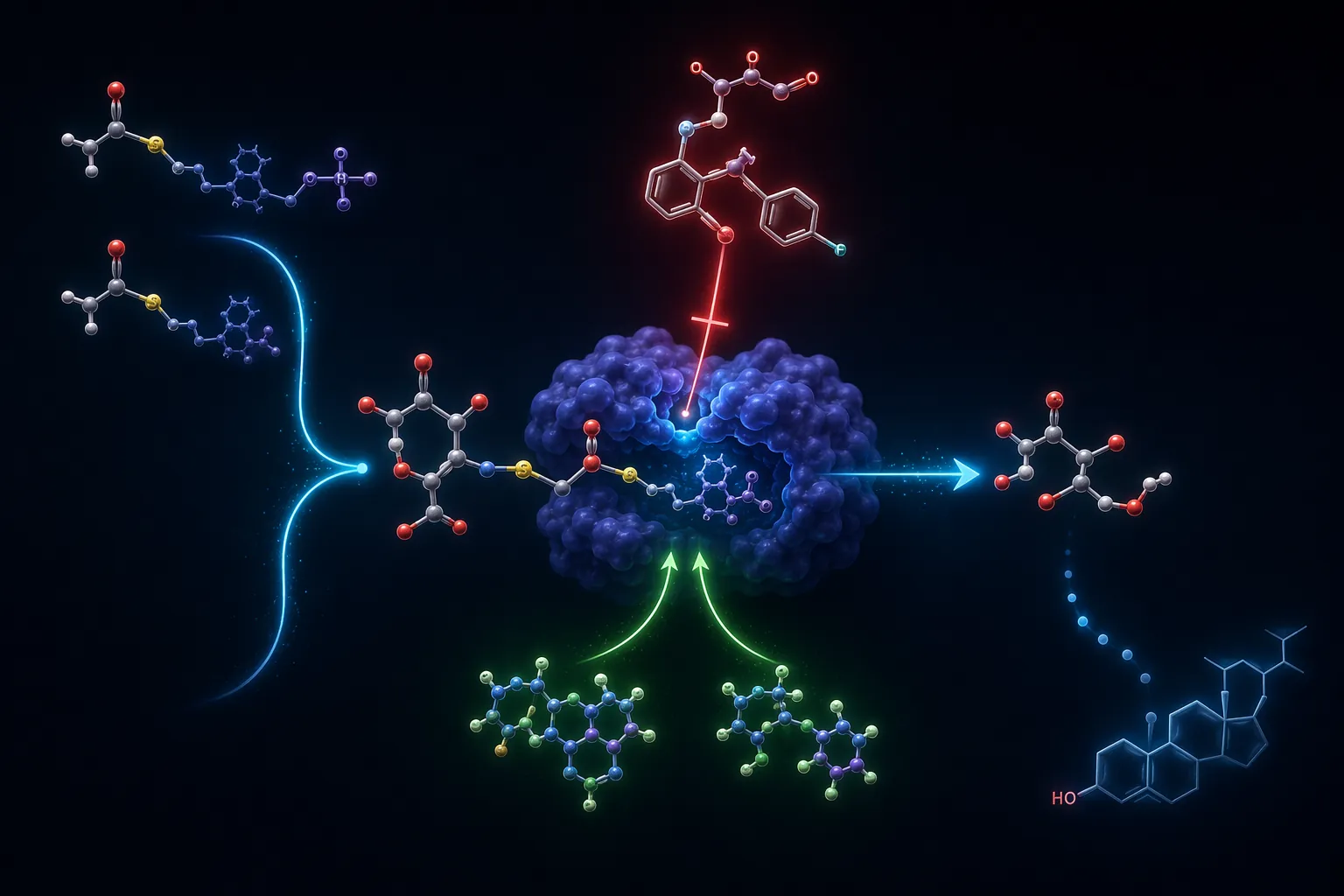
That one sentence can generate several MCAT answers. If a passage adds a statin, the immediate biochemical effect is reduced HMG-CoA reductase activity. If it asks about the reaction’s reducing power, the answer points to NADPH. If it asks why synthesis slows, the answer is not “statins bind cholesterol” or “statins remove LDL from blood.” The direct target is the enzyme.
Draw it as a short pathway, not as a wall of intermediates:
- Acetyl-CoA feeds cholesterol synthesis.
- HMG-CoA sits before the committed cholesterol-synthesis route.
- HMG-CoA reductase converts HMG-CoA to mevalonate.
- The reductase step uses 2 NADPH.
- Statins competitively inhibit HMG-CoA reductase.
Do not spend your first hour memorizing every downstream cholesterol intermediate unless your own prep materials have already made that level of detail necessary. For most MCAT reasoning, mevalonate is the name worth keeping because it tells you the pathway has passed the statin-sensitive gate.
The branch point that prevents wrong answers
HMG-CoA is dangerous because it appears in two metabolic neighborhoods. Cytoplasmic HMG-CoA goes toward cholesterol synthesis. Mitochondrial HMG-CoA in the liver goes toward ketone bodies through HMG-CoA lyase. If a question stem includes fasting, liver mitochondria, or ketogenesis, do not automatically drag in statins.
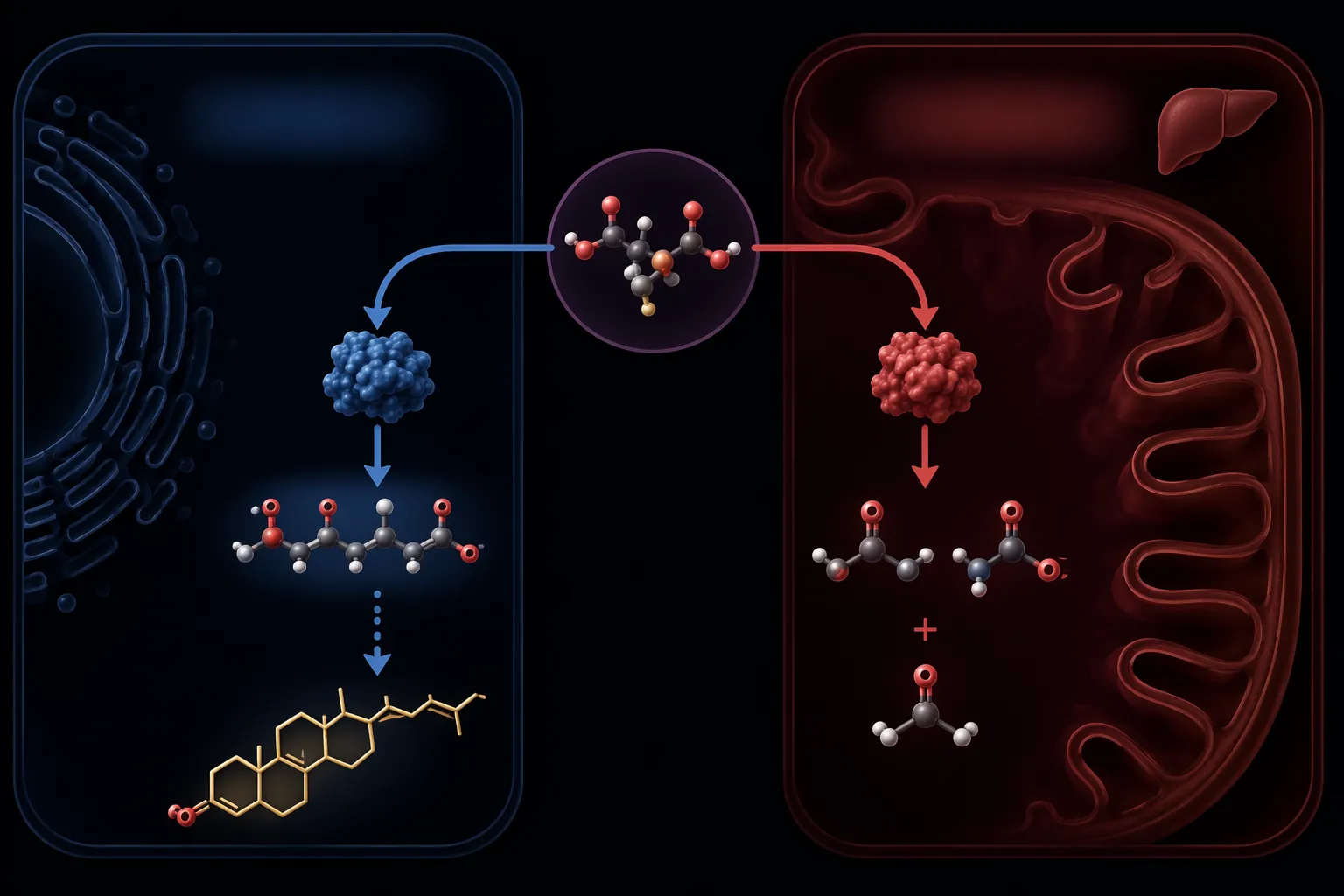
The clean card is “same molecule name, different compartment, different fate.” That is the kind of distinction the MCAT likes because it tests organization, not trivia density.
How statins lower LDL without directly attacking LDL
Once hepatic cholesterol synthesis drops, liver cells compensate by increasing LDL-receptor expression, which increases LDL uptake from blood; MCAT-style explanations should treat this as an indirect receptor-upregulation mechanism, not as direct LDL degradation by the drug.[2]
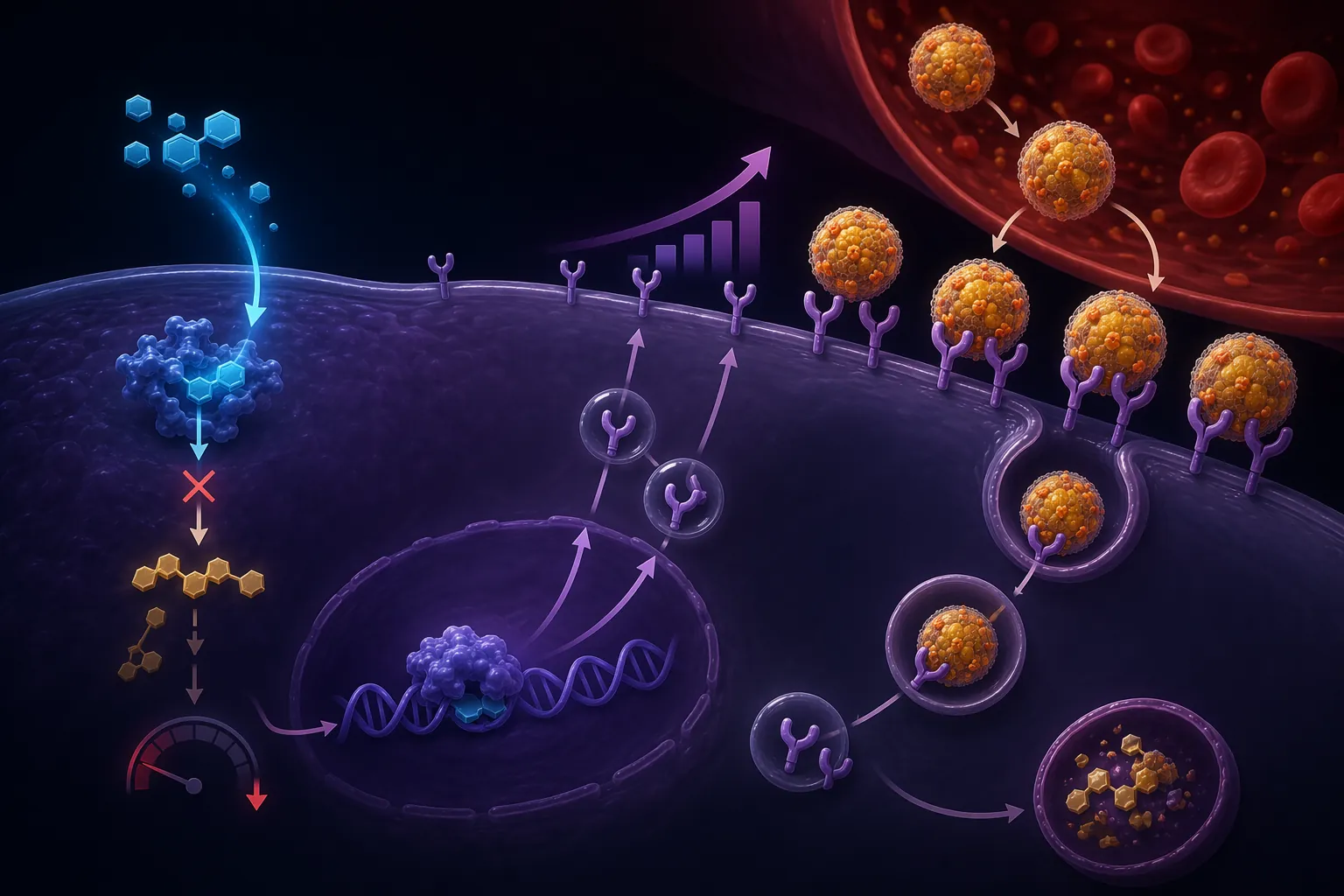
That mechanism is worth practicing in cause-and-effect order: statin inhibits HMG-CoA reductase, intracellular hepatic cholesterol falls, LDL-receptor expression rises, more circulating LDL is taken up by the liver, blood LDL decreases. If you can say that chain without notes, you are studying the clinical effect at the correct MCAT depth.
Regulation belongs on the same map
Add regulation beside the enzyme instead of making a separate page. Cholesterol provides feedback inhibition. Insulin activates cholesterol synthesis. Low insulin, high glucagon, and AMPK inhibit it. This is where statins connect back to ordinary metabolism: fed-state signals favor storage and synthesis; low-energy or fasting-associated signals restrain an expensive anabolic pathway.
The representative full cost of one cholesterol molecule is often taught as 18 acetyl-CoA, 18 NADPH, and 36 ATP. Treat that as a useful MCAT-style data point, while remembering that exact presentation can vary across biochemistry resources.
Keep the clinical table compact
You need just enough clinical context to recognize what a passage is talking about. Total cholesterol below 200 mg/dL is commonly treated as desirable, and LDL targets are often framed as below 100 mg/dL or, in higher-risk contexts, below 70 mg/dL. Do not turn those numbers into a full treatment algorithm.
| Statin intensity | Typical LDL-C reduction | Examples to recognize |
|---|---|---|
| High | At least 50% | Atorvastatin 40-80 mg; rosuvastatin 20-40 mg |
| Moderate | 30-49% | Lower or mid-range statin doses, depending on the drug |
| Low | Less than 30% | Lowest-intensity dosing patterns |
Those intensity bands are clinical-study material, not the center of MCAT biochemistry. High-intensity statins are commonly described as lowering LDL-C by at least 50%, moderate intensity by 30-49%, and low intensity by less than 30%; atorvastatin 40-80 mg and rosuvastatin 20-40 mg are high-intensity examples.[3]
If your prep source expects dose recognition, the student-created mnemonic “PRASLPF 2-5-10-20-40-40-80” maps to pitavastatin 2, rosuvastatin 5, atorvastatin 10, simvastatin 20, lovastatin 40, pravastatin 40, and fluvastatin 80 as a simplified dose-order aid.[3] Label it honestly in your notes: useful memory tool, not official MCAT doctrine.
Turn the map into cards that test reasoning
The second half of the session is where most students either secure the topic or waste it. Reading the pathway once feels productive because every sentence is understandable. Retrieval is the part that exposes whether you can answer under passage pressure.
Use a small card set. If you already use Anki, keep these inside your metabolism deck and follow the same review rules you use for other MCAT cards. If your system is messy, fix the workflow with How to Use Anki for the MCAT before adding another pile of half-reviewed facts.
| Card type | Front | Back |
|---|---|---|
| Enzyme | What is the rate-limiting enzyme in cholesterol synthesis? | HMG-CoA reductase |
| Reaction | HMG-CoA reductase converts ___ to ___ and uses ___ | HMG-CoA to mevalonate; 2 NADPH |
| Drug mechanism | Statins inhibit HMG-CoA reductase by what inhibition type? | Competitive inhibition |
| Compartment | Cytoplasmic HMG-CoA vs mitochondrial liver HMG-CoA: what are the fates? | Cytoplasmic to cholesterol; mitochondrial liver to ketone bodies |
| LDL mechanism | Why do statins lower circulating LDL? | Reduced hepatic cholesterol increases LDL-receptor expression, increasing LDL uptake |
| Regulation | What activates or inhibits cholesterol synthesis? | Insulin activates; cholesterol feedback, low insulin, high glucagon, and AMPK inhibit |
| Clinical number | High-, moderate-, and low-intensity statins lower LDL-C by about what ranges? | At least 50%; 30-49%; less than 30% |
Avoid cards that only ask “What are statins?” The MCAT can hand you the drug name in the passage. The harder move is connecting the drug to an enzyme, a compartment, a cofactor, and a downstream receptor response.
A five-minute retrieval drill
After making the cards, close the source and redraw the topic from memory. Put a blank page in front of you and produce four things: the cholesterol synthesis line, the branch-point split, the LDL-receptor chain, and the regulation box. Then check only what you missed.
- Write “acetyl-CoA → HMG-CoA → mevalonate → cholesterol.”
- Place HMG-CoA reductase over the HMG-CoA-to-mevalonate arrow.
- Add “2 NADPH” and “competitive statin inhibition” at that step.
- Draw a separate mitochondrial liver branch from HMG-CoA to ketone bodies.
- Explain how lower hepatic cholesterol leads to higher LDL-receptor expression and lower blood LDL.
- Add insulin, cholesterol feedback, glucagon, and AMPK to the regulation box.
If you miss a link, repair that link only. Do not respond to one forgotten cofactor by opening a complete pharmacology chapter.
What to ignore unless your practice questions demand it
The usual trap is treating every medicine-adjacent topic as if it might become a clinical exam. For MCAT statins, these are low-priority unless they appear inside a passage and are needed to answer that passage:
- Full ACC/AHA prescribing algorithms
- ASCVD risk-calculator equations
- Drug-by-drug adverse-effect management
- Exhaustive statin dose lists
- Non-statin lipid-lowering treatment ladders
A passage can always teach you extra clinical context in the stem. Your job is to bring the stable biochemistry: enzyme, cofactor, compartment, regulation, and receptor mechanism.
When you are done
You are done studying statins for now when you can answer these from memory:
- What enzyme do statins inhibit, and what reaction does it catalyze?
- How many NADPH are used at the HMG-CoA reductase step?
- Why does cytoplasmic versus mitochondrial HMG-CoA matter?
- How does inhibiting hepatic cholesterol synthesis lower circulating LDL?
- Which signals activate or inhibit cholesterol synthesis?
- What are the rough high-, moderate-, and low-intensity LDL-lowering bands?
If those answers are solid and your practice questions are not exposing new gaps, stop expanding the topic. Go back to broader MCAT metabolism review, passage timing, and your spaced-repetition queue.
References
- Statin Medications, StatPearls.
- Cholesterol Synthesis, Premier MCAT Prep.
- Simplified Guide to Statin Therapy, Epomedicine.
Comments
Join the discussion with an anonymous comment.