
Method
How to Study the 2026 Dyslipidemia Guidelines for Exams
Learn the 2026 dyslipidemia guideline's key changes for exam prep using its own CPR framework as a study skeleton, paired with spaced repetition and active recall, in a 2-week timeline.
Evidence panel
- Evidence level
- High
- Primary citation
- Improving Students’ Learning With Effective Learning Techniques: Promising Directions From Cognitive and Educational Psychology, Psychological Science in the Public Interest, 2013
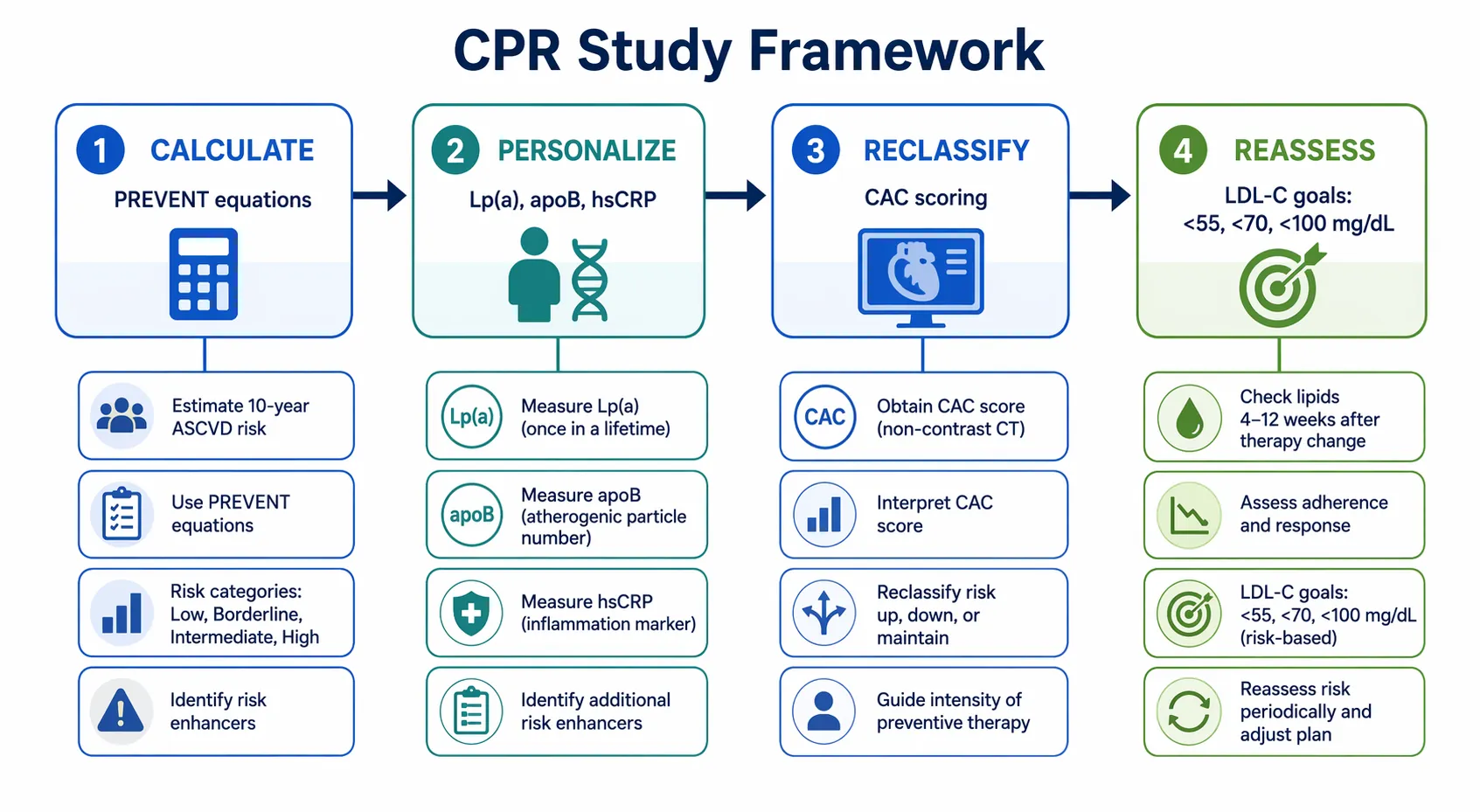
If your exam is close, the first move is not to print the 2026 dyslipidemia guideline and read it from page 1. Your goal is exam performance, not clinical implementation. For that goal, the useful gift inside the guideline is its own risk-assessment sequence: Calculate, Personalize, Reclassify, Reassess, or CPR.[1]
Use CPR as the filing system. Then attach active recall and spaced repetition to each file. That gives you a way to study the new dyslipidemia guidelines without treating every paragraph as equally testable.

Start With CPR, Not With Page Count
The CPR sequence was created for risk assessment in the 2026 guideline. Here, it is being repurposed as a study skeleton. That distinction matters: the guideline is not endorsing a study method. It simply gives students a better organizing structure than a long highlighted document.
| CPR bucket | What to study first | Exam task |
|---|---|---|
| Calculate | PREVENT-ASCVD equations replacing the Pooled Cohort Equations | Explain why the risk calculator changed |
| Personalize | Lp(a), apoB, and hsCRP as risk-enhancing markers | Recognize when a standard risk estimate needs more context |
| Reclassify | Coronary artery calcium scoring | Identify CAC as a decision-layer, not a first-line memorization rabbit hole |
| Reassess | LDL-C goals by risk tier: <55, <70, <100 mg/dL | Recall thresholds quickly and apply them to risk categories |
That table is the map you should study from. It is also the sequence your flashcards should follow. If a fact does not fit into one of those four buckets, it may still matter clinically, but it probably should not get equal attention during a two-week exam-prep sprint.
Calculate: Learn Why PREVENT Replaced the Older Risk Calculator
For exams, Calculate is not just “use a calculator.” The testable idea is that the 2026 guideline moves from the older Pooled Cohort Equations toward the PREVENT-ASCVD equations because the older tool overestimated 10-year risk by 40% to 50%.[2]
That number is worth more than passive recognition. Turn it into a cause-and-effect card: “Why did the guideline replace the Pooled Cohort Equations?” Answer: because they overestimated 10-year ASCVD risk, and PREVENT is intended to improve risk estimation in the newer framework.[2]
Do not overextend the tool. PREVENT is not intended for patients with familial hypercholesterolemia, so FH should stay in its own mental folder rather than being forced into the general calculator pathway.[3]
A good exam card here is not a definition card. It should make you retrieve the reason for the change, the direction of the old error, and the FH caveat in one pass.
High-yield recall prompts for Calculate
- What tool replaces the Pooled Cohort Equations in the 2026 dyslipidemia guideline?
- What was the major problem with the older 10-year risk estimate?
- In what kind of patient should you avoid treating PREVENT as the default conceptual pathway?
- Is this an adoption fact, an effectiveness fact, or a risk-estimation rationale?
Personalize: Give Lp(a) the Most Space
Personalize is where students often collect too many biomarkers and remember none of them. Prioritize Lp(a), then place apoB and hsCRP around it as additional risk-enhancing markers. Lp(a) deserves the most attention because universal screening is one of the clearest shifts in the 2026 guideline materials.[3]
The memory hook is unusually clean: about 1 in 5 people globally have elevated Lp(a), but fewer than 5% of Americans have been screened.[3] Those two numbers make the personalization logic concrete. A risk factor can be common enough to matter and still be undermeasured in routine care.
The risk levels also make good flashcard material. Lp(a) of 125 nmol/L is associated with about 1.4-fold ASCVD risk, while 250 nmol/L is associated with about 2-fold risk.[4] For an exam, the point is not to practice ordering labs. The point is to recognize why the guideline asks readers to look beyond a standard risk calculation.
ApoB and hsCRP belong in the same bucket, but they should not steal the study session. Treat them as personalization markers: apoB helps represent atherogenic particle burden, and hsCRP signals inflammatory risk context. If your course gives more detail, use your course’s emphasis; otherwise, keep these tied to the broader principle that risk may need refinement beyond the first calculator output.
Flashcard format that prevents biomarker soup
| Card front | Card back |
|---|---|
| In the CPR framework, where do Lp(a), apoB, and hsCRP belong? | Personalize: they refine risk beyond the initial calculation. |
| Why is Lp(a) especially testable in the 2026 update? | Universal screening is a major shift, elevated Lp(a) is common, and screening has historically been low. |
| What Lp(a) levels are linked with about 1.4-fold and 2-fold ASCVD risk? | 125 nmol/L and 250 nmol/L, respectively. |
| What is the exam-level role of apoB and hsCRP here? | Risk personalization, not replacing the CPR structure. |
Reclassify: Know What CAC Is Doing
Reclassify is the shortest study bucket for most students. Coronary artery calcium scoring is a decision-layer: it helps move a patient’s risk interpretation when the first estimate and risk-enhancing factors do not settle the question. For exam prep, do not turn CAC into a separate imaging chapter unless your course explicitly does that.
The useful retrieval prompt is simple: “After calculating and personalizing risk, what can reclassify risk?” Answer: CAC scoring. That is enough for the core 2026 CPR pathway. Add course-specific thresholds only if your instructor or exam blueprint requires them.
Reassess: Memorize the Restored LDL-C Goals
Reassess is where the cleanest numbers live. The 2026 guideline restores LDL-C treatment goals for the first time since 2018: less than 55 mg/dL for very high risk, less than 70 mg/dL for high risk, and less than 100 mg/dL for borderline or intermediate risk.[1]
These are not “read once and recognize later” numbers. They are threshold facts, and exams like threshold facts. Put them on separate cards, mixed cards, and application cards.
| Risk tier | LDL-C goal |
|---|---|
| Very high risk | <55 mg/dL |
| High risk | <70 mg/dL |
| Borderline or intermediate risk | <100 mg/dL |
One card should ask for the whole ladder. Another should ask in reverse: “An LDL-C goal of less than 70 mg/dL corresponds to which risk tier?” A third should use a short hypothetical patient stem, clearly marked as hypothetical, and ask which target would be expected if the patient were categorized as high risk.
Build the Cards Before You Feel Ready
Waiting until you “understand the whole guideline” before making cards is usually a delay tactic. The evidence base for studying is much kinder to retrieval than to rereading. Dunlosky and colleagues rated practice testing and distributed practice as high-utility techniques, while elaborative interrogation and self-explanation were less universally strong but still useful when applied well.[5]
That does not mean every card should be a tiny isolated fact. The better move is to make different card types for different CPR tasks.
| Content type | Best card style | Example |
|---|---|---|
| Threshold | Direct recall | What LDL-C goal corresponds to very high risk? |
| Rationale | Cause-and-effect recall | Why did PREVENT replace the Pooled Cohort Equations? |
| Caveat | Exception recall | Which dyslipidemia condition should not be treated as a standard PREVENT use case? |
| Marker | Bucket sorting | Do Lp(a), apoB, and hsCRP belong under Calculate, Personalize, Reclassify, or Reassess? |
| Clinical logic for exams | Short hypothetical stem | A hypothetical high-risk patient has an LDL-C goal of what? |
Elaboration belongs where the mechanism helps memory. For example, tying PREVENT to overestimation gives you a reason for the update. Tying Lp(a) to common elevation plus low screening gives you a reason universal screening became memorable. Elaborating the name of every participating society is much less useful unless your exam specifically asks policy-history questions.
A Two-Week Plan for the 2026 Dyslipidemia Guideline
As of Q3 2026, the guideline is only a few months old, so treat implementation tools and derivative summaries as dated resources. For studying, the official guideline and your course or MCAT expectations remain the checkpoint. The plan below is for exam readiness, not for independent clinical decision-making.
| Day | Main task | Retrieval task |
|---|---|---|
| 1 | Skim only enough to map CPR: Calculate, Personalize, Reclassify, Reassess | Write the four buckets from memory |
| 2 | Study Calculate: PREVENT replacing Pooled Cohort Equations | Recall the 40% to 50% overestimation point and FH caveat |
| 3 | Make Calculate cards and do first review | Answer without notes, then correct cards |
| 4 | Study Personalize with emphasis on Lp(a) | Recall prevalence, screening gap, and risk levels |
| 5 | Add apoB and hsCRP as personalization markers | Sort markers into the Personalize bucket |
| 6 | Review Calculate and Personalize together | Explain why risk calculation alone may not be enough |
| 7 | Study Reclassify: CAC scoring | Identify CAC as the reclassification step |
| 8 | Study Reassess: LDL-C goals | Drill <55, <70, and <100 mg/dL until instant |
| 9 | Make reverse LDL-C cards | Given a target, name the risk tier |
| 10 | Mix all CPR cards | Do a shuffled active-recall session |
| 11 | Use short hypothetical stems | Apply risk tier, marker, or CPR bucket without looking |
| 12 | Patch weak spots | Rewrite missed cards, especially thresholds and caveats |
| 13 | Do a timed recall sheet | Recreate CPR, LDL-C goals, PREVENT rationale, and Lp(a) facts |
| 14 | Verify against official guideline and course expectations | Retire low-yield cards; keep missed high-yield cards active |
The weight is not equal. Reassess gets extra repetitions because LDL-C targets are pure threshold memory. Calculate gets extra explanation because PREVENT tests the reason the guideline changed. Personalize gets extra space because Lp(a) combines a new screening emphasis with memorable population and risk data. Reclassify gets recognition-level treatment unless your course asks for more.
Use the Student-Awareness Gap Carefully
There is a real reason to build a method for guideline-heavy topics. A 2026 study reported that up to half of final-year U.S. medical students were not aware of relevant clinical practice guidelines.[6] That finding should be read as a need signal, not as a permanent verdict on every medical school curriculum. The focus groups were conducted from 2022 to 2024, and curricula can change.[6]
For an MCAT student or an M1/M2, the practical lesson is narrower: if official documents feel hard to convert into study tasks, you are not unusual. The fix is not more highlighting. The fix is a retrieval structure that forces the document to become testable.
What to Check Before the Exam
- Can you write Calculate, Personalize, Reclassify, Reassess from memory and place each major update in the right bucket?
- Can you explain why PREVENT replaced the Pooled Cohort Equations, including the 40% to 50% overestimation point?
- Can you state the FH caveat without being prompted?
- Can you recall why Lp(a) screening is memorable: elevated prevalence, low screening, and the 125 nmol/L and 250 nmol/L risk levels?
- Can you match LDL-C goals to risk tiers instantly: very high risk <55 mg/dL, high risk <70 mg/dL, borderline/intermediate risk <100 mg/dL?
- Can you identify CAC scoring as the Reclassify layer without drifting into unnecessary imaging detail?
If you are studying primarily for the MCAT, use this as a disease-guideline add-on rather than a replacement for your core content plan. The broader planning, tool selection, and schedule-building work belongs in the MCAT Study Prep Guide.
You can become exam-ready on the major 2026 dyslipidemia updates in under two weeks if you use CPR as the map, retrieval as the work, and spaced review as the retention plan. Before test day, still verify the details against the official guideline and whatever your MCAT resource, professor, or course packet actually expects.
References
- 2026 ACC/AHA/Multisociety Guideline for the Management of Blood Cholesterol, Circulation, 2026, link
- ACC/AHA Issue Updated Guideline for Managing Lipids, Cholesterol, American College of Cardiology, March 13, 2026, link
- 2026 Dyslipidemia Guidelines, Family Heart Foundation, 2026, link
- ACCEL Lite: Keeping It Simple, American College of Cardiology, April 27, 2026, link
- Improving Students’ Learning With Effective Learning Techniques: Promising Directions From Cognitive and Educational Psychology, Psychological Science in the Public Interest, 2013, link
- Final-year medical students’ awareness and use of clinical practice guidelines: A qualitative study, Journal of Clinical Epidemiology, 2026, link
Applies to
Exam applicability isn't specified for this technique yet. See all exam hubs.
Comments
Join the discussion with an anonymous comment.