
Method
How to Use NYT Strands as a Productive Study Break
NYT Strands isn't just a fun word game—it can also sharpen your vocabulary, pattern recognition, and focus. This guide explains how to use Strands as a productive study break, what the research says about its cognitive benefits, and practical strategies for integrating it into your study routine.
Evidence panel
- Evidence level
- pending review
- Primary citation
- citation pending review
“I’m just going to play today’s Strands before I get back to work” can mean two very different things. It can mean a bounded, language-heavy reset before returning to a lab report, or it can mean opening one puzzle, checking one hint, peeking at one strategy page, then somehow losing the better part of an hour. The difference matters more than whether the strands spangram word game looks academically respectable.
Strands is not content review. It will not teach the Krebs cycle, write a thesis paragraph, or replace flashcards before an exam. Its best use is narrower and more believable: a short cognitive conditioning break that keeps vocabulary, pattern recognition, and focused attention awake without sending you into the infinite-scroll machinery that most students already know too well.
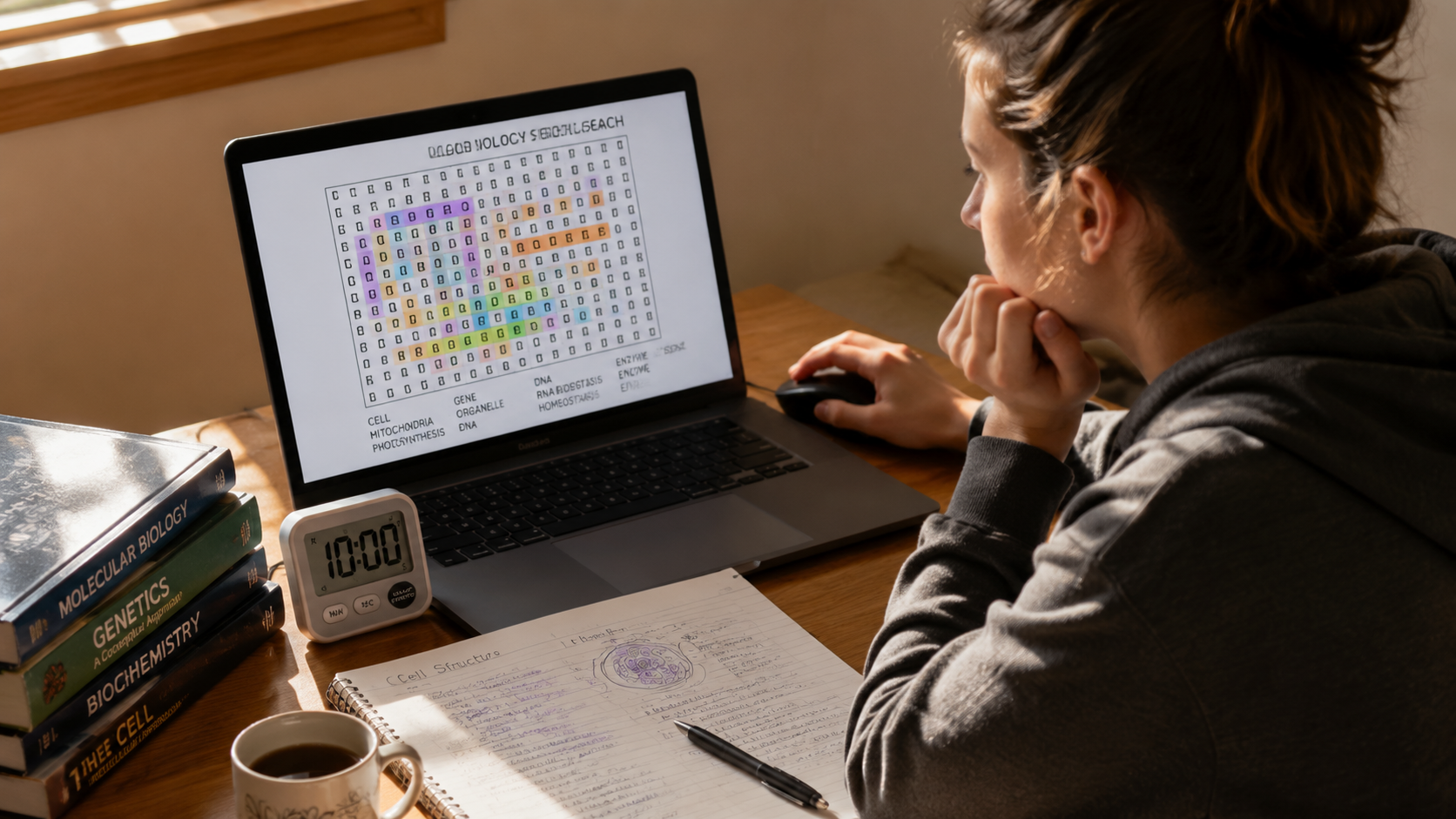
Why This Study Break Is Different From Scrolling
A useful break should do two things: interrupt fatigue and make it easy to come back. Strands has a built-in advantage because there is only one new puzzle each day. That daily release pattern gives the break a natural edge; once the board is solved, there is no endless feed of new boards waiting underneath it. TechRadar and TheGamer both describe the one-puzzle-per-day structure as part of how the game works, and that structure is what makes it usable as a study break rather than an open-ended game session.[1][2]
The scale also matters. WordsRated reported 1.3 billion Strands plays in 2024, an average of 3.56 million plays per day, making it the third most popular New York Times game after Wordle and Connections.[3] This is not a niche habit that only a few puzzle people are trying to justify. A lot of students are already making little bargains with themselves around games like this, so the honest question is whether the bargain is well designed.
Compared with scrolling, Strands asks for a more specific kind of attention. You scan a letter grid, test possible words, notice when a found word fits the day’s theme, and revise your guess about the whole category. The game gives you friction instead of pure novelty. That friction is useful only if you let it stay friction; if every stuck moment becomes an excuse to hunt for hints, the break starts acting less like a puzzle and more like a phone loop.
The Theme Words Do More Than Fill the Board
The strongest case for Strands as a student-friendly break is the theme system. You are not just finding any legal word in a grid. You are trying to find words that belong together, often across a category that does not become obvious right away. That creates a different mental task from memorizing a word list: you have to hold possible meanings in your head while the board slowly tells you what kind of language it wants.
WordsRated found that Strands had featured more than 3,070 unique theme words in its analysis, with 80% appearing in only one puzzle. The same analysis reported that the most common theme-word length was 5 letters, at 19.5%, and that 86% of all theme words fell between 4 and 8 letters.[3] Those details are more useful than a vague claim that word games are “good for your brain.” They suggest a game that repeatedly exposes players to varied, medium-length vocabulary instead of drilling the same tiny bank of terms.
That variety is one reason Strands can feel like a gentle vocabulary nudge. Some days lean toward food, geography, science, idioms, entertainment, or everyday categories. A player may already know most of the words, but the act of grouping them still rehearses meaning, spelling, and association. When the theme is unfamiliar, the puzzle can also make a word memorable because it appears inside a pattern rather than as an isolated definition.
There is some outside research support for that idea, but it should stay modest. Life Beyond High School reports that a 2015 paper in the International Journal of Applied Linguistics found themed word puzzles can support incidental vocabulary acquisition, meaning learners pick up words naturally when they appear in topical clusters.[4] Since that source is secondary reporting rather than the paper itself, it is safest to treat the finding as support for a limited claim: themed puzzles can create useful vocabulary exposure. They do not automatically turn puzzle time into a full vocabulary curriculum.
Student comments line up with that limited claim. The Campanile quoted one student saying New York Times games “improved my vocabulary and the speed at which I can think of synonyms for words in my writing,” and another saying the games help them “think more critically in the mornings by waking up my brain.”[5] Testimonials are not proof, but these are the kinds of benefits that sound plausible because they match the mechanics: faster word retrieval, more flexible synonym thinking, and a warmed-up attention span.
The Spangram Is the Real Mental Workout
The spangram is what keeps Strands from being just a themed word search. It is the word or phrase that spans the board and explains the puzzle’s theme. Finding it means moving between details and the larger category: this word fits, that one almost fits, this cluster might point to weather, or music, or kitchen tools, or something more sideways.
That back-and-forth is the useful part. A student reading a history chapter does something similar when connecting individual events to a larger cause. A student drafting an essay does it when scattered evidence suddenly becomes a paragraph topic. A biology student does it when vocabulary terms stop feeling like separate cards and start forming a process. Strands is much smaller than those tasks, but it rehearses the same movement: detail, pattern, category, revision.
The spangram also forces a player to tolerate uncertainty for a few minutes. Early in a puzzle, you may have two or three theme words and no clean explanation. The temptation is to demand the answer immediately. Staying with the board a little longer is where the conditioning happens: you scan again, test a path, reject a false pattern, and let the category sharpen. That is a better mental posture for returning to difficult reading than the quick reward rhythm of most social feeds.
WordsRated’s spangram data makes that mechanic feel less repetitive than it might sound. The most common spangram length in its analysis was 10 letters, appearing in 18.7% of puzzles, and only 11 spangrams had ever repeated.[3] In practice, that means the central category clue changes enough to keep the task from becoming a memorized routine. You are not simply learning “Strands answers”; you are repeatedly practicing how to infer the hidden category from partial evidence.
The Data Scientist reports that a 2020 study in Frontiers in Human Neuroscience ranked crossword-style puzzles as the second most effective method for improving brain functioning, behind learning a new language or instrument.[6] That is interesting, but it should not be inflated into a promise about Strands specifically. Strands is crossword-adjacent in its language demand, but it has its own format. The safer takeaway is that structured word puzzles belong in the family of activities that can exercise language, memory, and pattern recognition when played with attention.
Where the Break Goes Wrong
The problem is not playing Strands before studying. The problem is using Strands as a respectable-looking doorway into avoidance. A student can start with a 10-minute puzzle and then slide into hint pages, social posts about the answer, yesterday’s game, Wordle, Connections, Mini Crossword, and messages that came in while the browser was open. At that point, the original puzzle is no longer the break; it is the alibi.
The Baylor Lariat frames New York Times games as a strong study break because they keep the mind active without the infinite-scroll trap of social media.[7] That comparison is fair only if the student preserves the boundary. The daily limit helps, but it does not physically return anyone to their notes. The player still has to decide that a finished board means the break is over.
Hints deserve special suspicion. They are not morally bad; sometimes they keep a puzzle from becoming irritating. But if the goal is a mental warm-up, reaching for hints too quickly removes the useful strain. DigiNo’s student-oriented review recommends solving without hints when possible because hints reduce the cognitive load of the puzzle.[8] That advice fits the study-break version of Strands: the effort is the point, not just the completion screen.
A Practical Routine That Keeps Strands in Its Place
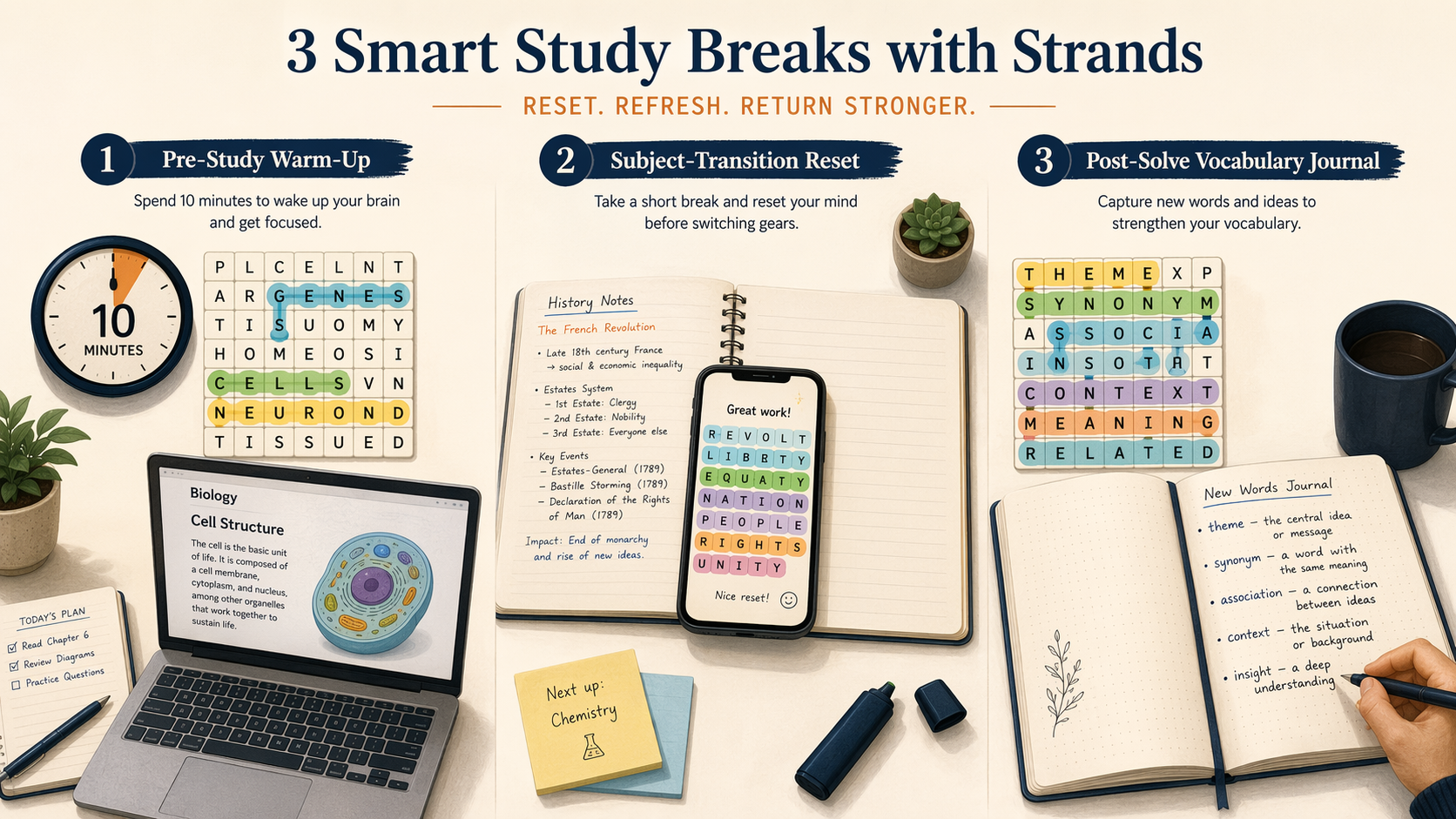
The cleanest way to use Strands is to decide its job before opening it. Not every study day needs a puzzle, and not every tired brain needs more letters. But when you are close to working and need a small reset, Strands can fit into one of three roles.
| Use | When it helps | Boundary |
|---|---|---|
| Pre-study warm-up | Before reading, writing, or reviewing notes when your attention feels cold | Set a 10-minute timer, then begin the planned study task |
| Subject-transition reset | Between two different subjects, such as moving from history reading to math practice | Solve one daily puzzle only; do not open other games |
| Post-solve vocabulary journal | After a puzzle with unfamiliar or useful words | Write down a few words and definitions, then close the game |
Use It Before the Work, Not Instead of the Work
A 10-minute pre-study warm-up works best when the next task is already chosen. “After Strands, I will read pages 42–55” is different from “After Strands, I’ll figure out what to do.” The first plan gives the puzzle a landing strip. The second lets the break expand while you negotiate with yourself.
The timer matters because Strands can be both bounded and sticky. If the board is solved in six minutes, stop early and enjoy the gift. If the timer ends before the solve, make a choice: leave it unfinished and start studying, or spend one more clearly defined minute looking for the spangram. What you should not do is let “almost solved” become a floating excuse with no endpoint.
Use It Between Subjects When Your Brain Needs a Gear Shift
The subject-transition reset is probably Strands at its most useful. After dense reading, a small puzzle can clear the residue before a problem set. After math, a word grid can make language feel available again before drafting. The goal is not to squeeze productivity out of every second; it is to avoid the kind of break that makes returning harder.
This is where Strands beats many “quick” phone breaks. A social feed rarely has a natural stopping point. Strands does. The board ends, the theme resolves, the spangram appears, and the student can go back to the next notebook without feeling as if the internet is still tugging on their sleeve.
Turn Good Words Into a Tiny Journal Prompt
The vocabulary journal version should stay tiny. After solving, write down any unfamiliar theme word, one synonym, or one sentence using the word correctly. If every word was familiar, write the theme and one related word that did not appear. This takes the incidental vocabulary exposure and turns it into a small act of retrieval.
Do not turn this into a decorative study system. No color-coded master spreadsheet is required. The point is to notice language, use it once, and return to the real assignment. One sentence with a new word is more useful than designing a vocabulary routine elaborate enough to avoid the essay waiting beside it.
The Rule Set
- Open Strands only after choosing the next study task.
- Use a 10-minute timer for a warm-up or transition break.
- Try the puzzle without hints first; use hints only if frustration is replacing focus.
- Stop after the daily puzzle, even if other NYT games are available.
- If a word is worth keeping, write one definition or original sentence before returning to work.
Used this way, Strands belongs in a study-methods toolbox as a deliberate break strategy. Its daily structure limits the session, its theme words create varied vocabulary exposure, and its spangram mechanic asks for the kind of associative thinking students use when they connect details to larger ideas. That is enough to make it more mentally productive than social media for many study breaks. It is not enough to make it studying.
References
- NYT Strands. TechRadar.
- NYT Strands Beginner Tips, Tricks & Strategy Guide. TheGamer.
- NYT Strands Statistics. WordsRated.
- Word Puzzle Benefits for Adult Learners. Life Beyond High School.
- New York Times games rise in popularity among students, building community. The Campanile.
- How Word Games Like Strands Can Improve Cognitive Performance. The Data Scientist.
- New York Times games are the perfect study break. The Baylor Lariat. September 12, 2024.
- Strands Game Review. DigiNo.
Applies to
Exam applicability isn't specified for this technique yet. See all exam hubs.
Comments
Join the discussion with an anonymous comment.