Method
How to storm-proof your exam prep before the power goes out
A timed before-during-after protocol to safeguard months of exam-prep momentum against storm disruptions — covering digital backup, offline study materials, and post-storm recovery so a single weather event doesn't derail your test score.
Evidence panel
- Evidence level
- Moderate
- Primary citation
- Dunlosky, J., et al. (2013). Improving Students’ Learning With Effective Learning Techniques. Psychological Science in the Public Interest.
Storm preparedness tips for students should protect more than a dorm room. If you are two weeks from the SAT, ACT, GRE, or MCAT, a power outage can break the study loop you have spent months building: score-gap tracking, flashcard review, timed sections, video lessons, and the small confidence that comes from knowing what tomorrow’s work is supposed to be.
That risk is no longer an edge case for students in hurricane, severe thunderstorm, wildfire, or winter-storm regions. The United States had 28 billion-dollar weather disasters in 2023, the latest complete annual count available as of July 2026, and weather-related power outages increased 78% between 2000–2010 and 2011–2021.[1] The practical lesson is simple: if your prep system exists only in the cloud, on one laptop, or inside a campus building you may not be allowed to enter, it is not storm-ready.
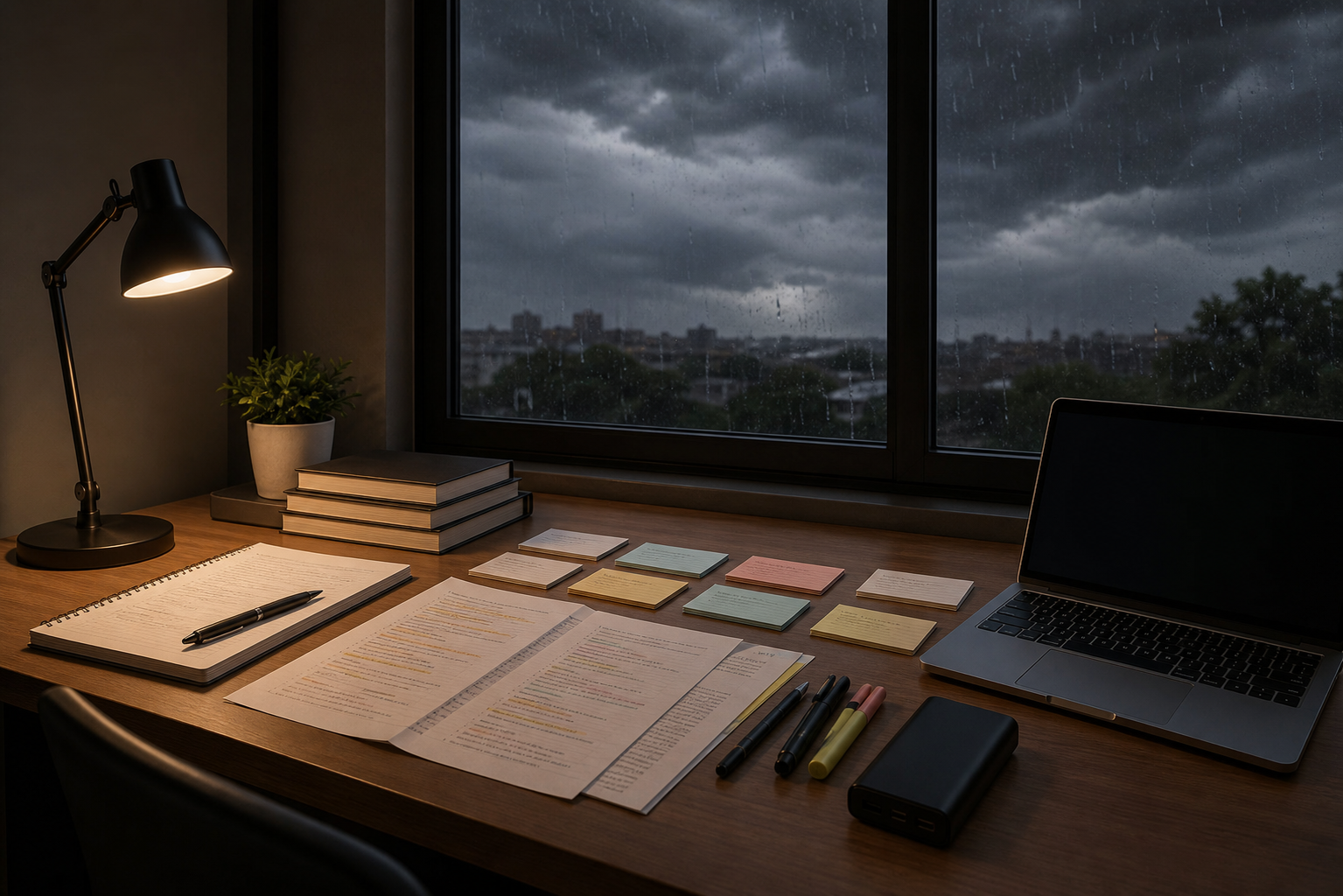
This does not replace evacuation orders, shelter guidance, campus alerts, or local emergency instructions. Safety comes first. The goal here is narrower: add a study-continuity layer to the exam plan you already have, so the storm does not force you to reconstruct your prep from memory after three bad days.
Start With The Assumption That Power And Internet May Fail
Most exam prep now assumes three things will be available: a charged device, internet access, and a quiet place where your materials live. Storms can remove all three at once. A laptop battery dies. A flashcard app stops syncing. The campus library closes. A test center posts an update while your phone is at 9%.
The preparedness gap is large enough that students should not rely on last-minute improvisation. FEMA’s National Household Survey found that 48% of Americans had emergency supplies set aside and 32% had practiced an emergency plan.[2] A 2023 study of 111 engineering students at the University of Texas at Arlington found that 63% reported zero or one prior disaster experience; that sample is small and not nationally representative, but it is a useful warning about how many students may be handling their first serious disruption while also trying to protect school or exam deadlines.[3]
Treat the storm plan as a redundancy check. Your exam board may control rescheduling rules. Your campus may control building access. The weather may control whether you can travel. You control whether your next two or three study sessions can survive without Wi-Fi.
The 48-Hour Window: Preserve The Materials You Cannot Replace Quickly
For hurricanes, a watch can give roughly a 48-hour preparation window; for winter storms, the useful student window may be much shorter, often closer to 12–24 hours in practice. Do not wait for perfect certainty. Once there is a serious chance that power, travel, or campus access will be disrupted, switch from ordinary studying to continuity setup.
The first job is to make your materials portable and offline. Download the practice tests, question sets, explanations, formula sheets, vocabulary decks, content outlines, and score logs you would need for the next several days. If your current plan depends on digital tools, decide which parts actually need a screen and which can be copied to paper.
- Download the next two to four planned study sessions, not your entire prep archive.
- Export or screenshot the study calendar, score tracker, missed-question log, and test-day checklist.
- Save PDFs locally on a laptop and phone, then back up the same files to cloud storage if service is still stable.
- Print or hand-copy the minimum packet: one timed section, one review set, one formula or grammar sheet, and the next flashcard group.
- Write down account usernames, customer-support paths, and exam-board login pages without including passwords on an unsecured sheet.
SAT students using a score-gap approach should protect the exact gap they are working on, not restart with random mixed practice after the storm. If your current SAT plan is built around weak domains, preserve that sequence from your SAT score-gap method and keep the next Bluebook-related tasks visible. If your prep relies on Khan Academy and Bluebook together, decide in advance which items from your Khan Academy SAT Practice with Bluebook workflow can be done on paper.
GRE students should do the same for vocabulary and quantitative error logs. A flashcard app is useful until the phone has to be saved for alerts. If you are comparing or switching decks, your GRE vocab flashcard plan should leave you with a small physical or printable subset for outage days, not thousands of cards you cannot triage.
MCAT students have a harder continuity problem because the content load is larger and the tools are often more fragmented. Back up the resources you actually use, not every resource you once bookmarked. If your MCAT setup spans question banks, Anki, content review, and practice-test analytics, use your MCAT study tools comparison as a checklist for what must remain accessible offline.
Then check the official exam source before the connection gets worse. SAT students should check College Board and Bluebook channels. ACT students should check ACT test-day cancellation information. GRE students should check ETS test-center updates. MCAT students should check AAMC emergency and scheduling communications. Policies change, and secondhand screenshots age badly; use official sources for closures, rescheduling, and identification rules.
A 48-Hour Continuity Checklist
| Prep System | What To Make Redundant | Why It Matters |
|---|---|---|
| Study schedule | Print or screenshot the next week, including rest days and review blocks | You can restart without guessing what the old plan was |
| Practice materials | Download PDFs, question sets, answer keys, and explanations | A dead connection does not erase the next session |
| Flashcards | Export, screenshot, print, or hand-copy the next small deck | Review continues without draining phone battery |
| Score tracking | Save recent section scores and missed-question categories | Post-storm recovery starts from evidence, not anxiety |
| Exam logistics | Record test-center address, admission-ticket status, ID rules, and official update channels | Travel and rescheduling decisions stay tied to the exam board |
The 24-Hour Window: Pack A Study Go-Bag, Not A Second Bedroom
At 24 hours, stop trying to perfect the archive. FEMA’s kit guidance emphasizes basic supplies such as water, food, light, batteries, a radio, first-aid items, sanitation supplies, chargers, and important documents; students can add a thin academic layer to that same go-bag idea.[2]
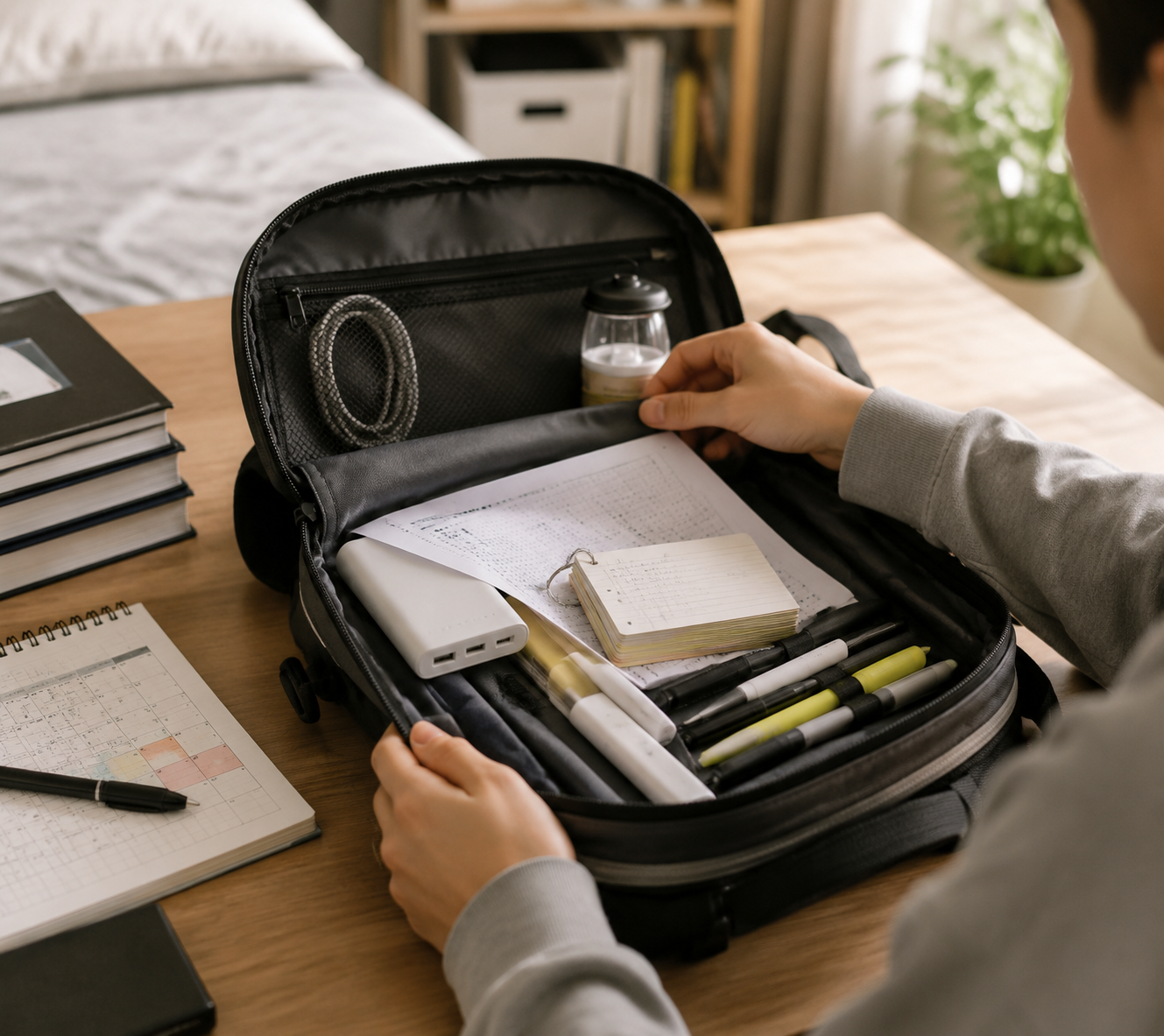
The academic layer should be small enough to carry if you have to move rooms, leave campus, or sit in a hallway during an alert. A stuffed binder is less useful than a focused packet you will actually open.
- One printed timed section or short problem set, with answer explanations if available.
- A small flashcard stack or handwritten sheet for formulas, grammar rules, equations, vocabulary, amino acids, or recurring errors.
- A pen, pencil, scratch paper, and a clipboard or notebook that works away from a desk.
- A charged power bank, charging cable, and wall adapter kept together.
- A battery-powered light that does not require your phone.
- Water and snacks that do not require cooking, especially if your campus dining plan may be interrupted.
If you may need to drive to a test center soon after the storm, fill the gas tank while it is still safe to do so. If you are on campus, look at the university’s emergency guidance before assuming normal services will remain open. Ready.gov’s campus preparedness guidance puts responsibility on institutions and individuals; for students, that means knowing where alerts arrive, where to shelter, and how campus reopening will be communicated.[4]
Clear the study area only after the essentials are backed up and packed. Loose papers near a window, a laptop left charging on the floor, or a notebook sitting under a leak-prone vent can undo good planning in a boring way. Put the next-session packet, ID, wallet, chargers, and medicine where you can grab them in one motion.
During The Storm: Study Only In Ways That Fit The Conditions
During the storm, studying is secondary to safety. Follow local alerts, evacuation orders, shelter-in-place directions, residence-life instructions, and family plans. NOAA’s severe-weather safety guidance warns that flying debris is the top killer in many severe storms, so interior shelter decisions are not optional study preferences.[5]
If you are safe, the best outage study is not a fake full practice test under miserable conditions. It is maintenance work: retrieval, review, and short drills that keep the neural path warm without burning the battery you may need for alerts.
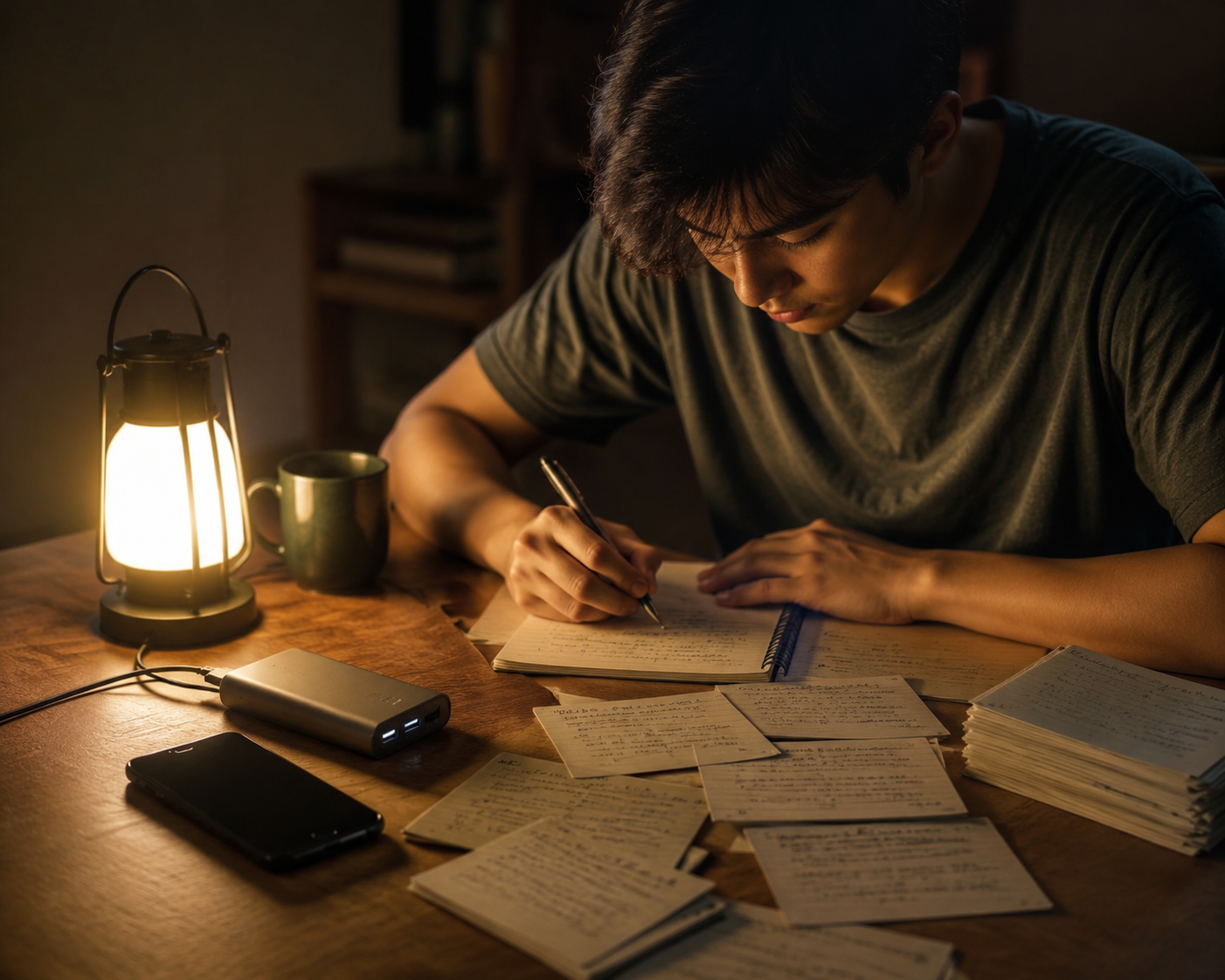
Active recall is the right default because it can run on paper, aloud, or mentally. A major review by Dunlosky and colleagues rated practice testing as high utility and distributed practice as high utility, while many familiar techniques, such as rereading and highlighting, received lower ratings.[6] That does not mean every storm hour should become a grind session. It means that if you have 20 usable minutes, self-testing beats passively staring at notes by flashlight.
- For SAT or ACT reading: summarize a passage’s main claim from memory, then check the text.
- For SAT or ACT math: redo missed problems from the final line backward, explaining each step aloud.
- For GRE vocabulary: cover definitions and generate your own sentence before checking the card.
- For GRE quant: classify old misses by concept before solving anything new.
- For MCAT: draw a pathway, equation relationship, or concept map from memory, then mark gaps.
Phone use should be deliberate. Text instead of calling when possible, dim the screen, close streaming apps, and avoid using the phone as a lamp if you have another light. If a practice app tempts you into an hour of low-value scrolling, put it away and use the printed packet. The phone is now an alert device first and a study device second.
For students who normally use flashcards heavily, keep the session small. Power-outage flashcard work should protect recall, not create a backlog that becomes punishment later. That is especially true for MCAT students using large decks; the same caution behind when MCAT flashcards hurt more than they help applies even more when sleep, light, and power are unstable.
After The All-Clear: Re-Enter The Plan Before You Rewrite It
After the storm, wait for official all-clear messages before traveling. Campus reopening, road conditions, residence-hall access, and test-center status may not move at the same speed. A building can have power while nearby roads remain unsafe; a test center can be closed while your neighborhood looks fine.
Before studying, check three channels in this order: local safety alerts, campus or school communications, and the official exam-board source for your scheduled test. If your exam date is close, do not rely on a friend’s message or an old policy page. Confirm whether the SAT, ACT, GRE, or MCAT administration is still happening, whether the test center has posted a closure, and what the official rescheduling path is.
Then reopen the offline packet you prepared before the outage. That packet is valuable because it tells you what you were supposed to be doing before the storm interrupted the timeline. Start with one short diagnostic action: review the missed-question log, redo a small set, or check the last score-gap category. Do not build a new four-week plan while tired, displaced, or still waiting for internet service.
| If This Happened | Do This First | Do Not Do This Yet |
|---|---|---|
| You missed one study day | Resume the next planned session and shorten the warm-up | Add a full extra practice test immediately |
| You missed two or three days | Use the saved score log to choose one review priority | Try to make up every lost hour in one night |
| Your test center may be affected | Check the official exam-board and test-center channels | Assume the exam is canceled or active based on social media |
| Your materials are still offline | Keep using the printed packet and local downloads | Switch tools just because one app is unavailable |
| You feel behind | Protect sleep and restart with a short, scored task | Rewrite the whole schedule from panic |
For SAT students, return to the saved score gap. For GRE students, return to the vocabulary set or quant error category that was already next. For MCAT students, return to the content block or practice-review cycle already in motion. If the official exam status changes, adjust the dated plan around the new constraint; if it does not, keep the original test date as the anchor.
The quiet win is not studying heroically through a dangerous storm. It is having enough redundancy that, once the safety situation is clear, your exam prep still has a next step. Check the alerts, verify the exam status, use the offline materials, and return to the SAT, ACT, GRE, or MCAT plan you already trusted.
References
- Emergency Preparedness Statistics 2024-2025 — Safecastle.
- Build A Kit — Ready.gov/FEMA.
- Disaster Preparedness and Awareness among University Students — Patel et al., 2023.
- Ready Campus — Ready.gov.
- Severe Weather Safety Checklist — NOAA/National Weather Service.
- Improving Students’ Learning With Effective Learning Techniques — Dunlosky et al., 2013.
Comments
Join the discussion with an anonymous comment.