
Method
The Five-Indicator Method for Press Freedom Case Studies
This article introduces a repeatable five-indicator framework for analyzing press freedom cases, enabling journalism students to produce evidence-backed case studies rather than relying on intuition.
Evidence panel
- Evidence level
- High
- Primary citation
- Methodology used for compiling the World Press Freedom Index 2026, Reporters Without Borders, 2026
A press freedom controversy usually announces itself before it explains itself. A student editor is removed from a role, a university says a publication crossed a line, a lawsuit claims a newspaper is being punished for what it printed, or an international student wonders whether an opinion piece could become evidence against them. The first reaction may be clear enough: something feels wrong. The harder classroom task is turning that reaction into a press freedom case study for journalism students that can survive questions about evidence, category, severity, and uncertainty.
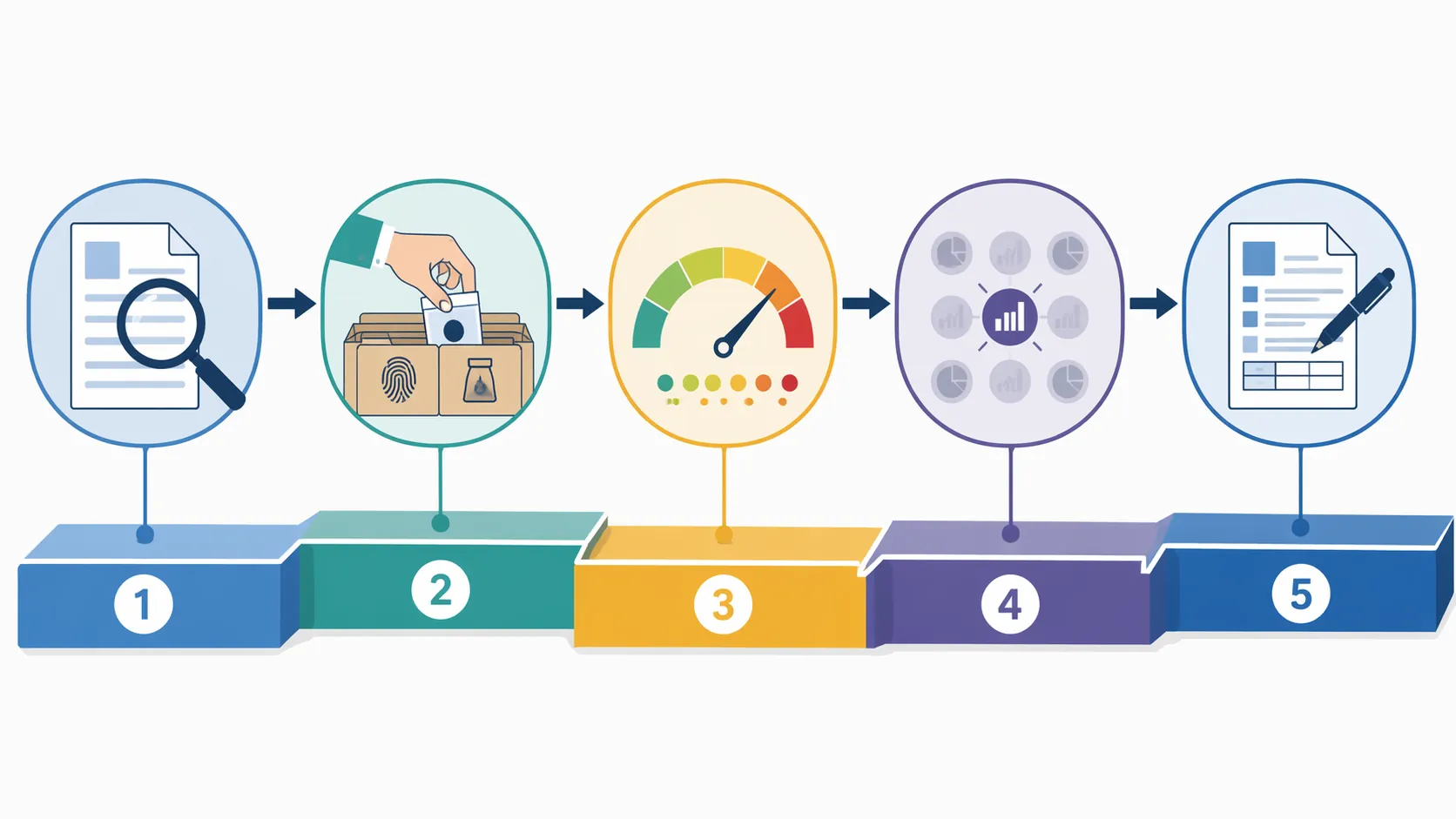
The method is simple to state, though not always quick to apply: identify the case, collect evidence under five press freedom indicators, grade the severity of pressure in each dimension, decide which indicator is carrying the strongest evidence, and write the analysis as a dated judgment rather than a permanent verdict.
The reason to use a framework is not that it makes the moral question disappear. It keeps the moral question from doing all the work. In 2026, Reporters Without Borders reported the lowest average global press freedom score in the Index’s 25-year history, with 52.2% of countries classified as “difficult” or “very serious” and less than 1% of the world’s population living in a country rated “good” for press freedom.[2] The legal indicator also declined in 110 of 180 countries, the sharpest one-year drop among the indicators in that report.[2] Those numbers do not tell a student what happened in any one newsroom, courtroom, or campus office. They explain why students need a disciplined way to ask.
Start With The Evidence Posture
Before applying any framework, name what kind of evidence you are holding. That one move prevents a case study from treating a global index, a pending lawsuit, and a teaching resource as if they all prove the same kind of claim.
| Material | Evidence Quality | How To Use It |
|---|---|---|
| RSF 2026 methodology | High | Use it as the main analytical framework because the indicators, sub-questions, scoring range, coefficients, questionnaire process, and expert review are documented. |
| SPLC lawsuit tracker and named legal materials | High for case posture and documented filings; limited for final outcomes when cases remain pending | Use these cases as calibration exercises, not as settled lessons if the litigation was still ongoing at the review date. |
| Columbia and Harvard case-method teaching resources | Moderate | Use them to justify structured case analysis in teaching, not to claim empirical proof that this exact press freedom method improves student outcomes. |
The RSF methodology is useful because it is visible enough to be argued with. The 2026 Index methodology describes five contextual indicators, each scored from 0 to 100, and says the questionnaire was designed by a seven-member expert panel of academics and RSF specialists and distributed in 25 languages.[1] That does not make the Index neutral in some view-from-nowhere sense. RSF is an advocacy organization with a stated commitment to press freedom. For classroom work, that means the framework should be treated as a documented, normative tool: strong enough to structure analysis, not strong enough to end inquiry.
The student cases used later in this article should be read with a similar warning. Several matters in the Student Press Law Center’s June 2026 lawsuit tracker were ongoing as of July 6, 2026, including Stanford Daily v. Rubio.[3] A good case study can still use pending litigation, but it should say “last reviewed” and distinguish allegations, court orders, filings, and final judgments.
The Five Indicators Ask Different Questions
The common student mistake is to collapse every pressure into one large word: censorship. Sometimes that is the right word. Often it is too blunt. RSF’s five indicators help separate pressures that may arrive together but operate through different channels: political context, legal framework, economic context, sociocultural context, and safety.[1]

Political Context
The political context indicator asks whether political actors, governing bodies, or institutional authorities create conditions in which journalism can be done independently. RSF’s 2026 methodology lists 35 sub-questions for this indicator, more than any other contextual category.[1] That count matters. It signals that political pressure is not limited to a censor’s written order. It can include access, interference, editorial pressure, public hostility from officials, or institutional retaliation.
For a student case study, political context evidence might include board meeting minutes, statements from administrators, public comments by elected officials, appointment and removal authority, email instructions to advisers, changes in publication oversight, or records showing who had power over funding, staffing, or distribution. The question is not merely whether a student journalist was criticized. It is whether a power holder used an institutional position to shape, punish, deter, or reward coverage.
Legal Framework
The legal framework indicator asks what law permits, prohibits, protects, or threatens. RSF’s methodology assigns this indicator 26 sub-questions.[1] In a classroom, this category is where students often become either too confident or too timid. A lawsuit is not automatically proof that press freedom was violated; a statute is not automatically meaningful unless someone invokes it, enforces it, ignores it, or benefits from it.
Legal evidence includes complaints, motions, orders, statutes, school policies with legal force, prior restraints, subpoena demands, anti-SLAPP rulings, immigration provisions, criminal charges, defamation claims, or administrative proceedings. The important distinction is between a legal environment and a legal event. A protective anti-SLAPP law may improve the legal framework even when a publisher still has to spend months defending itself. A vague disciplinary rule may chill coverage even before anyone is punished under it.
Economic Context
The economic context indicator also has 26 sub-questions in the RSF methodology.[1] This category asks who controls the resources journalism needs: money, printing, web hosting, advertising, equipment, salaries, office space, legal defense, insurance, or distribution. In student media, economic pressure can look less dramatic than a ban and still change behavior. A publication that keeps its formal editorial rights but loses access to activity fees, printing support, adviser hours, or campus distribution points may remain “free” in theory while becoming weaker in practice.
Economic context is not the same as ordinary scarcity. A small newsroom with a small budget is not automatically a press freedom case. The evidence becomes relevant when financial control is tied to coverage, viewpoint, independence, or retaliation. Students should ask who made the funding decision, what explanation was given, whether comparable groups were treated similarly, and whether the financial change followed specific reporting.
Sociocultural Context
The sociocultural context indicator has 22 sub-questions in the RSF methodology.[1] It asks how social norms, identity pressures, public stigma, community backlash, and cultural expectations affect journalism. This is the category that can be hardest to write about carefully because it often involves atmosphere. Atmosphere matters, but it needs evidence.
Useful evidence might include organized campaigns against a publication, threats of social exclusion, harassment aimed at reporters because of identity or viewpoint, pressure on sources not to speak, or community norms that make certain topics unusually costly to cover. The student writer should avoid converting ordinary disagreement into sociocultural repression. Strong evidence shows that social pressure changed access, participation, safety, publication decisions, or the willingness of sources and journalists to continue.
Safety
Safety is structurally different from the other indicators. RSF’s 2026 methodology uses 15 questionnaire items plus a weighted abuse tally, with coefficients ranging from 1 for media ransacking to 100 for murder.[1] It also gives a specific formula: score = 100 − K × Σ(ki × xi) / log₁₀(pop).[1] A student does not need to reproduce the Index calculation for a classroom case study, but the formula teaches an important lesson: safety is not a mood category. It is built around incidents, weights, and scale.
Safety evidence should therefore be concrete: arrests, assaults, detentions, doxxing, credible threats, police seizure of equipment, newsroom raids, forced exile, or murder. Some chilling effects belong partly under safety, especially when students can show that a threat plausibly affected behavior. But a vague sense of discomfort is not the same as documented danger. If the case turns on intimidation without physical harm, the analysis should say so rather than inflate the severity grade.
A Workflow For Building The Case Study
Case-method teaching resources from Columbia University and Harvard Law School support the value of giving students a structured problem, asking them to analyze facts, and requiring them to defend decisions rather than merely memorize doctrine.[4][5] That support is useful but limited. It justifies the classroom shape of the exercise. It does not prove that this exact five-indicator method is the only way to study press freedom.
- Define the case in one sentence: who acted, who was affected, what journalistic activity was involved, and what decision or pressure created the controversy.
- Create an evidence log under the five indicators instead of writing the argument first.
- Label each item by source type: filing, order, policy, public statement, interview, institutional record, news report, or advocacy summary.
- Assign a preliminary severity grade for each indicator: none, low, moderate, high, or severe.
- Identify the dominant indicator, then name secondary indicators and uncertainties.
- Write the case study with a last-reviewed date if litigation, policy review, or employment status may have changed.
The evidence log should come before the thesis sentence. Students who begin with “this is censorship” usually start selecting facts to defend that conclusion. Students who begin with five columns are more likely to notice that the strongest evidence may sit somewhere else: legal threat rather than political interference, economic retaliation rather than culture-war backlash, safety risk rather than ordinary criticism.
| Severity Grade | What It Means In A Student Case Study |
|---|---|
| None | No usable evidence for this indicator, or the available facts point away from it. |
| Low | Some pressure appears, but it is indirect, weakly documented, or not clearly tied to journalistic activity. |
| Moderate | Evidence shows a real burden on reporting, publication, staffing, access, or source participation. |
| High | Evidence shows direct institutional, legal, financial, social, or safety pressure that could materially restrict journalism. |
| Severe | Evidence shows extreme consequences such as imprisonment, serious violence, newsroom closure, forced removal, or a comparable loss of capacity. |
These grades are not RSF scores. They are classroom severity labels. The point is to make the judgment inspectable. If another student disagrees, they should be able to point to the same evidence log and argue that a grade is too high, too low, or assigned to the wrong indicator.
Calibration Case: A Student Media Director Is Fired
The Student Press Law Center’s June 2026 tracker included litigation over Indiana University’s firing of student media director Jim Rodenbush.[3] A student could be tempted to begin with a broad claim that the firing was a campus press freedom crisis. The five-indicator method slows that sentence down.
The first question is political context: who had authority over the adviser, what reason was given, what publication activity preceded the decision, and whether the action plausibly changed editorial independence. If the strongest evidence shows that institutional officials removed a person who helped preserve student newsroom autonomy, the dominant indicator may be political or institutional context. Legal framework becomes secondary unless the case turns on statutory rights, constitutional claims, contractual protections, or court orders. Economic context might matter if the removal changed staffing resources or operating support. Safety likely remains low unless there is evidence of threats or physical danger.
That classification does not minimize the firing. It locates the pressure. The person who absorbs the consequence is not an abstract “press freedom environment.” It is the adviser, the students who lose a buffer between editorial decisions and institutional power, and the publication that must decide whether the next controversial story is worth the risk.
Calibration Case: Anti-SLAPP Protection Changes The Legal Analysis
Kay v. The Irish Rover is useful because it prevents students from treating every lawsuit against a publication as the same kind of legal pressure. In that matter, a judge ordered $199,450.40 in legal fees under Indiana’s anti-SLAPP law.[3] The fee order is a concrete legal fact, not just a general claim that student media should be protected.
For the legal framework indicator, the case can be analyzed in two movements. The lawsuit itself may have imposed cost, uncertainty, and stress on a student publication. The anti-SLAPP remedy, however, shows a legal mechanism operating in the other direction: deterring claims that target protected speech and shifting fees after a successful defense. A careful student analysis can therefore say that legal pressure existed, while also concluding that the legal framework contained a meaningful protective device in this instance.
That is a more useful conclusion than “lawsuits chill speech.” Some do. Some fail. Some produce rulings that clarify protection. The case study has to show which one the evidence supports.
Calibration Case: Immigration Risk And Chilling Effects
Stanford Daily v. Rubio, filed in August 2025, argued that immigration law provisions used to detain international students for op-eds chilled press freedom.[3] As noted earlier, the case posture was not a final classroom holding as of the July 6, 2026 review date in the research materials. That caveat belongs in the first paragraph of any student write-up, not buried after the conclusion.
This case is a good test of overlap. The legal framework indicator matters because the alleged pressure operates through immigration law. The sociocultural context indicator may also matter because the chilling effect depends on how international students understand public expression, surveillance, belonging, and risk. Safety could enter if detention or threatened detention is documented in the record being analyzed. A student should not force one label to carry the entire case when the evidence shows a compound pressure.
The dominant-indicator judgment still has to be made. If the filings and legal theory are the strongest evidence, legal framework should lead. If interviews or records show that students stopped writing, declined bylines, or avoided sources because of perceived social and immigration consequences, sociocultural context may deserve more space as a secondary indicator. The case study should mark the difference between what the lawsuit alleges, what the court has decided, and what student behavior can actually be shown to have changed.
How To Write The Analysis Without Overclaiming
A finished case study should not read like a verdict first and an investigation second. It should let the reader see the route from evidence to judgment. The structure can be compact:
- Case identification: name the actor, affected journalist or publication, disputed journalistic activity, and date range.
- Evidence posture: state which sources are documentary, which are advocacy summaries, which are allegations, and which are court or institutional decisions.
- Indicator analysis: discuss only the indicators supported by evidence, with the strongest one first.
- Severity judgment: grade each relevant indicator and explain the grade in one or two evidence-based sentences.
- Uncertainty: identify pending litigation, missing records, disputed facts, or behavior that cannot be inferred from the available materials.
- Conclusion: state the dominant indicator and the dated press freedom judgment.
The dated judgment is not a hedge; it is a standard of accuracy. Index scores are snapshots. Lawsuits move. Administrators change their explanations. Students graduate. A case study written in Q3 2026 should say what was known then and what would need to be checked later.
A strong press freedom case study does not merely announce that press freedom was harmed. It shows which indicator carries the strongest evidence, which indicators are secondary, what remains uncertain, and why the conclusion should be treated as an evidence-graded judgment rather than a permanent verdict.
References
- Methodology used for compiling the World Press Freedom Index 2026, Reporters Without Borders, 2026.
- 2026 RSF Index: press freedom at a 25-year low, Reporters Without Borders, 2026.
- Eight student media lawsuits we’re following, Student Press Law Center, June 2026.
- Case Method Teaching, Columbia University.
- The Case Study Teaching Method, Harvard Law School.
Applies to
Exam applicability isn't specified for this technique yet. See all exam hubs.
Comments
Join the discussion with an anonymous comment.