Method
Polio Virus Eradication Methods Explained
Polio eradication relies on three interdependent method pillars: vaccination, surveillance, and outbreak response. Understanding how they interact explains the 99.9% case reduction since 1988 and the persistent transmission in the last two endemic reservoirs.
Evidence panel
- Evidence level
- High
- Primary citation
- CDC MMWR, Surveillance to Track Progress Toward Polio Eradication — Worldwide, 2022–2023
A useful study of polio virus eradication methods starts with the apparent contradiction, not with a victory lap. In 1988, polio caused an estimated 350,000 cases across 125 countries; as of the Global Polio Eradication Initiative update current through mid-July 2026, 14 wild poliovirus type 1 cases had been reported in two countries, a reduction of more than 99.9% from the pre-eradication baseline.[1][2] At the same time, the 2026 year-to-date count listed 87 circulating vaccine-derived poliovirus cases across 15 countries, compared with those 14 wild poliovirus cases.[2]
Those 2026 numbers should be read with the usual caution: current-year polio data carry reporting lag, and lag matters most in places where insecurity or access restrictions already make surveillance harder. Still, the broad pattern is real enough for exam purposes. Eradication has worked on a historic scale, but the remaining problem is no longer just “find the last wild virus and vaccinate around it.” The program now has to interrupt wild poliovirus in the last endemic reservoirs while also preventing vaccine-derived outbreaks in under-immunized populations.
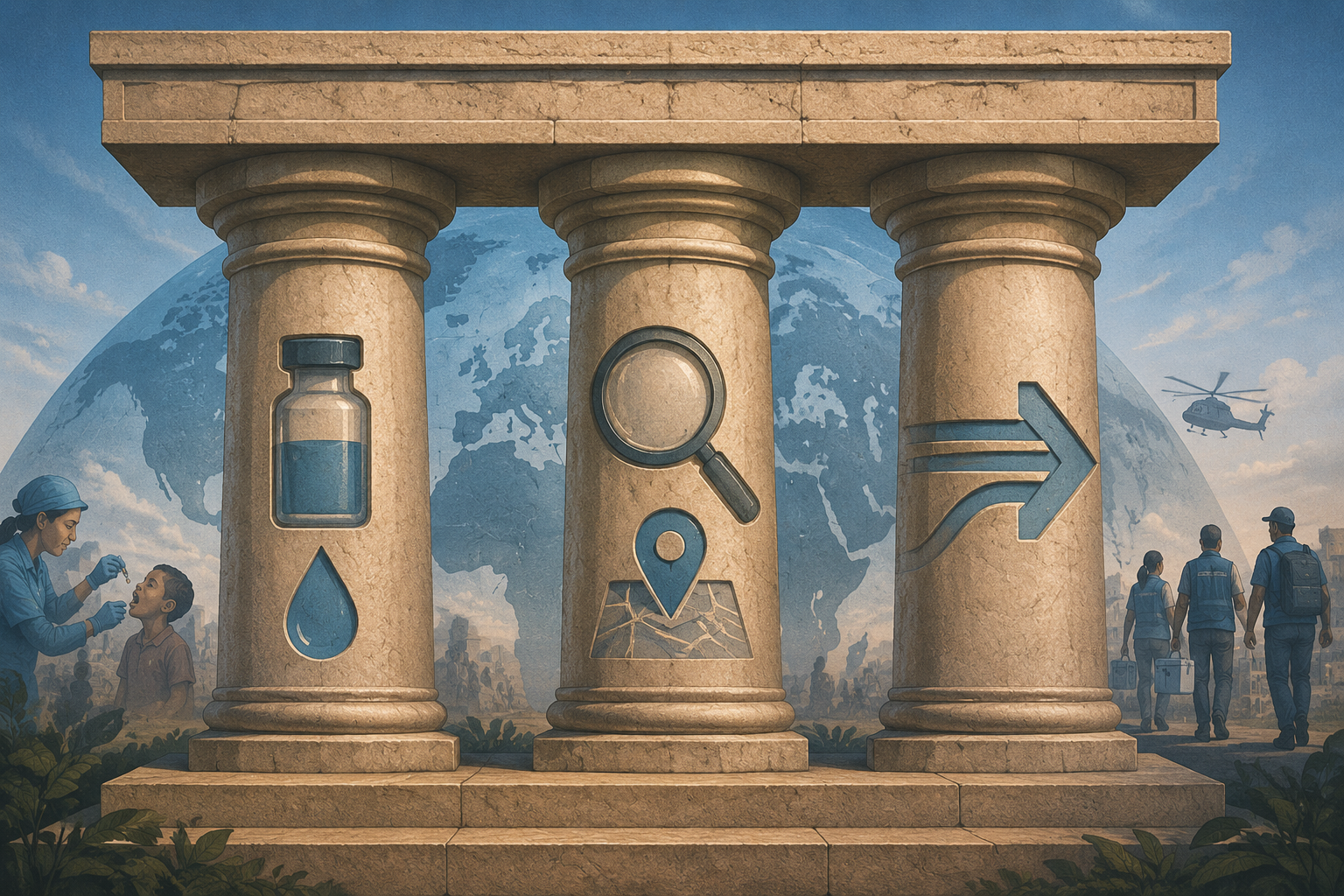
The clean study-guide answer is that polio eradication rests on three method pillars: vaccination, surveillance, and outbreak response. The less clean, more important answer is that none of the three works independently. Vaccination reduces susceptibility and transmission; surveillance shows where virus is moving; outbreak response turns detection into fast immunization campaigns. When all three reach the same communities with enough speed and trust, polio disappears. When one pillar is blocked, the others start losing value.
The Three Methods In One View
| Method pillar | What it does | What it misses if used alone |
|---|---|---|
| Vaccination | Builds immunity through OPV, IPV, and newer nOPV2 tools. | Cannot confirm where virus is still circulating without surveillance. |
| Surveillance | Detects possible poliovirus through acute flaccid paralysis reporting, stool testing, laboratory confirmation, and sewage monitoring. | Does not stop transmission unless detection triggers immunization action. |
| Outbreak response | Uses supplementary immunization activities and mop-up campaigns after virus is found. | Arrives too late or too narrowly if surveillance is weak or vaccination access is poor. |
That table is enough to remember the architecture, but not enough to explain the mechanism. Most weak answers treat “vaccination” as one tool and “surveillance” as a vague monitoring system. Polio eradication is more specific than that. It uses vaccines with different transmission effects and surveillance indicators with numerical performance thresholds. Those details are where the method either becomes operational or stays decorative.
Vaccination Is A Trade-Off Map, Not A Single Tool
Oral polio vaccine and inactivated polio vaccine are both central to eradication, but they solve different problems. OPV is live-attenuated, given orally, comparatively inexpensive, and especially valuable because it induces intestinal mucosal immunity that helps reduce person-to-person transmission. IPV is injected and avoids the vaccine-derived poliovirus risk associated with live oral vaccine, but it does not produce the same mucosal effect in the gut.[3][4]
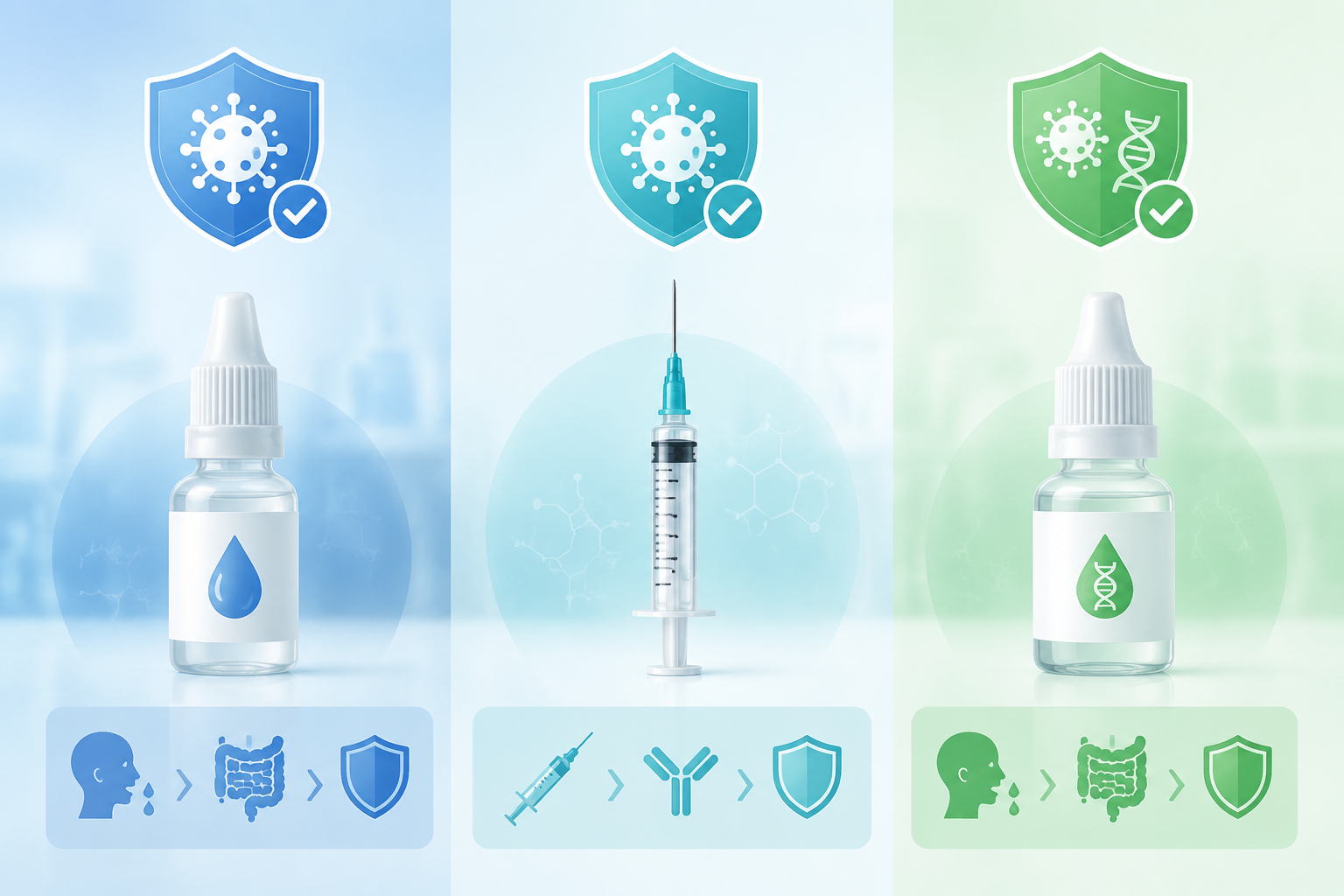
That difference explains why OPV became such a powerful eradication tool. A vaccine that is easy to administer and helps block transmission is valuable in mass campaigns, especially where health systems cannot reliably deliver repeated injections to every child. But the same live-attenuated feature that makes OPV useful also creates its most important exam nuance: in rare circumstances, the weakened vaccine virus can cause vaccine-associated paralytic polio, and in under-immunized communities it can circulate long enough to genetically change into circulating vaccine-derived poliovirus.
The correct conclusion is not that OPV “causes the polio problem.” The correct conclusion is narrower and more useful: OPV helped drive the historic collapse in polio transmission, but where population immunity is too low, vaccine virus can keep moving and create cVDPV outbreaks. That is why current cVDPV counts can exceed wild poliovirus counts even though vaccination remains the reason wild poliovirus has been pushed into such a small geographic corner.
| Vaccine | Main eradication value | Main limitation or risk |
|---|---|---|
| OPV | Oral delivery and strong mucosal immunity help reduce transmission. | Live-attenuated virus can rarely cause VAPP and can seed cVDPV in under-immunized populations. |
| IPV | Protects vaccinated individuals from paralysis without cVDPV risk. | Does not provide the same intestinal mucosal immunity needed to interrupt transmission. |
| nOPV2 | A genetically stabilized oral type 2 vaccine designed to reduce reversion risk. | Still depends on campaign quality and high coverage; it is not a substitute for reaching missed children. |
Where nOPV2 Fits
Novel oral polio vaccine type 2, or nOPV2, is best understood as an adaptation to the cVDPV2 problem. It was designed to be more genetically stable than Sabin OPV2, reducing the risk that the vaccine virus reverts toward neurovirulence during circulation. WHO prequalified nOPV2 in December 2023, and published reviews describe about 1 billion doses administered across 35 countries, with an estimated 82% reduction in cVDPV2 emergence risk compared with Sabin OPV2.[5][6]
That is a major technical improvement, but it should not be written as a miracle fix. A more stable oral vaccine can reduce one pathway of risk; it cannot compensate for campaigns that miss too many children, surveillance that detects spread late, or access restrictions that prevent vaccinators from entering households. In eradication logic, vaccine design and vaccine delivery are separate variables.
Surveillance Is Measured, Not Assumed
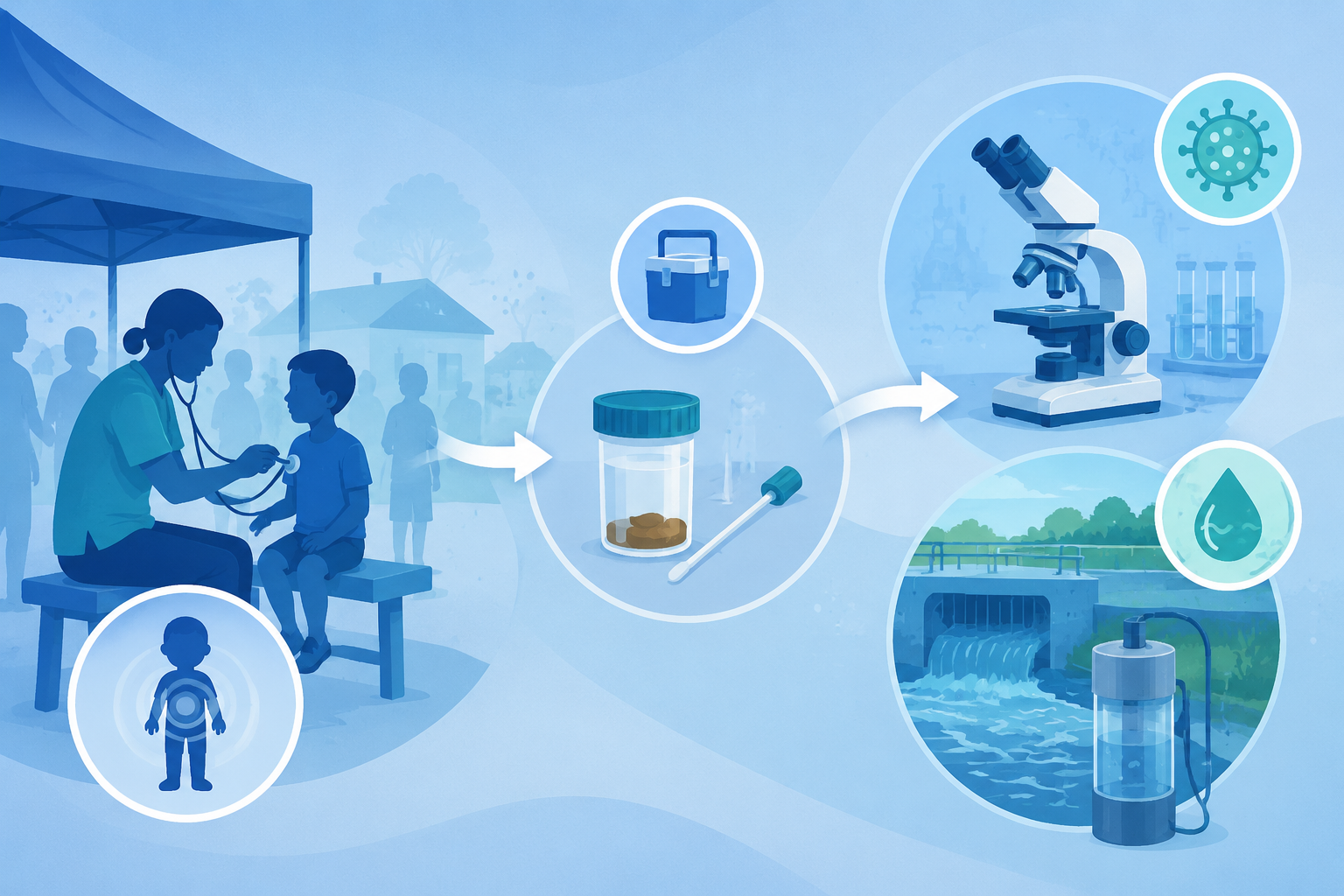
Surveillance is the pillar students most often under-explain. It is not a passive count of confirmed polio cases. Because most poliovirus infections do not present as obvious paralysis, eradication programs look for acute flaccid paralysis, investigate suspected cases, collect stool specimens, and test them through the laboratory network. The point is to detect poliovirus circulation even when confirmed paralytic cases are rare.
AFP surveillance has performance standards because a country can report “no polio” for two very different reasons: there is no poliovirus, or the system is missing cases. Two benchmarks matter especially. First, at least 80% of AFP cases should have adequate stool specimens collected. Second, the system should detect at least two non-polio AFP cases per 100,000 children under 15 years of age, which shows that the surveillance net is sensitive enough to catch the background rate of paralysis-like illness.[7]
The distinction is not academic. In 2023, only 20 of 28 priority countries met the national AFP surveillance target, according to CDC reporting.[7] That does not mean the other eight countries had polio transmission. It means their surveillance performance was not strong enough to give the same level of confidence. In an eradication program, “not detected” and “not present” must be kept separate until the surveillance indicators support the stronger claim.
Environmental surveillance adds another layer. Sewage sampling can detect poliovirus shed in stool before, or without, a recognized paralytic case. The Global Polio Laboratory Network includes 144 laboratories supporting this detection and confirmation system.[7] That lab network turns local samples into program decisions: whether a virus is wild or vaccine-derived, where it is genetically linked, and whether response campaigns need to widen.
| Surveillance component | Operational question it answers |
|---|---|
| AFP case detection | Are children with sudden flaccid paralysis being found and reported? |
| Adequate stool collection | Are specimens collected well enough and fast enough to test suspected cases? |
| Non-polio AFP rate | Is the system sensitive enough to detect expected background paralysis-like illness? |
| Environmental surveillance | Is poliovirus circulating silently in sewage even without a recognized case? |
| Laboratory sequencing and confirmation | Is the virus wild, vaccine-derived, imported, or linked to a known chain of transmission? |
Outbreak Response Connects Detection Back To Immunization
Outbreak response is the rapid-action pillar. Once poliovirus is detected through AFP surveillance or environmental sampling, programs use standardized operating procedures, supplementary immunization activities, and mop-up campaigns to raise immunity around the affected area. The basic sequence is simple: detect virus, classify it, define the response zone, choose the appropriate vaccine, vaccinate quickly, and keep watching for further spread.
This pillar depends heavily on the first two. If surveillance detects virus late, the response starts behind the outbreak. If vaccination teams cannot reach missed children, extra campaign rounds may still leave transmission pockets. A mop-up campaign is not a magic eraser; it is a time-sensitive attempt to close immunity gaps after the program has evidence that virus is moving.
- Detection: AFP reporting, stool testing, environmental sampling, and laboratory confirmation identify poliovirus.
- Classification: laboratories distinguish wild poliovirus from vaccine-derived poliovirus and link isolates genetically.
- Campaign planning: teams decide which vaccine to use, where to vaccinate, and how many rounds are needed.
- Implementation: supplementary immunization activities and mop-up campaigns try to reach children missed by routine services.
- Follow-up: surveillance checks whether the transmission chain has stopped or whether response needs to expand.
Why The Same Methods Do Not Finish Everywhere
The remaining wild poliovirus problem is concentrated in Afghanistan and Pakistan, but that should not be mistaken for a failure of basic eradication theory. The barriers are operational and political: conflict, vaccine refusal, zero-dose children, restrictions on access, and threats to the people doing the work. Published accounts have noted that more than 200 polio workers have been killed in Pakistan, and that Taliban restrictions affected house-to-house campaigns in southern Afghanistan.[8][5]
Those conditions damage all three pillars at once. Vaccination coverage becomes uneven because some children are missed repeatedly. Surveillance becomes less reliable because health workers cannot investigate every suspected case or collect specimens under ideal conditions. Outbreak response slows because rapid campaigns depend on access, local acceptance, and security. A map can show a district boundary, but transmission follows the actual routes of families, workers, conflict, displacement, and trust.
Zero-dose children are especially important because cVDPV risk is not evenly distributed across a country. It concentrates where immunity is low enough for vaccine-derived virus to circulate. A national coverage figure can look respectable while a local community remains vulnerable. For eradication, the missed cluster matters more than the average.
This is also why refusal cannot be handled as a footnote about attitudes. Refusal changes behavior at the door. It determines whether a vaccinator can put drops in a child’s mouth, whether a household will report illness, and whether a response campaign can close the gap after virus is detected. Insecurity does the same by force rather than choice. Either way, the method pillar exists on paper but fails at the point of contact.
The cVDPV Paradox, Stated Precisely
The most common bad explanation of cVDPV is to make it sound like an argument against vaccination. The more precise explanation is that cVDPV is a risk produced by live oral vaccine virus only when the virus is allowed to circulate in populations with insufficient immunity. High immunity stops both wild poliovirus and vaccine-derived poliovirus. Low immunity gives either one room to move.
That is why the 2026 split matters for a polio virus eradication methods study. The 87 reported cVDPV cases do not erase the reduction from 350,000 annual cases in 1988 to a small number of wild poliovirus cases in 2026.[1][2] They show that the endgame has a different risk profile than the expansion phase. When wild virus becomes rare, the program has to manage the residual risks of the very tools that helped make it rare.
In exam language, avoid the two easy mistakes. Do not write that OPV is simply dangerous; it has been indispensable for reducing transmission. Do not write that IPV alone solves the problem; it protects against paralysis without the same mucosal effect needed for community transmission control. The trade-off is the answer.
An Advanced Debate: Virus Eradication Or Disease Eradication?
A minority scholarly position argues that the global goal may need to shift from literal poliovirus eradication to disease eradication: preventing paralytic disease through permanent high population immunity, even if virus elimination remains elusive. Chumakov and colleagues made that argument in The Lancet Global Health in 2021.[9] This is not the GPEI consensus goal, but students may encounter it in advanced readings because it challenges the endpoint rather than the basic tools.
The debate is useful only after the method system is clear. If a student cannot explain OPV/IPV trade-offs, AFP surveillance thresholds, environmental monitoring, and response campaigns, then “disease versus virus eradication” becomes an abstract opinion rather than an applied public health question. The debate belongs late because it depends on understanding why the current endpoint is difficult.
What To Remember For Exam Purposes
Polio eradication is not stalled because the world lacks methods. It is stalled where vaccination, surveillance, and outbreak response cannot operate together with enough reach, trust, speed, and local adaptation. The same system that has reduced polio by more than 99.9% still has to function in the places least suited to neat implementation.
- Vaccination explains both the success and the risk: OPV helps block transmission, IPV avoids cVDPV risk, and nOPV2 reduces reversion risk but still depends on high coverage.
- Surveillance quality determines what the program can see: AFP reporting, adequate stool collection, non-polio AFP rates, sewage monitoring, and laboratory confirmation are measurable parts of the method.
- Outbreak response is the link back to action: detection must trigger fast supplementary immunization and mop-up campaigns.
- The last-mile problem is simultaneous failure under pressure: missed children, insecurity, refusal, restrictions, and worker danger weaken all three pillars at once.
References
- About Global Polio Eradication, CDC.
- Polio This Week, Global Polio Eradication Initiative.
- Polio eradication, Wikipedia.
- GPEI Strategy 2022–2026, Global Polio Eradication Initiative.
- Novel Oral Poliovirus Vaccine Type 2: A Review of Safety, Immunogenicity, and Effectiveness, Pathogens.
- Polio’s Last Stand: The Global Fight for Eradication, ASM, September 2024.
- Surveillance to Track Progress Toward Polio Eradication — Worldwide, 2022–2023, CDC MMWR.
- Polio eradication: the final challenge, Cell.
- Choosing the right path toward polio eradication, The Lancet Global Health, 2021.
Applies to
Exam applicability isn't specified for this technique yet. See all exam hubs.
Comments
Join the discussion with an anonymous comment.