
Method
Build Vocabulary With NYT Strands 'Big Talk' in 10 Minutes
Learn how a single daily NYT Strands puzzle can become a 10-minute vocabulary-building exercise, using the 'Big Talk' puzzle as a concrete example.
Evidence panel
- Evidence level
- pending review
- Primary citation
- citation pending review
The useful thing about the July 19, 2026 NYT Strands puzzle is not that it gave students another set of “Big Talk” hints to search for. It is that, once solved, it handed over a tidy little vocabulary cluster: the spangram SUPERSIZEIT, plus GIANT, BEHEMOTH, LEVIATHAN, MAMMOTH, and COLOSSUS as the theme words for Strands #868.[1]
That is a better starting point than a random word list. All five words live near “huge,” but they do not do the same job in a sentence. GIANT can be plain or fairy-tale. BEHEMOTH feels heavy, institutional, or monstrous. LEVIATHAN brings oceanic, biblical, or state-power weight. MAMMOTH often sounds prehistoric, logistical, or effortful. COLOSSUS suggests scale with public grandeur, sometimes a statue, sometimes a person or organization that seems to tower over others.

Strands is especially good for this kind of miniature lesson because the puzzle already makes the brain do some sorting. The daily game is played on a 6-by-8 grid, and every letter is used exactly once.[2] Instead of recognizing a word on a flashcard and moving on, the solver has to hunt for letter paths, test possible answers, reject look-alikes, and eventually notice the theme binding the board together.
The solve is the warm-up. The vocabulary gain happens in the few minutes after it.
A 5-Minute Post-Solve Routine
After a puzzle like “Big Talk,” do not immediately close the tab. Keep the solved answer set visible and spend five more minutes turning recognition into usable language.
| Time | Action | What You Produce |
|---|---|---|
| 2 minutes | Look up each theme word’s definition and origin | A quick note on meaning, register, and source |
| 2 minutes | Write one original sentence for each word | Five sentences that do not use the words interchangeably |
| 1 minute | Add the words to a theme-organized vocabulary journal | One cluster labeled with the puzzle theme or date |
| Optional | Save weekly theme sets as flashcards | Review cards grouped by meaning, not alphabet |
The point is not to become an etymologist before breakfast. The point is to slow each word down long enough that it leaves a trace: what it means now, where its flavor comes from, and where it would sound natural.
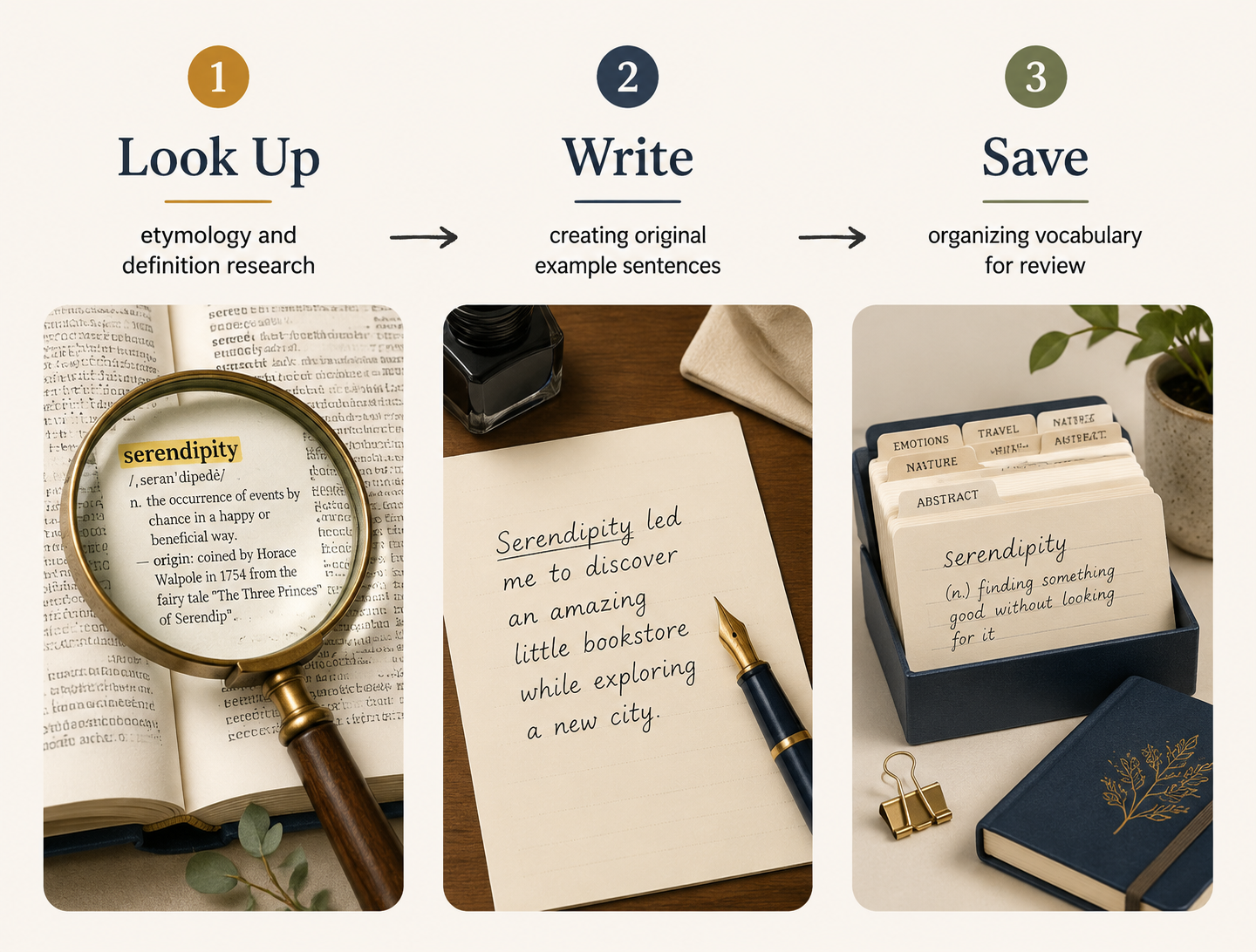
Work the “Big Talk” Words Until They Stop Meaning Only “Big”
Start with GIANT, the most flexible word in the set. Merriam-Webster traces it through Greek gigas, Latin gigant-, and Anglo-French geant, with English use beginning in the 13th century.[3] That origin is useful mostly because it explains why the word can still carry a mythic shadow, even when the sentence is ordinary.
A weak study sentence would be: “The building was giant.” It proves recognition, but little else. A stronger sentence gives the word a job: “The company behaved like a giant in the market, able to lower prices until smaller rivals disappeared.” Now GIANT is not just about physical size; it is about dominance.
BEHEMOTH needs a different sentence. Merriam-Webster traces it to Hebrew bəhēmōth and the biblical beast in Job 40, with first English use in the 14th century.[4] That background helps explain why the word often feels heavier than GIANT. A behemoth is not merely large; it can be lumbering, hard to move, and almost too massive to manage.
Try: “The new scheduling system became a behemoth, requiring three approvals before a student could change one lab section.” The sentence does not need ancient creatures or dramatic thunder. It uses the word’s weight to describe bureaucracy.
LEVIATHAN is close to BEHEMOTH but not identical. Merriam-Webster traces it to Hebrew liwyāthān, a biblical sea serpent, and notes that Herman Melville used the word more than 100 times in Moby-Dick.[5] That matters because LEVIATHAN often feels vast, powerful, and difficult to grasp all at once. It can describe a sea creature, a ship, a state, a corporation, or any system whose scale makes an individual feel small.
A useful sentence might be: “In the novel, the city government appears as a leviathan, swallowing complaints into departments no one can fully map.” That sentence would sound odd with MAMMOTH and too ornate with GIANT. Good: the distinction is starting to hold.
MAMMOTH brings another texture. Merriam-Webster traces it to Russian mamont, probably from Mansi mān-oŋt, meaning “earth horn,” in reference to tusks dug from the ground.[6] In modern use, MAMMOTH can still point to the extinct animal, but students will often meet it in phrases such as “a mammoth task,” “a mammoth project,” or “a mammoth amount of evidence.”
That makes the sentence test simple: “The debate team faced a mammoth research task before the regional tournament.” Here MAMMOTH does not mean elegant, divine, or monstrous. It means enormous in workload.
COLOSSUS should not be flattened into “very large statue word.” Merriam-Webster traces it to Greek kolossos, “gigantic statue,” and notes the Colossus of Rhodes, a statue more than 100 feet tall built around 280 BC; the word entered English before the 12th century.[7] In current use, COLOSSUS often gives scale a public, impressive, almost monumental quality.
A sentence that preserves that feeling: “By senior year, the quiet robotics club had become a colossus at the science fair, drawing a crowd before the judges even arrived.” COLOSSUS sounds more theatrical than “large club,” and that is the point. It lets the writer choose posture, not just size.
The Notebook Entry Can Stay Small
A student does not need a decorated journal or a complicated template. One compact entry is enough:
| Word | Quick Distinction | Original Use |
|---|---|---|
| GIANT | Large, powerful, often dominant | The startup feared being copied by a giant with a larger legal team. |
| BEHEMOTH | Huge, heavy, difficult to manage | The registration portal became a behemoth after every department added its own form. |
| LEVIATHAN | Vast power or creature, often hard to comprehend | The agency felt like a leviathan to families trying to appeal one decision. |
| MAMMOTH | Enormous in size, task, or amount | The class faced a mammoth reading load before finals. |
| COLOSSUS | Monumental, towering, publicly impressive | The championship team returned as a colossus on campus. |
If you have only one extra minute, write the sentence column. Definitions are easy to look up again. A sentence forces the word to survive outside the puzzle.
Why the Puzzle Helps Before the Studying Even Starts
Word games can support vocabulary learning for reasons that are more precise than “games are fun.” A 2025 WordELA discussion identifies active recall, spaced repetition, emotional engagement, and multisensory stimulation as mechanisms that can strengthen retention compared with passive review.[8] That does not prove that every student who plays Strands will automatically build vocabulary. It does explain why the mechanics are promising when paired with a brief production task.
The first mechanism is active recall. In Strands, the answer is not presented cleanly on a card. The solver has to retrieve possibilities from partial patterns: a B near an E, a run of letters that might become BEHEMOTH, a theme clue that nudges the mind toward size. Even a wrong guess can narrow the search space.
The second mechanism is semantic clustering. “Big Talk” gives five words that share a neighborhood but keep different addresses. That clustering is why the post-solve routine works better than copying five unrelated dictionary words. The student is not memorizing isolated labels; the student is building a small map of near-synonyms and learning where the borders blur.
The third mechanism is scaffolding. Hints in a word game should not be treated as shameful shortcuts. Used well, they are retrieval supports: enough information to restart the search, not so much that the brain merely receives the answer. That matters for students who are tired, busy, or playing between other obligations. A scaffold keeps effort productive.
The daily cadence adds one more advantage. Because Strands appears as a daily puzzle, it naturally invites spaced practice rather than a single long vocabulary session.[2] The review can be modest: at the end of the week, skim the clusters you saved and choose two words to reuse in a class discussion post, essay draft, or practice paragraph.
Students who want a broader look at the learning science behind visual and playful study tools can also compare this routine with the principles in Do Visual Learning Apps Actually Work? What the Science Says and How to Choose Wisely. The important overlap is not the app category. It is the move from passive exposure to active, meaningful use.
Use the Date, Then Let the Method Travel
“Big Talk” is an unusually clean example because its theme words form such a tight cluster. Not every Strands board will be this convenient. Some will give pop culture references, objects, foods, verbs, or phrases that are less useful for academic vocabulary.
That is fine. The routine adjusts:
- If the theme words are unfamiliar, define them and write sentences.
- If the words are familiar but close in meaning, write distinctions.
- If the theme is cultural or historical, note only the context needed to use the word accurately.
- If the puzzle is mostly easy, choose the one word you would not naturally use in your own writing.
The guardrail is simple: do not let lookup become collecting. For BEHEMOTH and LEVIATHAN, the biblical origins are memorable, but the student’s final task is still modern usage. Could you use BEHEMOTH to describe a badly designed campus system? Could you use LEVIATHAN to describe a vast institution in a history essay? If yes, the origin has done its job.
The Less-Than-10-Minute Version
For a school day, keep the full routine short enough that you will actually do it:
- Solve the daily Strands puzzle, using hints if needed.
- Circle or copy the theme words after the spangram reveals the organizing idea.
- Look up definitions and origins only far enough to understand tone and usage.
- Write one fresh sentence for each useful word.
- Save the cluster under the date or theme for a quick weekly review.
For Strands #868, that means SUPERSIZEIT becomes more than a satisfying spangram. It becomes the label on a small vocabulary set: GIANT for dominance, BEHEMOTH for unwieldy mass, LEVIATHAN for vast power, MAMMOTH for enormous effort or amount, and COLOSSUS for monumental presence. The puzzle gives the cluster. The five minutes after the puzzle make it yours.
References
- NYT Strands Hints, Answers and Help for July 19, #868, CNET, July 19, 2026.
- Strands, The New York Times Games.
- Giant Definition & Meaning, Merriam-Webster.
- Behemoth Definition & Meaning, Merriam-Webster.
- Leviathan Definition & Meaning, Merriam-Webster.
- Mammoth Definition & Meaning, Merriam-Webster.
- Colossus Definition & Meaning, Merriam-Webster.
- Word Games and Vocabulary Learning, WordELA, 2025.
Applies to
Exam applicability isn't specified for this technique yet. See all exam hubs.
Comments
Join the discussion with an anonymous comment.