
Method
Best Places to See the Northern Lights for Students in 2026
This article ranks northern lights destinations by affordability and aurora probability, giving US-based college students a data-backed comparison to pick the best option within a $500–$1,500 budget.
Evidence panel
- Evidence level
- Moderate
- Primary citation
- Space.com, Northern lights 2026: Where and when to see the aurora
If your northern lights budget is closer to $700–$1,200 than “once-in-a-lifetime luxury,” the best places to see northern lights for student travel in 2026 are not the places with the prettiest brochure photos. They are the places where the math survives airfare, dorm beds, winter logistics, and the number of nights you can realistically stay.
As of July 23, 2026, the practical verdict is simple: choose Fairbanks if you are US-based and cannot make a transatlantic flight work; choose Abisko if you can reach northern Europe and want the strongest cost-to-probability play; choose Tromsø if you want the best student-city infrastructure with a credible three-night aurora chance.
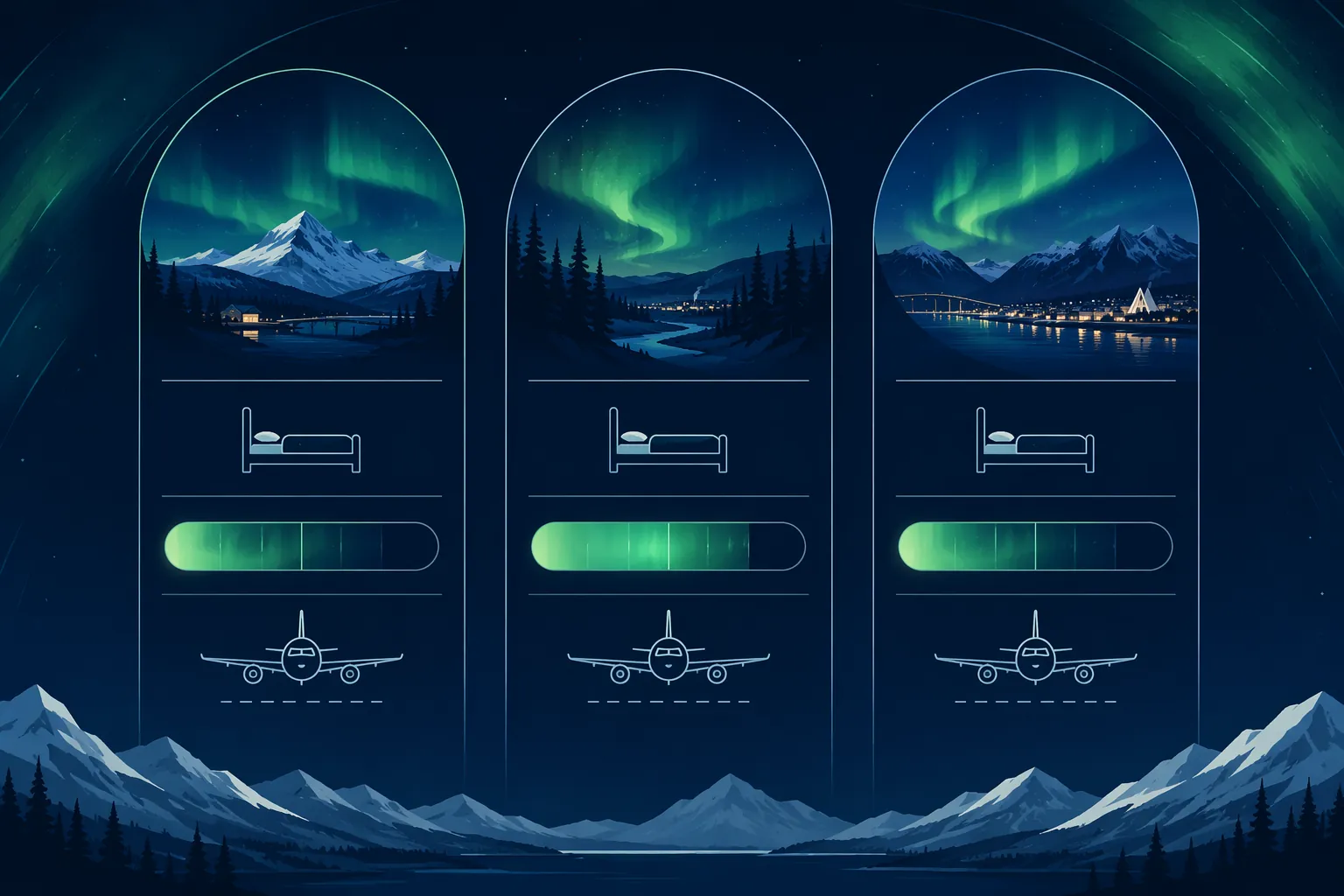
The 2026 Aurora Window Is Good, But It Does Not Replace Planning
The solar-cycle evidence is encouraging, with one important caveat. Space.com describes the Solar Cycle 25 peak as occurring in 2024–2025 while still treating 2026 as a strong viewing year because the declining phase can produce powerful geomagnetic storms.[1] Aurora Expeditions frames 2026 as part of a peak-period opportunity for northern lights travel.[2] Those are compatible enough for planning, but they are not a guarantee that one cheap night outside a city will deliver the sky you came for.
That is why the ranking below gives weight to a three-night stay. A destination that looks cheap for one night can become unrealistic if the affordable version requires five nights, a rental car, paid tours, or winter gear you do not own.
Student Ranking: Cost, Probability, and Logistics Together
| Rank | Destination | Best for | Budget evidence | Aurora evidence | Student logistics judgment |
|---|---|---|---|---|---|
| 1 | Abisko, Sweden | Students who can reach Europe cheaply | Hostel dorm beds from about $30/night; local supermarket examples include beer around $1.01 and tortellini around $2.10.[3][4] | Reported 80–90% chance over three nights, helped by the local “blue hole” microclimate.[1][4] | Best cost-probability ratio, but US airfare can break the budget. |
| 2 | Fairbanks, Alaska | US-based students avoiding transatlantic flights | Budget estimate around $130–$220/day.[4] | Aurora visible on more than 80% of clear nights; some three-night packages advertise 98% sighting rates.[5] | Most realistic high-probability option from the US, especially with Seattle or Anchorage flight access. |
| 3 | Tromsø, Norway | Students who want infrastructure and nightlife with aurora access | Dorm beds from about $29/night; budget flights from London have been cited under $100 return via Wizz Air.[3][6] | Reported 85%+ probability over three nights.[6] | Strongest student-city setup, but tours and Norway food costs need discipline. |
| 4 | Kemi, Finland | Accommodation-price hunters | Median vacation-rental cost listed at $101.97/night in HomeToGo’s 2025 Affordable Aurora Report coverage.[7] | Aurora destination, but the provided evidence is stronger on lodging cost than student logistics. | Useful price anchor, not the cleanest student pick without a transport plan. |
| 5 | Iceland by campervan | Groups splitting costs | One documented shoestring trip reported about €250/person, or roughly $300, with a €160 five-day campervan rental and €50 Wizz Air flights.[8] | Good aurora country, but this case proves group-split economics, not that Iceland is generally cheap. | Can work for experienced groups; risky for solo students without winter-driving confidence. |
| 6 | Svalbard, cruises, package-heavy Arctic trips | Students paying for guidance, safety, or a special trip | No low-cost student benchmark in the provided evidence. | Potentially excellent Arctic experiences, but not supported here as $500–$1,500 student defaults. | Treat as upgrade choices, not budget recommendations. |
Abisko: Best Value If You Can Get to Europe
Abisko is the rare aurora destination where the cheap version and the high-probability version are not obviously different trips. The reason it keeps rising to the top is the combination: dorm beds from about $30/night, unusually favorable clear-sky claims, and a three-night aurora probability commonly reported around 80–90% because of the area’s “blue hole” microclimate.[1][3][4]
For a student budget, that matters more than a spectacular but expensive one-night tour somewhere else. If lodging is $30-ish per night, three nights does not automatically destroy the trip. It also leaves room for boring costs that travel articles tend to hide: groceries, local transport, luggage, winter layers, and the extra hostel night caused by train or flight timing.
The catch is not Abisko itself. The catch is getting there. A US student still has to price the international flight and the final leg into northern Sweden. If that airfare pushes the trip above your ceiling, Abisko’s dorm-bed math stops helping. For students already studying in Europe, or those who can use a cheap transatlantic fare plus rail or regional flights, it becomes the cleanest value pick in the comparison.
Fairbanks: The US-Based Default
Fairbanks is not cheap in the way a hostel town is cheap. It earns its place because it solves the US-access problem honestly. AFAR notes direct access from Seattle and Anchorage, and the aurora is described as visible on more than 80% of clear nights.[5] For a student starting in the US, avoiding a transatlantic flight can matter more than shaving $20 off a dorm bed.
The working budget is still serious: one budget estimate places Fairbanks around $130–$220 per day.[4] That number should make you pause before calling Alaska “affordable.” A three-night trip can fit a $700–$1,200 savings target if flights cooperate and you keep the itinerary plain. It can also break that target quickly if you add rental cars, repeated guided tours, or last-minute lodging.
Fairbanks is the right answer when the alternative is a Europe plan that only looks cheap after airfare disappears from the spreadsheet. It is also better for students who want US payment systems, domestic phone plans, no passport dependency, and less administrative friction. None of that makes Alaska low-cost; it makes it the most realistic high-probability option for many US-based students.
Tromsø: The Balanced Student-City Option
Tromsø is the option for students who want more infrastructure around the trip: hostels, transit, other young travelers, cafés, supermarkets, and a real city to retreat to when the weather is rude. Sources describe it as a student city, with dorm beds from about $29/night and cited budget flight access from London under $100 return via Wizz Air.[3][6]
Its aurora case is also strong enough to treat seriously. FrogMom cites an 85%+ probability over three nights.[6] That is the right unit for student planning: not “can the lights appear here,” but “does a short trip have a defensible chance without adding three more nights I cannot pay for?”
Tromsø’s weakness is that Norway can punish casual spending. A cheap dorm bed does not automatically mean a cheap trip if every meal, tour, and airport transfer is bought impulsively. For students already in Europe, especially those who can reach London or another low-cost flight hub, Tromsø may be the most comfortable compromise. For US students, it needs a very good flight deal to beat Fairbanks or Abisko on total cost.
Budget Tiers: Pick the Destination Your Spreadsheet Can Survive
| Total student budget | Most realistic choice | Why |
|---|---|---|
| $500–$800 | Only works with a major flight advantage, a nearby departure point, or a group split | This tier is tight for any Arctic trip once flights, lodging, food, and gear are counted. Iceland campervan math has been documented around $300/person, but only in a specific group-split case.[8] |
| $800–$1,200 | Fairbanks from the US, Abisko or Tromsø from Europe | This is the serious student-planning tier: three nights, basic lodging, grocery discipline, and no assumption that tours are unlimited. |
| $1,200–$1,500 | Abisko, Fairbanks, Tromsø, or an all-in Lapland package | This range can absorb more logistics. A Yes-Trips six-day Lapland tour lists €797, about $870, including accommodation, dog sledding, guided aurora hunting, and winter gear.[9] |
The Yes-Trips Lapland tour is useful as a benchmark, not because every student should book it. At €797, or about $870, for six days with accommodation, dog sledding, guided aurora hunting, and winter gear, it shows what an all-in student-oriented package can include.[9] If your independent plan costs almost the same but still requires you to rent gear, arrange transport, and guess where to stand at night, the package deserves a real comparison.
The Iceland campervan example belongs in a different box. Offbeat Escapades documents a northern-lights trip at about €250/person, or roughly $300, using a €160 five-day campervan rental, €50 Wizz Air flights, and self-catering.[8] That is impressive, but it is not proof that Iceland is generally cheap. It is proof that a group with the right flight, the right rental split, and enough confidence to self-manage winter travel can bend the cost curve.
Where Kemi Fits
Kemi, Finland deserves attention because accommodation data gives it a real price signal. HomeToGo’s 2025 Affordable Aurora Report coverage placed Kemi’s median vacation-rental cost at $101.97/night, making it the cheapest aurora destination in that accommodation comparison.[7]
That is valuable if you are comparing apartments, splitting with friends, or trying to avoid the most expensive Arctic towns. It is not enough, by itself, to outrank Abisko, Fairbanks, or Tromsø for a student. The missing questions are the ones that decide the actual trip: how expensive is the final transport leg, how many nights can you afford, do you need paid activities to make the trip work, and how much aurora probability are you buying for the total cost?
When the Recommendation Changes
- If you do not have a passport or cannot risk international flight volatility, Fairbanks moves up.
- If you are already in Europe for study abroad, Abisko and Tromsø become much stronger than Alaska.
- If you need included winter gear, guided transport, or a safety net, compare package prices against your independent plan instead of assuming DIY is cheaper.
- If you are traveling solo, be careful with Iceland campervan math; the strongest low-cost case depends on splitting costs.
- If you only have one or two nights, do not overread three-night probability claims. The evidence is usually describing a short stay, not a single evening.
Some students should pay more. That is not a failure of budgeting. A guided aurora chase, included gear, safer transport, or a centrally located hostel can be the correct decision if the cheaper version leaves you stranded, underdressed, or dependent on winter driving you are not prepared to do.
The Practical Selection Rule
Start with your departure point, not the destination photo. If you are US-based and cannot find a cheap Europe fare, price Fairbanks first. If you can reach northern Europe affordably, price Abisko first. If you want the easiest student infrastructure and can reach Norway cheaply, price Tromsø first.
Then force every option through the same test: three nights of lodging, round-trip transport to the destination, food, airport or train transfers, winter clothing or rentals, and one realistic aurora-viewing plan. If the destination only looks affordable before those lines are filled in, it is not your best student option.
Prices, flight routes, exchange rates, and student discounts move fast. Treat 2025 pricing data as a strong benchmark, not a guaranteed 2026 fare, and recheck the full trip cost before booking.
References
- Northern lights 2026: Where and when to see the aurora, Space.com, https://www.space.com/northern-lights-2026-where-when
- Northern Lights Predictions, Aurora Expeditions, https://www.aurora-expeditions.com/blog/northern-lights-predictions
- Cheapest Places to See the Northern Lights, Holiday Expert, https://holidayexpert.com/cheapest-places-to-see-the-northern-lights/
- Best Places to See Northern Lights, MonkeyTravel, https://monkeytravel.app/blog/best-places-to-see-northern-lights
- The World’s Best Places to See the Northern Lights, AFAR, https://www.afar.com/magazine/the-worlds-best-places-to-see-the-northern-lights
- Places to See Northern Lights Norway, FrogMom, https://frogmom.com/places-to-see-northern-lights-norway/
- The Most Affordable Destinations in North America for Northern Lights, Travel + Leisure, https://www.travelandleisure.com/the-most-affordable-destinations-in-north-america-for-northern-lights-8789271
- Northern Lights on a Shoestring Budget, Offbeat Escapades, https://offbeatescapades.com/northern-lights-on-a-shoestring-budget/
- Northern Lights Tour, Yes-Trips, https://yes-trips.com/trip/northern-lights-tour
Applies to
Exam applicability isn't specified for this technique yet. See all exam hubs.
Comments
Join the discussion with an anonymous comment.