
Method
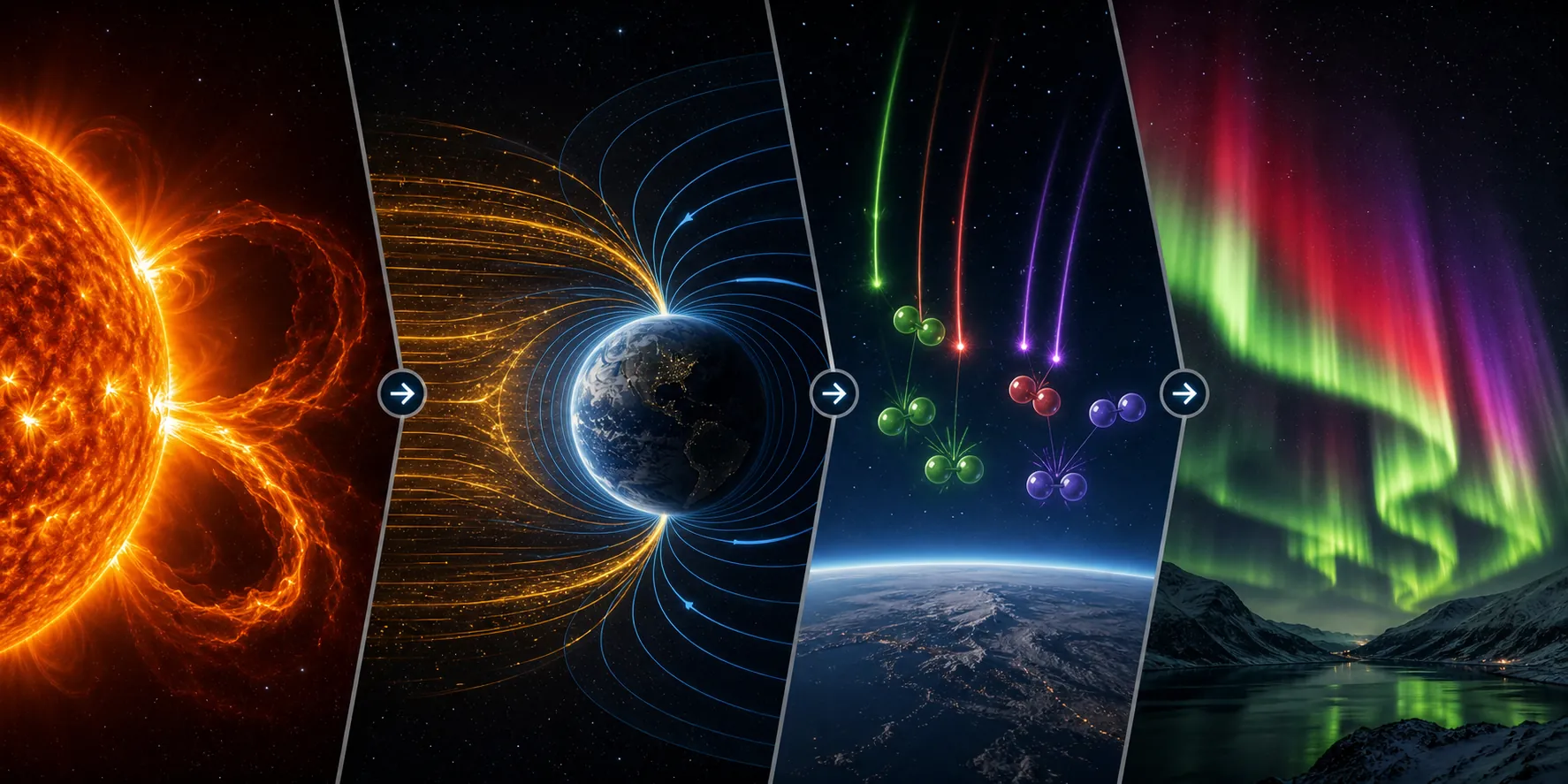
Learn How Northern Lights Form with a 4-Step Memory Chain
Memorize how the northern lights form in four steps using a Source → Transport → Interaction → Emission chain, then apply the same framework to other science processes tested on exams like the SAT and MCAT.
Evidence panel
- Evidence level
- Moderate
- Primary citation
- Dunlosky et al. (2013) Improving Students' Learning With Effective Learning Techniques
You need to explain how northern lights form, and you need to keep the order straight when the test question is staring back at you. Start with the whole chain before you memorize any color names:
| Step | Question to Ask | Aurora Answer |
|---|---|---|
| Source | Where does the energy or material begin? | The Sun releases charged particles, especially during solar activity such as coronal mass ejections. |
| Transport | How does it travel or get directed? | Solar wind carries particles through space, and Earth's magnetic field steers many of them toward the polar regions. |
| Interaction | What does it hit or change? | Energetic particles collide with oxygen and nitrogen high in Earth's atmosphere. |
| Emission | What comes out that we can detect? | Excited atoms and molecules release photons, producing green, red, blue, or purple aurora light. |
That Source → Transport → Interaction → Emission chain is an instructional scaffold, not an official aurora-science taxonomy. Its job is to give your memory handles for a causal sequence. The handles are useful only if you can explain what moves, what collides, and what light is released.
Last reviewed July 2026: auroras are also timely because Solar Cycle 25 reached its official maximum in 2024–2025, and elevated aurora activity may continue into 2027–2028 as solar activity evolves after maximum; yearly visibility forecasts can still shift with space-weather conditions.[1]
The Four Links, Explained Without Losing the Order
For an exam answer, the most common failure is not forgetting the word aurora. It is mixing up the sequence: students jump from “the Sun” straight to “green sky” and skip the transport and collision steps. Build the answer one link at a time.
1. Source: the Sun supplies the charged particles
The source is the Sun, especially its outer atmosphere and solar activity that releases streams of charged particles. NOAA describes auroras as connected to the solar wind and to disturbances that send energetic particles toward Earth; coronal mass ejections can intensify the process when they arrive near Earth.[2]
The memory picture should be active: not “the Sun causes lights,” but “the Sun sends charged particles outward.” That wording protects the next step, because particles have to travel before they can make anything glow.
2. Transport: solar wind moves the particles, and Earth's magnetic field redirects them
The particles do not fall straight down like rain. They travel through space in the solar wind, which NOAA describes as moving at roughly 400 kilometers per second under typical conditions.[2] When this stream reaches Earth's magnetic environment, the magnetic field shapes where many charged particles can go.
That is why northern lights are associated with polar regions. Earth's magnetic field guides charged particles toward areas near the magnetic poles, where they can enter the upper atmosphere more easily than they would at lower latitudes.[2]
3. Interaction: particles collide with oxygen and nitrogen high above the ground
Now the answer becomes chemistry and physics instead of just space weather. The incoming energetic particles collide with gases in Earth's upper atmosphere, especially oxygen and nitrogen. Those collisions transfer energy to atoms and molecules, pushing electrons into excited states.[2]
For recall, keep the verb precise: collide. If you write “the particles mix with the atmosphere,” the explanation gets mushy. The tested idea is that energy is transferred during collisions, and that energy changes the state of atmospheric particles.
4. Emission: excited atoms and molecules release photons
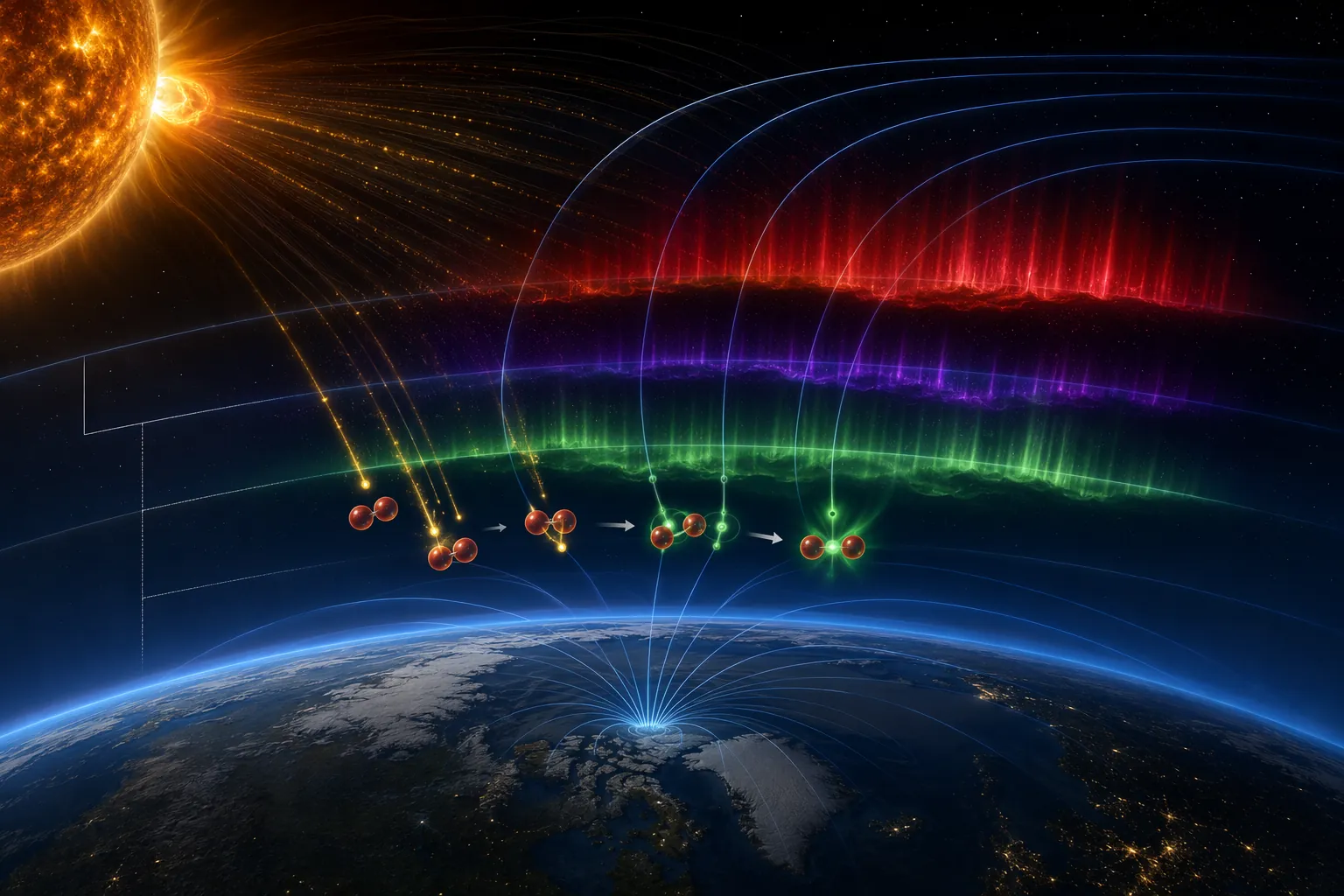
Excited particles do not stay excited forever. When electrons drop back to lower-energy states, energy leaves as photons. Those photons are the light you see as an aurora. NASA's student explanation uses the same core idea: charged particles from the Sun interact with gases in Earth's atmosphere, and those gases give off light.[3]
The colors are not random decoration. Green auroras are strongly associated with oxygen emission at 557.7 nanometers, while red auroras are associated with oxygen emission at 630 nanometers; nitrogen interactions can contribute blue and purple colors.[4] If your teacher expects color detail, attach it to the Emission step, not to the Source step.
Altitude can help the color facts stick. NOAA notes that the bright green oxygen emission is common around roughly 100 kilometers, while red oxygen emissions occur higher up, often above about 300 kilometers where oxygen is more rarefied.[2] Historical triangulation work by Carl Størmer placed most auroras above about 70 kilometers, with many near 100 kilometers.[5]
What to Memorize First, Second, and Only If Needed
Do not start with every aurora fact you can find. Start with the causal spine, then layer details only when they attach to the right link.
| Priority | Memorize This | Why It Matters |
|---|---|---|
| First | Source → Transport → Interaction → Emission | It protects the order of the explanation. |
| Second | Sun particles → magnetic-field steering → oxygen/nitrogen collisions → photons | It turns labels into science. |
| Third | Green oxygen 557.7 nm, red oxygen 630 nm, blue/purple nitrogen | It adds precision for color questions. |
| Optional | Glow, patches, arcs, rays, coronas | It helps describe visible forms, but it is not the main formation mechanism. |
The five visible forms—glow, patches, arcs, rays, and coronas—are useful as a second-layer vocabulary set, not as the main explanation of how northern lights form.[5] A student who can list five shapes but cannot explain oxygen releasing photons has memorized the wrong layer first.
Why the Mnemonic Helps, and Where It Stops Helping
There is evidence for using memory supports, but the evidence is not equal for every technique. Dunlosky and colleagues rated keyword mnemonics as moderate utility, imagery for text as limited utility, self-explanation as moderate utility, and practice testing as high utility.[6]
That matters because Source → Transport → Interaction → Emission is partly a keyword mnemonic. It gives you four labels. Labels lower the panic level, but they do not prove understanding. The stronger study move is to use the labels as prompts for practice testing: cover one part, retrieve the next part, then explain why the next part follows.
The UNC Learning Center's memory guidance emphasizes understanding first and then linking new material to what you already know.[7] A causal chain does that well when you use it honestly: you connect an unfamiliar sky event to a familiar question pattern—where did it start, how did it move, what did it hit, what was produced?
Practice the Chain the Way a Test Will Break It
Reading the chain once is recognition. Exams usually demand retrieval. Use the aurora example as a short drill, not as a paragraph to admire.
- Forward retrieval: write Source, then cover the notes and produce Transport, Interaction, and Emission from memory.
- One-link cover: hide only one box in the table and fill it in. This catches the common weak link instead of letting the memorized parts carry you.
- Reverse retrieval: start with green light and work backward to photons, oxygen, collisions, magnetic steering, solar wind, and the Sun.
- Why-link check: after each arrow, say the cause out loud. Solar wind matters because it transports charged particles. Collisions matter because they excite atmospheric gases.
- Transfer drill: remove the aurora words and apply the same four labels to a different science process.
A clean self-test might look like this: “Explain how northern lights form using Source, Transport, Interaction, and Emission. Include the role of Earth's magnetic field and name one gas involved.” If your answer says only “solar particles make colorful lights,” you have the first and last links but not the mechanism.
A stronger answer would be: “The Sun releases charged particles. Solar wind carries them toward Earth, and Earth's magnetic field guides many toward polar regions. There, energetic particles collide with oxygen and nitrogen in the upper atmosphere. The excited atoms and molecules release photons, producing aurora colors such as green oxygen light.”
Use the Same Four Questions on Other Science Processes
This is where the method earns its space in an exam notebook. The aurora is the worked example, but the four questions can help with many multi-step science explanations in SAT, ACT, MCAT, or GRE-style study. That does not mean those exams officially endorse this framework. It means the framework gives you a repeatable way to organize causal passages and science content.
| Topic | Source | Transport | Interaction | Emission or Product |
|---|---|---|---|---|
| Northern lights | Solar particles | Solar wind and Earth's magnetic field | Collisions with oxygen and nitrogen | Photons: green, red, blue, or purple aurora light |
| Photosynthesis, simplified | Sunlight | Light reaches chloroplasts | Pigments and reaction systems use absorbed energy | Stored chemical energy in sugars |
| Greenhouse effect, simplified | Sunlight warming Earth | Earth emits infrared radiation | Greenhouse gases absorb and re-emit infrared energy | Heat retained in the lower atmosphere |
Those two transfer examples are deliberately brief. Photosynthesis and the greenhouse effect each deserve their own detailed chain when you study them. The point here is the exam habit: do not memorize a paragraph as a blob when it can be rebuilt as a sequence of causes.
For passage-based exams, the chain also gives you a way to annotate without underlining everything. Mark the source of energy or material, the path it takes, the interaction that changes something, and the measurable product. Then test yourself from the markings rather than rereading the whole passage.
A Fast Notebook Version
If you are compressing this into a half-page of notes, write it like this:
Northern lights formation

Source: Sun releases charged particles.
Transport: Solar wind carries them; Earth's magnetic field guides many toward polar regions.
Interaction: Particles collide with oxygen and nitrogen high in the atmosphere, exciting electrons.
Emission: Electrons drop back down and release photons.
Color layer: oxygen = green 557.7 nm and red 630 nm; nitrogen = blue/purple.
Then close the notebook and rebuild it. If you cannot rebuild the arrows, the mnemonic has not done its job yet.
Where to Take It Next
For SAT and ACT science practice, use the chain on passage explanations: identify the starting input, the movement or transfer, the interaction, and the result. For MCAT study, make the same move with cell signaling, metabolism, light absorption, membrane transport, and reaction pathways. For GRE science passages, use it as a reading scaffold when a dense paragraph describes a mechanism.
The practical boundary is simple: Source → Transport → Interaction → Emission is a portable scaffold, not the learning by itself. Use it to quiz causal links, reverse the sequence, and transfer the pattern to the next process in your StudyMethod SAT, ACT, MCAT, or GRE study plan.
References
- Northern lights (aurora borealis) — What they are and how to see them — Space.com
- Aurora Tutorial — NOAA / NWS Space Weather Prediction Center
- What Is an Aurora? — NASA Space Place
- Aurora colors: What causes them and why do they vary? — Space.com
- Aurora — Wikipedia
- Strengthening the Student Toolbox — American Federation of Teachers, 2013
- Memorization Strategies — UNC Learning Center
Comments
Join the discussion with an anonymous comment.