
Method
Master Historical Analysis for GRE with the Clipper Endeavor Crash
This article teaches a six-step historical analysis method using the 1952 Pan Am Clipper Endeavor crash—whose wreckage was discovered in July 2026—so GRE Analytical Writing test-takers can build a transferable framework for evaluating evidence, reconciling sources, and crafting persuasive arguments.
Evidence panel
- Evidence level
- High
- Primary citation
- UTA Pressbooks - What is Historical Analysis?
Last reviewed: July 22, 2026. The wreckage of Pan Am’s Clipper Endeavor was reported found on July 21, 2026, with underwater photographs showing identifiable Pan Am markings still visible on the aircraft debris field near Puerto Rico.[1] Because this is a breaking discovery, some details may be refined as investigators, historians, and the search team release fuller documentation. For a GRE writer, that uncertainty is not an inconvenience. It is the lesson.
A useful study of the Pan Am Clipper Endeavor crash should not stop at the dramatic fact that a long-lost aircraft has been located. The stronger question is what the new evidence can and cannot do. Photographs of a wreckage field can confirm location, physical identity, distribution of debris, and preservation. They do not, by themselves, settle every dispute about passenger behavior, crew procedure, language barriers, panic, or institutional responsibility. That distinction is exactly the kind of distinction GRE Analytical Writing rewards: evidence matters most when the writer explains its range.
The method used here is the ordinary discipline of historical analysis: test sources, weigh eyewitnesses, reconcile contradiction, separate causes, construct a narrative, and defend the best explanation. Standard accounts of historical method trace those moves through source criticism, credibility tests, and explanation-building; UTA’s historical analysis chapter frames the work less as collecting facts than as asking how evidence supports a claim.[2][3] The Clipper Endeavor case is unusually useful because the same event gives you official investigation material, rescue records, survivor testimony, corporate memory, archival rediscovery, and now underwater imagery.
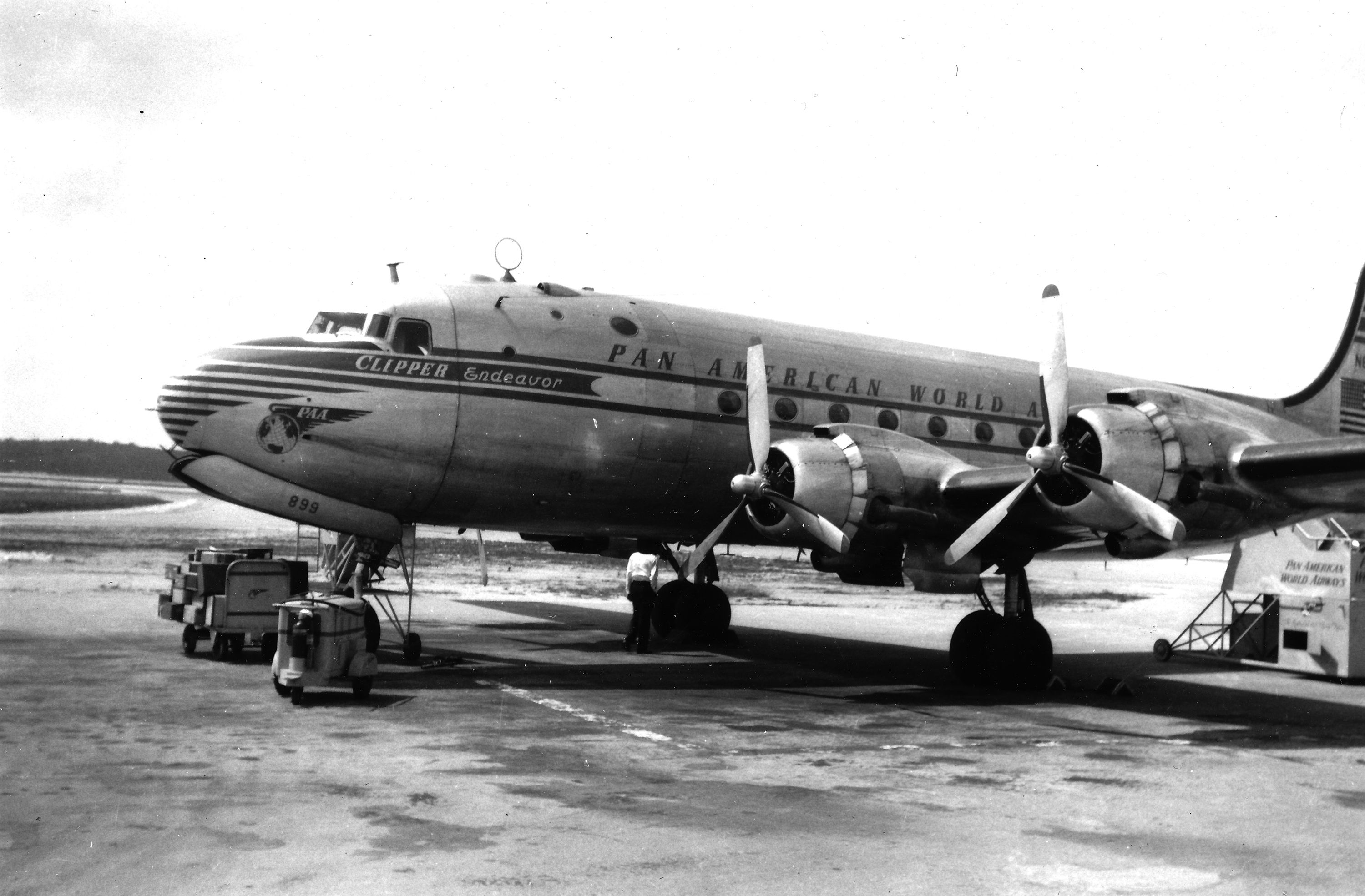
The crash story, kept only as large as the argument needs
Pan Am Flight 526A, the Clipper Endeavor, ditched in the Atlantic after departing San Juan, Puerto Rico, in 1952. The aircraft was a Douglas DC-4. Publicly available crash summaries describe engine trouble, an attempted return, and a water landing that did not end the danger for the people aboard.[4] The grimly instructive part is not only that people died. It is that the accident created a survival paradox: many passengers appear to have survived the ditching itself, yet did not successfully leave the aircraft before it sank or became unsurvivable.[4][5]
That is where the case stops being a simple aviation tragedy and becomes a demanding evidence problem. Different accounts place different emphasis on language barriers, inadequate preflight briefing, fear of sharks, panic, and the operational conditions of rescue. A weak essay would list those factors as if accumulation equals analysis. A stronger essay asks which source is making each claim, when the claim was made, what the source could observe, and whether the explanation describes a proximate behavior or a system that made that behavior more likely.
The July 2026 discovery adds a new category of primary material to that evidence trail. CNN reported that the search produced more than 350,000 underwater photographs and that images showed Pan Am identification on the wreckage.[1] The Air/Sea Heritage Foundation’s project page frames Mission Endeavor as a search and documentation project tied to the Clipper Endeavor site.[6] Those photographs are powerful, but their strongest use is not emotional. They allow historians to compare physical evidence with earlier reports, maps, and narratives.
The six moves, before the case gets complicated
Under exam pressure, method has to be short enough to remember and strong enough to prevent summarizing. This is the working sequence:
| Historical move | Question to ask | GRE writing habit |
|---|---|---|
| Source criticism | Who produced this evidence, when, and with what limits? | Qualify the claim before using it. |
| Eyewitness evaluation | What could this person actually perceive and later remember? | Use testimony for the right kind of claim. |
| Contradictory-source reconciliation | Can two accounts both be partly true at different levels? | Do not flatten tension into a single neat cause. |
| Causality analysis | Which causes are immediate, and which are systemic? | Separate trigger, condition, and consequence. |
| Narrative construction | What sequence best explains the evidence without overclaiming? | Build paragraphs that move from fact to inference. |
| Evidence-based argument | Why is this explanation stronger than alternatives? | Defend the reasoning, not just the example. |

Start with source criticism, not with the most vivid detail
Historical method begins by testing the source before borrowing its authority. The classic questions are plain: When was the source created? Where did it come from? Who made it? Has it been altered? Is the author credible for this specific claim?[2] Those questions are not museum etiquette. They keep a writer from treating every piece of evidence as if it has the same weight.
Apply that to the Clipper Endeavor. An official accident investigation is strong for reconstructing flight sequence, operational failure, and safety recommendations. It is weaker for capturing the full subjective experience of a terrified passenger inside a sinking cabin. A survivor interview is strong for human perception, confusion, fear, and remembered instruction. It is weaker for measuring what happened across the whole aircraft. A corporate historical foundation may preserve records and institutional memory, but its account also deserves attention to institutional perspective. A 2026 underwater photograph is direct evidence of physical remains; it does not interview the dead.
This is the first GRE translation: do not write, “The evidence proves that passengers died because they panicked.” Write something closer to: “Several accounts point to panic and fear as immediate barriers to evacuation, but those accounts need to be weighed against official findings about briefing, communication, and procedure.” The second sentence does more intellectual work. It has not become timid; it has become harder to attack.
The newly discovered imagery should be handled the same way. Its date gives it news value, but its evidentiary value depends on what it shows. If the images document the aircraft’s identity and wreckage field, cite them for identity and location. If they later support a structural claim, that claim should wait for a qualified analyst or released documentation. The mistake is to let discovery footage serve as a universal proof token.
Eyewitnesses answer some questions better than others
Eyewitness material is indispensable in this case because the central question concerns behavior inside an emergency. But eyewitnesses are not interchangeable. Historical method asks whether a witness was present, whether the witness could observe the relevant fact, whether the statement was made near the event or much later, and whether memory may have been shaped by trauma, repetition, or later public narratives.[2]
The Clipper Endeavor evidence trail reportedly includes living survivor perspectives at radically different points on the reliability spectrum: an elderly former nurse who could potentially describe perception and response, and a rescued baby whose survival is historically meaningful but who could not have formed usable memory of the event.[1] Both lives matter. They do not provide the same kind of evidence.
That distinction is a writing skill. In a GRE Argument essay, a survey respondent, a manager, a customer, and an outside auditor may all be “sources,” but each can support only certain claims. The test often rewards the writer who says, in effect, “This testimony is relevant, but not sufficient for that conclusion.” The Clipper Endeavor case makes the habit concrete: survivor testimony can illuminate fear, confusion, and perceived instruction; it cannot alone establish the full causal hierarchy of the accident.
The contradiction is the teaching object
The hardest part of the Clipper Endeavor case is the part most worth studying: why did so many people fail to evacuate after a ditching that some survived at first? One account may stress language barriers. Another may stress the absence or inadequacy of a preflight safety briefing. Another may emphasize fear of sharks or panic. These are not automatically rival explanations. They may describe different layers of the same failure.
A language barrier explains why instructions may not have been usable for some passengers. A missing or ineffective briefing explains why passengers lacked rehearsed expectations before the emergency. Fear explains why a person who hears an instruction may still not act on it. Panic describes a psychological condition under threat. Operational context explains what rescuers, crew, and passengers could realistically do in the water. The analytical task is to decide which claim belongs at which level.
The Air Force witness map reportedly found in Puerto Rican archival material during a 2024 Expedition Unknown episode matters for the same reason: if authenticated and properly contextualized, a near-contemporary witness map can be compared against older search assumptions and later underwater findings.[1] Its value is not that it makes all other evidence obsolete. Its value is that it gives another fixed point against which existing claims can be tested.
This is where many student essays lose control. They see contradiction and choose one source too quickly. A better paragraph can preserve tension while still making a judgment: “The evacuation failure is best explained not by choosing between panic and briefing failure, but by treating panic as a likely immediate behavior under conditions that poor communication and inadequate preparation made more dangerous.” That sentence does not pretend to know every passenger’s mind. It uses contradiction to build a more precise explanation.
Causality runs from cockpit trouble to cabin survival practice
Causality is not a single arrow. In the Clipper Endeavor case, one level concerns the flight emergency and ditching. Another concerns passenger survival after impact. A third concerns institutional learning after the accident. Mixing those levels produces sentences that sound forceful but explain very little.
The cleanest causal chain comes after the crash: accident, investigation, recommendation, regulation, practice. Pan Am Historical Foundation material states that the crash directly led to the first mandated preflight safety briefings and emphasizes the later recognition of cabin crew authority in passenger survival.[5] Public crash summaries also connect the accident with Civil Aeronautics Board recommendations and subsequent safety briefing requirements.[4] That does not mean the crash alone created all modern cabin safety culture. It means this accident is a documented cause in a specific regulatory change.
That distinction is useful for GRE writing because it avoids both extremes: the vague claim that “tragedies improve safety” and the exaggerated claim that one crash single-handedly produced modern aviation safety. A defensible version is narrower: the Clipper Endeavor investigation helped convert passenger briefing from optional or inconsistent practice into a mandated safety procedure. The narrower claim is stronger because the evidence can actually carry it.
There is also a broader methodological consequence. A 2026 Journal of Safety Research study by Bills and colleagues reports that seven of 12 leading Safety Investigation Authorities now use systemic methodologies traceable to modern investigative frameworks.[8] That finding should not be turned into a claim that the Clipper Endeavor alone produced systemic safety investigation. It can support a more careful point: aviation safety investigation increasingly treats accidents as system events, and the Clipper Endeavor is an early, concrete case in which investigation moved attention from the moment of impact to communication, procedure, and survivability.
Build the narrative after the evidence has been ranked
Narrative construction is not decoration. It is the disciplined ordering of evidence so a reader can see why one interpretation is more plausible than another. The order matters. If the story begins with passengers’ fear, the argument may drift toward individual blame. If it begins with institutional procedure, the argument may better explain why fear became fatal. If it begins with the 2026 discovery, the writer must quickly clarify what the discovery adds to older knowledge.
A workable narrative for this case would move in three bands. First, the 1952 accident: a commercial aircraft ditches near Puerto Rico, and survival depends not only on impact but on evacuation. Second, the evidence conflict: official findings, survivor accounts, rescue context, and later archival materials place different emphasis on why passengers did not leave the aircraft. Third, the institutional consequence: investigators and regulators treated passenger briefing and cabin authority as safety issues, not as courtesy routines.
The 2026 wreckage discovery belongs in that narrative as a new evidence layer. It may confirm the site, enrich physical reconstruction, and invite renewed comparison with maps and reports. Used carefully, it strengthens the account without turning the discovery itself into the whole explanation.
Turn the case into an evidence-based argument
The final move is not to mention the crash. It is to use the crash to prove a claim. McCullagh’s account of historical explanation, summarized in standard historical-method discussions, emphasizes that the best explanation should account for the evidence better than competing explanations, fit known facts, avoid unnecessary assumptions, and have explanatory power.[2] That is close to what a strong GRE essay does even when the topic has nothing to do with history.
For an Issue essay about whether institutions learn more from failure than success, the Clipper Endeavor can support a qualified claim: failure can produce durable reform when investigation translates a tragic outcome into a specific procedural requirement. The case is better than a generic “aviation became safer” example because it identifies a mechanism: passenger evacuation failure became evidence for mandated preflight safety briefings.
For an Argument essay, the case trains the habit of attacking inference rather than tone. If an argument says, “Passengers died because they panicked, so safety briefings would not have mattered,” the Clipper Endeavor evidence trail gives you several pressure points. Panic may have occurred, but that does not exclude preparation as a causal factor. A briefing may not eliminate fear, but it can change what people understand before fear begins. A survivor’s memory may be vivid, but it cannot replace a system-level investigation. New wreckage imagery may strengthen physical reconstruction, but it cannot automatically settle behavioral causation.
The same structure works beyond aviation. See also: another case-evidence approach for GRE AW if you want a current-event example from cybersecurity, or GRE prep planning by cost, time, and score data if you need to place writing practice inside a broader study schedule. For another source-criticism model, the ancient-evidence problem in Did Homer exist? is a useful counterpart: fewer modern records, more distance, but the same discipline of matching claim strength to evidence strength.
A paragraph framework you can actually use
When you bring a historical case into a GRE essay, use the case in four moves, not as a miniature encyclopedia entry:
- State the claim narrowly: “Institutional failure can lead to reform when investigation identifies a repeatable procedural weakness.”
- Introduce the evidence with source limits: “In the Clipper Endeavor crash, official and historical accounts connect evacuation failure with later passenger-briefing requirements.”
- Explain the mechanism: “The lesson was not simply that accidents are tragic, but that passengers cannot be expected to improvise safety behavior they were never taught.”
- Qualify the conclusion: “The case does not prove that every disaster produces reform; it shows that reform becomes more likely when evidence is gathered, ranked, and translated into enforceable practice.”
That is the transferable value of the Clipper Endeavor. The wreckage discovery makes the case current; the crash history makes it memorable; the method makes it useful. Strong Analytical Writing is not built by having a dramatic example ready. It is built by showing how each piece of evidence changes the strength of the argument.
References
- Pan Am Clipper Endeavor wreckage found, CNN, July 21, 2026, link
- Historical method, Wikipedia, link
- What is Historical Analysis?, UTA Pressbooks, link
- Pan Am Flight 526A, Wikipedia, link
- Clipper Endeavor, Pan Am Historical Foundation, link
- Mission Endeavor Project Overview, Air/Sea Heritage Foundation, link
- Critical thinking in the classroom: the historical method and historical discourse as tools for teaching social studies, PMC, 2025, link
- Journal of Safety Research study on Safety Investigation Authorities and systemic methodologies, ScienceDirect, 2026, link
Comments
Join the discussion with an anonymous comment.