
Method
How to Study Male Breast Cancer for the MCAT
An evidence-graded study resource that shows pre-med students how to use male breast cancer as a consolidated cross-section topic, simultaneously covering genetics, endocrinology, epidemiology, health disparities, and sociocultural framing across multiple MCAT sections.
Evidence panel
- Evidence level
- Moderate
- Primary citation
- The Awareness and Attitude of the General Population Towards Male Breast Cancer - PMC 2023
A male breast cancer awareness study guide is worth your MCAT time only if it does more than tell you that the condition exists. The useful version asks: can one disease help you practice genetics, endocrine signaling, cancer biology, health behavior, stigma, disparities, and graph interpretation without making you jump between ten unrelated examples?
For male breast cancer, the answer is yes, with boundaries. It is not “the” cancer topic for the MCAT. You still need the broader cell cycle, oncogene, tumor suppressor, DNA repair, hormone signaling, and epidemiology material in your main MCAT study workflow. But as a cross-section case, it is unusually efficient because the same facts keep changing test domains: BRCA2 becomes DNA repair and inheritance; Klinefelter syndrome becomes sex chromosomes and endocrine risk; ER-positive tumors become receptor signaling; delayed diagnosis becomes health beliefs and access; incidence and mortality differences become data interpretation.

Use evidence labels while you study it. High evidence means the fact is stable enough to build a mechanism card around. Moderate evidence means the fact is useful for passage reasoning but needs population or study-design context. Limited evidence means the number may still be useful, but you should label it as a projection, single case type, or narrower claim.
Start With the MCAT Job, Not the Disease
The study session should not begin with a general oncology summary. Begin by sorting each fact into what the MCAT can ask you to do with it.
| Fact type | Evidence label | MCAT use |
|---|---|---|
| BRCA2 mutation raises male breast cancer lifetime risk from about 0.1% baseline to 5-10% | High | Genetics, DNA repair, tumor suppressor logic, relative vs absolute risk |
| Klinefelter syndrome is associated with a 20-60x increased risk | High to moderate | Sex chromosomes, nondisjunction, endocrine environment, risk-factor reasoning |
| More than 90% of tumors in a large Mayo Clinic cohort were ER-positive | High for the dataset; note 2004-2014 window | Receptor signaling, endocrine therapy logic, passage pattern recognition |
| More than 85% are invasive ductal carcinoma; lobular carcinoma is rare | High for basic pathology framing | Tissue structure, ductal vs lobular anatomy, why male anatomy changes tumor distribution |
| A single-center Turkish study found 61.1% of participants did not know men can develop breast cancer | Moderate; not a universal U.S. estimate | Health beliefs, awareness, screening behavior, sampling and generalizability |
| Black men have higher incidence and mortality risk than White men in American Cancer Society reporting | High for disparity prompt use | Social determinants, access, stratified data, incidence vs mortality |
| About 2,670 new U.S. cases and 530 deaths are estimated for 2026 | Limited; projection | Projection vs observed count, rare disease base-rate reasoning |
That table is the whole reason this topic earns a study block. You are not collecting trivia. You are building a compact passage bank.
Bio/Biochem: Turn the Risk Factors Into Mechanisms
Start with BRCA2 because it is the cleanest Biology/Biochemistry anchor. The Rutgers Genetics Coordinating Center describes male BRCA2 carriers as having an estimated 5-10% lifetime risk of breast cancer, compared with about 0.1% in the general male population; that is often summarized as a 50- to 100-fold increase [1]. For MCAT purposes, the fold increase is less important than what it forces you to retrieve: DNA repair, tumor suppressor function, inherited predisposition, penetrance, and the difference between relative and absolute risk.
A weak card says, “BRCA2 increases male breast cancer risk.” A better card asks, “Why can a DNA repair gene alter cancer risk in tissue that is not usually treated as a major male cancer site?” Now the answer has to move through genome stability, accumulation of mutations, loss of normal cell-cycle control, and tissue-specific context. That is closer to how a passage behaves.
Klinefelter syndrome gives you a different kind of Bio/Biochem integration. MCAT students usually file XXY under nondisjunction and move on. Here, that is not enough. Klinefelter syndrome is described in medical education references as the strongest male breast cancer risk factor, associated with about a 20- to 60-fold increased risk [2][3]. The study value is the chain: meiotic nondisjunction changes sex chromosome complement; sex chromosome complement changes gonadal and endocrine physiology; endocrine environment changes hormone-sensitive tissue risk.
Do not turn that into a memorized slogan that “more X chromosomes cause cancer.” That is too sloppy for the MCAT. The better reasoning is that chromosomal abnormalities can influence development and hormone levels, and hormone-responsive tissues can respond to altered endocrine signaling. If a passage gives you testosterone, estrogen, aromatase, receptor expression, or negative feedback data, the Klinefelter association becomes a mechanism prompt rather than a fact-recognition prompt.
The pathology pattern is also useful. The National Breast Cancer Foundation reports that more than 85% of male breast cancers are invasive ductal carcinoma, while lobular carcinoma is rare because male breast tissue typically has rudimentary terminal lobules [4]. That single sentence is doing anatomy, histology, and cancer classification at once. Ductal predominance is not random; it follows from what structures are present in the tissue.
This is where a lot of students accidentally study labels instead of causes. “IDC” is a label. “Ductal tumors predominate because the relevant ductal structures exist while fully developed lobular structures are limited” is reasoning. The MCAT rewards the second version because it transfers to unfamiliar tissue passages.
Hormone receptor status adds the endocrine layer. In a Mayo Clinic analysis of 10,873 male breast cancer patients diagnosed from 2004 through 2014, more than 90% of tumors were estrogen receptor-positive [5]. That is a strong pattern for study purposes, but label the dataset window. You can use it to practice receptor-ligand signaling, transcriptional regulation, hormone-responsive proliferation, and why receptor status matters biologically. You should not use it to make broad claims about every current treatment pattern without checking newer clinical guidelines.
Age and presentation can become passage clues rather than memorization targets. The National Breast Cancer Foundation gives a median diagnosis age of 67 and describes a painless subareolar mass as present in more than 85% of cases, with nipple retraction or inversion also commonly reported [4]. The Mayo cohort reported a median age of 64 [5]. For the MCAT, the exact age difference is not the point. The point is that older age, receptor-positive disease, tissue anatomy, and delayed symptom interpretation can all appear in the same clinical vignette.
Bio/Biochem Cards Worth Making
- BRCA2 card: “A tumor suppressor involved in DNA repair is inherited in a mutated form. What changes in cancer risk logic: mutation rate, cell-cycle control, penetrance, or hormone signaling?”
- Risk card: “A disease risk rises from 0.1% to 5-10%. What is the relative increase, and why does the absolute risk still matter?”
- Klinefelter card: “How can an XXY karyotype connect nondisjunction to endocrine risk without claiming that chromosomes directly ‘cause’ one tumor type?”
- Histology card: “Why would invasive ductal carcinoma be more common than lobular carcinoma in male breast tissue?”
- Receptor card: “If a tumor is ER-positive, what kind of intracellular signaling and gene-expression effects should you expect a passage to test?”
If you use spaced repetition, put only the stable mechanism pieces into long-term review. The MCAT Anki workflow is better for these cards than for storing every awareness statistic. Mechanisms deserve repeated retrieval; context-specific survey numbers deserve careful interpretation practice.
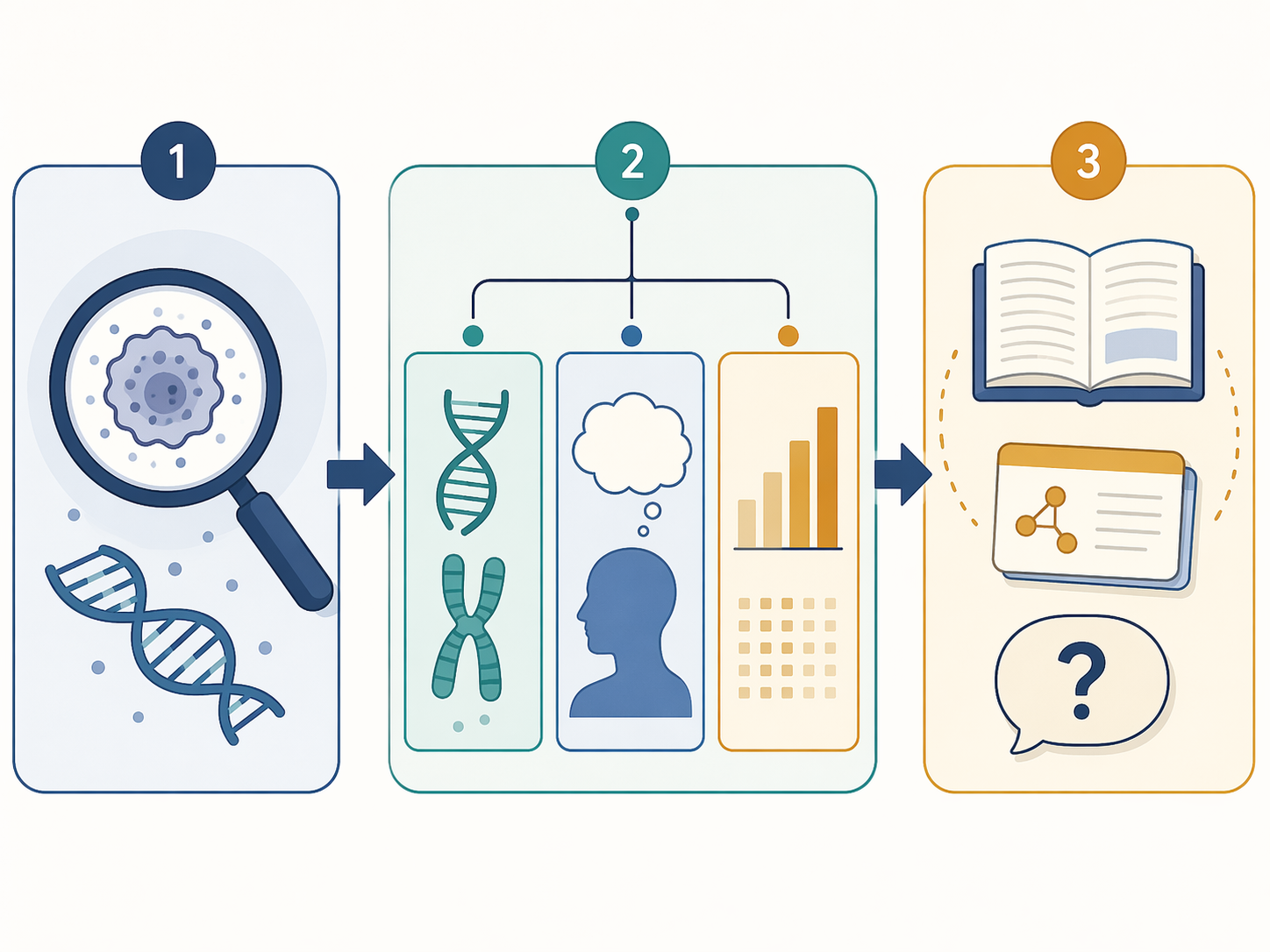
Psych/Soc: Treat Awareness as a Testable Social Fact
The Psych/Soc value of male breast cancer is not that it gives you an awareness slogan. It gives you a compact example of how illness categories are biological and social at the same time.
Altiner and colleagues published a 2023 single-center study of 411 participants in Turkey that directly measured public awareness and screening behavior. In that sample, 61.1% of participants did not know that men can develop breast cancer [6]. That is useful MCAT material, but it is moderate evidence for your purposes, not a universal U.S. statistic. The study was conducted in a specific setting, and generalizability matters.
The behavior data are even better for Psych/Soc reasoning. In the same study, only 9.2% of men had ever performed breast self-exam, compared with 69.6% of women; 5.7% of men had undergone breast imaging in the previous year, compared with 31.9% of women; and men were less likely to perceive that they had sufficient breast cancer knowledge, 18.4% versus 38.5% for women [6]. These are not just “people do not know things” facts. They separate knowledge, perceived knowledge, self-exam behavior, and imaging behavior.
That distinction matters because the MCAT likes to test gaps between attitudes and behavior. A person can know that a disease exists and still avoid screening. A person can lack knowledge because information campaigns are gendered. A person can notice a symptom but delay care because the symptom does not fit the category they have learned for their own body. Those are different explanations, and a good Psych/Soc answer choice usually depends on keeping them separate.
Thomas’s 2010 qualitative work is especially useful here because it captures the cultural sorting rule directly: “men get prostate cancer, women get breast cancer” [7]. Do not flatten that into a cute quote. It is a social construction of illness example. The disease has biological mechanisms, but the category “breast cancer patient” is socially coded in a way that can affect recognition, disclosure, help-seeking, and stigma.
A passage could ask about labeling theory, gender norms, perceived susceptibility, stigma, or health communication. The same vignette could also test whether you can avoid overclaiming: a qualitative study can reveal themes and meanings, but it does not by itself estimate national prevalence.
How Delayed Diagnosis Becomes MCAT Material
Delayed diagnosis is where the Bio and Psych/Soc material touch. Culell and colleagues reported that more than 40% of cases presented at stage 3 or 4, partly in the context of an average 10-month delay from symptom onset to diagnosis [8]. Use that as passage material, not as a reason to memorize staging minutiae.
The testable question is what could produce the delay. Symptom appraisal, gendered disease expectations, clinician suspicion, access to care, embarrassment, knowledge gaps, and lack of routine screening can all be plausible contributors. A careful answer will not treat “men are unaware” as the only cause unless the passage data support that narrower conclusion.
This is also where students need to stop using “rare” as a synonym for “not high-yield.” Rare conditions can be high-yield when they expose mechanisms. Male breast cancer is rare, but rarity is exactly why base rates, delayed recognition, and social categorization become visible.
Data Interpretation: Incidence, Mortality, and Base Rates
The epidemiology numbers should be studied as data interpretation practice, not as a scoreboard of facts. A Clinical Breast Cancer study summarized by breastcancer.org reported that the age-standardized incidence rate more than doubled from 0.40 to 0.77 per 100,000 men between 1990 and 2021 [9]. That sentence can test several things at once: age standardization, rate versus count, relative change, absolute rarity, and the danger of interpreting an increase without asking what the denominator is.
Breastcancer.org also lists about 2,670 new U.S. cases and about 530 deaths estimated for 2026 [10]. Label those as projections. In a passage, “estimated for 2026” is not the same evidentiary object as “observed in a registry from 1990 to 2021.” The MCAT may not ask you to know that exact distinction for this disease, but it absolutely expects you to read time windows and data sources carefully.
The National Breast Cancer Foundation gives a male lifetime risk of about 1 in 755 [4]. Pair that with the BRCA2 risk range from Rutgers and you get a clean relative-versus-absolute-risk drill. A 50- to 100-fold increase sounds enormous, and biologically it is meaningful. But the absolute lifetime risk in carriers is still reported as 5-10%, not 80% or 90% [1]. If you can explain both statements without contradiction, you are doing the kind of statistical reasoning the MCAT wants.
Disparity data add another layer. The American Cancer Society reported that Black men had the highest male breast cancer incidence, a 51% higher incidence rate than White men in SEER data, and a 76% higher mortality risk [11]. For Psych/Soc and data passages, do not collapse those into one claim. Incidence concerns new cases. Mortality concerns death. A higher mortality risk could reflect stage at diagnosis, access to care, tumor biology, treatment differences, comorbidities, structural factors, or some combination, depending on what the passage actually provides.
A Quick Passage-Reading Drill
When you see a male breast cancer passage, mark each number before you interpret it.
- If the number is a lifetime risk, ask whether you are comparing absolute risk or fold change.
- If the number is an incidence rate, ask whether it is age-standardized and what population is in the denominator.
- If the number is a projection, do not treat it as a confirmed count.
- If the number comes from a single-center survey, do not generalize it to all men or all U.S. patients.
- If the number describes mortality, do not assume it has the same explanation as incidence.
Build the Study Session Around Transfer
A productive study session can be short, but it should not be shallow. Give yourself one page or one digital note and divide it into four columns: disease fact, mechanism, MCAT section, and evidence label. The evidence label is what keeps the note honest.
| Disease fact | Mechanism to retrieve | Likely MCAT section | Study action |
|---|---|---|---|
| BRCA2 carriers have substantially higher lifetime risk | DNA repair, tumor suppressor loss, mutation accumulation | Bio/Biochem | Make a mechanism card and a relative-risk card |
| Klinefelter syndrome is a strong risk factor | Nondisjunction, XXY karyotype, endocrine changes | Bio/Biochem | Draw the meiosis error and explain the hormone-risk link |
| Most tumors are ER-positive | Steroid hormone receptor signaling and gene transcription | Bio/Biochem | Write a passage-style question about receptor blockade |
| Awareness and screening behaviors differ by gender in one study | Health beliefs, perceived susceptibility, stigma, behavior gap | Psych/Soc | Write one question that separates knowledge from behavior |
| Black men have higher incidence and mortality risk | Disparities, access, structural factors, outcome stratification | Psych/Soc and data interpretation | Practice explaining incidence vs mortality without overcausal language |
| Incidence rate more than doubled over 1990-2021 but remains low in absolute terms | Age standardization, denominator, absolute vs relative change | Data interpretation | Convert the sentence into a graph-reading prompt |
Then write three passage prompts. Do not make them all fact recall.
- Bio/Biochem prompt: A passage describes an older male patient with an ER-positive invasive ductal tumor and a family history of BRCA2 mutation. Which finding best explains inherited susceptibility?
- Psych/Soc prompt: A public health campaign finds that men recognize breast symptoms less often because they associate breast cancer with women. Which concept best describes this pattern?
- Data prompt: A graph shows male breast cancer incidence rising from 0.40 to 0.77 per 100,000 over several decades. Which conclusion is supported, and which would overstate the data?
Notice that the same case can support all three prompts. That is the efficiency gain. You are not trying to memorize a rare disease for its own sake; you are practicing how the MCAT rotates one real condition through different reasoning demands.
If this format works for you, compare it with another cross-section disease model, such as Bacillus cereus food poisoning on the MCAT. The organism is different, but the study move is similar: one entity, multiple testable angles. You can also place this kind of case note inside a broader tool stack if you are deciding between question banks, flashcards, and review systems in MCAT study tools for 2026.
What Not to Overstudy
Skip deep treatment algorithms unless a passage gives them to you. You do not need to memorize staging systems, medication sequences, or surveillance schedules for male breast cancer. If a passage wants treatment reasoning, it will usually give receptor status, mechanism, or trial data and ask you to interpret them.
Also avoid turning this into a general awareness essay. Awareness matters here because it connects to stigma, help-seeking, screening behavior, delayed diagnosis, and social categories of illness. Once you detach it from those testable mechanisms, it stops helping your MCAT prep.
The clean stopping point is this: male breast cancer is not a replacement for broader cancer, genetics, endocrinology, or disparities review. It is a compact case that shows how those reviews are supposed to talk to each other. Study it for transfer.
References
- Genetics of Male Breast Cancer - Rutgers Genetics Coordinating Center - rugcc.rutgers.edu/genmbc/
- Klinefelter Syndrome - Oncourse USMLE lesson - getoncourse.ai
- Klinefelter Syndrome - Medbullets Step 2/3 - step2.medbullets.com
- Male Breast Cancer - National Breast Cancer Foundation - nationalbreastcancer.org/male-breast-cancer/
- Male Breast Cancer in the United States: Treatment Patterns and Prognostic Factors in the 21st Century - Mayo Clinic - 2019 - mayoclinic.org
- The Awareness and Attitude of the General Population Towards Male Breast Cancer - PMC - 2023 - PMC10071202
- Male breast cancer: a qualitative study of the experiences of men with breast cancer - PubMed - 2010 - pubmed.ncbi.nlm.nih.gov/20885124/
- Male breast cancer: a multicentric study - Culell et al. - 2007
- Male Breast Cancer Incidence More Than Doubled Worldwide Over Three Decades - breastcancer.org - 2025 - breastcancer.org
- Male Breast Cancer Statistics and Facts - breastcancer.org - 2026 - breastcancer.org
- Study Finds Racial Disparities in Male Breast Cancer Incidence and Mortality - American Cancer Society - pressroom.cancer.org/SineshawMaleBreastCancerRace
Comments
Join the discussion with an anonymous comment.