
Method
How the Evidence on Lion's Mane Jellyfish Stings Reversed
This article explains how treatment recommendations for lion's mane jellyfish stings reversed between 2014 and 2017, using the case to demonstrate how study design improvements change evidence quality — a skill tested on MCAT and GRE exams.
Evidence panel
- Evidence level
- Limited
- Primary citation
- Jellyfish Sting Treatments: A Systematic Review, ILCOR, 2025
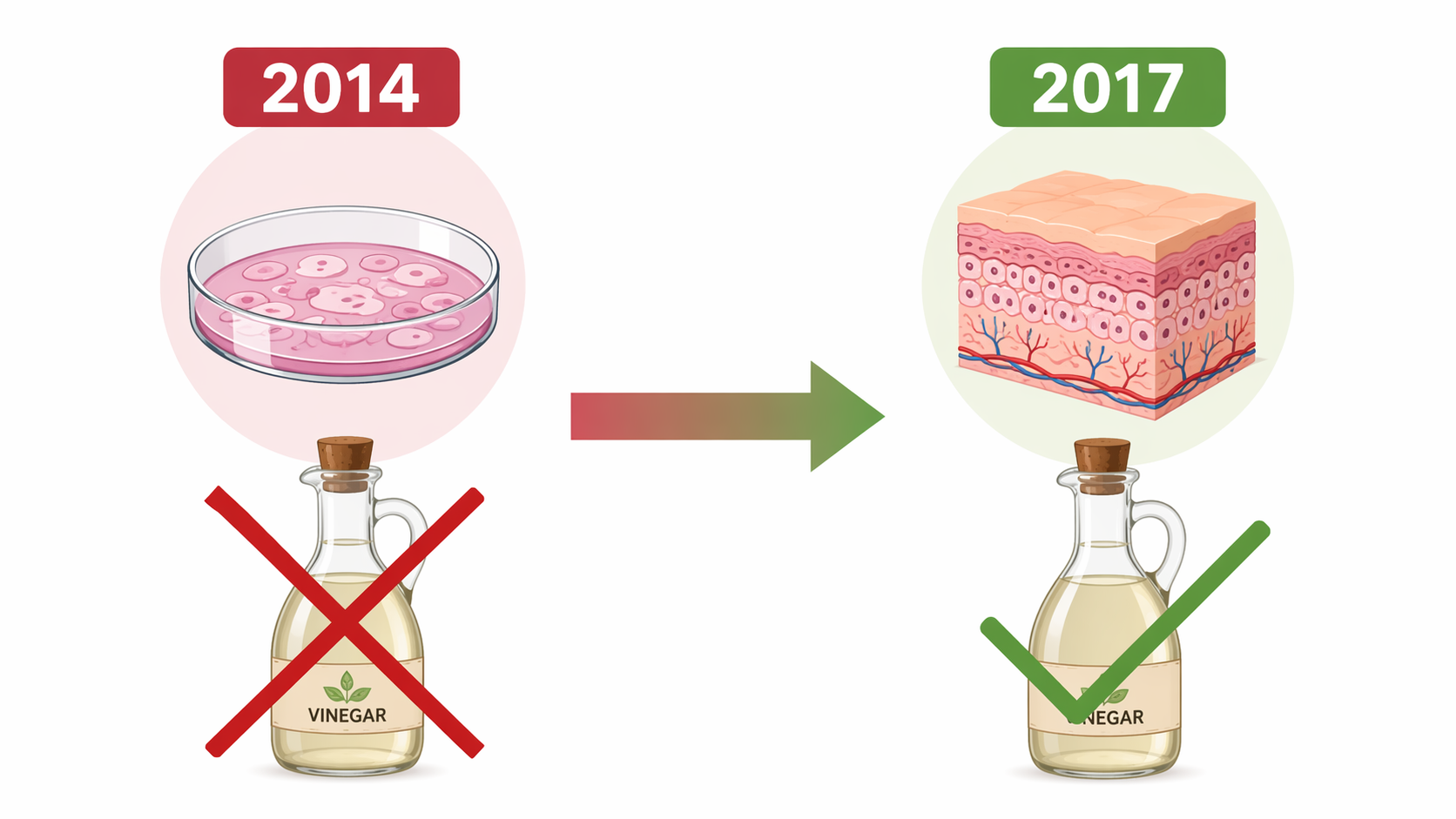
The useful part of the lion's mane jellyfish sting treatment study story is not that vinegar went from villain to hero. It is that the answer changed when the model changed. In 2014, an American Family Physician guide advised against vinegar for lion's mane jellyfish stings and recommended baking soda instead, with a Strength of Recommendation C, meaning expert opinion or disease-oriented evidence rather than strong patient-outcome evidence.[1] In 2017, Doyle and colleagues studied Cyanea capillata with an ex vivo human-skin model and found that 4% acetic acid, the active concentration in vinegar, irreversibly prevented nematocyst discharge for that species.[2]
That looks like a clean contradiction. On an exam passage, it is also a trap. The tempting answer is, "The old source was wrong; the new source is right." The stronger answer is, "The later study measured something closer to the real sting event, so it deserves more weight on that specific question, while the overall certainty remains limited."
The Reversal Was About Evidence Fit
The 2014 recommendation did not come out of nowhere. It relied on earlier evidence that vinegar could stimulate discharge of lion's mane nematocysts in vitro.[1] If the question is, "What happens when isolated stinging structures are exposed to a rinse in a lab dish?" that kind of test can be relevant. It gives a controlled view of nematocyst discharge.
But a beach sting is not a petri dish. A person has skin, pressure, tentacle contact, partial discharge, rinsing, and venom delivery. The 2017 study moved closer to that event by using human skin samples, live tentacle contact, and a specialized apparatus to quantify venom metalloprotease delivery under different treatment conditions.[2] That does not make it a randomized clinical trial. It does make the measured outcome better aligned with the practical question.
| Question a Reader Should Ask | 2014 Position | 2017 Doyle et al. Study |
|---|---|---|
| What was being tested? | Whether vinegar could trigger nematocyst discharge in an in vitro setting | How treatments affected discharge and venom delivery in an ex vivo human-skin model |
| How close was the model to a real sting? | Farther away: isolated lab conditions | Closer: tentacle contact with human skin samples |
| What did the source conclude about vinegar for lion's mane? | Avoid vinegar; use baking soda instead | Vinegar prevented Cyanea capillata nematocyst discharge |
| How strong was the evidence? | Strength of Recommendation C in the AAFP guide | Improved experimental model, but not high-certainty clinical evidence |
For MCAT and GRE purposes, the critical move is to separate source authority from study design. A medical guide can be authoritative and still base one recommendation on weak evidence. A later laboratory study can improve the model and still fall short of proving patient-level outcomes. The job is not to crown whichever source sounds more confident. The job is to identify what each source actually measured.
In Vitro and Ex Vivo Are Not Interchangeable
An in vitro test is good at isolating a mechanism. That is its strength and its weakness. If vinegar causes nematocysts to fire in a controlled dish, that is worth noticing. It warns against a simple assumption that rinsing is harmless. But it may not tell us how much venom reaches human tissue during a more realistic sting scenario.
The ex vivo model in Doyle et al. narrowed that gap. The researchers were still outside a living patient, but they used human skin samples and live tentacle contact, then quantified venom delivery. That combination matters because the feared outcome is not merely whether a microscopic capsule fires. The beachside concern is whether treatment increases or decreases venom delivery into tissue.[2]
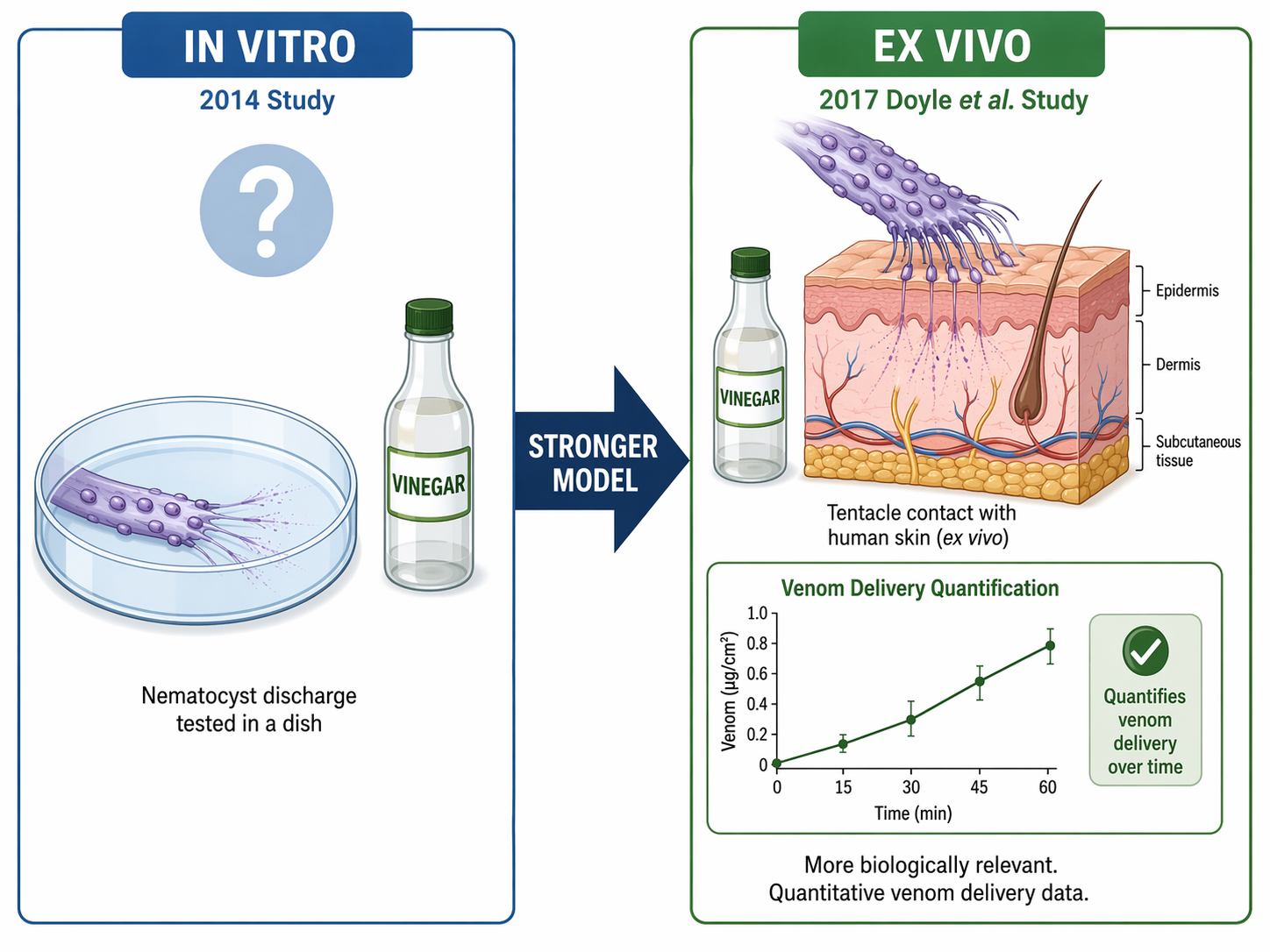
That is why the reversal is more interesting than a correction. The 2014 advice can be understood as a reasonable conclusion from a narrower model. The 2017 result did not simply shout louder. It asked a better-aligned question: when Cyanea capillata tentacles interact with human skin, what happens to discharge and venom delivery under vinegar treatment?
A strong test-taker notices the shift in outcome. "Nematocyst discharge in vitro" and "venom delivery in an ex vivo skin model" are related, but they are not the same endpoint. If a passage presents both, the safer inference is not that one study destroys the other. It is that the second study has higher ecological relevance for the treatment question, while still carrying the limits of a nonclinical model.
What Stayed More Stable: Heat for Pain Relief
The vinegar issue draws attention because it reversed. Heat is the steadier part of the record. The 2014 American Family Physician guide assigned hot water immersion at 43-45°C a Strength of Recommendation B for pain relief, based on randomized controlled trial evidence.[1] Doyle et al. also recommended a two-step protocol: rinse with vinegar or Sting No More Spray, then use 45°C water for 40 minutes or a heat pack.[2]
Those two claims should not be blended carelessly. Heat support in the AAFP guide concerned pain relief. The Doyle protocol combined inhibition of further nematocyst discharge with heat treatment. A passage writer could easily ask which outcome belongs to which intervention. If the answer choice says hot water prevents nematocyst discharge, that is not the same claim as hot water reduces pain.
Species Specificity Is Part of the Evidence
One reason jellyfish advice becomes messy is that "jellyfish sting" sounds like one problem. The research question here is narrower: lion's mane jellyfish, Cyanea capillata. Evidence from another species may not transfer cleanly. A treatment that is sensible for one jellyfish can be untested, weaker, or even concerning for another.
That is the quiet danger in generic rules. Vinegar, seawater, ice, baking soda, alcohol, and other familiar remedies often get discussed as though the sting organism barely matters. In this case, the organism matters enough that the 2017 study's species-specific design is one reason it changes how the evidence should be weighed.[2]
This is also where folk-remedy material belongs: as a warning about evidence quality, not as the center of the article. Urine and alcohol are memorable because they sound like myths waiting to be debunked. The harder exam skill is less theatrical. It is recognizing when tradition, species mismatch, and weak study design have been packaged as confident practical advice.
The 2025 Systematic Review Keeps the Confidence Level Down
The 2017 study deserves attention because it improved the model. It does not deserve a victory lap. A 2025 ILCOR-commissioned systematic review rated the existing jellyfish sting treatment evidence as very low quality, citing risk of bias and heterogeneity across 10 included studies.[3] That judgment matters because it prevents the neat classroom version from becoming too neat.
Very low quality does not mean useless. It means the confidence in the effect estimate is limited. The evidence can still suggest that vinegar is more plausible for lion's mane stings than the 2014 recommendation allowed, especially because Doyle et al. used a more relevant model. But it does not justify saying that the question is settled at the level of high-quality clinical evidence.
That distinction is exactly the kind of thing exams reward. A weak reader treats the newest study as automatically superior. A better reader asks why it is superior, how far that superiority reaches, and what independent reviewers later said about the evidence base as a whole.
How to Read This Kind of Passage on the MCAT or GRE
When a passage gives you conflicting studies, slow down at the point where most people speed up. The conflict is not usually solved by choosing the more recent date or the more official institution. It is solved by tracking the design.
- Identify the measured outcome: discharge, venom delivery, pain relief, or clinical recovery.
- Locate the model: in vitro, ex vivo, animal, observational human data, or randomized clinical trial.
- Check the population or species: Cyanea capillata is not a placeholder for every jellyfish.
- Separate recommendation grade from source prestige: a respected guide can still label a claim Strength of Recommendation C.
- Update confidence without erasing uncertainty: a better model can change the best current inference without making the answer final.
In a GRE Analyze an Argument task, this case would invite a critique of assumptions. Does evidence from isolated nematocysts justify advice for human stings? Does an ex vivo model justify a clinical treatment rule? Are all jellyfish species being treated as interchangeable? Has the author confused a mechanism endpoint with a patient endpoint?
In an MCAT science or CARS passage, the same case could test scope. If Doyle et al. found that vinegar prevented nematocyst discharge in Cyanea capillata, the supported conclusion is species-specific and model-specific. It does not prove that vinegar is best for every jellyfish sting, and it does not prove clinical superiority over all alternatives.
The recommendation on vinegar reversed because the later evidence better resembled the biological event it was trying to inform. The broader evidence base remains weak enough that the disciplined answer is calibrated weighting, not blind trust in the newest study. When the conclusion changes, ask what changed in design, outcome, population, and evidence grade. That is the transferable skill.
References
- Jellyfish Stings, American Family Physician, 2014.
- Evaluation of Cyanea capillata Sting Management Protocols Using an Ex Vivo and In Vitro Envenomation Model, Toxins, 2017.
- Jellyfish Sting Treatments: A Systematic Review, ILCOR, 2025.
Comments
Join the discussion with an anonymous comment.