
Method
Life Insurance 1035 Exchanges for Tax Students
This article breaks down IRC §1035's four permitted exchange categories, the asymmetric one-way rules, and common exam traps that CPA, CFP, and EA candidates must know.
Evidence panel
- Evidence level
- High
- Primary citation
- 26 U.S. Code § 1035
The trap in a life insurance 1035 exchange exam question is that the phrase sounds broader than the statute. Section 1035 is not a general permission to swap anything tax-deferred for anything else tax-deferred. It is a narrow nonrecognition rule with four listed categories, and the direction of the exchange matters.
Start with the Code, because the answer choices usually punish anyone who remembers only the industry shorthand. IRC §1035(a) says no gain or loss is recognized on certain exchanges of insurance policies, endowment policies, annuity contracts, and qualified long-term care insurance contracts. The four permissions are not identical, and they are not reversible.[1]

The §1035(a) Matrix
For exam purposes, build the rule from §1035(a)(1) through (4), not from a general memory of “tax-free replacement.” The statute gives you these four buckets:[1]
| Old contract | Permitted new contract under §1035(a) | Statutory category |
|---|---|---|
| Life insurance contract | Life insurance, endowment, annuity, or qualified long-term care insurance contract | §1035(a)(1) |
| Endowment contract | Endowment, annuity, or qualified long-term care insurance contract | §1035(a)(2) |
| Annuity contract | Annuity or qualified long-term care insurance contract | §1035(a)(3) |
| Qualified long-term care insurance contract | Qualified long-term care insurance contract | §1035(a)(4) |
That table is the article. Everything else is commentary on how the table gets tested. A life insurance contract may move into a life insurance contract, an endowment contract, an annuity contract, or a qualified long-term care insurance contract. An endowment contract may move down into endowment, annuity, or qualified long-term care. An annuity contract may move only into another annuity contract or into qualified long-term care. A qualified long-term care insurance contract may move only into another qualified long-term care insurance contract.[1]
The pattern is downward, not circular. Once the old contract is an annuity, life insurance is no longer an available destination under §1035(a). That is the rule many otherwise prepared candidates miss because “insurance exchange” feels like a category rather than a set of arrows.
Life Insurance Can Go to an Annuity; an Annuity Cannot Go to Life Insurance
The most testable asymmetry is life-to-annuity versus annuity-to-life. Section 1035(a)(1) expressly permits an exchange of a life insurance contract for an annuity contract. Section 1035(a)(3), however, permits an annuity contract to be exchanged only for another annuity contract or for a qualified long-term care insurance contract. It does not include life insurance as a destination.[1]
Kitces highlights the same one-way structure: permanent life insurance can be exchanged into a nonqualified annuity, but a nonqualified annuity cannot be exchanged into life insurance under §1035. That is not a planning preference; it is the statutory ordering of the permitted exchanges.[2]
So if an exam stem says a taxpayer owns a nonqualified deferred annuity and wants to exchange it for a life insurance policy without current gain recognition, the §1035 answer is no. The fact that both products may be tax-deferred does not supply a missing statutory arrow.
The Four Categories, Read Like an Exam Stem
1. Life Insurance as the Old Contract
This is the broadest starting point. A life insurance contract may be exchanged for another life insurance contract, an endowment contract, an annuity contract, or a qualified long-term care insurance contract.[1]
The exam danger is overgeneralizing from this bucket to the others. Life insurance has the widest set of destinations; that does not mean every contract can move back into life insurance. If the old contract in the stem is life insurance, the permitted destination list is broad. If the old contract is not life insurance, stop and reread the specific subsection.
2. Endowment as the Old Contract
An endowment contract may be exchanged for another endowment contract, an annuity contract, or a qualified long-term care insurance contract.[1] Life insurance is not listed as a destination in §1035(a)(2).
Endowment contracts appear less often in ordinary consumer explanations, but they matter in a statute-based question because they sit between life insurance and annuity in the exchange order. They can move to annuity; they cannot move to life insurance under this provision.
3. Annuity as the Old Contract
An annuity contract may be exchanged for another annuity contract or for a qualified long-term care insurance contract.[1] That is all the statute gives you.
This is where answer choices like “annuity for life insurance” become attractive and wrong. They borrow the logic of replacement planning rather than the language of §1035(a)(3). On an exam, the correct move is not to ask whether the taxpayer remains in the insurance world. The correct move is to ask whether the new contract appears in the subsection that governs the old contract.
4. Long-Term Care as the Old Contract
A qualified long-term care insurance contract may be exchanged only for another qualified long-term care insurance contract.[1] It is the narrowest category. Qualified long-term care can be a destination from life insurance, endowment, or annuity, but once it is the old contract, §1035(a)(4) does not send it back into those other forms.
The long-term care language has a statutory history reason. The Pension Protection Act of 2006 expanded §1035 treatment to allow certain exchanges into qualified long-term care insurance contracts, a change commonly noted in financial institution explainers.[3] For a tax student, the useful point is not the sales motivation. The useful point is that LTC now appears in the destination column for several categories, but it does not make the exchange matrix reversible.
Identity Requirements: Same Owner, Same Insured or Annuitant
After the product type, look at identity. A §1035 exchange generally requires continuity of ownership and continuity of the relevant insured or annuitant. If the old contract and new contract change the owner, insured, or annuitant in a way that breaks the required identity, the answer is not rescued merely because the products themselves appear somewhere in §1035.
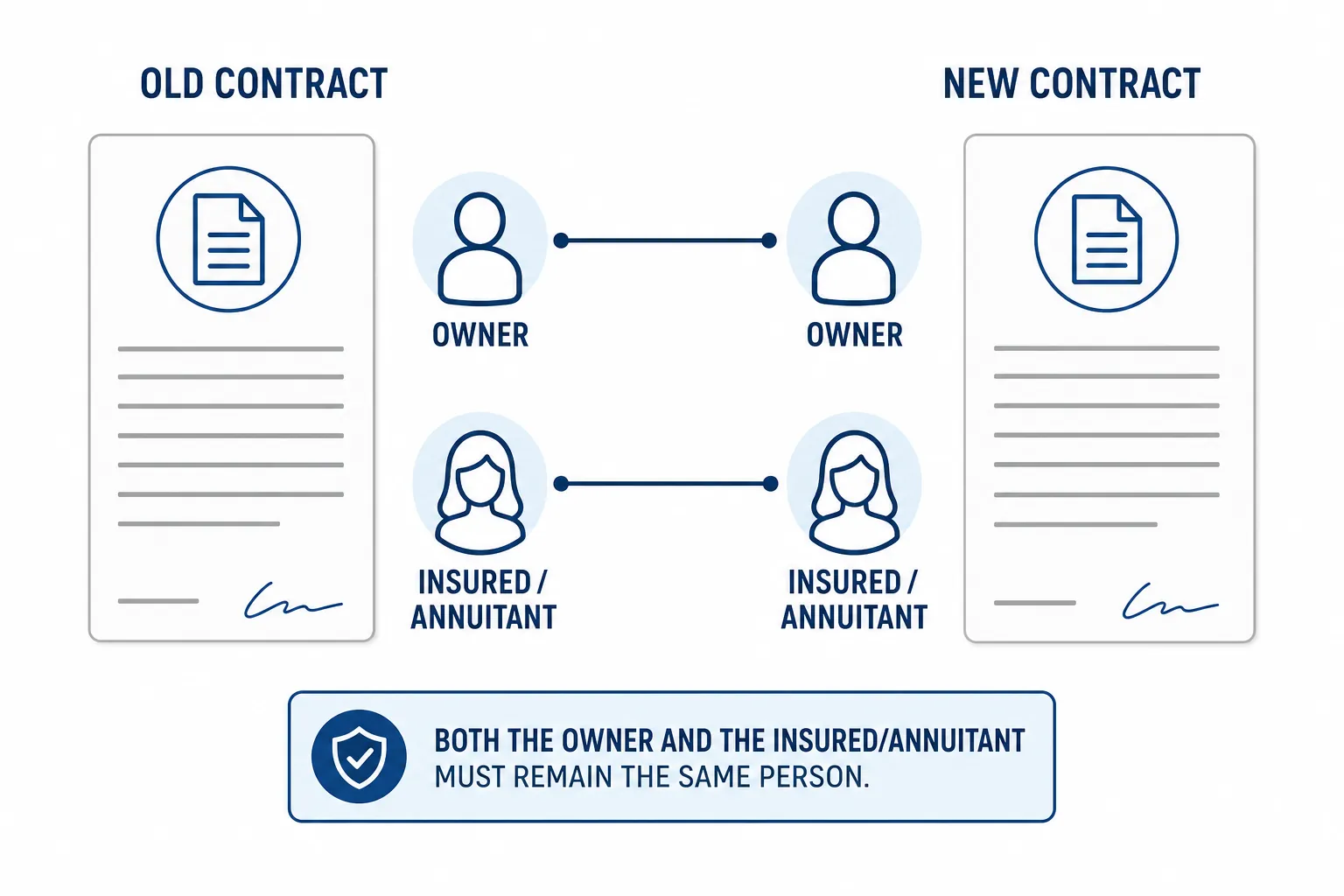
Section 1035(b) defines the relevant contract terms, and the statute’s nonrecognition rule operates on an exchange of contracts, not on a disguised transfer to a different taxpayer.[1] Secondary explanations commonly state the operational exam version this way: the exchange must preserve the same owner and the same insured or annuitant, depending on the contract involved.[2]
In a stem, underline the parties before you admire the product match. “A exchanges her policy on B’s life for a new policy on C’s life” is not the same identity profile as “A exchanges her policy on B’s life for another policy on B’s life.” The exam writer does not need an elaborate fact pattern; one changed name can be enough.
Qualified Retirement Accounts Are Outside §1035
Do not import IRA and qualified plan rollover rules into §1035. The provision concerns specified nonqualified insurance and annuity contract exchanges. IRAs, 401(k)s, and other qualified retirement accounts are not exchanged under §1035 merely because they can hold tax-favored assets or involve annuity-like economics.[2][4]
This distinction matters because exam stems often mix retirement vocabulary with annuity vocabulary. A nonqualified annuity contract may be in the §1035 universe. A qualified retirement account is not made eligible by calling the movement a “1035 exchange.” Use the correct Code mechanism for the asset and account type; do not let the word “annuity” pull qualified plan assets into the wrong rule.
Nonrecognition Does Not Mean a New Basis
Section 1035 is a nonrecognition rule. That means the permitted exchange does not trigger current gain or loss recognition. It does not mean the taxpayer receives a clean new basis in the replacement contract.
Basis generally carries over under the substituted-basis principles of §1031(d), and Investopedia’s overview of §1035 explains the practical consequence: the old contract’s basis moves into the new contract rather than being reset by the exchange.[4] For exam purposes, keep the point compact: tax-free exchange does not equal basis step-up.
A simple hypothetical shows the mechanics without turning this into a basis-planning lesson. If a taxpayer has basis in an old nonqualified annuity and makes a qualifying §1035 exchange into a new nonqualified annuity, the exchange itself is not the moment for current gain recognition, but the basis history follows into the replacement contract. The taxpayer does not get to pretend the old gain disappeared.
Timing and Withdrawals: Do Not Invent a Safe Harbor
Some planning discussions address withdrawals before an exchange and the risk that the steps may be treated together rather than separately. The available source record supports only a cautious exam point: Revenue Ruling 2007-24 is cross-referenced in secondary discussions, but the ruling text itself is not treated here as directly reviewed authority. Kitces discusses the step-transaction concern and the absence of a simple statutory bright-line timing rule for withdrawal-before-exchange sequencing.[2]
So do not memorize a made-up number of days as a universal safe harbor. If the exam tests timing, it is more likely testing the principle that form and sequence can matter, not asking you to bless a withdrawal-exchange recipe that the statute itself does not give.
A Fast Way to Work the Stem
When a question puts life insurance, annuity, endowment, LTC, owner names, insured names, basis, and retirement-account language into one paragraph, do not read it like a product suitability problem. Read it like a classification problem.
- Identify the old contract first: life insurance, endowment, annuity, or qualified long-term care insurance.
- Use only the destination list in the matching subsection of §1035(a)(1), (2), (3), or (4).
- Check the arrow direction; never allow annuity to life insurance under §1035.
- Verify same owner and same insured or annuitant where the exchange requires identity continuity.
- Remove qualified retirement accounts from the §1035 analysis and consider the correct retirement-account rule instead.
- If the exchange qualifies, remember that gain or loss is not currently recognized, but basis carries over.
That order keeps the statute in charge. A candidate who starts with “tax-free insurance swap” has to remember exceptions. A candidate who starts with the old contract and the statutory destination list usually does not.
Where the Rule Stops
Section 1035 is a narrow nonrecognition rule for specified nonqualified insurance, endowment, annuity, and qualified long-term care insurance contract exchanges. It is not a general retirement-account rollover rule. It is not a reversible swap rule. And it is not a license to ignore owner, insured, annuitant, basis, or timing facts because the products sound related.
If you can reconstruct the four statutory categories without looking, you can usually spot the trap before the answer choices start sounding reasonable.
References
Applies to
Exam applicability isn't specified for this technique yet. See all exam hubs.
Comments
Join the discussion with an anonymous comment.