
Method
IRAC Case Briefing for Students Using the TPS Immigration Law Case
Learn the IRAC case-briefing method step by step through Mullin v. Doe, the 2026 Supreme Court decision on Temporary Protected Status termination. This article gives students a transferable analytical technique for law school and exam prep.
Evidence panel
- Evidence level
- Limited
- Primary citation
- Mullin v. Doe, Cornell LII, 2026
If you have a Supreme Court case in front of you and need to turn it into an IRAC brief, start by refusing to brief “the case” as one giant reaction. Brief the question being decided. Mullin v. Doe, decided on June 25, 2026, is useful for that discipline because the opinions force three different legal questions into view: statutory jurisdiction, equal protection, and a separation-of-powers argument that appears in a concurrence rather than the majority holding.[1]
This is a methods article, not a news recap. The evidence for IRAC as a study routine is modest: it is a widely used legal-writing and case-briefing convention, not a magic formula with strong experimental proof behind every step. Its value here is practical. It gives you a way to keep the question, governing rule, relevant facts, reasoning, and outcome from sliding into one undifferentiated paragraph.
The IRAC Question Comes Before the Case Summary
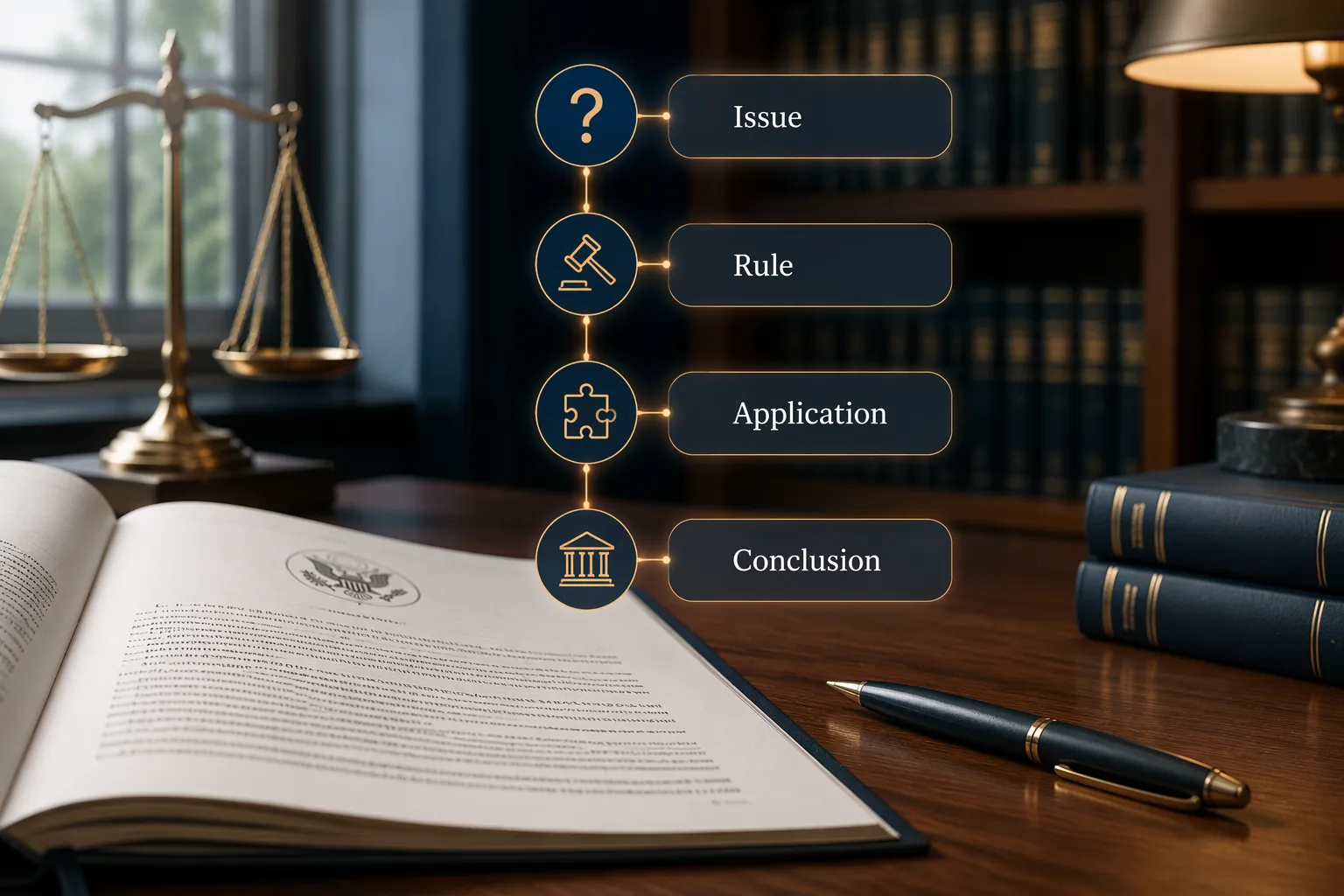
A workable IRAC brief answers four questions in order. The Issue asks what legal question the court had to resolve. The Rule identifies the legal standard that controlled that question. The Application explains how the court used the facts, text, precedent, or institutional considerations under that rule. The Conclusion states what came out of that issue.
That sounds simple until the opinion gives you more than one issue. A beginner often reads the syllabus, majority, concurrence, and dissent and walks away with a single sentence: “The Court let the administration end TPS.” That sentence may be true at the level of practical result, but it is too blunt for a case brief. It does not tell you which claim was barred, which constitutional theory failed, and which constitutional theory only appears in a separate opinion.
| IRAC Box | What You Write | What You Avoid |
|---|---|---|
| Issue | The precise legal question before the court | A broad policy question or personal reaction |
| Rule | The statute, doctrine, or precedent that controls | Every legal principle mentioned anywhere in the opinions |
| Application | How the court connects selected facts and legal materials | A plot summary of the litigation |
| Conclusion | The answer to that issue and its effect | A statement that overclaims what all justices agreed to |
Map Mullin v. Doe Before You Brief It
Mullin v. Doe concerned the termination of Temporary Protected Status for Haitian and Syrian nationals. TPS is a statutory protection that can allow nationals of designated countries to remain and work in the United States temporarily when conditions in the home country make return unsafe or impracticable.[2] That background matters, but it should not be the first box in your IRAC brief. The first box is the issue.
The stakes were not abstract. An April 2026 FWD.us report, using 2024 American Community Survey data and March 2025 Congressional Research Service population figures, estimated that about 1.3 million TPS holders from 17 countries contributed $29 billion annually to the U.S. economy and paid $7.8 billion in taxes.[3] Those figures help explain why the litigation mattered to families, employers, and communities. They do not prove how the jurisdictional statute should be read or whether the equal protection claim should succeed.
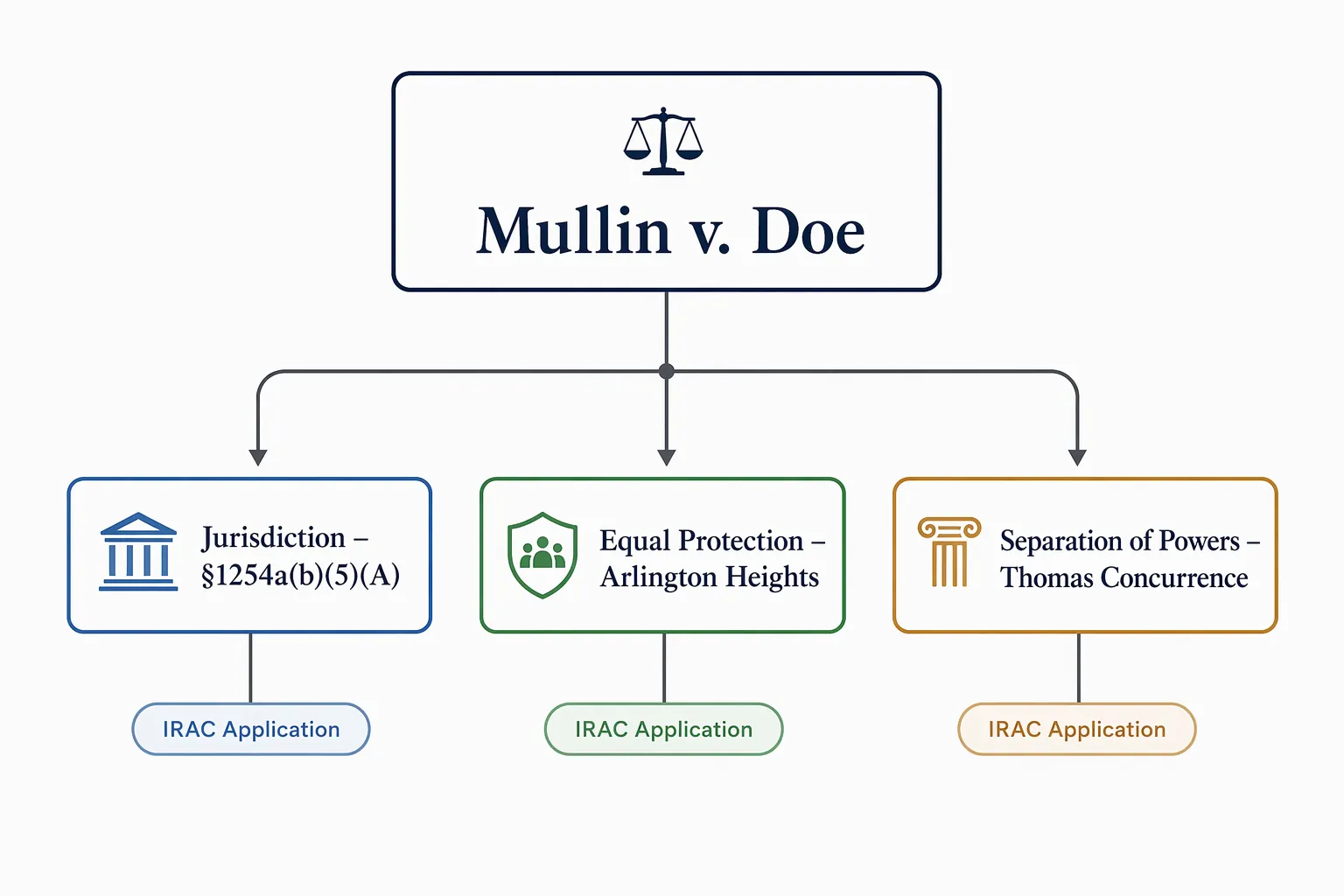
For briefing purposes, the case separates into this working map:
- Jurisdiction: whether 8 U.S.C. §1254a(b)(5)(A) barred judicial review of non-constitutional challenges to TPS termination.
- Equal protection: whether the plaintiffs plausibly showed that the termination decisions were infected by racial animus under the Arlington Heights framework.
- Separation of powers: whether Congress may strip courts of jurisdiction over constitutional claims, a position developed in Justice Thomas’s concurrence rather than adopted as the majority’s holding.
That map does more than organize your notes. It prevents a common briefing error: treating a fifth vote for the judgment as though every sentence in the fifth justice’s separate writing became the law of the case.
IRAC Pass One: Jurisdiction
Issue
The jurisdiction issue asks whether §1254a(b)(5)(A) prevented courts from reviewing the plaintiffs’ non-constitutional claims challenging the termination of TPS designations.[1]
Rule
For this issue, the rule comes from the jurisdiction-stripping language of the TPS statute. The Court treated the statutory review bar as controlling for non-constitutional objections to the Secretary’s TPS determinations.[1] In an IRAC brief, that means the rule box should not begin with equal protection doctrine, immigration policy, or a general presumption of review. It should begin with the statutory limit on review.
Application
The useful student move is to notice how little the court needs to say about the wisdom of ending TPS once it classifies a claim as non-constitutional and within the statutory review bar. The analysis narrows. The relevant materials are not the hardship caused by termination, the economic contributions of TPS holders, or the strength of the plaintiffs’ policy objections. The relevant materials are the statutory text, the type of claim being brought, and whether that claim is one Congress placed outside judicial review.
This is where many case briefs become sloppy. A student may write, “The Court held the administration could terminate TPS.” That statement skips the jurisdictional path. A stronger Application box says: the Court characterized certain challenges as non-constitutional attacks on TPS termination decisions; because §1254a(b)(5)(A) barred review of those claims, the courts lacked authority to consider them.[1]
The oral argument reporting illustrates why the statutory question mattered. The New York Times reported Justice Sotomayor asking, “What you basically are saying is that Congress wrote a statute for no purpose,” a question aimed at what work the review-limiting statute was supposed to do.[4] Treat that as reported oral-argument context, not as a substitute for the opinion. For your brief, the holding still comes from the Court’s written disposition.
Conclusion
On the jurisdiction issue, the Court concluded that the statutory bar prevented review of the non-constitutional claims.[1] The clean conclusion is narrow: those claims were not judicially reviewable. Do not turn that into a conclusion that every challenge to TPS termination was barred, because the constitutional claim required separate analysis.
IRAC Pass Two: Equal Protection
Issue
The equal protection issue asks whether the plaintiffs showed that the TPS termination decisions were motivated by unlawful racial animus, including through presidential statements about Haitians and Syrians, under the framework associated with Village of Arlington Heights.[1]
Rule
For equal protection, the rule is not the TPS review bar. The question changes, so the rule changes. The relevant doctrine asks whether government action was taken with discriminatory purpose, and Arlington Heights supplies a way to evaluate intent using direct and circumstantial evidence.[1]
In a student brief, the Rule box should stay disciplined. It should identify the intent framework and the kind of evidence that may matter. It should not simply announce that offensive statements are bad or that immigration decisions receive deference. Those may become part of the argument, but they are not the rule by themselves.
Application
This is the most instructive part of Mullin for students because the majority and dissent do not merely disagree about the emotional tone of the case. They make different choices about which facts matter to the legal inquiry.
The majority treated the equal protection materials as insufficient to connect the challenged TPS decisions to unconstitutional animus. In briefing terms, the majority’s Application box minimizes the probative value of presidential statements and focuses on whether the plaintiffs established the necessary legal connection between those statements and the agency decisions.[1]
The dissent, by contrast, foregrounded statements attributed to the President and treated them as central to the intent analysis.[1] Just Security’s analysis describes the majority’s factual presentation as “sanitized” and emphasizes the dissent’s reproduction of the statements as part of a dispute over how the record should be read.[5] That contrast is not decoration. It is the Application step in action: legal reasoning often turns on whether a fact is characterized as background noise, circumstantial evidence, or direct evidence of purpose.
A weak brief would write, “The majority ignored racist statements, while the dissent cared about them.” That may capture a reaction, but it does not yet brief the doctrine. A stronger Application box asks what Arlington Heights requires and then tracks how each opinion treats the same material under that requirement. Did the statements show decisionmaker intent? Were they temporally or institutionally connected to the TPS terminations? Were later agency explanations enough to break the connection? Those are legal questions, not just narrative choices.
This is also where students should be careful with the word “facts.” The majority’s facts are not automatically neutral because they appear in the majority. The dissent’s facts are not automatically legally decisive because they are vivid. Your IRAC brief should record how each opinion uses the facts to answer the legal question. If you want to add critique, place it after the brief, not inside the rule statement.
Conclusion
On equal protection, the Court rejected the plaintiffs’ constitutional challenge.[1] The conclusion should say that the equal protection claim failed under the Court’s analysis. It should not say that the Court held presidential statements can never matter in an intent inquiry, because that would be broader than the case requires.
IRAC Pass Three: Separation of Powers in the Thomas Concurrence
Issue
The separation-of-powers issue asks whether Congress can strip federal courts of jurisdiction over constitutional claims. In Mullin, that argument is most important because Justice Thomas wrote separately to address it; it is not the majority’s holding.[1]
Rule
The rule box here has to identify the source correctly. Justice Thomas’s concurrence argued that Congress has broad authority to limit federal jurisdiction and criticized Bolling v. Sharpe, the case applying equal protection principles to the federal government through the Fifth Amendment.[1] That is a separate opinion. It helps explain one justice’s reasoning for the judgment, but it does not become the controlling rule unless the Court adopts it.
Application
This is the place to slow down over vote-counting. A student sees that Justice Thomas supplied a vote for the judgment and may assume that his full concurrence is now the rule. That is not how opinions work. The judgment tells you who won. The majority opinion tells you the reasoning that controlled for the Court. A concurrence may agree with the result while using a different or broader theory.
So the Application box for this issue should not be written the same way as the jurisdiction box. For jurisdiction, you can describe the Court’s controlling statutory analysis. For the Thomas concurrence, you should write something like this: Justice Thomas would go further and conclude that the statutory bar could foreclose even constitutional claims, because in his view Congress may restrict federal jurisdiction in this area and Bolling was wrongly decided.[1] That sentence is useful because it preserves the difference between “the Court held” and “one concurring justice argued.”
The separation-of-powers discussion matters for students even if it is not the holding. It shows how a case can contain a live constitutional theory that may appear on an exam as a concurrence question: identify the argument, explain its source, and state why it does or does not control the outcome.
Conclusion
The proper conclusion is limited. Justice Thomas’s concurrence advances a broader separation-of-powers position, but the briefing lesson is that it remains concurrence territory.[1] If your case brief reports it as the Court’s holding, your brief has confused judgment with controlling rationale.
A Compact Student Brief of Mullin v. Doe
After you work through the separate IRAC passes, you can compress them into a class-ready case brief. The compressed version should be shorter than your reading notes but more precise than a news summary.
| Issue | Rule | Application | Conclusion |
|---|---|---|---|
| Did §1254a(b)(5)(A) bar review of non-constitutional TPS termination challenges? | The TPS statute limits judicial review of certain TPS determinations. | The Court classified the relevant non-constitutional objections as falling within the statutory review bar. | Those non-constitutional claims were not reviewable. |
| Did the TPS terminations violate equal protection because of racial animus? | Discriminatory-purpose analysis under Arlington Heights considers evidence of intent. | The majority found the plaintiffs’ evidence insufficient; the dissent gave greater weight to presidential statements and record context. | The equal protection claim failed. |
| Could Congress bar review of constitutional claims entirely? | Justice Thomas’s concurrence advanced a broad jurisdiction-stripping theory and criticized Bolling. | That reasoning supported his vote but went beyond the majority’s necessary holding. | The theory belongs in the concurrence box, not the controlling-holding box. |
That table is not a replacement for reading the opinion. It is a guardrail. If you cannot fill one cell without borrowing language from another issue, you probably have not separated the questions yet.
How This Transfers to Cold Calls, Exams, and GRE Analytical Writing
In a law school cold call, IRAC keeps you from narrating everything you read. If the professor asks about jurisdiction, answer jurisdiction. Do not lead with the dissent’s moral force unless the question has moved to equal protection. If the professor asks whether Thomas’s view controls, do not answer by saying he was the fifth vote. Explain the difference between judgment and holding.
On an exam, the same routine helps you allocate time. A statutory-review question needs text and claim classification. An equal protection question needs intent doctrine and record use. A concurrence question needs opinion mechanics: majority, concurrence, dissent, holding, judgment. The facts are not equally relevant to every question.
For GRE Analytical Writing, the transfer is less about legal doctrine and more about argument control. A legal passage may contain a claim, a standard, evidence, and a conclusion. IRAC trains you to ask what the argument must prove, what rule or assumption governs the proof, what evidence is actually doing work, and whether the conclusion follows. That is not a substitute for GRE-specific practice, but it is a useful discipline for test-takers who tend to summarize instead of analyze.
Mullin v. Doe works as a TPS immigration law case study for students because it makes the same reader perform the routine more than once. The case does not reward a single political label or a single holding sentence. It rewards separating questions, assigning the right rule to each question, watching how facts move inside the Application step, and stopping the Conclusion before it becomes broader than the opinion.
References
- Mullin v. Doe, Cornell Legal Information Institute, June 25, 2026, link
- Temporary protected status and the Supreme Court: An explainer, SCOTUSblog, March 2026, link
- Temporary Protected Status Report, FWD.us, April 2026, link
- Supreme Court Oral Arguments on Immigration and Temporary Protected Status, The New York Times, April 29, 2026, link
- Supreme Court Mullin Doe TPS, Just Security / Stanford Law School, link
Comments
Join the discussion with an anonymous comment.