
Method
Can Intermittent CO₂ Breathing Prevent Dementia?
A new study on intermittent CO₂ breathing shows it can activate brain waste clearance and reduce dementia-related proteins. But is it ready for home use? This article breaks down the evidence, sample sizes, and caveats.
Evidence panel
- Evidence level
- Limited
- Primary citation
- Ryman et al., npj Parkinson's Disease, 2025
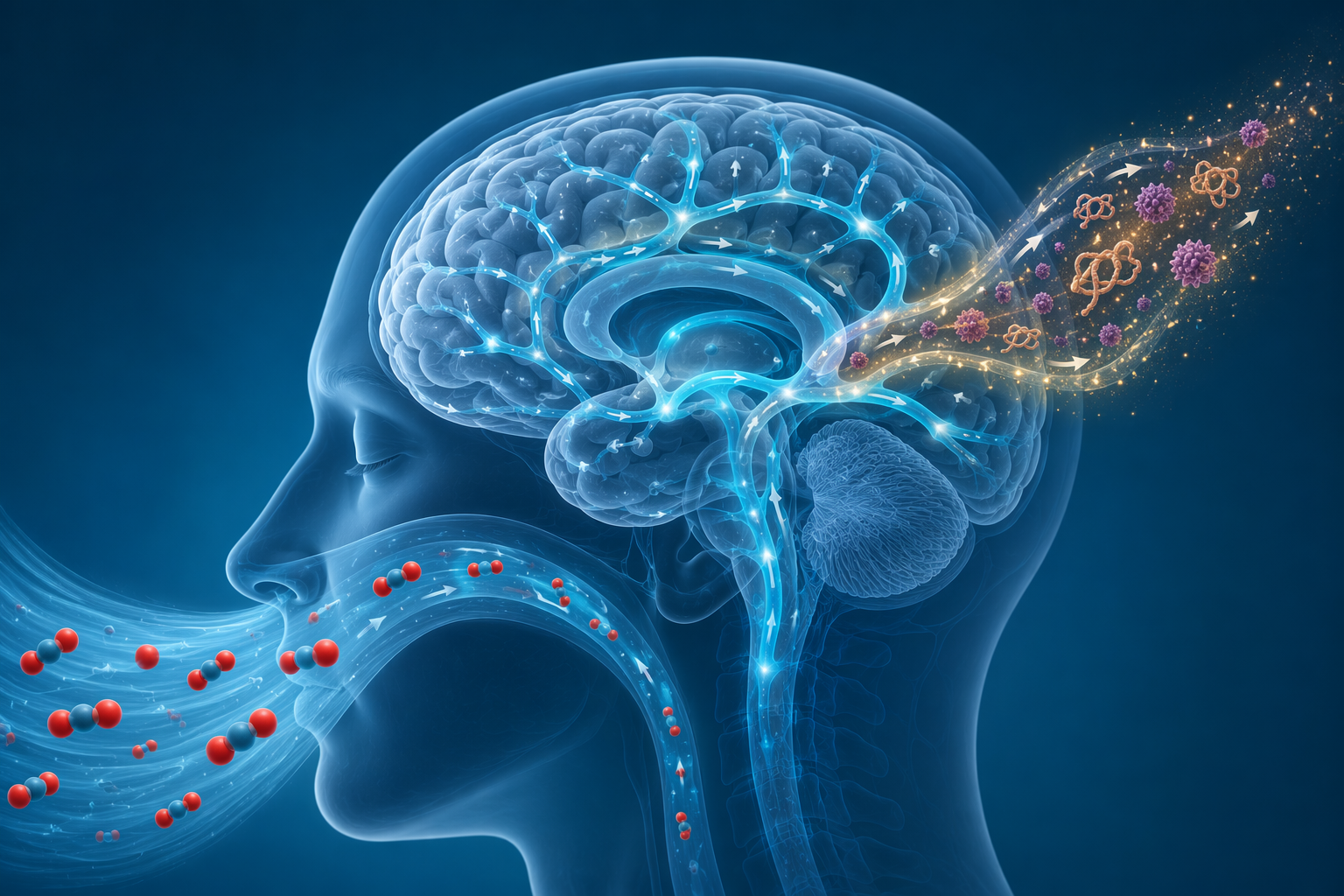
The short answer is: interesting biology, early evidence, no consumer-ready dementia-prevention method. The studies attracting attention are not saying that ordinary CO2 exposure is good for the brain, and they are not showing that people can prevent dementia by breathing differently at home. They are testing a controlled intermittent hypercapnia protocol: a research-supervised gas mixture containing 5% CO2, delivered in repeated 35-second ON/OFF cycles for about 30 minutes, with biomarker changes measured afterward.[1]
That distinction matters because the most intriguing part of the work is also the easiest part to oversimplify. The claim is not “more CO2 clears the brain.” The claim is narrower: brief, cycling increases in CO2 may activate brain-fluid dynamics linked to glymphatic waste clearance while a person is awake. In small human samples, that has been associated with short-window reductions in proteins relevant to neurodegenerative disease. It has not yet been shown to prevent dementia, preserve memory, slow clinical decline, or improve long-term cognitive outcomes.
What Was Actually Tested
The protocol being discussed is specific enough that changing it may change the biology. Participants did not sit in a stuffy room. They did not inhale carbon monoxide. They did not try a breathing exercise. In the published University of New Mexico and Mind Research Network work, the intervention used intermittent hypercapnia: 5% CO2 delivered in alternating 35-second ON and OFF periods for roughly 30 minutes.[1]
| Question | What the current evidence supports |
|---|---|
| Was this CO2 or carbon monoxide? | CO2. Carbon monoxide, or CO, is a different gas and a poisoning hazard. |
| Was this normal indoor CO2 exposure? | No. The protocol used controlled 5% CO2 cycling under research conditions. |
| Was it continuous CO2 exposure? | No. The pattern was intermittent, with 35-second ON/OFF cycles. |
| Was dementia prevention measured? | No. Current human evidence centers on glymphatic activation and biomarker clearance, not dementia incidence. |
| Can someone approximate it at home? | No. The available evidence does not support self-administration. |
The cycling pattern is not a decorative detail. CO2 changes blood chemistry, breathing drive, vascular tone, and brain physiology. A controlled pulse may create rhythmic fluid movement; a sustained exposure can become a different physiological condition. This is why the intervention should be read as a lab protocol, not as a wellness habit with a convenient ingredient.
Why Researchers Care About Glymphatic Activation
The glymphatic system is one of the brain’s waste-clearance pathways. It is often discussed in sleep research because sleep-related brain rhythms appear to help move fluid through brain tissue and clear soluble waste. The newer CO2 work is striking because it suggests that a wakefulness-based intervention may be able to induce some of the fluid-dynamic features usually associated with sleep-linked clearance biology.[2]
That is a real scientific opening. Alzheimer’s disease and related dementias involve proteins such as amyloid-beta and tau; Parkinson’s disease and related disorders involve alpha-synuclein. If a short physiological intervention can measurably alter clearance of these proteins, it deserves careful study. The word “clearance,” though, should not be stretched into “prevention.” A biomarker moving after an intervention is not the same as fewer people developing dementia years later.
The Strongest Published Evidence Is Still Small at the Protein Level
The load-bearing published study is Ryman et al. 2025 in npj Parkinson’s Disease. It included 73 participants overall and tested whether intermittent hypercapnia could activate glymphatic function during wakefulness.[1] Within that broader study, the protein-clearance substudy was much smaller: 10 participants. In that n=10 group, researchers reported reductions after intermittent hypercapnia in alpha-synuclein, neurofilament light chain, GFAP, amyloid-beta, and pTau217.[1]
Those protein names are why the finding travels so quickly. Amyloid-beta and pTau217 sit close to the Alzheimer’s conversation; alpha-synuclein sits close to Parkinson’s disease biology; NfL and GFAP are often discussed as markers of neuronal or glial injury. Seeing several of them move in the same experimental direction after a short intervention is unusual enough to justify attention.
But the sample size is not a footnote. A 10-person substudy can show that a biological signal is worth following. It cannot establish a reliable clinical effect across ages, disease stages, vascular profiles, medication patterns, sleep status, or dementia risk groups. It also cannot tell us whether repeated sessions would remain beneficial, lose effect, create risk, or change cognition.
The 2026 Dementia-Relevant Data Are Closer to the Headline, but Less Settled
The more dementia-facing result came through an AAIC 2026 presentation. According to the reported conference data, 12 participants received the 30-minute 5% CO2 intermittent protocol: 8 healthy participants and 4 participants with elevated tau or mild cognitive impairment. The presentation reported amyloid-beta and tau clearance after the intervention.[3]
That is meaningful because it moves the discussion closer to Alzheimer’s-related proteins in a group that includes people with elevated tau or mild cognitive impairment. It is also secondary evidence at this point. A conference presentation is not the same evidentiary object as a peer-reviewed paper, and n=12 is not a prevention trial. The New Scientist coverage and University of New Mexico materials help explain why researchers are excited, but they do not convert the result into clinical guidance.[3][4]
As of Q3 2026, the human evidence has a clear hierarchy: the 2025 peer-reviewed paper is the strongest base; the 2026 AAIC report is a relevant but preliminary extension; neither shows reduced dementia incidence or preserved cognition over time.
What the Biomarker Changes Do and Do Not Mean
A protein decrease after an intervention can mean several things. It may reflect increased movement of proteins out of brain compartments. It may reflect a temporary redistribution into measurable fluid spaces. It may reflect a clearance window that opens briefly and then closes. Current reports point to a transient effect, with a clearance window of about 1 hour rather than a demonstrated long-term reset of brain waste handling.
For dementia prevention, the missing outcomes are the ones patients and families actually live with: memory trajectories, daily functioning, conversion from mild cognitive impairment to dementia, safety after repeated exposure, and disease incidence over years. None of those outcomes has been reported as established evidence for intermittent CO2 breathing.
This does not make the biomarker data unimportant. Early mechanistic studies often begin with physiology before they reach clinical endpoints. It does mean the responsible label is experimental. The finding belongs in the category of “possible mechanism worth testing,” not “dementia-prevention method to try.”
Why Indoor CO2 Is the Wrong Comparison
One of the most misleading takeaways would be to treat everyday CO2 exposure as beneficial. Indoor CO2 studies are about a different exposure pattern and a different question. Allen et al. 2016 reported that office-like CO2 levels in the 945 to 1,400+ ppm range impaired cognitive performance measures compared with lower-CO2 conditions.[5]
That finding does not disprove intermittent hypercapnia as a research intervention. It simply prevents the lazy interpretation that “CO2 helps the brain.” A stuffy classroom, poorly ventilated office, or sealed bedroom is not reproducing 5% CO2 delivered in 35-second cycles with monitoring. Chronic low-level exposure and brief controlled pulses are different biological situations.
The same caution applies to prolonged hypercapnia. Goodman and Iliff’s 2020 review discusses evidence that sustained hypercapnia can impair glymphatic function, which is exactly why the intermittent timing cannot be separated from the hypothesis.[6] If the rhythm is part of the mechanism, then “more” is not a safe or logical substitution.
CO2 Is Not CO
A quick correction is necessary because the search terms get messy: CO2 is carbon dioxide; CO is carbon monoxide. Carbon monoxide poisoning is dangerous and can be fatal. Nothing in the intermittent CO2 research suggests inhaling carbon monoxide, blocking ventilation, or manipulating combustion sources.
Even with CO2, the safety boundary remains firm. A research gas mixture delivered with supervision is not equivalent to a consumer device, a bag-breathing experiment, a mask hack, or an attempt to tolerate air hunger. CO2 affects breathing drive and cardiovascular physiology; people with pulmonary, cardiac, neurologic, panic, or vascular conditions may have risks that a headline will not disclose.
What Would Need to Happen Before This Becomes a Prevention Method
The next evidentiary step is not a better home protocol. It is larger, peer-reviewed human research that separates short-term biomarker movement from durable clinical benefit. A credible dementia-prevention claim would need repeated-session safety data, standardized monitoring, appropriate control conditions, longer follow-up, and cognitive or clinical endpoints.
- Peer-reviewed replication of the AAIC 2026 findings in larger samples.
- Clear reporting of who benefits, who does not, and who may be harmed.
- Dose and timing studies that test whether the 35-second cycling pattern is essential.
- Longer follow-up showing whether protein changes translate into cognition or disease-course outcomes.
- Clinical-grade safety procedures before any use outside research settings.
Until then, the fairest reading is also the narrowest one: intermittent CO2 breathing may become an important tool for studying wakeful glymphatic activation and dementia-related protein clearance. In Q3 2026, it is not a dementia-prevention intervention for consumers.
References
- Intermittent hypercapnia activates glymphatic clearance in humans, npj Parkinson’s Disease, 2025
- Brain-wide vasomotion drives glymphatic fluid transport, Journal of Cerebral Blood Flow & Metabolism
- AAIC 2026 presentation on intermittent CO2 breathing and amyloid-beta and tau clearance, Alzheimer’s Association International Conference, 2026
- CO2 breathing may clear dementia-related proteins from the brain, New Scientist, 2026
- Associations of cognitive function scores with carbon dioxide, ventilation, and volatile organic compound exposures in office workers, Environmental Health Perspectives, 2016
- Glymphatic dysfunction in aging and neurodegeneration, Goodman & Iliff, 2020
Applies to
Exam applicability isn't specified for this technique yet. See all exam hubs.
Comments
Join the discussion with an anonymous comment.