
Method
How scientists find life's building blocks in meteorites
This article explains the multi-step analytical pipeline — from clean sample acquisition and hot-water extraction to derivatization and mass spectrometry — that researchers use to detect organic compounds like amino acids and nucleobases in meteorite and asteroid samples, and how understanding this workflow helps students critically evaluate claims about extraterrestrial origins.
Evidence panel
- Evidence level
- pending review
- Primary citation
- citation pending review
A student hearing that meteorites contain life’s building blocks usually gets handed the exciting part first: amino acids, nucleobases, sugars, organic chemistry from space. The better question starts one step earlier: if a dark rock lands on Earth, or if asteroid grains arrive sealed from a spacecraft mission, how would scientists actually know what tiny organic molecules are inside?
The answer is less like spotting a fossil and more like making an extremely careful cup of tea. In NASA Goddard’s astrobiology workflow, a meteorite sample can be heated in water so soluble compounds move out of the crushed rock and into the liquid. That liquid extract is then cleaned, chemically prepared, and sent through instruments that separate and identify molecules far below what a human could see, smell, or weigh directly.[1]
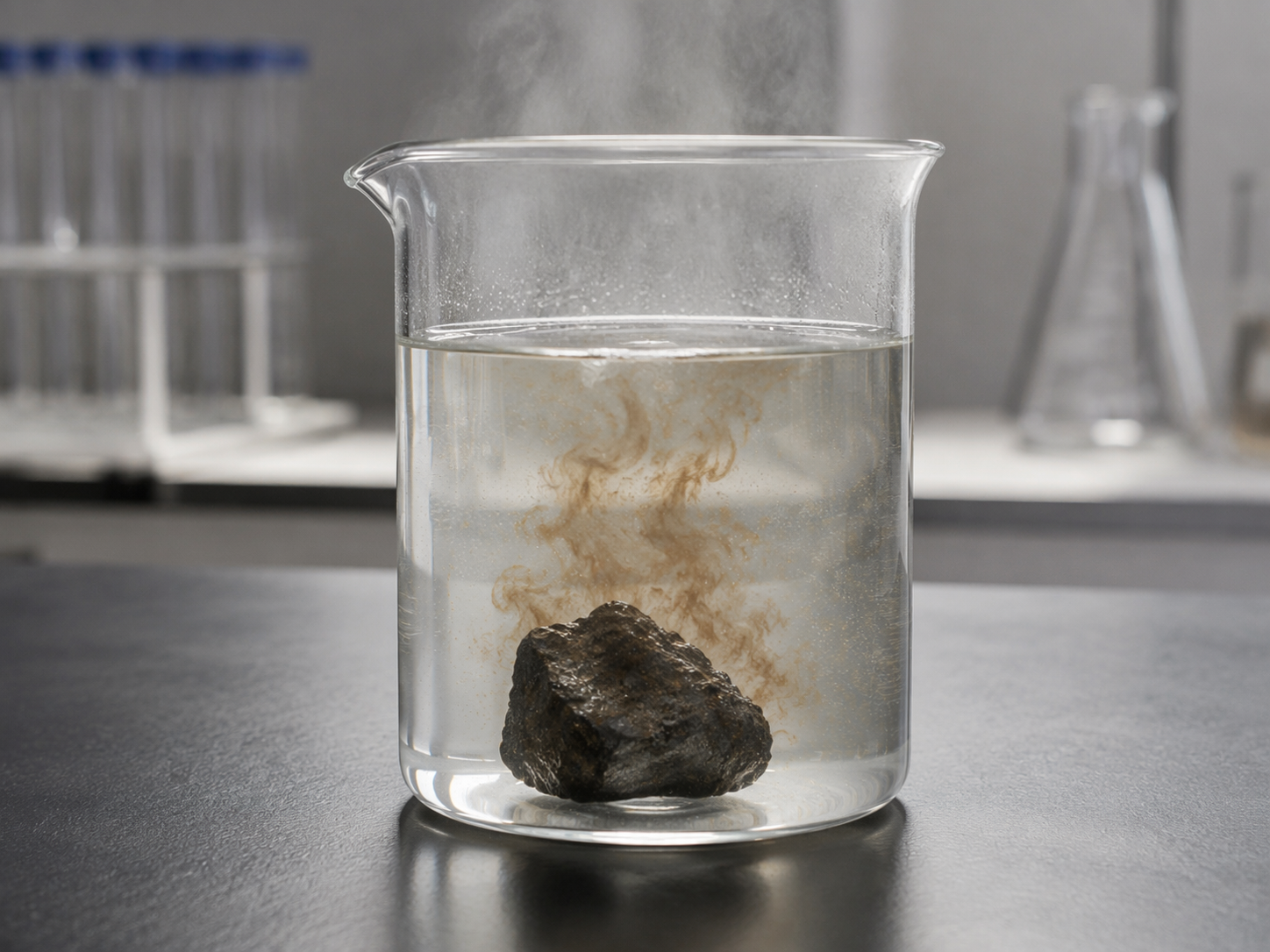
That “meteorite tea” image is useful because it keeps the claim physical. The molecule is not simply “found” in the rock by declaration. Something is sampled, something is dissolved, something is removed, something is tagged, and only then does an instrument produce a signal. Each step can strengthen the evidence, and each step can also introduce a question.
The sample matters before the instrument does
A mass spectrometer cannot rescue a careless sample history. If a meteorite has sat on Earth, it has met rainwater, soil chemistry, microbes, handling tools, storage bags, and laboratory air. Some meteorites still preserve extraterrestrial organic chemistry, but the interpretation has to account for everything that may have touched them after arrival.
This is why asteroid-return samples are so valuable. NASA’s OSIRIS-REx mission brought back material collected directly from asteroid Bennu, and the returned sample included 121.6 grams of regolith available for study.[2] That does not make every molecule automatically extraterrestrial in origin, but it changes the contamination question. Scientists can compare the sample with witness materials, curation records, clean-room procedures, and mission hardware history rather than reconstructing an unknown journey through a field, desert, or ice sheet.
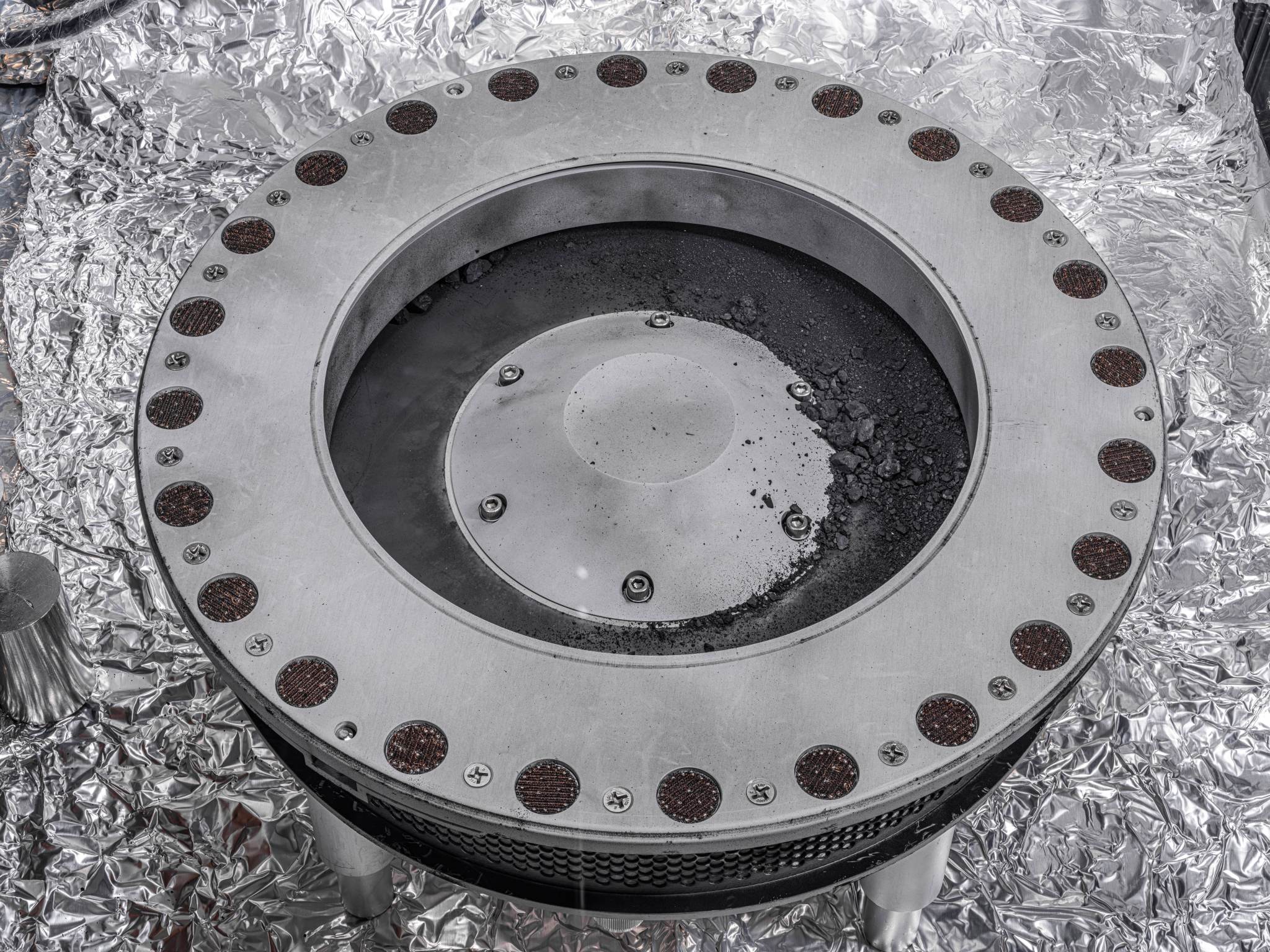
For a student, this is the first checkpoint in reading any headline about life’s building blocks in meteorites: ask what the sample is and how it was handled. A freshly returned asteroid sample, a curated Antarctic meteorite, and a long-known meteorite fragment from a museum drawer do not carry the same evidentiary burden.
Hot water pulls out the soluble chemistry
The hot-water extract is a practical compromise. Many biologically relevant small molecules are polar enough to move into water, so heating a powdered sample with water can draw out amino acids, nucleobases, and related compounds. The result is not a pure bottle of “space amino acids.” It is a complicated liquid containing target molecules, salts, minerals, and many other soluble materials from the sample.[1]
That messy extract is exactly why abundance numbers should not be treated as if they were stamped onto the meteorite. The number reported for a molecule depends partly on what the extraction method was able to remove. If one study uses one solvent condition and another uses a different preparation, they may not be measuring an identical chemical fraction.
This matters especially when the molecule is scarce. A compound present at a trace level can disappear into background noise if it is not efficiently extracted, or appear less abundant if the chosen method leaves much of it behind. The pipeline is not a neutral window; it is a set of choices that makes some molecules easier to see than others.
Desalting is not cleanup for neatness
After extraction, researchers often need to remove salts and other interfering materials. In amino acid analysis, a common route uses cation-exchange chemistry: positively charged amino acids bind to the exchange material while many salts and unwanted components are washed away, and then the amino acids are released for later analysis.[3]
This step is easy to underestimate because it sounds like housekeeping. It is more serious than that. Salts can interfere with chemical reactions, damage separations, suppress ionization in mass spectrometry, and make a weak signal harder to trust. The analyst is not polishing the sample for aesthetic reasons; the analyst is reducing the number of ways the instrument can be misled.
| Stage | What happens | What the student should ask |
|---|---|---|
| Clean acquisition and curation | The sample is collected, stored, and documented with contamination control in mind. | What touched the sample before analysis? |
| Hot-water extraction | Soluble compounds move from powdered rock or regolith into water. | Which molecules would this method favor or miss? |
| Cation-exchange desalting | Salts and interfering materials are reduced before measurement. | Could matrix effects distort the signal? |
| Derivatization | Target molecules are chemically tagged or transformed so instruments can detect them better. | Which chemical classes does this route make visible? |
| GC-MS or HPLC/ESI-HRMS detection | Molecules are separated, ionized, and identified by mass-related signals. | How strong is the identification, and what comparison standards were used? |
Chemical tagging turns tiny molecules into measurable ones
Amino acids and related compounds are small, polar, and often not cooperative enough to analyze directly by every instrument. Before gas chromatography-mass spectrometry, or GC-MS, researchers commonly derivatize them: they chemically alter the molecules so they become more volatile, more separable, or easier to detect.[3]
Two derivatization routes show why “they found amino acids” is too vague. One route uses OPA/NAC, short for o-phthaldialdehyde and N-acetyl-L-cysteine, which can help analyze amino acids by liquid chromatography and distinguish enantiomers: mirror-image forms of chiral molecules. Another route uses TFA/TFAA chemistry, involving trifluoroacetic acid and trifluoroacetic anhydride, to prepare amino acids for GC-MS analysis.[3]
The choice is not cosmetic. A derivatization method decides which compounds react well, which ones react poorly, and what kind of evidence the instrument can produce. If the question is simply whether an amino acid is present, one analytical route may be enough. If the question is whether left- and right-handed forms occur in equal amounts, the method has to preserve and resolve chirality.
That chirality question is one reason Bennu has been so closely watched. Reports on Bennu material described amino acids with a racemic pattern, meaning left- and right-handed forms appeared in roughly equal amounts, and Daniel Glavin’s team has continued investigating what that means.[2] A racemic result is important, but it is not a final origin story by itself. It may fit nonbiological chemistry, it may reflect alteration history, and it still has to be interpreted alongside contamination controls and method details.
Mass spectrometry supplies the signal, not the whole conclusion
Once molecules are extracted, cleaned, and prepared, the instrument begins the part that usually gets compressed into one phrase. GC-MS separates derivatized compounds as they travel through a gas chromatograph, then measures mass-related fragments that help identify them. HPLC/ESI-HRMS takes a different path: high-performance liquid chromatography separates compounds in liquid, electrospray ionization turns them into ions, and high-resolution mass spectrometry measures them with enough precision to separate very similar formulas.
The instrument’s output is not a little label saying “life ingredient confirmed.” It is a pattern: retention time, mass-to-charge values, fragmentation behavior, comparisons with standards, blank controls, and statistical decisions about what counts as a real peak. The better the paper, the easier it is to follow how the authors moved from a signal to an identification.
This is where sensitivity can be both beautiful and dangerous. Oba and colleagues used HPLC/ESI-HRMS to identify a broad set of purine and pyrimidine nucleobases in carbonaceous meteorites, reporting detection capability at parts-per-trillion levels.[4] That level of sensitivity is astonishing. It also means contamination control, blanks, extraction choices, and identification criteria become more important, not less.
Nucleobases show why method details change the number
Nucleobases are the nitrogen-containing molecules familiar from DNA and RNA, such as purines and pyrimidines. Finding them in meteorites is meaningful because it shows that prebiotic organic chemistry can be associated with extraterrestrial materials. It does not show that DNA arrived inside the meteorite, and it does not show that life arrived inside the meteorite.
Oba et al. are especially useful for students because their work makes the method-dependence visible. The study compared extraction conditions and noted that different extraction methods can produce different abundance values for nucleobases.[4] That caveat does not weaken the importance of the detection. It tells the reader what kind of claim the data can support: not “this meteorite contains exactly one permanent amount of this nucleobase,” but “under this extraction and analytical workflow, this compound was detected and quantified in this way.”
Murchison is impressive, but not a magic number
The Murchison meteorite often appears in discussions of organic richness, and for good reason. A 2010 study reported very high molecular diversity in Murchison, including a figure of more than 14,000 molecular compositions detected by high-resolution mass spectrometry.[5] That is a spectacular result, but it should not be repeated as though “14,000 compounds” were a universal, context-free property of the meteorite.
The number belongs to a particular study, sample preparation, instrument, and interpretation of mass-spectrometric data. Another method could emphasize a different portion of the meteorite’s chemistry. The lesson is not to be unimpressed by Murchison. The lesson is to be precise about what kind of measurement produced the impressive figure.
What students can safely conclude
Detecting amino acids, nucleobases, sugars, and other organic compounds in meteorites or asteroid samples is real evidence that complex organic chemistry occurs beyond Earth. It is not a shortcut to saying life came from space. The phrase “building blocks of life” is useful only if it remains attached to the laboratory route that made the molecules visible.
A careful reader can separate four different claims. First, a molecule was detected. Second, it was identified with a particular level of confidence. Third, it is unlikely to be contamination, based on sample history and controls. Fourth, it may tell us something about extraterrestrial chemistry or prebiotic chemistry. Those claims are related, but they are not the same claim.
So the next time a headline says a meteorite contains life’s ingredients, the useful follow-up is not automatic disbelief. It is a sequence of better questions: Where did the sample come from? How was it kept clean? What was extracted? What was removed before analysis? Which derivatization route was used? Did the instrument detect the molecule directly or through a chemical tag? Were blanks and standards reported? Does the interpretation distinguish extraterrestrial origin from contamination or unresolved chemistry?
The romance is still there. It is just more interesting when the evidence is allowed to be as detailed as the claim.
References
- Basic Explanation, NASA Goddard Astrobiology Analytical Laboratory.
- Life’s Building Blocks Found in Bennu Samples, Eos.
- Compound-specific carbon isotope analyses of amino acids in meteorites, National Center for Biotechnology Information, 2019.
- Identifying the wide diversity of extraterrestrial purine and pyrimidine nucleobases in carbonaceous meteorites, National Center for Biotechnology Information, 2022.
- High molecular diversity of extraterrestrial organic matter in Murchison meteorite revealed 40 years after its fall, Proceedings of the National Academy of Sciences, 2010.
Applies to
Exam applicability isn't specified for this technique yet. See all exam hubs.
Comments
Join the discussion with an anonymous comment.