
Method
How Historical Research Solved the 1952 Puerto Rico Plane Crash
This article uses the 1952 Pan Am Flight 526A crash and its 2026 rediscovery to show how historians apply source criticism, archival investigation, oral history, and sonar technology to reconstruct events when witnesses are gone and documents are incomplete.
Evidence panel
- Evidence level
- Moderate
- Primary citation
- Pan Am Flight 526A CAB Report (1952)
The useful question in the 1952 Puerto Rico plane crash historical research case is not simply where the wreck was. It is what kind of claim could be made at each stage before the wreck was found. Pan Am Flight 526A, the Clipper Endeavor, went down near Puerto Rico on Good Friday in 1952. All 69 people aboard survived the initial water impact, but 52 later drowned after the aircraft sank in less than three minutes.[1] For 74 years, the physical wreck location remained unconfirmed. In July 2026, researchers announced that they had located it, after archival research narrowed the search area enough for autonomous sonar and photographic survey to test the claim.[2]
That sequence matters for students who are learning to evaluate evidence in GRE Analytical Writing, MCAT CARS and Psych/Soc passages, SAT or ACT reading, and AP Research. A passage about this crash could easily tempt a reader into choosing one dramatic source: survivor memory, an official accident report, a rediscovered map, or a high-resolution underwater survey. The stronger answer is less cinematic. Each source answers a different question, and each source also has a limit.
The Civil Aeronautics Board’s probable-cause account belongs near the beginning because it establishes the official causal argument. The crash was attributed to engine failure connected to inadequate maintenance, and the fatal outcome after impact was linked to the lack of a passenger briefing and the resulting refusal or delay in evacuating the sinking aircraft.[1][3] That is a serious causal claim, not a decorative detail. It should be read as the CAB’s determination from the accident investigation, not as permission to pretend that every individual decision in the cabin can be reconstructed with certainty.
The crash was not the same problem as the search
A crash investigation and a wreck-location investigation can overlap without being the same project. The first asks why the aircraft came down and why so many people died after surviving impact. The second asks where the physical remains came to rest. Confusing those questions produces weak reasoning. A survivor can be strong evidence about cabin conditions and panic, while being weak evidence about the final resting place of an aircraft that sank in open water. An official report can be strong evidence about the agency’s causal finding, while still leaving later researchers with a wide physical search area.

For exam purposes, this distinction is the difference between evidence that explains behavior and evidence that locates an object. The Clipper Endeavor case is useful because the same event requires both. The deaths after impact make survivor testimony indispensable. The missing wreck makes testimony insufficient.
This is also why the case works as a modern counterpart to ancient-history source criticism. In a case like Did Homer Exist? A Source Criticism Case Study, the difficulty is distance in time and transmission. Here, the difficulty is more concrete: people lived into the twenty-first century, agencies produced records, and yet the ocean still made the decisive physical evidence inaccessible for decades.
Source criticism starts by asking what each document can actually prove
A disciplined reader does not begin by asking whether a source feels vivid. The first questions are plainer: when was it created, where does it place the event, who created it, what earlier material does it rely on, has the version been copied or summarized, and are its claims credible for the question being asked. Those questions sound abstract until the Clipper Endeavor materials are lined up.
| Evidence | What it is strongest for | What it cannot carry alone |
|---|---|---|
| CAB accident findings | Official probable-cause reasoning about engine failure, maintenance, briefing, evacuation, and drowning | Precise physical location of the wreck decades later |
| Survivor accounts | Cabin experience, panic, reluctance to evacuate, and the human meaning of the disaster | Independent geographic proof of the final wreck site |
| USAF pilot chart map | Localization: narrowing a broad ocean search into a workable area | Visual identification of wreckage |
| AUV sonar and photographic survey | Physical confirmation and identification of wreckage | The historical reasoning that made the search area worth testing |
The CAB file has an authorship and date advantage. It was produced as an official accident investigation, close to the event, by the institution responsible for making findings about civil aviation accidents.[1] That does not make it magically complete. It means that when the question is “What did the official investigation conclude about probable cause?” it outranks a later retelling. When the question is “What did it feel like inside the aircraft as it sank?” it must be read beside survivor testimony, because the official form of a finding compresses fear, hesitation, and authority into administrative language.
The survivor accounts have the opposite strength. Multiple accounts describing panic and passengers refusing to leave support the general pattern that people did not evacuate quickly enough, especially when those accounts align with the CAB’s broader finding.[2][3] But the accounts were collected and repeated across long intervals, and memory changes under stress, retelling, age, and media framing. That does not make survivor memory useless. It means a careful claim should sound like this: survivor accounts help establish the texture and consistency of the evacuation failure, while official findings and physical evidence are needed for causal and geographic claims.
That kind of sentence is exactly the habit standardized tests reward. It separates experience from location, agency finding from later inference, and testimony from proof. It also avoids the lazy binary in which memory is either sacred or suspect. In this case, memory is evidence, but it is not the whole evidentiary chain.
The archival breakthrough changed the size of the question
The most important methodological move in the 2026 rediscovery was not the moment when sonar saw the wreck. It was the earlier archival narrowing that made a sonar search practical. Russ Matthews of the Air Sea Heritage Foundation found a hand-drawn U.S. Air Force pilot’s chart map from 1952 at the Archivo General de Puerto Rico. That map shifted the search from a broad, hard-to-use ocean area into a target that could be tested during a limited AUV deployment.[2][4]
This is localization in its most literal form. A source can be historically valuable not because it tells a complete story, but because it places a claim somewhere. Before the chart map, the research team had survivor accounts, official findings, and a known disaster. Those materials justified looking, but they did not by themselves make the seafloor searchable at useful resolution. After the map, the problem changed from “somewhere in a large area” to “this area is worth testing first.”
For a research-design reader, that is the hinge of the case. A 48-hour technology window is not much help if the target area is too large. The archival source did not replace sonar; it disciplined sonar. It told the machine where its precision might matter.
The map also shows why “primary source” is not a magic label. A hand-drawn pilot chart from 1952 still has to be questioned. Who drew it? Based on what observation? Was it copied, annotated, preserved, or cataloged in a way that changed its meaning? Does it align with other materials? Its value comes from surviving those questions well enough to guide a testable search, not from being old.
That is the same logic students need when handling a policy case, a historical passage, or a science-and-society prompt. In multi-method research design, one method often does the narrowing work while another does the measurement work. The mistake is expecting every method to answer every question.
Oral history preserved meaning, not coordinates
The living-survivor material belongs in the case, but it should not be forced to do the wrong job. Reporting on the rediscovery described two known living survivors involved through the Expedition Unknown work: a former nurse aged 102 and another survivor who had been an infant passenger at the time and was 74 in 2026.[4][5] Their presence gives the story continuity across a nearly impossible span of time. It also creates the emotional pressure that makes readers want the rediscovery to function as closure.
But closure is not the same as geographic proof. A survivor who was an infant at the time cannot supply an adult eyewitness memory of the crash site. A centenarian survivor can help preserve lived experience and later meaning, but age, trauma, and the passage of decades require caution. The responsible claim is narrower and stronger: oral history helped preserve the human stakes and corroborate the remembered pattern of panic, while archival and physical evidence carried the location claim.
That distinction is not coldness. It is respect for both people and evidence. Survivor accounts should not be inflated into technical proof merely because they are moving. They also should not be dismissed because they are personal. In the Clipper Endeavor case, they are part of the chain because they help explain why an aircraft accident with 69 initial survivors became a mass drowning event.
The technology confirmed a claim that research had already made testable
The underwater work is impressive, and it should be allowed to be impressive. A Kongsberg HUGIN autonomous underwater vehicle, deployed from the Fugro Brasilis research vessel, ran a roughly 30-hour autonomous side-scan sonar mission. The wreck was detected on the first pass, and the later photographic survey produced more than 350,000 images.[5] Identification was confirmed through visual evidence including the Pan Am winged globe logo and “Clipper Endeavor” lettering on the fuselage.[5]
The easy headline is that technology solved a 74-year-old mystery. The better version is that technology extended the reach of historical method. Sonar can detect shapes and anomalies on the seafloor. Cameras can document markings. Neither can decide, by itself, which old map deserved trust, how survivor accounts should be weighted, or whether a later media account is summarizing an official finding accurately. Those are source-criticism problems.
The first-pass discovery is therefore not evidence that the search was easy. It is evidence that the search area had been narrowed well. If the archival work had left hundreds of square kilometers equally plausible, the same equipment could have produced far less decisive results within the same operating window. The machine mattered because the question had been made small enough for the machine to answer.
What the CAB finding can and cannot teach
The CAB’s finding about the absence of passenger briefing is especially useful for reasoning practice because it links procedure, authority, panic, and consequence. In the official account, the lack of briefing contributed to passengers refusing or failing to leave the aircraft after a survivable ditching, and the resulting deaths came from drowning rather than impact trauma.[1][3] That is why the case should not be treated as only an aviation-location story.
Still, the counterfactual must be handled carefully. It is reasonable to say that a briefing protocol might have improved evacuation behavior, because that is the direction of the CAB’s safety logic. It is too strong to claim that a specific number of lives definitely would have been saved by a briefing. The available evidence supports the policy-relevant conclusion that briefing mattered; it does not let a writer rerun the cabin minute by minute with mathematical certainty.
This is a useful distinction for GRE Issue essays and MCAT passages. If you use the Clipper Endeavor as evidence, do not write it as “technology proves safety briefings save lives.” That skips several steps. A more defensible use is: an official investigation into a survivable 1952 ditching concluded that inadequate maintenance contributed to the crash and that the absence of passenger briefing contributed to fatal evacuation failure; later historical research located the wreck by combining source criticism, archival narrowing, oral history, and sonar confirmation.
For students building an evidence bank, that difference matters. The same case can support an argument about procedural design, institutional learning, or research triangulation. It should not be stretched into an all-purpose anecdote. If you are practicing this kind of evidence control for exam writing, the same discipline applies when turning a contemporary case into GRE Issue Essay evidence: the strongest examples are usually the ones with clear limits.
A compact model for triangulation
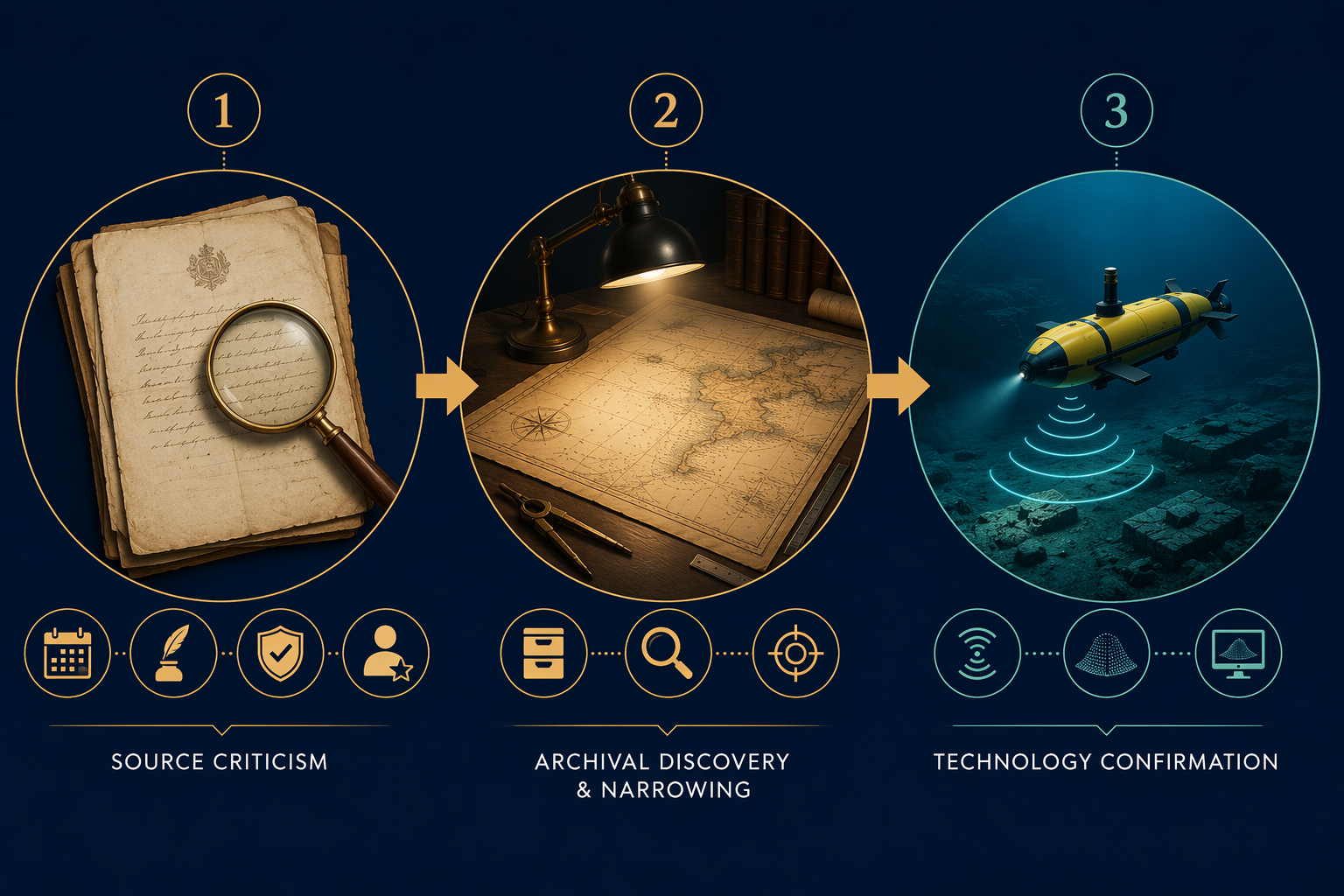
Triangulation does not mean piling up sources until a claim feels heavy. It means assigning the right job to each source and noticing when independent lines of evidence converge. In the Clipper Endeavor case, survivor testimony identified the lived problem of panic and evacuation failure. The CAB findings supplied an official causal account. The USAF chart map narrowed the physical search. Oral history preserved continuity and human meaning. Sonar and photographic survey tested the physical location claim.
- Use survivor testimony for experience, behavior, and recurring patterns, then cross-check it against records.
- Use official reports for institutional findings, while distinguishing those findings from later summaries.
- Use archival maps and charts for localization only after asking who made them and how they were preserved.
- Use technology for confirmation when the historical question has been narrowed enough to test.
This is also a useful MCAT Psych/Soc example because the fatal sequence involves authority, group behavior, stress, and compliance. It is a useful CARS example because the passage-level task is not to admire the technology, but to evaluate the relationship between claims and evidence. Students preparing through an MCAT study plan or building reading habits for the SAT and ACT can use the same basic move: identify what each source measures before deciding what conclusion it supports.
The policy consequence was the real ending
The rediscovery gave the Clipper Endeavor a physical endpoint, but the safety lesson had entered aviation practice much earlier. After the crash, the CAB recommended mandatory pre-flight safety demonstrations for over-water flights, and that kind of passenger briefing remains recognizable in commercial aviation 74 years later.[3][6] The point is not that every modern briefing descends from one accident alone. The narrower and better-supported point is that this investigation became part of the evidence-to-policy chain that made passenger safety demonstrations a standard expectation.
That is where the 1952 Puerto Rico plane crash historical research case earns its value as a method example. Testimony identified the human failure inside the aircraft. Official investigation framed the causal lesson. An archival map made the missing wreck searchable. Oral history preserved memory without replacing proof. Sonar and images confirmed the physical claim. The wreck was found in 2026 because the methods were sequenced in the right order.
References
- Pan American World Airways, Inc., near San Juan, Puerto Rico, April 11, 1952, National Transportation Library / ROSA P
- Mission Endeavor Project Overview, Air Sea Heritage Foundation
- Crash of a Douglas DC-4 off San Juan: 52 killed, Bureau of Aircraft Accidents Archives
- Wreckage of 1952 Pan Am plane crash found after 74 years, TODAY.com
- Mystery of missing Pan American Airways Flight 526A solved, Heritage Daily, July 2026
- A Tragic Good Friday – 11 April 1952, Coast Guard Aviation History
Comments
Join the discussion with an anonymous comment.