
Method
Evidence-based study methods for flood watch safety
Learn how to apply retrieval practice, spaced repetition, and scenario-based elaboration to master flood watch safety protocols. This article connects evidence-based study techniques directly to the hierarchical watch-to-warning knowledge that saves lives.
Evidence panel
- Evidence level
- Moderate
- Primary citation
- Effect of disaster training on knowledge regarding flood risk management amongst families with older people, PMC, 2022
Flood watch safety is usually handed to learners as something to read: a webpage, a flyer, a checklist, a slide before the quiz. That is the wrong study shape for the job. The hard part is not recognizing the phrase “Flood Watch” when it appears in a multiple-choice question. The hard part is retrieving the next action when the alert changes, the rain is still falling, a road is blocked, and nobody is politely waiting while you reread the safety page.
So a useful flood watch safety study plan has to treat the alert system as procedural knowledge. You are learning a hierarchy, action triggers, and timing decisions. That means the study methods should look more like practice for a lab procedure or emergency drill than like highlighting a definition.
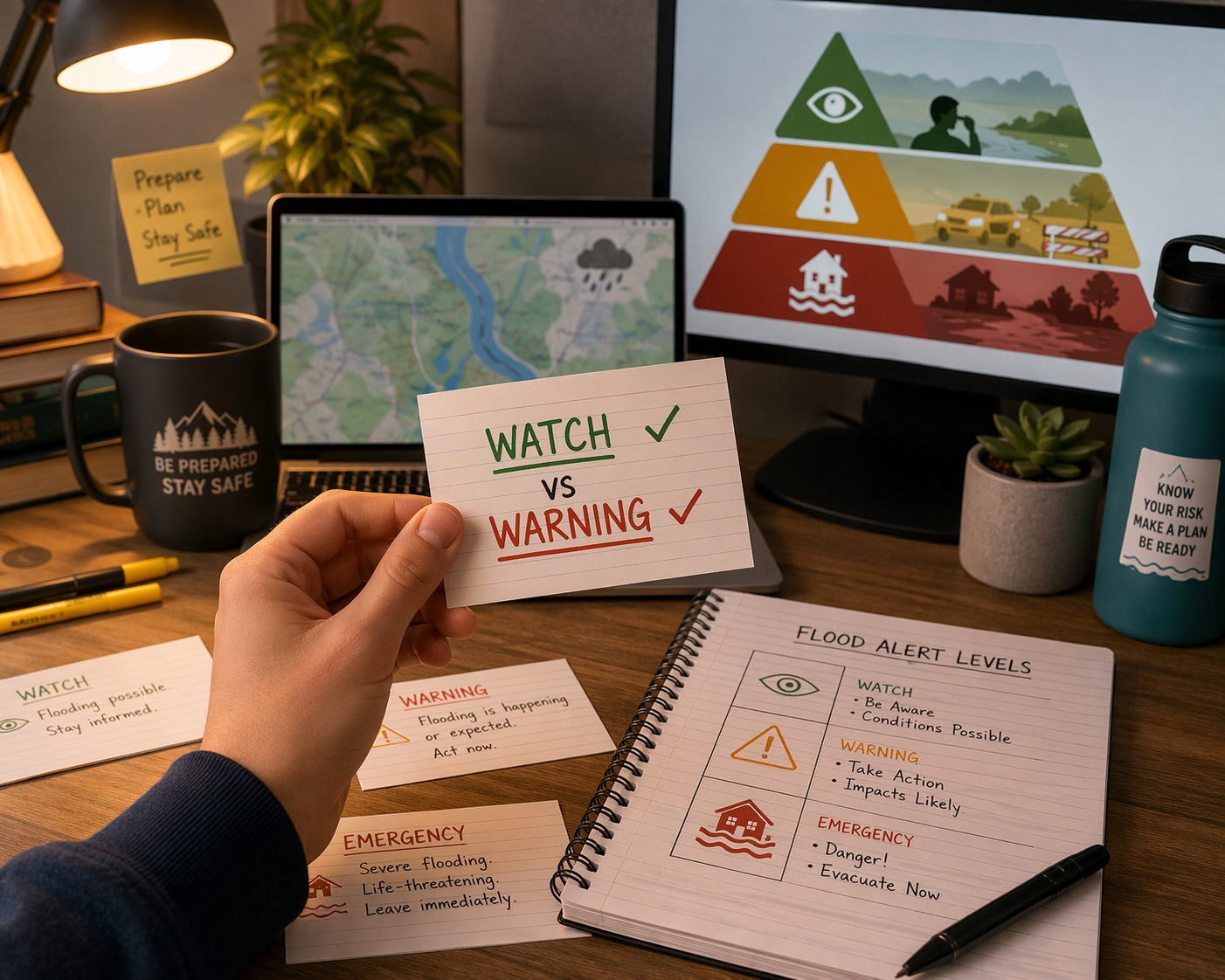
Start with the hierarchy you must be able to retrieve
The National Weather Service distinction is the load-bearing structure. A Flood Watch means conditions are possible and confidence is in the 50–80% range; the action language is “Be Prepared.” A Flood Warning means flooding is happening or expected and confidence is above 80%; the action language shifts to “Take Action.” A Flash Flood Warning means imminent danger and requires action now.[1]
That confidence shift matters for studying. If you only memorize “watch = possible” and “warning = happening,” you may pass the easiest quiz item and still miss the decision logic. The better target is: “What level of confidence or immediacy is being communicated, and what does that require me to do next?”
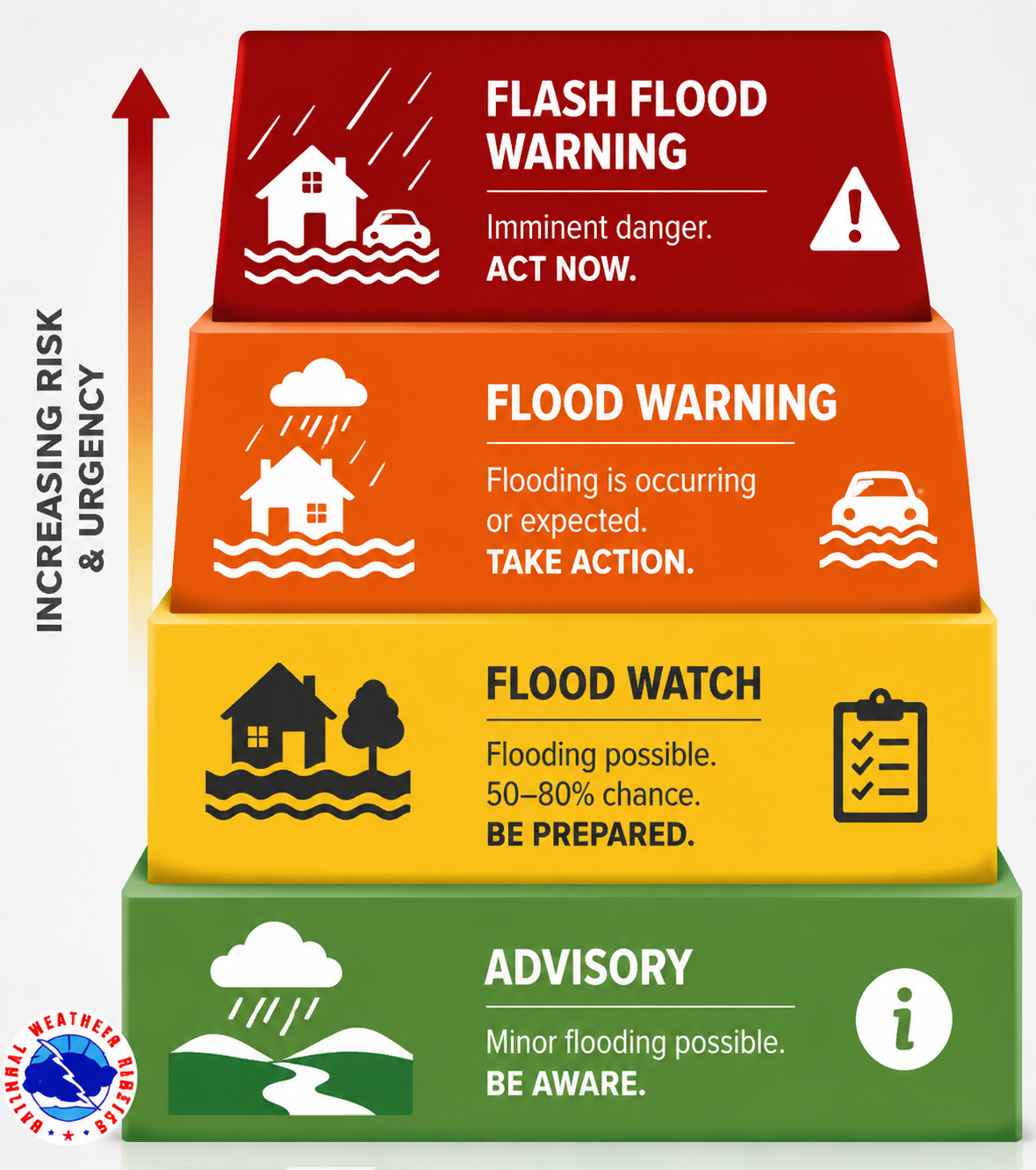
The NWS also groups flood communication into multiple flood-related products, including advisories, watches, warnings, and flash flood warnings; the point for a learner is not to collect every label like vocabulary cards from a glossary, but to know which labels change behavior.[2]
| Alert language | What it signals | Study target |
|---|---|---|
| Flood Advisory | Flooding may cause inconvenience or minor impacts, but is generally less severe than a warning. | Do not treat every alert as equal; identify whether the situation has crossed into warning-level action. |
| Flood Watch | Flooding is possible; NWS confidence is 50–80%. | Name preparation actions without looking: monitor updates, know routes, check supplies, avoid committing to flood-prone travel. |
| Flood Warning | Flooding is happening or expected; NWS confidence is above 80%. | Shift from monitoring to action: move away from flood areas, follow local instructions, do not drive through floodwater. |
| Flash Flood Warning | Danger is imminent or already occurring. | Act immediately; do not spend the first minutes searching for definitions. |
A table like this is useful only if it becomes something you can reproduce. If you can look at it and nod, that is recognition. If you can cover it and rebuild the action column from memory, that is a better start.
Make retrieval practice the main study move
Retrieval practice means forcing yourself to bring the answer back without seeing it first. For flood watch safety study, that is much more useful than rereading the same alert definitions until they feel familiar. Familiarity is a poor substitute for producing the right action under pressure.
If you want the broader study-method argument, see our guide to retrieval practice versus rereading. For this topic, the method becomes very concrete: hide the definitions, show yourself an alert, and answer what you would do first.
Good self-tests should ask for action, threshold, and change. They should not merely ask for a definition.
- Prompt: “A Flood Watch is issued for your county. What does the confidence range tell you, and what are your first three preparation actions?”
- Prompt: “The alert changes from Flood Watch to Flood Warning. What changed: probability, immediacy, or both? What action should change with it?”
- Prompt: “You receive a Flash Flood Warning while already away from home. What do you stop doing immediately?”
- Prompt: “Which alert means ‘Be Prepared,’ which means ‘Take Action,’ and which means ‘Take Action Now’?”
- Prompt: “What mistake would a person make if they treated a watch like a warning? What mistake would they make if they treated a warning like a watch?”
That last prompt is not decoration. Confusing the two directions produces different consequences. Treating a watch like a warning may create unnecessary urgency; treating a warning like a watch may leave you waiting when the message has already crossed into action.
There is evidence that training can move flood knowledge, not just attitudes. In a quasi-experimental study of disaster training for families with older people, Fatmah reported a 12.9-point gain in general disaster knowledge and a 20-point gain in flood-specific knowledge after a single training session, with p = 0.001.[3] The study was conducted in Indonesia, so it should not be treated as a U.S.-specific guarantee. Still, it supports a useful learning principle: when people are actually trained on flood-risk material, measurable knowledge can improve.
A five-minute recall drill
Use this drill after reading the NWS alert definitions once. Do not keep the page open while answering.
- Write the four alert labels you need to distinguish: advisory, watch, warning, flash flood warning.
- Next to each label, write the action phrase or behavior shift.
- Add the confidence thresholds for Flood Watch and Flood Warning.
- Create one example of a wrong response for each label.
- Check the source, correct errors in a different color, then repeat the same drill tomorrow without looking.
The wrong-response step is often where real learning shows up. A learner who can say “Flood Watch means be prepared” may still be vague about what preparation means. A learner who can say “The mistake is deciding to drive a low-water route because nothing is happening yet” is closer to usable knowledge.
Do not mistake risk perception for mastery
Concern helps, but it is not the same as performance. Ogunyiola and Dada’s 2025 regression study of 112 flood-affected residents found that risk perception predicted some protective behavior, with β = 0.323, p = 0.001, and adjusted R² = 0.322. The same study also found that factors such as ethnicity, occupation, and length of residence mattered, and its Hispanic/Latino subgroup was small, so those subgroup findings should be read cautiously.[4]
For studying, the lesson is plain enough: feeling at risk does not prove you can retrieve the action sequence. A student may understand that floods are dangerous and still fail the operational question: “The alert just changed; what do you do now?”
This also explains why passive public-message exposure can be weak study material. Salley and colleagues analyzed 118,146 tweets across nine states during 2022 floods and found that organizational messages lacked actionable directives; none of the five topic clusters they identified—Traffic, Weather, Operations, Society, and Power—contained words such as “evacuate” or “shelter.”[4] A person can consume many messages and still not rehearse a decision.
That is not a reason to dismiss public communication. It is a reason not to outsource your learning to whatever message happens to cross your feed during a storm. Your study system has to supply the action verbs if the message does not.
Turn definitions into scenarios
Scenario-based elaboration is where the hierarchy stops being sterile. Instead of repeating “watch, warning, flash flood warning,” you attach the terms to maps, roads, time pressure, family roles, and choices. That extra context can make recall more flexible.
A 2025 quasi-experimental study by Intaramuean and colleagues used flood education with 150 primary school learners and found that programs incorporating local maps and scenario-based learning significantly improved preparedness scores, with p < 0.05.[5] The study was in Thailand and involved younger learners, so the exact results should not be copied onto a U.S. college or certification setting. The learning pattern, though, is useful: local, scenario-rich practice can improve preparedness measures.
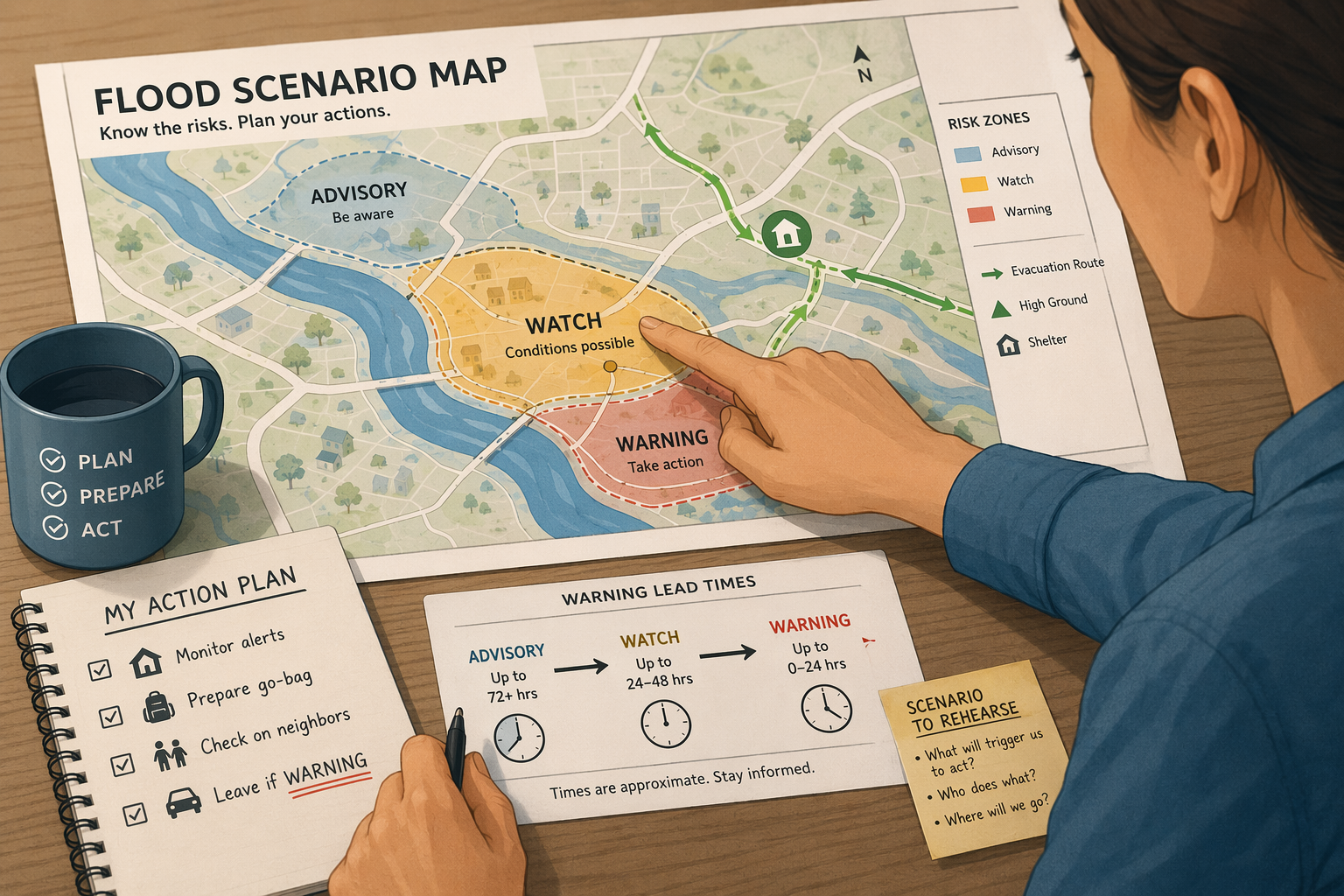
Build scenarios around the decision points that actually change behavior:
- Alert level: advisory, watch, warning, or flash flood warning.
- Confidence or immediacy: possible, likely or occurring, imminent.
- Location: home, school, work, road, low-water crossing, flood-prone neighborhood.
- Constraint: limited time, no car, older relative, pet, blocked route, poor cell service.
- Action trigger: monitor, prepare, avoid travel, move to safer ground, follow evacuation or shelter instructions.
A scenario card does not need to be dramatic. In fact, ordinary scenarios are better for study because they catch the everyday misjudgments: “I will wait until the water looks deep,” “I know this road,” “The warning is for the county, not my street,” “I only need to check one more errand.”
Example scenario card format
| Card field | What to write |
|---|---|
| Front | A Flood Watch is issued at 6 p.m. for your county. You have class tomorrow morning and usually drive through a low-lying road. |
| Recall questions | What does the watch confidence range mean? What do you prepare tonight? What travel decision should you reconsider before morning? |
| Back | Flooding is possible, with NWS confidence in the 50–80% range. Prepare, monitor updates, identify safer routes, and avoid relying on flood-prone travel if conditions worsen. |
| Follow-up | The alert becomes a Flood Warning. What changes immediately? |
Keep the numbers where they belong. The card should not invent local rainfall totals, fake river gauges, or pretend to be an official forecast. If you use a hypothetical example, label it as hypothetical. The study goal is to practice the decision structure, not to make up realistic-looking emergency data.
Practice compressed-time decisions
Short lead time exposes weak learning. In a Mayfield, Kentucky flash flood case discussed by BBC Future, 46% of informed residents received warnings only 1–3 hours ahead, while 76% of uninformed residents who did receive warnings got the same short lead time.[6] That is exactly the kind of fact that belongs in a study scenario, because it removes the fantasy of having all afternoon to review definitions.
Use the case as a timing constraint, not as a script. A good practice card might say: “You have 1–3 hours of warning before a flash flood threat affects normal routes. What information do you check first? Who needs to be contacted? What action should not wait until water is visible?”
The NWS “Turn Around Don’t Drown” material is also useful here because it gives concrete physical stakes: 6 inches of moving water can knock a person down, and 12 inches can sweep away a car.[1] Do not turn those numbers into trivia. Turn them into a retrieval cue: “If water is covering the roadway, what is the rule?”
Some public-safety slogans land unevenly across audiences; studies of “Turn Around Don’t Drown” have noted weaker effects with young men. For study purposes, that means a slogan should not be the whole lesson. The learner still needs to practice the behavior: identify the flooded roadway, stop the planned route, choose a safer alternative, and explain why driving through is not a calculated shortcut.
Use spaced repetition to keep the hierarchy available
Flood watch safety is easy to “know” right after reading. The problem is next week, next semester, or during the first storm of the season. Spaced repetition is the scheduling system that keeps the watch-to-warning hierarchy retrievable after the original lesson has faded.
You can adapt the review intervals in our spaced repetition schedule for finals week if this is part of a course unit. If you prefer apps, a digital flashcard system using spaced repetition algorithms can work well; our flashcard app buying guide explains what to look for.
For a two-week flood watch safety study block, use short reviews rather than one long cram session.
| When | What to retrieve | How to check |
|---|---|---|
| Day 1 | Alert hierarchy, confidence thresholds, action phrases. | Rebuild the table from memory, then compare with NWS language. |
| Day 2 | Watch versus warning decisions. | Answer scenario cards without notes. |
| Day 4 | Flash flood warning and road-water decisions. | Explain the action rule aloud in under one minute. |
| Day 7 | Mixed alerts in random order. | Shuffle cards so you cannot predict the category. |
| Day 10 | Compressed-time scenario. | Use a 1–3 hour warning window and write the first actions. |
| Day 14 | Full retrieval check. | Recreate hierarchy, thresholds, actions, and two scenarios from memory. |
If you are preparing for an exam, you can place these reviews inside a broader midterm study schedule template. If the assessment or certification date is farther away, use a 30-day exam countdown planner and schedule flood-safety retrieval checks as recurring items rather than one completed task.
Teach the hierarchy to someone else, briefly
Teaching others is not the center of the plan, but it is a useful final test. The protégé effect works best here when the teaching is specific: explain the alert hierarchy, ask the other person what they would do, and correct the watch-warning confusion immediately.
BBC Future’s reporting on Bangladesh describes volunteer warning networks using megaphones and door-to-door warnings to reach communities at risk.[6] That is not the same as a student study group, and it should not be flattened into a classroom trick. Still, it shows something memorable about warning knowledge: the person delivering the warning has to organize the message into action language for someone else.
A simple version for study is a two-minute teach-back:
- Explain the difference between a Flood Watch and Flood Warning without notes.
- Ask the listener what they would do if the alert escalated.
- Give one road-water scenario and make them choose an action.
- Have the listener ask you one “what if” question.
If you cannot explain the hierarchy cleanly to a younger sibling, roommate, parent, or classmate, you probably have recognition rather than recall. That is fixable. Go back to the retrieval cards.
A practical flood watch safety study plan
Here is the compact version. It is deliberately more practice plan than safety brochure.
- Learn the NWS hierarchy first: advisory, Flood Watch, Flood Warning, Flash Flood Warning.
- Memorize the action shift: be prepared, take action, take action now.
- Retrieve the confidence thresholds for Flood Watch and Flood Warning without looking.
- Build flashcards that ask for actions, not definitions only.
- Add scenario cards with maps, routes, timing constraints, and escalation from watch to warning.
- Review the cards on a spaced schedule over at least two weeks.
- Teach the hierarchy once to another person and notice where your explanation gets vague.
The calibrated claim is not that flashcards make someone perfectly safe in a flood. Access, transportation, disability, language, local infrastructure, trust, and the quality of official messaging all affect what people can do. But for the part that belongs to learning—the ability to distinguish the alert, retrieve the action trigger, and respond without rereading—the evidence points toward active practice. Learn the hierarchy, test yourself on it repeatedly, rehearse realistic scenarios, and make the first move automatic enough that an alert produces an action, not a search for the definition.
References
- Flood Warning VS. Watch, National Weather Service.
- Flood Related Products, National Weather Service.
- Effect of disaster training on knowledge regarding flood risk management amongst families with older people, PMC, 2022.
- Bridging the gap in flood risk communication, Frontiers in Communication, 2025.
- Empowering flood preparedness, ScienceDirect, 2025.
- The flood warnings that save lives, BBC Future, 2025.
Applies to
Exam applicability isn't specified for this technique yet. See all exam hubs.
Comments
Join the discussion with an anonymous comment.