
Method
How Are Pompeii's Body Casts Made? The Fiorelli Method Explained
This article breaks down the four-stage Fiorelli method that created Pompeii's famous body casts, from ash calcification to plaster injection. Students will learn the exact process, what the casts preserve, and how to apply similar step-by-step reasoning to exam science passages.
Evidence panel
- Evidence level
- High
- Primary citation
- The casts of Pompeii: Post-depositional methodological insights (PLOS ONE, 2023)
The Pompeii body casts are not preserved corpses. They are plaster replicas made from empty spaces left inside hardened volcanic material after human bodies decayed. That distinction matters because it answers the first student question quickly: the visible white form is cast material, while real skeletal remains are often still embedded inside it.
The method is usually called the Fiorelli method after Giuseppe Fiorelli, the archaeologist credited by Pompeii’s official archaeological park with perfecting it in 1863. Since then, a little over a hundred casts have been made at Pompeii, including the well-known group of 13 in the Garden of the Fugitives.[1] Some popular sources give a slightly later date for the first casts, but for this explanation it is cleaner to follow the official archaeological park’s 1863 date.
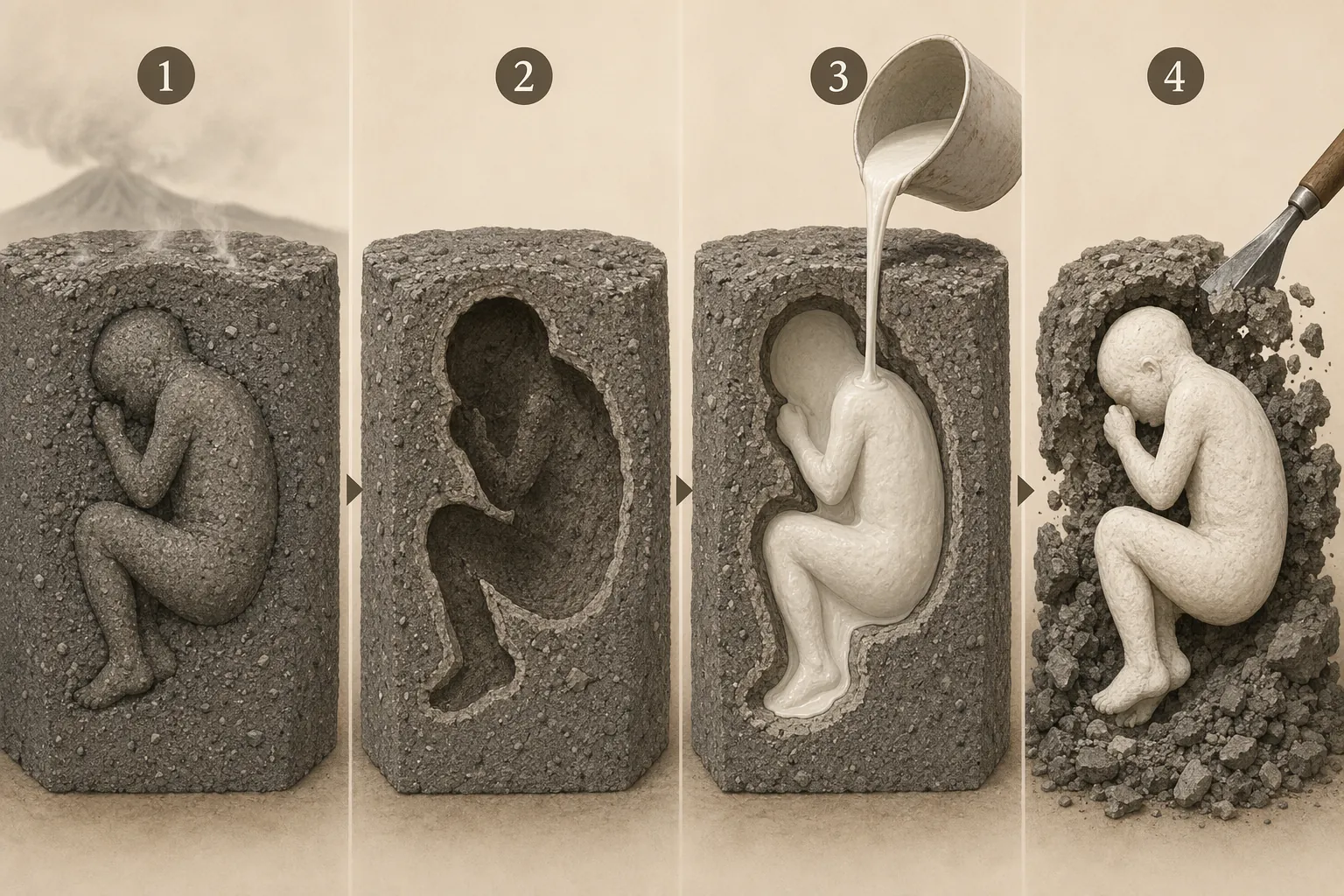
| Stage | What happens | Why the next step becomes possible |
|---|---|---|
| 1 | Hot volcanic ash surrounds the body and hardens. | The hardened ash can hold the body’s outer shape. |
| 2 | Soft tissue decomposes inside that hardened material. | A human-shaped cavity remains where the body had been. |
| 3 | Liquid plaster of Paris is poured or injected into the cavity. | The plaster can flow into details before it sets. |
| 4 | The plaster hardens and the surrounding ash is removed. | The cast becomes a three-dimensional record of the void. |
The cast begins before any archaeologist arrives
Fiorelli did not invent the natural mold. Vesuvius did the first part. During the eruption, volcanic ash and debris covered victims. Over time, that material hardened into a compact layer around bodies and objects. The important point is not simply that people were buried. It is that the surrounding material became firm enough to preserve the negative space around the body.
That hardened shell is the reason the later casting worked at all. If the ash had stayed loose, it would have collapsed as the body decomposed. If it had not held fine surface detail, the final cast would have been only a rough human lump. Instead, the volcanic deposit could preserve the outline of limbs, folds in clothing, positions of hands, and impressions made by the body’s last posture.
This is the hinge in the whole process: the body disappeared, but the space around it did not. Soft tissue decomposed after burial, leaving a hollow cavity inside the hardened ash. The cavity was not an open hole visible from the surface. Excavators had to recognize that a void might be present before they destroyed it by digging through it.
Fiorelli’s move was to cast the absence
Earlier excavation could expose artifacts, walls, and bones, but a body-shaped void is easy to lose. Fiorelli’s practical insight was to treat the empty space as evidence. When excavators detected a cavity, they poured liquid plaster of Paris into it. The plaster flowed into the hollow left by the decayed body, including smaller surface details where the cavity had held them.
Once the plaster set, workers removed the surrounding volcanic material. What emerged was not the body but the cast of the space the body had occupied. That is why these objects can look startlingly personal while still being replicas. The cast records the outside shape of the person at death; it does not turn soft tissue into stone.
A useful way to remember the method is: ash makes the mold, decay makes the cavity, plaster fills the cavity, excavation reveals the cast. Each verb causes the next one. Without hardened ash, there is no stable mold. Without decay, there is no empty space. Without plaster, the void would vanish during excavation. Without careful removal, the cast would remain trapped or damaged.
What the casts actually preserve
The casts preserve final body position with unusual force. A curled torso, a raised arm, a turned head, or a child close to an adult can be read as posture, not as an artist’s reconstruction. The Garden of the Fugitives is the clearest place-based example: 13 casts were found in their original discovery positions in what had been an ancient vineyard.[1]
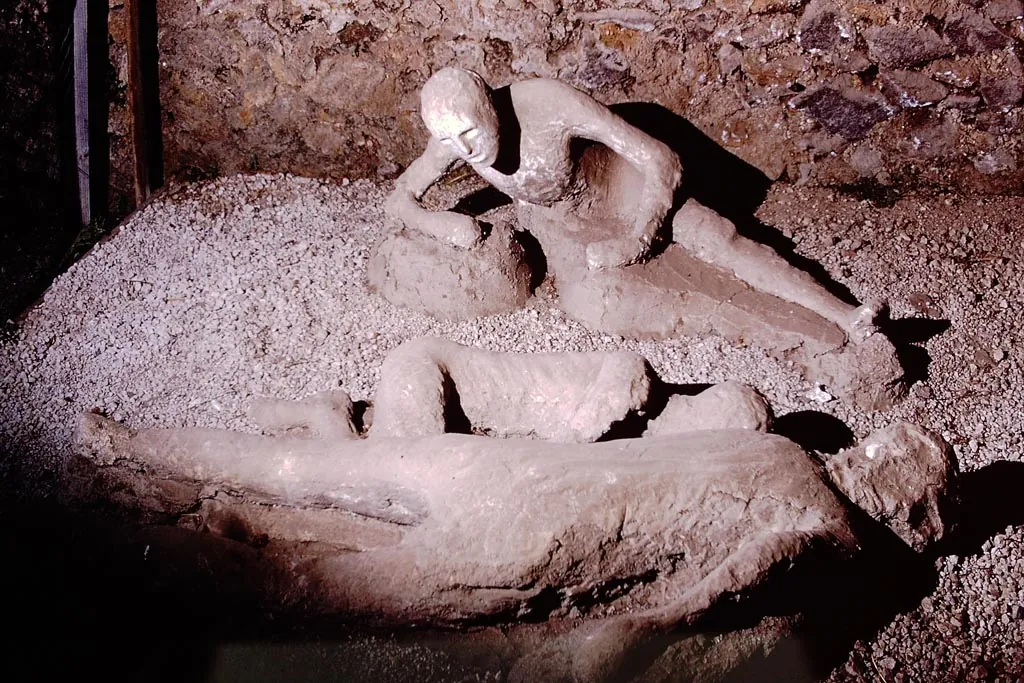
The casts can also preserve surface evidence that students might not expect from something made of plaster. Pompeii’s official description notes that the casts can show the agony of victims and the texture of garments.[1] Object-level descriptions from Pompeii-focused guides add examples such as wool, fine fabrics, shoes with iron studs, and facial expressions preserved by the cast surface.[3]
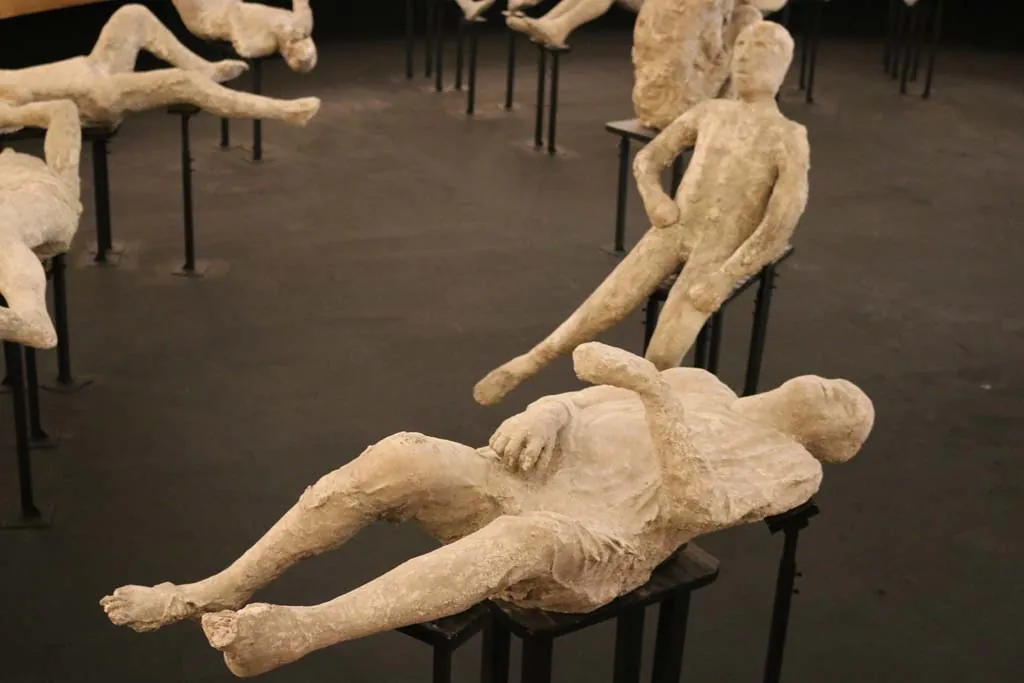
The clothing detail is more than decoration. It reminds us that the cast records contact between the body, clothing, and ash. A fold in fabric or the outline of footwear survives because the hardened deposit held the impression before plaster entered. The plaster did not know what it was copying; it simply filled whatever shape the cavity offered.
Bones complicate the simple phrase “plaster replica.” Scientific study of the casts has found that skeletal remains are typically enclosed within the plaster, meaning the cast is both a replica of the exterior void and a container for human remains.[2] So the best student answer is not “they are just plaster” or “they are real bodies.” The visible form is plaster; the object may contain original skeletal material.
The casts are powerful evidence, not a complete sample
A little over a hundred casts can feel like a large number when they are lined up in photographs or exhibitions, but they represent only a small portion of Pompeii’s dead. Recent exhibition coverage places estimated deaths at roughly 2,000 people, while Pompeii’s archaeological park gives the cast total as a little over a hundred.[4][1] The casts should not be treated as a complete census of victims.
They are also not a random sample. A cast could only be made where the volcanic material preserved a suitable void, where excavators recognized it, and where the cavity survived excavation. Many bodies were never cast. Some voids may have been lost before anyone knew what they were. That matters for interpretation: the casts reveal individual moments with extraordinary clarity, but they cannot by themselves tell the full demographic story of the eruption.
The same plaster that preserved evidence also limited later science
Fiorelli’s method was brilliant for visual and anatomical preservation. It was not designed for chemical analysis that would be invented much later. Alapont and colleagues note that plaster contamination can compromise chemical study of bones enclosed inside the casts.[2] That is the tradeoff: the method saved the body shape from destruction, but it also introduced material that can interfere with some kinds of modern testing.
This is a useful correction to a common “old method versus modern method” habit. The older choice was not simply wrong because it contaminated evidence. Without casting, many cavities might have been destroyed and no three-dimensional record would remain. The fair judgment is narrower: plaster casting preserved certain evidence exceptionally well while making some later analyses harder.
The casts themselves have needed rescue
The casts can look permanent because they seem fossil-like, but they are vulnerable artifacts. Pompeii’s archaeological park records that many casts were destroyed during the 1943 bombings in World War II and that partial restoration followed.[1] Their survival now depends on conservation choices, not on any magical durability built into plaster.
Later methods tried to reduce some of the limits of traditional plaster. In 1984, a transparent epoxy resin cast at Oplontis made hidden objects such as jewelry and coins visible inside the cast, something ordinary plaster could conceal.[3] More recently, laser scanning has allowed 3D-printed copies to travel for exhibitions while originals remain at Pompeii.[1]
Those updates do not replace the basic Fiorelli sequence students need to learn. They show that archaeological recording keeps changing after the famous discovery moment. A cast is not only evidence from 79 CE or from nineteenth-century excavation; it is also an object managed, restored, scanned, and interpreted in the present.
How to read the Fiorelli method on an exam
For a class visit, a history paper, or a science passage, the safest explanation starts with materials and sequence. Do not begin with “frozen in time.” Begin with hardened ash. Then track what changed: body to void, void to plaster-filled mold, mold to exposed cast.
- Material condition: volcanic ash hardened around the body.
- Biological change: soft tissue decomposed and left a cavity.
- Archaeological action: plaster was poured or injected into that cavity.
- Result: removing the surrounding ash revealed a plaster cast of the body-shaped void.
- Limit: the cast may contain bones, but plaster can contaminate chemical analysis.
The numbers worth holding onto are few: Fiorelli, 1863, a little over 100 casts, and 13 in the Garden of the Fugitives.[1] Add one caution beside them: the casts are memorable, but they are not the whole population of victims.
That same reading habit works beyond Pompeii. In any multi-step archaeology or science passage, identify the material conditions first, put the events in order, explain why each step makes the next possible, and separate what the method reveals from what it distorts.
References
- The Casts — Pompeii Sites
- The casts of Pompeii: Post-depositional methodological insights — PLOS ONE, 2023
- Pompeii plaster casts — pompeiin.com
- Haunting Casts Preserving Pompeii Victims' Final Moments 2,000 Years Ago Go on Display in a Solemn New Exhibition — Smithsonian Magazine, March 2026
Applies to
Exam applicability isn't specified for this technique yet. See all exam hubs.
Comments
Join the discussion with an anonymous comment.