
Method
Four Physical Mechanisms Behind Earthquake Swarms
Earthquake swarms are not random. This article breaks down the four distinct physical mechanisms—fluid migration, magma intrusion, aseismic slip, and induced seismicity—with real-world examples and diagnostic signatures, giving ASVAB and MCAT students a scannable framework for earth science questions.
Evidence panel
- Evidence level
- High
- Primary citation
- How earthquake swarms arise — Stanford Doerr School of Sustainability
For an exam passage, the important phrase in earthquake swarm causes explained is not “earthquake.” It is “causes.” A swarm is a cluster of earthquakes in one area over a relatively short time, without one obvious mainshock followed by smaller aftershocks.[1][2] That definition is useful only if it leads to the next question: what physical process is moving stress, fluid, magma, or pressure through the crust?
That is why a swarm question belongs in the methods category as much as in earth science. It asks students preparing for ASVAB General Science or an MCAT science-reasoning passage to match a data pattern to a mechanism. The same shaking can have different causes, and those causes do not carry the same hazard.
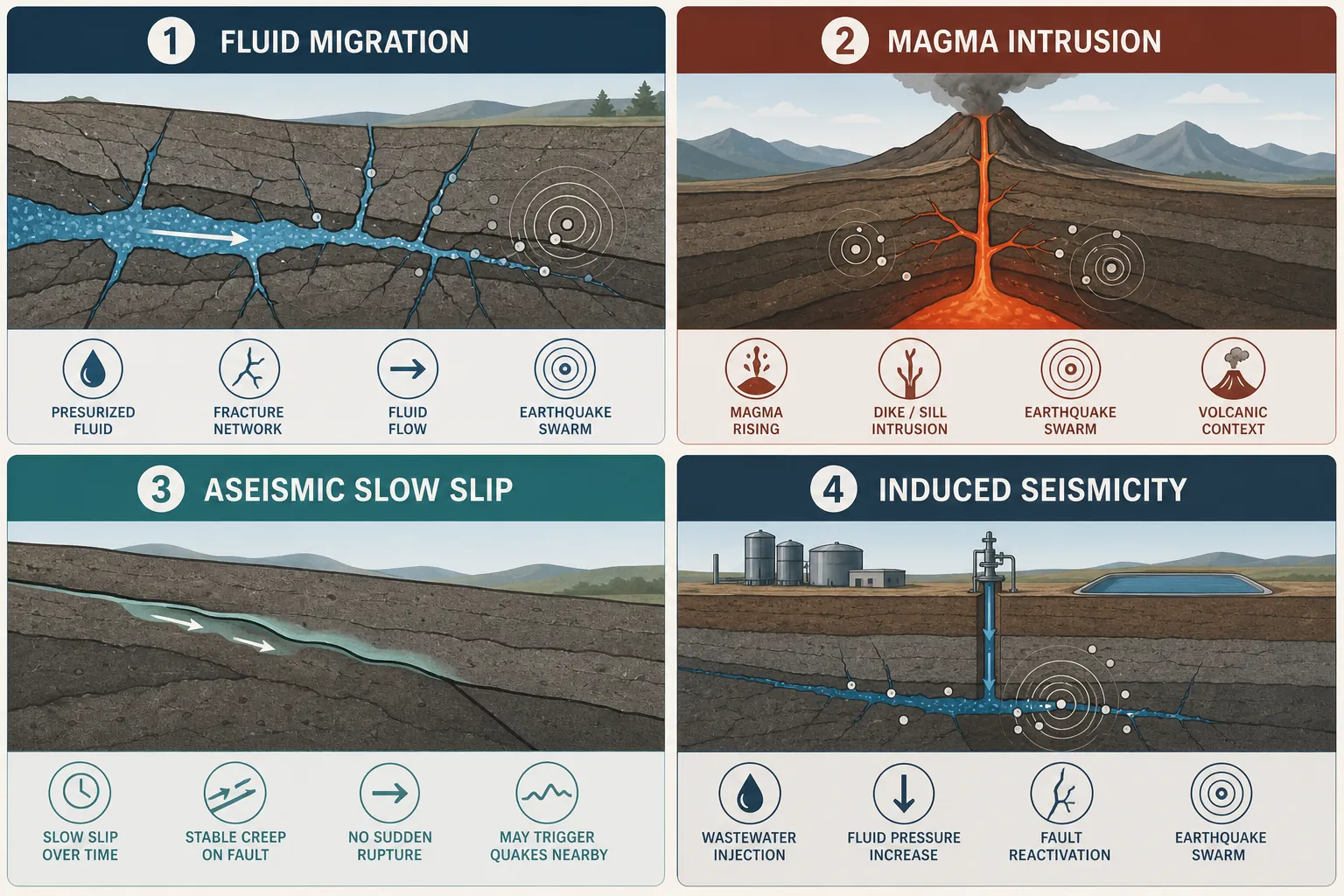
| Cause | Physical mechanism | Example from the research | Diagnostic signature to watch |
|---|---|---|---|
| Fluid migration | Pressurized water or CO2 lowers effective normal stress on faults; earthquakes can increase permeability and let more fluid move | Fault-valve simulations described by Stanford | Swarm hypocenters migrate through the crust, with documented rates around 0.1–1.0 km/day |
| Magma intrusion | Magma pushes into rock, changing stress and opening cracks near volcanic systems | Matsushiro, Japan, 1965–1967; Bárðarbunga, Iceland, 2025 | Volcanic setting, possible high b-values, deformation or volcanic monitoring context; eruption is not automatic |
| Aseismic slow slip | A fault patch creeps without ordinary seismic shaking and loads nearby locked patches | Transform-fault slow-slip studies | Migration along a fault without needing fluid as the trigger; focal mechanisms may fit fault creep and loading |
| Induced seismicity | Human activity, especially wastewater injection in documented basins, changes pore pressure or fault conditions | Central Oklahoma after 2008; Guy–Greenbrier, Arkansas | Temporal and spatial association with injection activity, basin geology, and faults near pressure changes |
Start With the Boundary: Swarm, Not Aftershock Sequence
A normal aftershock sequence has a large event that does the obvious organizing work. Smaller earthquakes follow as the crust adjusts. A swarm does not have that clean hierarchy. The earthquakes are clustered in space and time, but no single mainshock explains the whole sequence.[1][2]
That distinction blocks a common trap answer. If a question stem says many similar-sized earthquakes occurred in one area and asks what might cause the pattern, “aftershocks from the big one” is weak unless the passage gives a clear mainshock. For a swarm, look for the moving process: fluid, magma, slow slip, or human-caused pressure change.
Fluid Migration: The Cleanest Mechanism-to-Pattern Chain
Fluid migration is the first cause to learn because it gives the most testable chain. Pressurized water or CO2 enters fractured rock. That pressure lowers the effective normal stress holding fault surfaces together. A fault that was close to slipping now needs less additional stress to move.
The important part is the feedback loop. Small earthquakes can open new cracks or improve permeability along existing ones. More permeability lets more fluid move. More fluid pressure can trigger more earthquakes. Stanford’s fault-valve simulations describe this loop and report migration rates of about 0.1–1.0 km per day for swarm activity in that framework.[3]
In a passage, that rate matters because it turns a vague cluster into a trackable front. If earthquake locations shift across kilometers over days, the data are not just “busy.” They may be showing the path of pressure diffusion or fluid movement through connected fractures. The answer choice that mentions pore pressure, permeability, or reduced effective stress is usually closer to the mechanism than one that simply says “rocks are unstable.”
Do not overread the clue. Fluid migration can explain many swarms, but the presence of a swarm alone does not prove fluid caused it. Seismologists still compare the locations, timing, focal mechanisms, local geology, and sometimes geochemical or deformation data before making the call.
What a student should mark in the passage
- Words such as pore pressure, hydrothermal fluid, CO2, permeability, fractures, or effective normal stress
- Earthquake locations that migrate rather than stay fixed
- A cause that can feed on itself: quakes open pathways, pathways let more fluid move
- A trap answer that treats the swarm as random shaking with no physical transport process
Magma Intrusion: Volcanic Context Without the Eruption Shortcut
Magma intrusion can create swarms when molten rock pushes into surrounding crust. The magma does not have to reach the surface. It can force open cracks, shift stress on nearby faults, and produce many small earthquakes as rock adjusts around the intrusion.
The Matsushiro swarm in Japan is memorable for a reason: the 1965–1967 sequence produced about 1 million events, with a reported peak of 6,780 earthquakes in a single day in April 1966.[4] Those numbers are useful because they make clear that a swarm can be sustained and enormous without behaving like a neat mainshock-aftershock sequence.
But Matsushiro should not teach the wrong lesson. Volcanic swarms are not eruption synonyms. The key caution is that only about 10–30% of volcanic swarms culminate in eruption, based on White and McCausland’s 2016 synthesis cited in volcanic-swarm guidance.[2] In 2025, Bárðarbunga in Iceland produced more than 3,000 earthquakes, with the largest reported at magnitude 5.1, and did not erupt.[5]
So the diagnostic question is not “Is there a volcano nearby?” It is whether the swarm sits in a volcanic system and lines up with other evidence: migration that could trace a dike, ground deformation, gas changes, volcanic tremor, or an unusually high proportion of small events. The b-value can help here. Volcanic swarms have been reported with b-values up to 2.6, while tectonic swarms are commonly described around 0.7–1.0.[4][6]
A b-value describes the relative number of small earthquakes compared with larger ones. Higher b-values mean small earthquakes dominate more strongly. It is a useful clue, not a label maker. A passage that gives a high b-value in a volcanic area is giving evidence for a volcanic or fluid-rich process; a passage that gives only “many earthquakes near a volcano” has not proved eruption.
Aseismic Slow Slip: When the Fault Moves Quietly First
Some swarms begin with motion that is not itself a normal earthquake. In aseismic slow slip, part of a fault creeps over time instead of rupturing suddenly. That creeping patch can transfer stress to neighboring locked patches. The locked patches then fail in small earthquakes, creating a swarm.
Studies of transform-fault swarms have described slow-slip events that load adjacent locked patches and trigger earthquake swarms without requiring fluid as the cause.[4][6] That last phrase is exam-important. If an answer choice says every swarm needs water, magma, or gas, it is too broad.
The clue for slow slip is mechanical loading along a fault. The earthquakes may migrate along a fault zone, but the driver is creeping motion redistributing stress, not necessarily a pressure front moving through pore spaces. Focal mechanisms matter here because they show how the fault actually moved. If the tiny earthquakes have mechanisms consistent with the mapped fault, that supports a fault-slip interpretation.
Induced Seismicity: Pressure Changes With a Human Timestamp
Induced seismicity is not “humans create earthquakes from nothing.” The better version is more precise: human activity changes stress or pore pressure in a faulted crust that already has weaknesses. Wastewater injection is the best-known example in the research brief because it can raise pressure underground and reduce the resistance to slip on faults.
The Oklahoma case is regional, not universal. Keranen and colleagues reported that after 2008, a sharp increase in central Oklahoma seismicity was linked to wastewater injection, and that roughly 45% of central and eastern U.S. seismicity in their analysis was associated with this Oklahoma activity.[7] The same paper directly linked the Guy–Greenbrier, Arkansas swarm to injection wells.[7]
The diagnostic signature is partly spatial and partly temporal. Are earthquakes appearing near injection wells or pressure pathways? Did the timing change after injection began or after injection volumes changed? Does basin geology allow pressure to reach faults? Without those pieces, “human-caused” is only a guess.
For science-reasoning questions, this is a good place to separate correlation from mechanism. A chart showing earthquakes and injection in the same decade is not enough by itself. A stronger passage will connect pressure diffusion, fault orientation, timing, and earthquake locations.
How Seismologists Sort the Four Causes
A real swarm does not arrive with a label. Scientists compare several signatures, and an exam passage will usually give one or two of them. The trick is to notice what the measurement actually measures.
| Signature | What it measures | How it helps |
|---|---|---|
| Spatial migration | Whether earthquake locations move through time | A moving front can support fluid migration, magma intrusion, or slow slip, depending on context |
| b-value | The ratio of small to larger earthquakes | Higher values can support volcanic or fluid-rich interpretations, but do not prove one cause alone |
| Focal mechanism | The orientation and style of fault slip | Slip style can distinguish fault loading from random clustering |
| Geologic setting | Volcano, transform fault, sedimentary basin, geothermal or injection region | Context limits which mechanisms are plausible |
| Human activity record | Injection timing, location, and pressure history | Needed before calling a swarm induced |
Notice the overlap. Migration can appear in more than one mechanism. A high b-value can be suggestive but not decisive. A volcanic setting raises one possibility but does not erase fluid, fault-slip, or non-eruptive intrusion explanations. That is why the best answer is usually the one that matches multiple clues, not the one that recognizes a single keyword.
This is the same kind of causal sorting used in other science passages: identify the proposed mechanism, check the measurement, then ask whether the conclusion is narrower than the headline. The skill carries over to MCAT-style passage work and other evidence-evaluation problems, including broader science-passage analysis where a result is easy to overstate.
The Exam-Ready Judgment
Earthquake swarms are not random clusters, and they are not all warnings of the same hazard. Fluid migration lowers effective normal stress and can move through fractures in a feedback loop. Magma intrusion can trigger intense volcanic swarms, but most volcanic swarms do not culminate in eruption. Slow slip loads locked fault patches without requiring fluid. Wastewater injection can induce swarms where pressure changes reach susceptible faults.
When the passage gives data, do not ask which cause sounds most dramatic. Ask what changed physically in the crust, what pattern that change should leave, and whether the evidence is strong enough for the conclusion.
References
- What is an earthquake swarm? — USGS
- Aftershocks? Swarm? What is the difference? — USGS Yellowstone Volcano Observatory
- How earthquake swarms arise — Stanford Doerr School of Sustainability
- Earthquake swarm — Wikipedia
- What are earthquake swarms? Why they happen… — The Mercury News, Jan 2026
- Earthquake Swarm — ScienceDirect Topics — ScienceDirect
- Sharp increase in central Oklahoma seismicity since 2008 induced by massive wastewater injection — Science, 2014
Comments
Join the discussion with an anonymous comment.