
Method
Three Ways Daylight Saving Time Affects School Safety
Daylight saving time affects school safety through three distinct mechanisms: sleep deprivation that impairs student alertness, dark-morning commutes that increase pedestrian crash risk, and cumulative circadian disruption. This article breaks down the evidence for each threat, including the counterintuitive finding that DST's net safety effect may be near zero.
Evidence panel
- Evidence level
- High
- Primary citation
- Journal of Clinical Sleep Medicine
Ask how daylight saving time affects school safety, and the first honest answer is: which safety problem are we talking about?
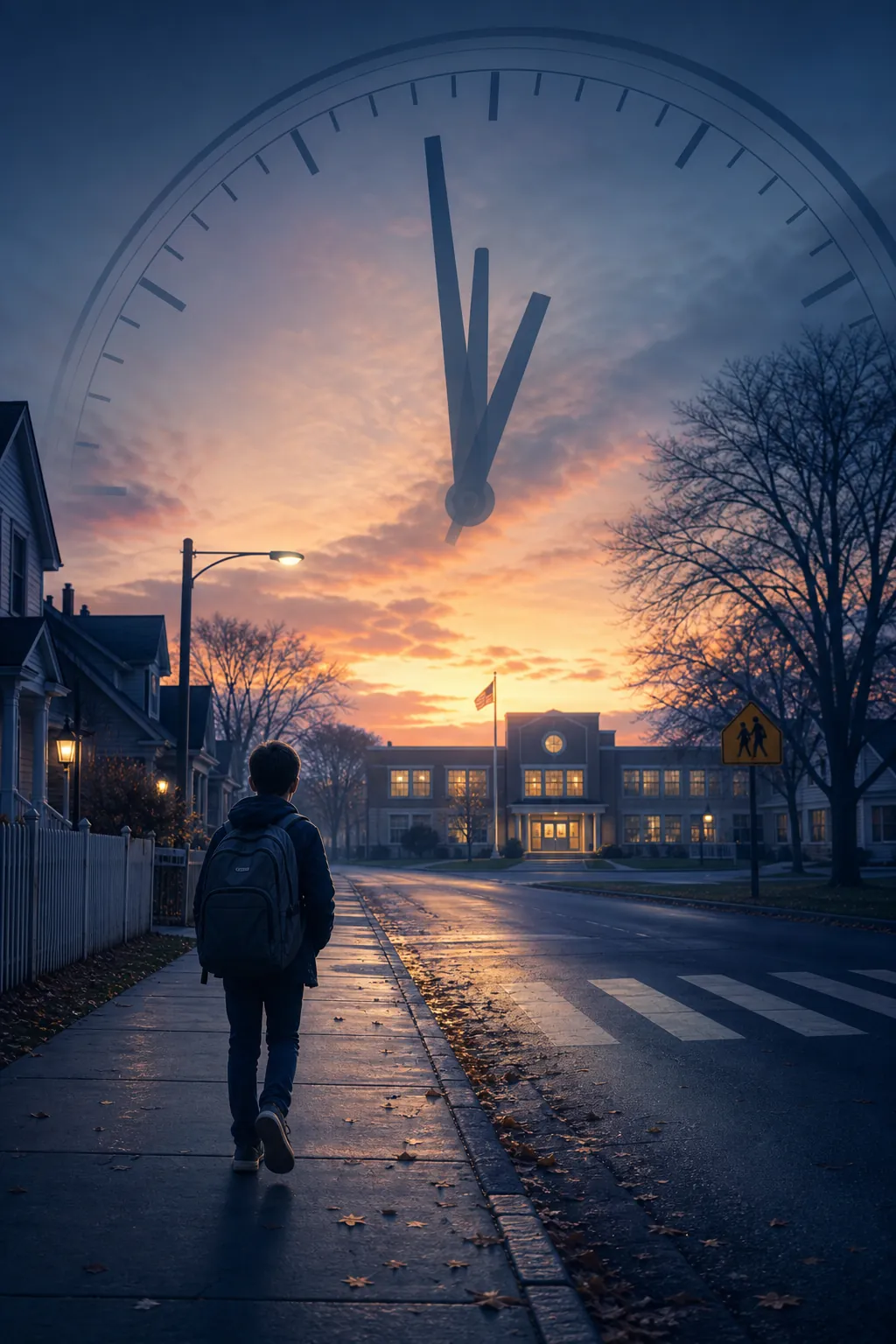
The spring clock change can make a teenager measurably sleepier during the school commute. A later sunrise can put students at crosswalks and bus stops in darker conditions. A longer mismatch between school schedules and adolescent biology can add to an already bad sleep baseline. Those are three different mechanisms, and mixing them together is how a useful safety conversation turns into a seasonal argument.
The traffic evidence also refuses to give a clean slogan. A 2024 Insurance Institute for Highway Safety analysis found that daylight saving time was associated with 26 fewer pedestrian fatalities per five-week post-change period, but 29 more vehicle occupant fatalities, leaving the net safety effect close to zero.[1] That does not make school-morning risk imaginary. It means the risk is uneven: some people gain safer light at one part of the day while others absorb danger at another.
The Three Mechanisms Are Not Interchangeable
A school safety plan has to separate the hazards before it can respond to them. The student driver who is slower to react after losing sleep is not facing the same hazard as the seventh grader crossing before sunrise. The student trying to study for a morning exam after several misaligned school nights is facing yet another problem.
| Mechanism | School-day concern | Evidence strength | What the evidence can and cannot say |
|---|---|---|---|
| Acute sleep loss after the spring transition | Drowsy student drivers, slower attention, more lapses during morning travel and class | High for measured sleep and alertness; broader crash evidence supports concern | Strong evidence of sleep and vigilance changes; not a school-only crash estimate |
| Darker morning commutes | Students walking, biking, waiting at bus stops, or crossing near campus in low light | High for darkness as a pedestrian fatality condition; moderate-to-high for DST-specific tradeoffs | Real morning-visibility concern, but DST may reduce pedestrian fatalities at other times |
| Circadian misalignment over time | Adolescents losing sleep because school schedules and body clocks are poorly matched | High for sleep biology and start-time guidance; limited for direct DST-to-school-injury outcomes | Supports caution, especially under permanent DST, but should not be overstated as direct crash proof |
This distinction matters because different adults control different levers. A parent can move bedtime earlier before the spring transition. A principal can add crosswalk coverage or remind families about dark arrivals. A district can examine bell times and bus tiers. None of those decisions is helped by treating daylight saving time as either harmless or catastrophic in every respect.
Mechanism 1: Acute Sleep Loss After the Spring Change
The clearest school-facing evidence starts with sleep, not with crash counts. In a Journal of Clinical Sleep Medicine study, researchers followed 35 high school students with a mean age of 16.5 around the spring daylight saving time transition. Sleep was measured with actigraphy, not just with students saying they felt tired. After the clock change, average sleep fell to 7 hours and 19 minutes, with a cumulative weekly loss of 2 hours and 42 minutes. Students also had higher Karolinska Sleepiness Scale scores and more lapses on the Psychomotor Vigilance Test.[2]
The sample was small, so it should not be stretched into a national injury rate. But for school operations, the result is hard to shrug off. Actigraphy plus vigilance lapses describes the exact kind of morning that makes a commute fragile: the student backs out of the driveway late, the bus arrives in the dim part of the morning, the first-period quiz starts before attention has caught up.
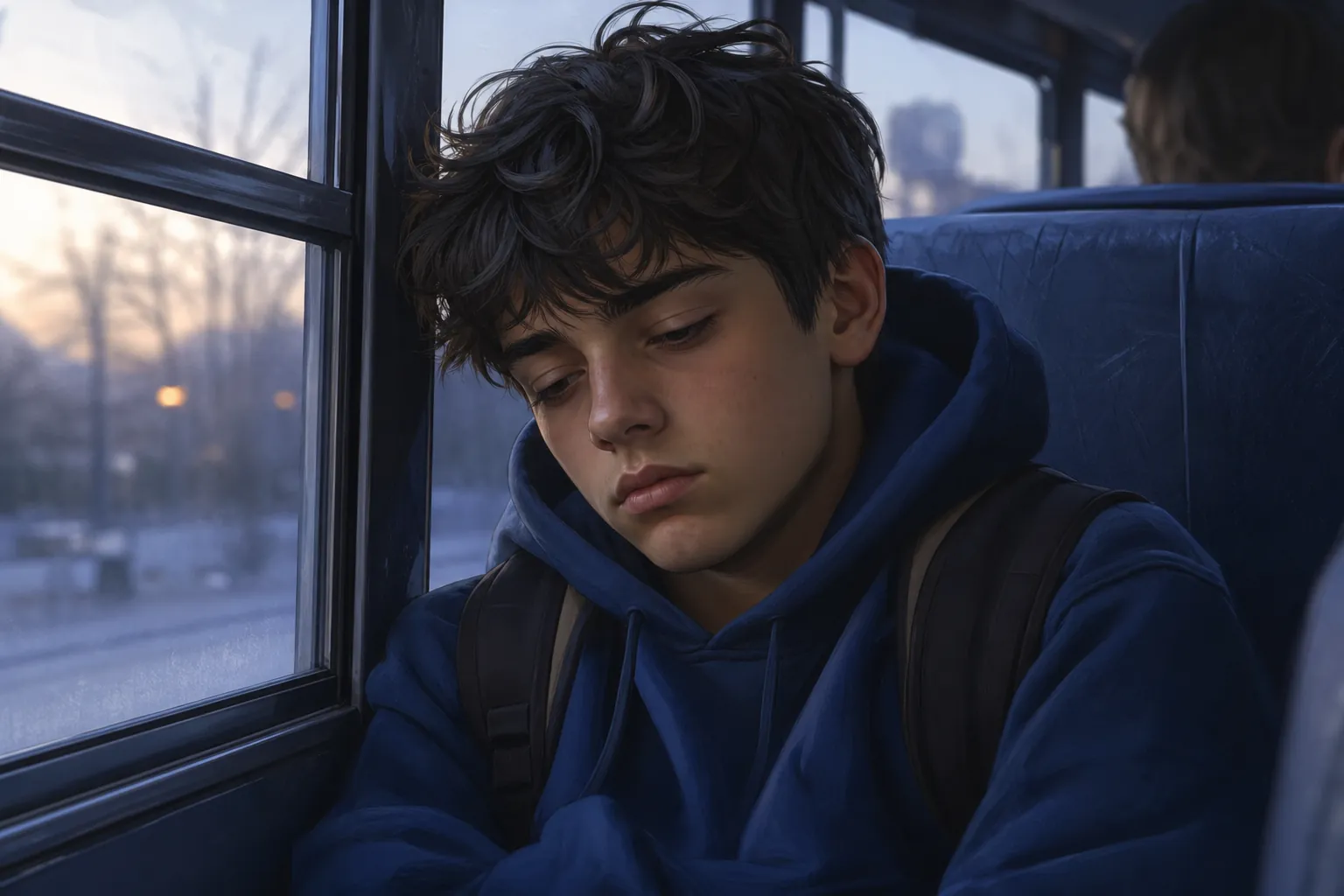
Traffic data point in the same direction at the population level. A 2020 Current Biology study reported a 6% increase in fatal traffic crashes in the United States during the week after the spring daylight saving time transition.[3] That finding is not limited to students, and it does not identify school commute crashes as a separate category. Still, it gives weight to the practical concern that a one-hour clock shift can show up in real-world driving outcomes.
For families with teen drivers, the mechanism is direct enough to act on. The riskiest version is not simply “a tired student.” It is a tired novice driver in a morning system where buses, walkers, drop-off traffic, and staff arrivals are all converging on the same few blocks.
Mechanism 2: Darker School Mornings
Morning darkness is the part of daylight saving time that parents notice at the curb. A child who was visible last week may now be standing near a crosswalk, driveway, or bus stop in conditions that give drivers less time to see and interpret movement.
The pedestrian evidence is blunt. NHTSA’s 2023 pedestrian traffic safety fact sheet reported that 72% to 77% of pedestrian fatalities occur in dark conditions.[4] That statistic does not prove that daylight saving time causes those deaths. It does explain why shifting morning school travel into darker conditions deserves more than a reminder to “be careful.” Visibility is a mechanism, not a mood.
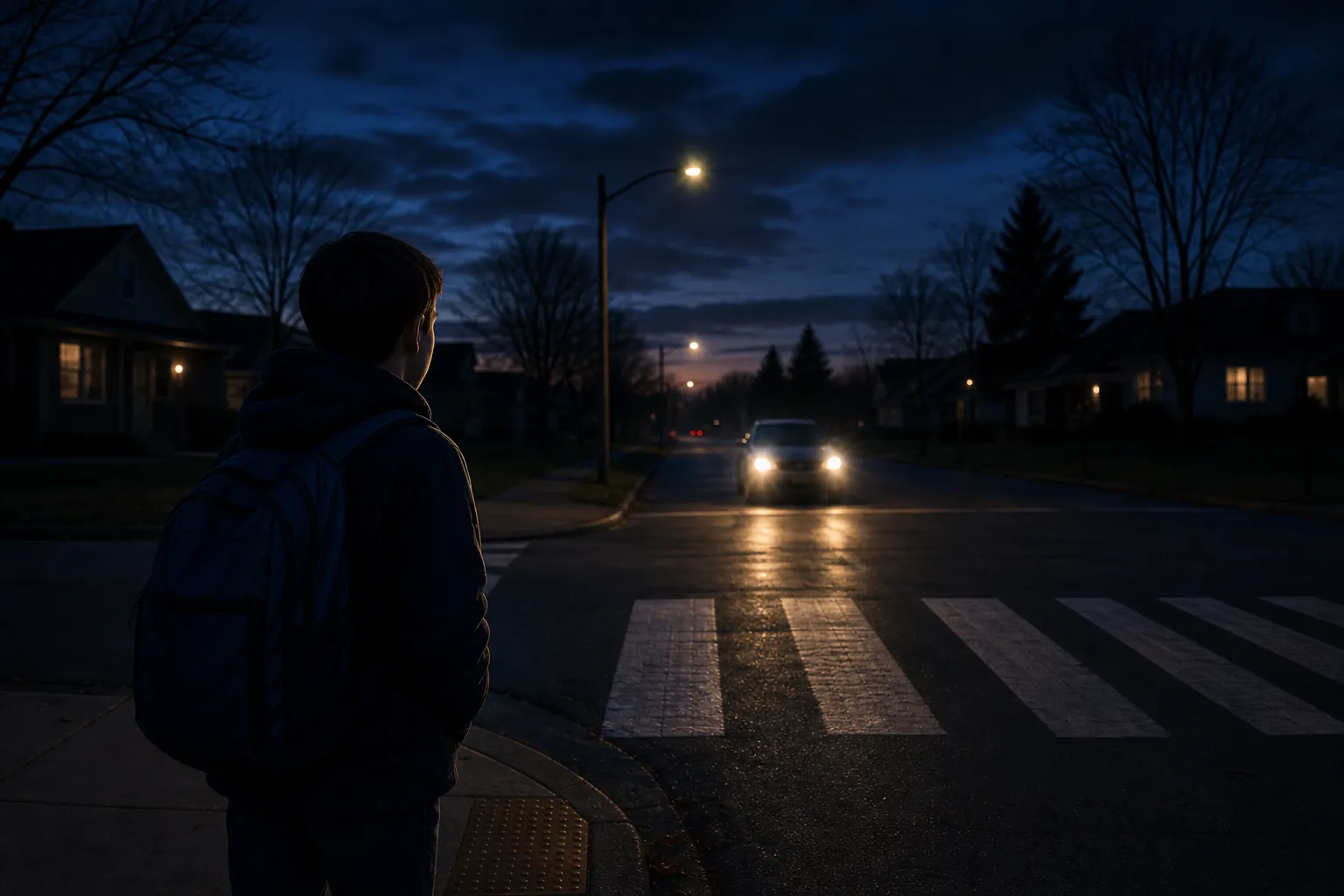
This is where the IIHS finding becomes especially important. The same shift that can darken school mornings can also brighten evening pedestrian travel. In the IIHS analysis, daylight saving time reduced pedestrian fatalities by 26 per five-week post-change period while increasing vehicle occupant fatalities by 29.[1] For a national traffic ledger, those effects nearly cancel. For a middle school with walkers arriving before sunrise, the ledger is not the only question.
A district does not need to claim that daylight saving time is uniformly dangerous to justify morning countermeasures. It can say something narrower and stronger: when sunrise moves later relative to arrival, students who walk, bike, or wait outside need more protection at the exact places where drivers are scanning least effectively.
What Morning Protection Looks Like
The useful responses are ordinary, which is why they are easy to skip. Recheck which crosswalks are staffed during the darker weeks. Move adults toward the crossings students actually use, not just the ones printed on the arrival map. Remind drivers that the first week after the spring change is not a normal Monday. Ask bus contractors whether pickup points leave students waiting in unlit areas. None of this requires proving a national catastrophe.
- For walkers: prioritize reflective gear, known routes, and crossings with adult coverage.
- For teen drivers: reduce optional early-morning driving during the first post-change week when possible.
- For schools: treat the first darker arrival week as a temporary operations problem, not just a newsletter topic.
- For parents: look at the actual light level at departure time, not the clock time that felt normal the week before.
Mechanism 3: Circadian Misalignment Builds More Slowly
The third mechanism is less dramatic than a crash statistic but matters for adolescents. Teen sleep is already under pressure before the clocks move. CDC data show that 71% to 84% of high school students get insufficient sleep on school nights.[5] In that setting, daylight saving time is not dropping into a well-rested system. It is pressing on a schedule that is already short of sleep.
This is also where permanent daylight saving time becomes a school issue rather than a preference poll. Later morning light can make it harder for adolescents to align wake time with biology, especially when middle and high schools start early. The American Academy of Pediatrics recommends that middle and high schools start at 8:30 a.m. or later, a policy position aimed at adolescent sleep needs rather than adult convenience.[6]
The boundary matters: the biology is strong, but direct school-safety outcome data tied specifically to long-term daylight saving time are limited. It is fair to say circadian misalignment can worsen adolescent sleep debt and alertness. It is too strong to say that every school injury, discipline problem, or test dip after a clock change is a daylight saving time effect.
That distinction is especially important for test-prep students. A 2017 study of more than 22,000 elementary students across six European countries found no statistically significant short-term daylight saving time effect on math, science, or reading test scores.[7] That does not mean sleep loss is harmless for learning or attention. It means the available test-score evidence does not support a simple claim that the clock change immediately lowers academic performance.
The 1974 Permanent-DST Lesson Is About Dark Mornings, Not Nostalgia
The United States has already tested the political fragility of dark school mornings. During the 1974 permanent daylight saving time experiment, public support reportedly fell from 79% to 42% within two months.[8] The episode is often remembered because children became visibly tied to the policy debate: secondary accounts report that eight children were killed in Florida in the first month, compared with two during the same period the prior year.[8]
Those Florida numbers should be handled carefully because the available brief points to secondary sourcing rather than a verified primary crash file. But the broader policy record is still instructive. A Congressional Research Service report notes that the 1974 experiment was shortened after public concern, and that the National Education Association, National School Boards Association, National PTA, and American Federation of Teachers opposed the year-round daylight saving time arrangement.[9]
The lesson is not that every permanent-DST proposal will reproduce 1974. It is that school mornings can overturn an abstractly popular idea very quickly. Evening light is pleasant until families are watching children cross arterial roads in the dark.
What Parents, Students, and Schools Can Reasonably Do
The evidence supports practical mitigation, not panic. The spring transition is predictable, which means the first intervention is scheduling, not moral advice after the fact. The American Academy of Pediatrics’ HealthyChildren.org recommends gradually shifting bedtime 15 to 20 minutes earlier for a full week before daylight saving time begins.[10]
That recommendation sounds small because it is supposed to be small. A family trying to move bedtime by a full hour on Saturday night is fighting homework, sports, jobs, siblings, and phones all at once. Fifteen to 20 minutes gives the body and the household a better chance of complying.
- If a student drives: protect the first post-change week by cutting late-night study sessions and avoiding unnecessary early trips.
- If a student walks or bikes: check the route in actual morning light and favor staffed or signalized crossings.
- If a student has a major exam: shift sleep earlier before the clock change rather than trying to “catch up” afterward.
- If a school manages arrival: add temporary visibility reminders, crossing supervision, and bus-stop checks during the darker arrival period.
- If a district debates bell times: evaluate daylight exposure, transportation tiers, and adolescent sleep together instead of treating start time as a standalone preference.
For policy discussions, the strongest school-safety case is not “daylight saving time kills children.” The stronger case is narrower: school systems should not ignore the combination of sleep loss, darker arrival conditions, and adolescent circadian vulnerability, especially when those burdens fall on students who have little control over bell schedules, bus routes, or parent work shifts.
There is also a health-policy backdrop, though it should not be used as a shortcut for school safety claims. A Stanford Medicine report on a 2025 PNAS study estimated that permanent standard time could reduce obesity by 2.6 million people and stroke by 300,000.[11] That kind of modeling adds weight to the circadian argument, but it does not replace the more concrete school questions: who is tired behind the wheel, who is crossing in darkness, and who is being asked to learn on too little sleep?
A Measured Answer
Daylight saving time does affect school safety, but not through one universal danger channel. The spring transition can reduce sleep and vigilance in teens. Later sunrise can make school arrivals darker and more hazardous for pedestrians. Longer circadian misalignment can deepen sleep debt in adolescents, though direct school-safety outcome evidence is thinner there.
At the same time, the net traffic-safety picture is mixed: daylight saving time can help pedestrians in one part of the day while hurting vehicle occupants in another.[1] That is exactly why school planning should be specific. Protect the morning. Protect the tired teen driver. Protect the student at the crosswalk. The national ledger may come out close to zero, but the school day does not distribute risk evenly.
References
- Changing the clocks helps pedestrians but hurts motorists, Insurance Institute for Highway Safety, 2024
- Sleep and the spring daylight saving time change: a natural experiment in adolescents, Journal of Clinical Sleep Medicine
- A Chronobiological Evaluation of the Acute Effects of Daylight Saving Time on Traffic Accident Risk, Current Biology, 2020
- Traffic Safety Facts 2023 Data: Pedestrians, National Highway Traffic Safety Administration
- High School Students Sleep Facts and Stats, Centers for Disease Control and Prevention
- School Start Times for Adolescents, American Academy of Pediatrics
- Daylight saving time and student performance, ScienceDirect, 2017
- When Daylight Saving Time Was Year-Round, HISTORY
- Daylight Saving Time, Congressional Research Service
- Daylight saving time: Don’t lose sleep over it, HealthyChildren.org
- Permanent standard time could prevent millions of cases of obesity and stroke, Stanford Medicine, 2025
Applies to
Exam applicability isn't specified for this technique yet. See all exam hubs.
Comments
Join the discussion with an anonymous comment.