
Method
The Trump Subpoenas Expose the Broken Promise of Branzburg v. Hayes
This article examines how the Supreme Court's fractured decision in Branzburg v. Hayes (1972) created a circuit-by-circuit patchwork of reporter's privilege doctrines, and how the 2025–2026 Trump administration subpoenas to major news outlets demonstrate the real-world consequences of that fragmentation for law students studying First Amendment law.
Evidence panel
- Evidence level
- High
- Primary citation
- Branzburg v. Hayes, Cornell Legal Information Institute
The too-clean classroom sentence is that Branzburg v. Hayes rejected a First Amendment reporter’s privilege. That sentence is not wrong. It is just incomplete in the way exam answers become incomplete when they turn a fractured Supreme Court decision into a single rule and stop reading before the concurrence.
In Branzburg, the Court held that reporters could be required to appear before grand juries and answer questions, even when the questioning threatened the confidentiality of sources. Justice White wrote for a five-Justice majority, and the formal result was a loss for the journalists claiming a constitutional privilege.[1] But Justice Powell, one of the five, wrote separately to say that courts should remain available to protect reporters from harassment or bad-faith investigations and should judge claims “on a case-by-case basis.”[1][2] Justice Stewart, dissenting, supplied the more rule-like test: the government should have to show probable cause or relevance to a specific violation, that the information cannot be obtained by alternative means, and that there is a compelling and overriding interest in the information.[1][2]
That is the puzzle behind the Trump subpoena disputes now facing journalists and the courts. The live controversy matters, but not because a president dislikes leaks or because reporters prefer confidentiality. It matters because Branzburg left federal courts with three usable fragments: White’s rejection, Powell’s balancing language, and Stewart’s dissenting test. Depending on the circuit, one of those fragments may do most of the work.
What Branzburg Actually Held
Branzburg consolidated cases involving reporters who had gathered information from confidential sources and then resisted grand jury demands for testimony. The majority treated the grand jury setting as central. It refused to create a First Amendment rule allowing journalists to withhold relevant information from grand juries simply because they had promised confidentiality to sources.[1]
Justice White’s opinion did not deny that news gathering has First Amendment value. It rejected the next move: turning that value into a constitutional testimonial privilege against grand jury questioning. The majority worried that a privilege would obstruct criminal investigations, require courts to define who counts as “the press,” and invite difficult line-drawing over when a reporter’s claim should prevail.[1]
For law students, the holding should be stated with that context attached. Branzburg rejected a First Amendment reporter’s privilege in the grand jury setting. It did not enact a federal shield statute. It did not resolve every subpoena to every journalist in every procedural posture. And, because Powell supplied the fifth vote while writing separately, it did not leave lower courts with a perfectly stable instruction.
Powell’s Concurrence Did the Damage, or the Saving, Depending on the Circuit
Powell’s concurrence is short, but it became the hinge. He joined the majority, so he counted for the rule that the reporters lost. Yet he also wrote that if a grand jury investigation were not being conducted in good faith, or if official harassment of the press were shown, courts could intervene. He described the proper approach as a case-by-case balancing of freedom of the press against the obligation of citizens to give relevant testimony.[1][2]
That language gave lower courts a way to say Branzburg was not a total foreclosure. The problem is that Powell did not write a test. He did not say which party bears what burden in an ordinary leak investigation. He did not identify the level of government need required. He did not separate confidential-source cases from nonconfidential materials, criminal cases from civil cases, or grand jury subpoenas from trial subpoenas.
Stewart’s dissent did what Powell’s concurrence did not. Stewart would have required the government to satisfy a three-part showing before forcing a reporter to identify a confidential source: relevance to a specific probable violation of law, inability to obtain the information by alternative means less destructive of First Amendment interests, and a compelling and overriding interest in the information.[1][2] It lost at the Supreme Court. Then versions of it started showing up in lower-court doctrine.
| Branzburg opinion | Formal status | What lower courts could take from it |
|---|---|---|
| Justice White’s majority | Controlling judgment | No First Amendment privilege against grand jury testimony on the facts before the Court |
| Justice Powell’s concurrence | Fifth vote for the majority | Case-by-case balancing language, especially where harassment or bad faith is alleged |
| Justice Stewart’s dissent | Not controlling | A structured three-part test later borrowed by many courts and shield-law discussions |
The Circuit Map Is Not a Footnote
Once Branzburg is read as three competing instructions instead of one clean sentence, the federal split becomes easier to understand. Some circuits treat Powell’s concurrence as permission to balance interests and recognize a qualified reporter’s privilege, including in criminal cases. Others read Branzburg much more narrowly for reporters and much more broadly for subpoenas.
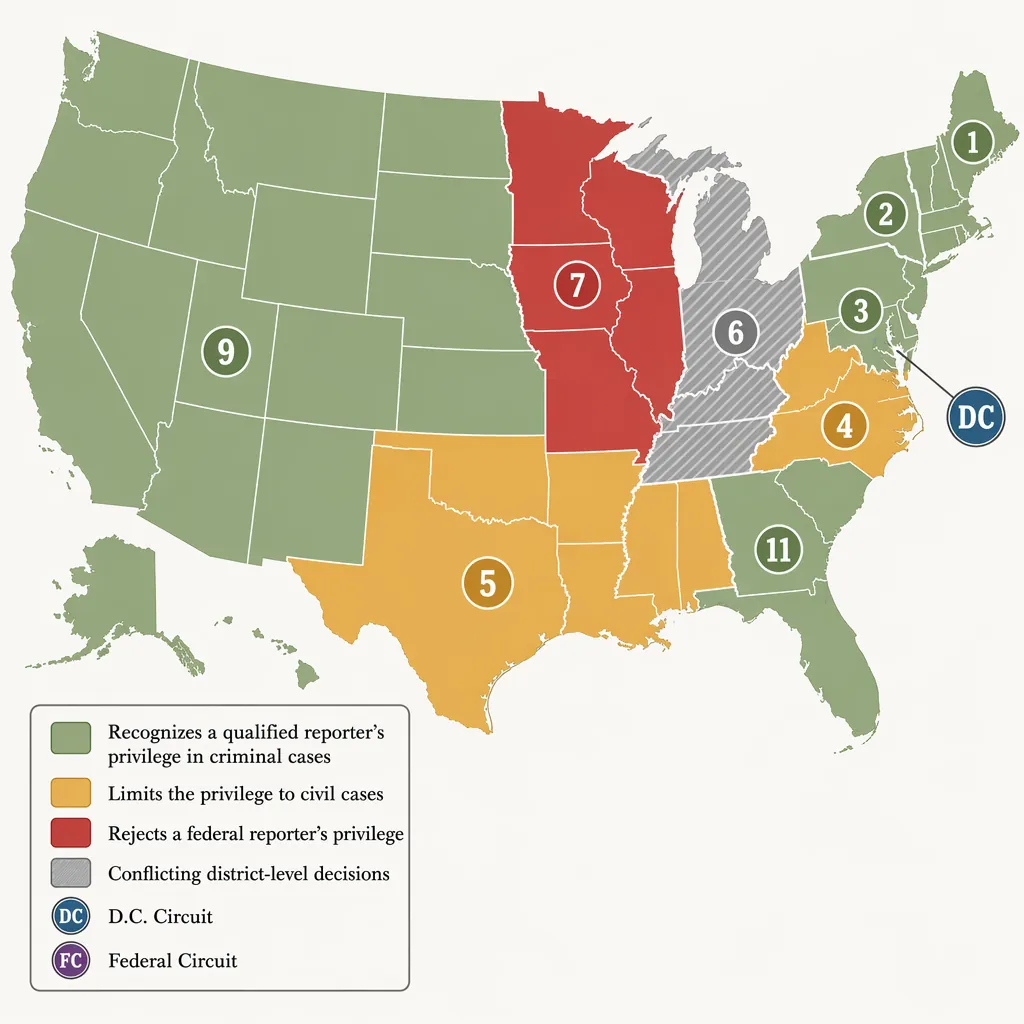
The Knight First Amendment Institute describes the federal reporter’s privilege landscape as badly fractured: the 1st, 2nd, 3rd, 9th, and 11th Circuits recognize a qualified privilege in criminal cases; the 4th and 5th Circuits recognize a privilege in civil cases but not criminal cases; the 7th Circuit rejects a federal reporter’s privilege; and the 6th Circuit has conflicting district-level decisions rather than a settled circuit rule.[3]
That split is not a small procedural nuisance. It changes the order of litigation. In a qualified-privilege circuit, the reporter can argue that the government must show need, relevance, and exhaustion of alternatives before compelling testimony or records. In a no-privilege circuit, the same reporter may have to fight on narrower grounds: overbreadth, relevance, procedural defects, bad faith, or ordinary grand jury limits.
The 7th Circuit gives the sharpest version of the rejection. In McKevitt v. Pallasch, Judge Posner wrote that “there isn’t even a reporter’s privilege in federal cases,” reading Branzburg as the opposite of a constitutional privilege and criticizing lower courts for building doctrine out of Powell’s concurrence and Stewart’s dissent.[4]
Other courts have been more willing to treat Powell’s concurrence as the controlling narrowest ground or, at least, as an invitation to balancing. The Reporters Committee’s privilege materials describe how federal courts have relied on Branzburg, Powell, and Stewart in different ways, with Stewart’s three-part approach becoming a recurring template even though it began as a dissent.[5]
State law can make the federal uncertainty look even stranger. The Reporters Committee counts 49 states and the District of Columbia as having some form of shield-law protection or judicial recognition, with Wyoming as the only state lacking both.[5] But a federal grand jury subpoena is not defeated by pointing to a state shield statute. That is why the federal circuit map matters so much when the Justice Department investigates leaks.
The 2025 DOJ Shift Moved the Question From Outline to Docket
The Trump-era subpoenas did not arise in a vacuum. On April 25, 2025, Attorney General Pam Bondi issued a memorandum rescinding Biden-era Justice Department protections that had generally barred compulsory process against journalists in leak investigations. New regulations at 28 C.F.R. § 50.10 followed on May 1, 2025.[6][7]
Those internal DOJ rules are not the same thing as constitutional doctrine. A department policy can restrict prosecutors more than the First Amendment does, and a later administration can revise the policy. Once the policy changed, Branzburg’s unresolved federal rule became more than a casebook headache. It became the background law reporters and news organizations had to litigate under.
May 2026: The Wall Street Journal Iran-War Subpoenas
In May 2026, CNN reported that the Justice Department had issued grand jury subpoenas for records of Wall Street Journal reporters connected to an article about internal discussions over possible military action against Iran. CNN also reported that Trump had personally delivered articles marked “Treason” to acting Attorney General Todd Blanche.[8]
The useful law-school question is not whether a president calling a leak treason makes the subpoena invalid. What matters doctrinally is what the forum does with that fact. In a circuit recognizing a qualified privilege, the newspaper could argue that the government must show the information is highly relevant, unavailable from alternative sources, and tied to a sufficiently compelling need. In a circuit taking the 7th Circuit view, the same fact pattern starts with a colder proposition: Branzburg rejected the privilege, and the reporter must find another doctrinal hook.
The Knight Institute criticized the subpoenas as an escalation against press freedom and emphasized that the subpoenas targeted reporters’ records in connection with leak investigations.[9] That characterization matters as advocacy and as institutional response. It does not itself answer the constitutional question. Courts still have to decide which Branzburg fragment governs.
June 2026: Testimony Subpoenas Issued, Then Withdrawn
The next month, NBC News reported that the Justice Department had issued grand jury subpoenas seeking in-person testimony from three Wall Street Journal reporters and one Washington Post reporter, then withdrew those subpoenas after public criticism.[10]
Withdrawal is not a merits ruling. It does not tell a future reporter what test applies. It does not create a privilege. It does not decide whether Powell’s concurrence authorizes balancing or whether White’s majority forecloses it in the grand jury context. It shows something more practically unsettling: the legal pressure can arrive before any appellate court has to cleanly pick a rule.
This is where classroom summaries can mislead by omission. If the only note is “Branzburg rejected reporter’s privilege,” then a withdrawn subpoena looks like politics outside the doctrine. If the circuit split is on the page, the same event looks like a pressure point inside the doctrine. The government may not need a final judicial victory for the subpoena to force a newsroom to retain counsel, negotiate with prosecutors, prepare privilege arguments, and decide how much risk a source can be asked to bear.
July 2026: Agents at the Homes of New York Times Reporters
On July 11, 2026, NPR reported that federal agents had served subpoenas at the homes of four New York Times reporters: Julian Barnes, Eric Lipton, Tyler Pager, and Eric Schmitt. The subpoenas required grand jury testimony five days later concerning reporting about Air Force One security.[11] The Guardian also reported on the subpoenas and identified the same Air Force One reporting context.[12]
Serving reporters at home is not a separate First Amendment test. But it sharpens the consequence of having no stable federal rule. A reporter receiving that subpoena is not asking an abstract question about press freedom. She is asking whether her circuit treats Powell’s concurrence as meaningful, whether Stewart’s dissent supplies the burden, whether the government must show exhaustion, whether the grand jury setting changes everything, and whether refusal risks contempt.
The Air Force One subpoenas also return the analysis to Branzburg’s hardest setting: grand jury testimony. A qualified privilege is easiest to defend in civil discovery, where private litigants may try to use reporters as cheaper investigators. It is harder when the government invokes criminal law and grand jury secrecy. That is why Branzburg’s original posture matters. The majority’s rule has its greatest force in precisely the kind of setting these subpoenas invoke.
A Law Student’s Version of the Subpoena Analysis
A useful answer does not start by announcing that journalists always win or always lose. It starts by identifying the source of law. Is the claim constitutional, common-law, statutory, or based on DOJ policy? Is the case in federal court? Is the subpoena part of a grand jury investigation, a criminal trial, or civil discovery? Is the material confidential-source information, unpublished notes, communications metadata, or testimony about reporting?
| Question | Why it matters |
|---|---|
| Which circuit is hearing the dispute? | The federal privilege may exist, be limited, or be rejected outright. |
| Is this a grand jury subpoena? | Branzburg’s majority is strongest in the grand jury context. |
| Is the reporter protecting a confidential source? | Many privilege arguments are strongest when source exposure is at stake. |
| Has the government exhausted alternatives? | This is central under Stewart-style balancing but irrelevant if no privilege applies. |
| Is the challenge based on DOJ policy? | Internal policy can constrain prosecutors but does not supply a fixed constitutional rule. |
For a hypothetical reporter in the 2nd Circuit, the analysis may include a qualified privilege argument because that circuit is listed among those recognizing the privilege in criminal cases.[3] For a hypothetical reporter in the 7th Circuit, McKevitt makes the argument far less promising because that circuit has rejected the existence of a federal reporter’s privilege.[4] The facts may be morally identical. The doctrine is not.
That is the part Branzburg left unstable. The same subpoena can be framed as an ordinary demand for relevant evidence, a press-harassment problem, a qualified-privilege dispute, or a question already answered against the reporter in 1972. Each framing has a plausible citation. None has become the nationally uniform federal rule.
The PRESS Act Would Have Answered the Institutional Problem
A federal shield law would not need to pretend Branzburg meant something clearer than it did. It could create the rule directly. The PRESS Act passed the House unanimously in January 2024, but it was blocked in the Senate in December 2024 after Trump opposed it.[13] As of July 2026, press-freedom advocates continued to point to the subpoenas as evidence of the need for federal statutory protection, and the Reporters Committee noted that the bill had not become law.[14]
The case for a statute is not that journalists should hold an absolute veto over criminal investigations. Branzburg rejected that position, and any serious analysis has to respect the force of compulsory process in criminal law. The case for a statute is that the federal system should not make reporter-source protection depend so heavily on circuit geography and on how much weight a court is willing to place on a one-Justice concurrence.
Branzburg’s broken promise is not that the Court denied an absolute privilege. The majority was clear enough about that. The broken promise is that, five decades later, students still have to outline a holding, a concurrence, and a dissent as if assembling the actual rule from loose parts; reporters still have to calculate risk across circuit borders; prosecutors still operate under shifting department policy; and courts still decide whether Powell quietly saved what White seemed to reject.
References
- Branzburg v. Hayes, Cornell Legal Information Institute
- Branzburg v. Hayes, The First Amendment Encyclopedia
- The Law of the Reporter’s Privilege Is a Mess. A Federal Shield Law Could Help Fix It, Knight First Amendment Institute
- 7th Circuit, Reporters Committee for Freedom of the Press
- II. Authority for and source of the right, Reporters Committee for Freedom of the Press
- AG Permits Journalist Subpoenas in Leak Investigations, Ballard Spahr, May 2025
- DOJ rescinds news media guidelines: What journalists need to know, Reporters Committee for Freedom of the Press
- Trump DOJ subpoenas Wall Street Journal reporters’ records in leak investigation, CNN, May 11, 2026
- Trump Administration Escalates Attack on Press Freedom with Subpoenas Targeting Wall Street Journal Reporters, Knight First Amendment Institute
- Trump administration tried to force journalists to testify before federal grand jury, NBC News
- Justice Department subpoenas New York Times reporters over Air Force One reporting, NPR, July 11, 2026
- Justice department subpoenas New York Times journalists over Air Force One story, The Guardian, July 11, 2026
- PRESS Act protections, The Fulcrum
- Reporters Committee statement on DOJ subpoenas targeting Wall Street Journal reporters, Reporters Committee for Freedom of the Press
Applies to
Exam applicability isn't specified for this technique yet. See all exam hubs.
Comments
Join the discussion with an anonymous comment.