
Method
Use the 2026 Eclipse and Perseids for Astronomy Study
The August 12, 2026 total solar eclipse and Perseid meteor shower peak offer a rare all-day sky event that doubles as an active astronomy lab. This article presents a structured study method—combining pre-event preparation, real-time observation, and post-event reflection—so students can turn skywatching into effective, evidence-based learning.
Evidence panel
- Evidence level
- Limited
- Primary citation
- Benefits of Astronomy Education in Summer Learning — Slooh
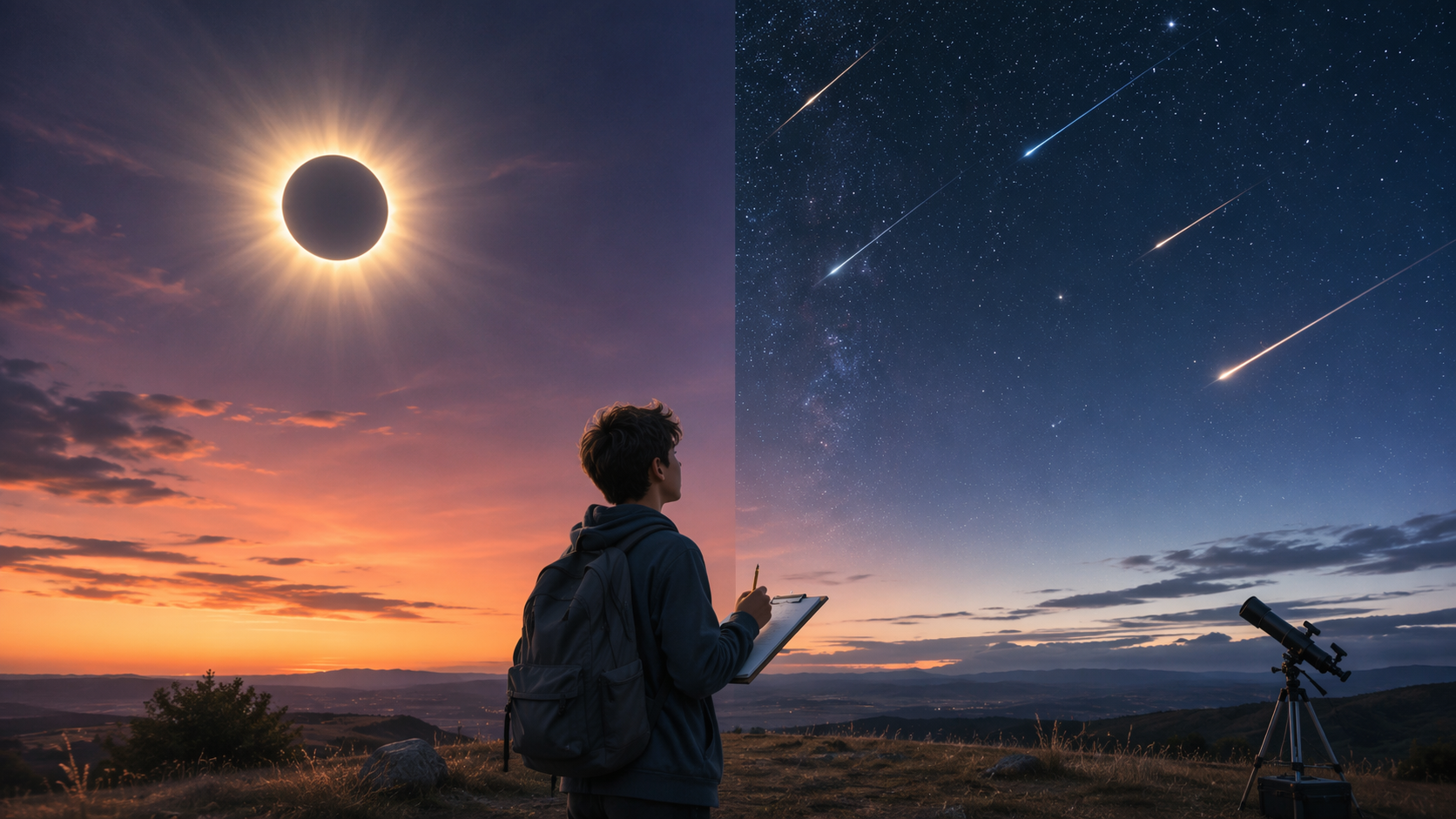
August 12, 2026 can be treated as an all-day astronomy lab: a total solar eclipse by day and the Perseid meteor shower near its peak at night. The useful study question is not simply whether the date is rare. It is whether a student can use the same day to remember eclipse geometry, lunar phase, meteoroids, parent comets, atmospheric entry, and observation limits more clearly a week later.
The answer can be yes, if the day is handled as a study session instead of passive skywatching. That means checking local eclipse circumstances before the event, predicting what should happen before looking, recording what actually happens during the eclipse and meteor session, and turning those notes into retrieval prompts afterward.
The 2026 eclipse is a real total solar eclipse, but not everyone will see totality. NASA gives the eclipse magnitude as 1.0386 and the maximum duration of totality as 2 minutes 18 seconds, with local timing and visibility depending on the observer’s position along or outside the path [1]. The Perseids are also real, but the familiar high hourly numbers describe idealized observing conditions, not a guarantee for a backyard under streetlights.
Why the same new moon matters twice
The cleanest study bridge between the two events is the Moon’s phase. A total solar eclipse requires the Moon to be positioned between Earth and the Sun, which is a new moon alignment. The same new moon also removes bright moonlight from the night sky, improving conditions for seeing fainter meteors.
That is more useful than a calendar coincidence. The student can write one cause-and-effect chain that links both parts of the day: new moon geometry makes a solar eclipse possible in the right path on Earth; the same dark lunar phase makes the Perseid night more favorable for meteor watching. EarthSky lists the August 12, 2026 new moon at 17:37 UTC and connects that timing to both the eclipse date and dark-sky Perseid viewing [2].
A simple pre-event sketch should show the Sun, Moon, and Earth in line for the eclipse, with the Moon’s shadow reaching only part of Earth. Next to it, the student can draw Earth moving through debris from the Perseid stream at night. The two sketches do not describe the same physical mechanism, but they do share a useful timing condition: the Moon is not brightening the night sky.
What students need to know before the day
Before August 12, the student should prepare just enough astronomy to make the observation active. The goal is not to memorize a full chapter outdoors. It is to arrive with predictions that can be checked.
| Topic | Before-event prediction | What to check during or after |
|---|---|---|
| Total solar eclipse | The Moon must be at new moon and aligned closely enough to cover the Sun from some locations on Earth. | Local eclipse type, contact times, whether the site is in totality or only partial eclipse. |
| Lunar phase | The Moon should not brighten the night sky after sunset because the date is near new moon. | Whether the night sky is actually dark enough locally, allowing for clouds, haze, and light pollution. |
| Perseid meteor shower | Meteors should appear as Earth encounters debris associated with the Perseid stream. | Observed meteor counts, viewing time, limiting conditions, and whether rates match idealized expectations. |
| Scientific uncertainty | Forecasts and published rates describe conditions and models, not personal guarantees. | Which differences came from location, weather, light pollution, or observation technique. |
For the eclipse, the first practical task is to use NASA’s eclipse page and tables or maps to find local circumstances. The path of totality crosses limited regions, including parts of Spain, Greenland, and Iceland, while many other areas see only a partial eclipse or no eclipse at all [1]. A student in a partial-eclipse location can still study solar-lunar geometry, but their worksheet should not use the word “totality” unless totality is actually visible from that site.
For the Perseids, the first practical task is to separate the shower’s ideal behavior from the student’s likely view. Space.com describes the 2026 Perseids as capable of a zenithal hourly rate around 100 under ideal conditions, with meteors traveling about 133,200 mph and the shower connected to comet Swift-Tuttle, whose nucleus is about 26 km wide and whose orbit is about 133 years [3]. Those are excellent study facts because they connect a visible streak to a parent body, orbital debris, and high-speed atmospheric entry. They are poor promises if they are used to imply that every observer will count 100 meteors in one hour.
Build the worksheet before looking up
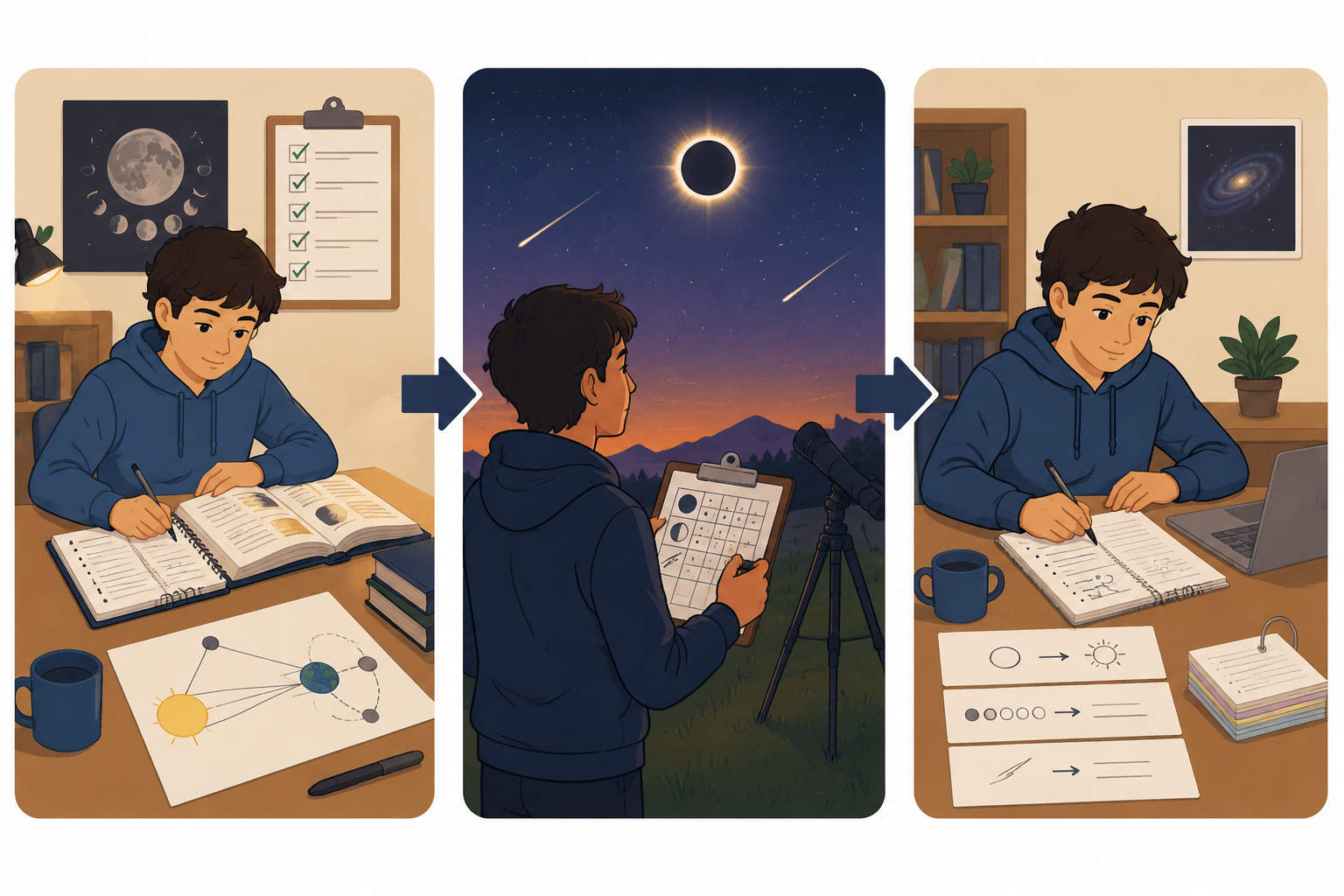
A good worksheet is not decorative. It keeps the student from replacing observation with memory of a headline. It should fit on two pages: one for the eclipse, one for the meteor session, with a small box at the bottom for same-night explanation.
Eclipse worksheet fields
- Location of observation and whether NASA’s map or table shows total, partial, or no eclipse there.
- Predicted local start, maximum, and end times from a reliable eclipse source.
- Predicted geometry sketch: Sun, Moon, Earth, and shadow path.
- Observed sky brightness changes, temperature impression if relevant, animal or human behavior only if honestly noticed, and cloud cover.
- One sentence explaining why a new moon is necessary but not sufficient for a total solar eclipse at every location.
Perseid worksheet fields
- Viewing start and end time.
- Approximate sky conditions: cloud cover, haze, nearby lights, and whether the observer’s eyes had time to adapt to darkness.
- Meteor count by time block, including zero-count intervals.
- Bright meteors or unusual streaks, described carefully without turning guesses into identifications.
- One sentence connecting the meteors to comet debris and atmospheric entry.
The zero-count interval matters. Students often remember spectacular observations better than boring ones, but science uses the boring parts too. If no meteors appear for 15 minutes, that is still an observation about local conditions, patience, and the difference between idealized shower rates and personal counts.
Students who already use structured notes can adapt the same flow used in AVID focused notes: take notes, process them, connect them to prior learning, summarize, and apply. The worksheet is the raw material; the learning happens when those notes are reorganized and retrieved.
During the eclipse: observe within strict safety limits
Solar eclipse observation has one non-negotiable boundary: students must not look directly at the Sun without proper eclipse viewing protection. The observation plan should be built around safe solar viewing methods and local expert guidance. If safe viewing is not available, the student can still use live data, diagrams, and post-event reports, but direct unsafe viewing is not part of a study method.
The best first action during the eclipse is not taking a photo. It is checking the prediction. Is the event starting close to the expected local time? Is the Sun’s coverage consistent with a partial or total event for that location? If clouds interfere, write that down rather than pretending the worksheet failed.
For students in totality, the briefness of the event matters educationally. NASA’s maximum totality duration for this eclipse is 2 minutes 18 seconds, and many locations will have less than that or no totality at all [1]. That small time window is a reason to prepare the explanation before the event, not after. A student who has already sketched the alignment can spend totality noticing rather than scrambling to understand what totality means.
For students outside the path of totality, the study value does not disappear. A partial eclipse is still evidence that the Moon’s apparent position can overlap the Sun from the observer’s line of sight. The worksheet should simply label the observation accurately. The difference between total and partial eclipse is not a disappointment in a science notebook; it is the point of the geometry.
During the Perseids: count honestly, then explain the mismatch
The Perseid session should begin with conditions, not meteors. Write down whether the sky is clear, whether nearby lights are visible, and how long the observer has been outside. EarthSky’s Perseid guidance emphasizes dark skies and notes that moonlight can strongly affect meteor visibility, which is why the 2026 new moon is helpful [4].
Then count in blocks. A student might use 10- or 15-minute intervals, but the exact block length matters less than consistency. Each block should include the number of meteors seen and a quick condition note: “thin clouds north,” “car headlights twice,” “looked away for two minutes.” This is how a meteor shower becomes data rather than a vague memory of waiting.
The explanation should use cautious language. The Perseids are associated with debris from comet Swift-Tuttle, and Earth encounters that debris stream as the particles enter the atmosphere at high speed [3]. A student can explain that brighter or more frequent meteors may appear under better conditions, but the personal count is not a direct measurement of the shower’s ideal zenithal hourly rate.
That distinction is worth practicing because astronomy is full of numbers that sound more personal than they are. A published rate is often a standardized or idealized figure. A notebook count is local, weather-dependent, and observer-dependent. Both can be useful if they are not confused.
The same-night journal entry is where retention starts
The most important writing should happen the same night, while the observation is still concrete but no longer unfolding. The student should close the worksheet and answer from memory first. That turns the event into retrieval practice rather than transcription.
- Explain why the Moon’s phase mattered to both the eclipse and the meteor session.
- Describe the difference between total eclipse visibility and partial eclipse visibility.
- Explain why the Perseid hourly rate in a guide may differ from the number counted locally.
- Connect one observed detail to one textbook concept.
- Write one question that remains unresolved.
Only after answering should the student reopen the worksheet and correct the entry. Corrections are not signs that the observation went badly. They show exactly where memory, concept, and evidence failed to line up.
A useful journal paragraph might sound like this: “The new moon mattered in two ways. During the day, the Moon was between Earth and the Sun, so observers in the correct path could see the Sun covered. At night, the same phase meant little moonlight, so faint Perseid meteors were easier to see. I counted fewer meteors than the ideal rate because my sky had local lights and thin clouds.” The exact wording can vary; the important feature is that it explains cause, observation, and limitation in the same answer.
Review it again after the sky is ordinary
One week later, the student should not reread the whole worksheet first. Start with blank recall. Draw the eclipse geometry. Define new moon in relation to the Sun, Moon, and Earth. Explain why dark skies help meteor observing. Name the Perseids’ parent comet if that was part of the course material. Then check the original notes.
This is where spaced repetition earns its place. The event creates a memorable anchor, but the delayed review tests whether the memory still carries the concept. Students who already use spaced review for exams can fold the eclipse and Perseid prompts into the same system they use for other subjects; the same principle appears in broader exam-prep planning such as this SAT exam prep guide.
The delayed review can be short. Five prompts are enough:
- Why does a solar eclipse happen only at new moon, but not at every new moon?
- What made my eclipse observation total, partial, or not visible?
- What is the difference between a meteoroid, meteor, and meteor shower?
- Why did my meteor count differ from an idealized Perseid rate?
- What did I observe that I could not have learned as vividly from a diagram alone?
If the student uses digital notes, the worksheet and journal can be turned into flashcards or quiz prompts. A tool-based workflow can help, as long as it does not invent observations. Students who want to digitize their notes can adapt ideas from using NotebookLM for studying by feeding in their own notes and asking for practice questions based only on those notes.
Where to watch, in study terms
For this article’s purpose, “where to watch” means “where can I make an accurate observation?” not “where is the most dramatic trip?” The eclipse location decision starts with NASA’s path and local timing information. If the site is outside totality, the worksheet should be designed for partial-eclipse observation or remote data comparison [1].
The meteor location decision starts with darkness and sky access. EarthSky describes the Perseids as a major annual meteor shower and emphasizes that the best viewing comes under dark skies, away from intrusive moonlight and artificial light [4]. In 2026, the new moon removes one major source of sky brightness, but it does not remove clouds, wildfire smoke, city light, obstructed horizons, or fatigue.
BBC Sky at Night Magazine has highlighted the unusual pairing of the August 2026 solar eclipse and Perseid meteor shower on the same date [5]. That newsworthiness is real, but the student’s plan should still be local. A partial eclipse plus a modest meteor count can teach more astronomy than a grand plan that never becomes careful observation.
What this method can and cannot claim
Observation can strengthen STEM learning because it gives students concrete experiences to connect to abstract concepts. Slooh’s discussion of astronomy education emphasizes observation, curiosity, and hands-on engagement as benefits of astronomy learning [6]. That supports the general educational direction: students often learn more when they actively connect a real phenomenon to an explanation.
It would still be too strong to claim that the 2026 eclipse-and-Perseids routine is a formally validated standalone method. The stronger, more honest claim is narrower: established study behaviors such as prediction, active recall, elaborative explanation, structured notes, and delayed review can be applied to this unusual observing day.
That narrower claim is enough. The event supplies the memory anchor; the student supplies the method. Without the method, August 12 becomes a story. With the method, it becomes a set of retrievable explanations.
Reuse the pattern after 2026
The same routine works for future eclipses, meteor showers, lunar eclipses, planetary conjunctions, or bright comet apparitions. Before the event, predict the geometry or physical cause. During the event, record conditions and observations. Afterward, explain what happened from memory. A week later, retrieve the explanation again and correct it against reliable sources.
The 2026 pairing is special because one lunar phase helps explain both halves of the day. The portable lesson is simpler: the sky becomes a study tool when students predict, observe, explain, and revisit what they saw.
References
- Total Solar Eclipse on August 12, 2026 — NASA Science
- Total solar eclipse visible August 12, 2026 — EarthSky
- Perseid meteor shower 2026 guide — Space.com
- Everything you need to know: Perseid meteor shower — EarthSky
- August 2026 solar eclipse and Perseid meteor shower — BBC Sky at Night Magazine
- Benefits of Astronomy Education in Summer Learning — Slooh
Comments
Join the discussion with an anonymous comment.