
MCAT Anki Decks: Best Pre-Made Decks, Where to Get Them, and How to Study

Why Anki Works for the MCAT
Spaced repetition is not a study hack. It is one of the most replicated findings in cognitive science. A 2026 PubMed meta-analysis covering 21,415 learners found that spaced repetition significantly outperforms standard study methods, with a standardized mean difference of 0.78 — a large effect by any benchmark. For MCAT specifically, a Boonshoft School of Medicine cohort found that students using Anki scored up to 12.9% higher on the CBSE compared to non-users, with gains across all science course blocks.
Those numbers matter because the MCAT demands retention at scale. You are not memorizing a chapter — you are keeping thousands of facts retrievable across biochemistry, physiology, psychology, sociology, physics, and general chemistry simultaneously. Anki's algorithm spaces your reviews so you see each card just before you would forget it, compressing the review time needed to maintain a large knowledge base.
Consistency is the other half of the equation. Spaced repetition only works if you show up every day. Missing sessions forces the algorithm to compress intervals, which creates a growing backlog that becomes harder to manage. A daily 20–40 minute Anki habit, maintained throughout your prep, outperforms marathon sessions followed by days off.
What Makes a Good MCAT Anki Deck
Popularity is a poor proxy for fit. The most downloaded deck on any forum was made by someone with a different timeline, different weaknesses, and different study habits than yours. Before committing to any deck, evaluate it on three criteria.
- Organization. Does the deck use tags and subdecks that let you filter and suspend cards by topic? A well-organized deck lets you unsuspend only the cards relevant to what you studied today. A poorly organized deck forces you to review everything or nothing.
- Card quality. Each card should test one specific concept. Cloze deletions with brief context, images where relevant, and links to source material are markers of quality. Cards that copy-paste paragraphs from textbooks are markers of a deck that was built for the creator, not for efficient review.
- Feasibility. Card count must match your available prep time. A 16,000-card deck requires over an hour of daily Anki even with six months of prep. Before choosing a large deck, use an Anki Card Calculator to estimate your daily review load at your target new-cards-per-day rate.
Every Major Pre-Made MCAT Deck Ranked and Reviewed
The following profiles cover every widely used MCAT Anki deck as of mid-2026. Each deck is assessed on organization, card quality, and feasibility using a 1–10 scale for each dimension, with scores drawn from community analysis. Download sources are included, but community-hosted links can change — verify before downloading.
MileDown (~2,900 cards)
MileDown is the default recommendation for most students, and for good reason. Its approximately 2,900 cards are organized into seven subject subdecks and further tagged by subtopic, making it easy to unsuspend only what you have studied. Every card uses cloze deletion format, includes an image, and links to a relevant Khan Academy or YouTube video. The deck was built alongside MileDown's own 90-page review sheets, so the cards align tightly with AAMC-tested material rather than textbook depth.
Organization: 8/10 | Card Quality: 8/10 | Feasibility: 9/10. Best for: most students, especially those with 2–5 months of prep. Source: Google Drive (search "MileDown MCAT deck" — link is community-maintained and should be verified at time of download).
AnKing MCAT Deck (via AnkiHub)
The AnKing MCAT deck is a composite built from MileDown, Mr. Pankow, Abdullah, and Coffin content, maintained through AnkiHub with weekly community updates. Its most distinctive feature is UWorld QID tagging: cards are tagged with the UWorld question IDs they correspond to, so you can unsuspend exactly the cards that match the questions you got wrong. This integration between practice questions and flashcard review is not available in any standalone deck.
AnkiHub requires an account. A free tier allows deck exploration; a paid membership is required for full sync and update access. Pricing is subject to change — verify current tiers on AnkiHub before committing. Best for: students who are already using UWorld and want a tightly integrated review loop, or students who want a single maintained deck rather than managing multiple downloads.
Mr. Pankow (~2,200 cards)
Mr. Pankow is the gold standard for Psych/Soc. Its roughly 2,200 cards are organized by the AAMC Psychology and Sociology framework and aligned with Khan Academy P/S blocks. Cards use real examples and contextual framing rather than bare definitions, which matters for a section that tests application more than recall. Users consistently report meaningful P/S score gains after completing this deck — some citing 5+ point improvements. The deck has since been incorporated into the AnKing MCAT deck, but it remains available as a standalone. Best for: students with specific P/S weaknesses or anyone targeting a high P/S score.
JackSparrow2048 (~5,978–6,000 cards)
JackSparrow2048 is frequently mentioned in MCAT forums and consistently misunderstood. The deck was never designed for public use — it was a personal study resource that happened to be shared. Cards use a front/back format with long explanations rather than cloze deletions, which means they function more like a mini-textbook than a flashcard system. The deck covers niche topics in depth but scores poorly on organization (4/10) and contains cards that spoil AAMC practice exam questions — a significant problem if you have not yet used those resources.
Community analysis labels it the most overrated MCAT Anki deck — it scored 16/30 on the organization/quality/feasibility rubric, the lowest of any major deck. Best for: detail-oriented students with 5+ months who have already completed all AAMC practice material and want maximum depth coverage. Not recommended as a primary deck for most students.
Ortho528 (~4,300 cards)
Ortho528 uses all cloze deletion format, includes diagrams and images, and is tagged by section. Its content draws from Kaplan, Princeton Review, and Khan Academy. The deck's weakness is limited explanations — cards test recall without much context, which can leave gaps in understanding for complex topics. It is a reasonable choice for beginners who want broad exposure quickly and are comfortable supplementing with content review. Best for: students early in prep who want a structured cloze-format deck without committing to a large card count.
Abdullah (~16,000 cards)
Abdullah is the most comprehensive standalone deck available, absorbing content from MileDown, Cubene, and Ortho528 into a single large resource with images, tags, and video links. The feasibility problem is real: at 16,000 cards, even a six-month daily schedule requires over an hour of Anki per day just for reviews. The deck is not fully tagged, which limits the suspend-first workflow. Organization: 9/10 | Card Quality: 9/10 | Feasibility: 4/10. Best for: students with 6+ months who can commit to a high daily Anki load and want maximum coverage depth.
Bouras (~13,000–13,333 cards)
Bouras combines Ortho528, MileDown, Khan Academy, and Science Simplified content into a hierarchically organized cloze deck. It is more manageable than Abdullah but still requires significant daily time. The hierarchical tagging structure is well-designed for the suspend-first workflow. Best for: students targeting 520+ who have 5–6 months and want a thorough, well-organized large deck without building a composite themselves.
Cubene (~4,600 cards)
Cubene is a Psych/Soc-focused deck built from a 300-page Khan Academy P/S document. It was created in 2018 but remains relevant because the P/S content on the MCAT has not changed substantially. If you are not using Mr. Pankow or the AnKing deck's P/S tags, Cubene is the next best dedicated P/S resource. Best for: students who want a standalone P/S deck with strong KA alignment.
| Deck | Card Count | Format | Org / Quality / Feasibility | Best For | Download Source |
|---|---|---|---|---|---|
| MileDown | ~2,900 | Cloze | 8 / 8 / 9 | Most students, 2–5 months | Google Drive |
| AnKing MCAT | Composite | Cloze + mixed | High / High / Varies | UWorld users, all timelines | AnkiHub (account required) |
| Mr. Pankow | ~2,200 | Cloze + contextual | High / High / 9 | P/S focus, 2+ months | AnkiHub (now integrated) |
| JackSparrow2048 | ~5,978–6,000 | Front/back | 4 / 5 / 7 | Detail-oriented, 5+ months, post-AAMC | Google Drive (verify link) |
| Ortho528 | ~4,300 | Cloze | 7 / 6 / 7 | Beginners wanting broad exposure | AnkiWeb / Google Drive |
| Abdullah | ~16,000 | Mixed | 9 / 9 / 4 | 6+ months, high daily commitment | Google Drive |
| Bouras | ~13,000–13,333 | Cloze | 8 / 8 / 5 | 5–6 months, targeting 520+ | Google Drive |
| Cubene | ~4,600 | Mixed | 7 / 7 / 7 | P/S standalone, no Mr. Pankow | Google Drive |
Choosing Your Deck by Study Timeline
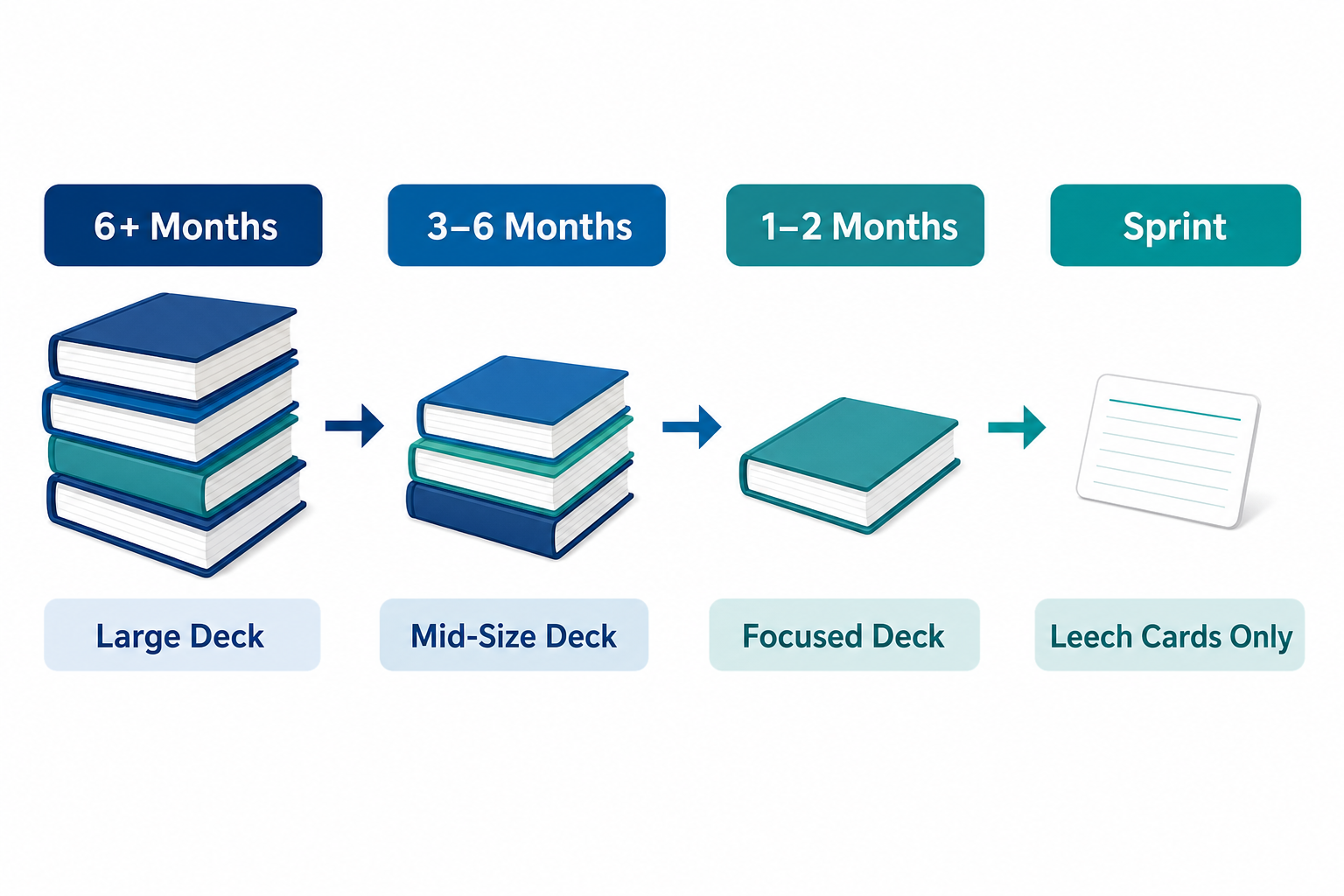
The single most important variable in deck selection is how much time you have. A deck that is optimal at six months becomes a liability at eight weeks. Use the framework below to match your current position to the right deck, then reassess at each phase transition.
| Timeline | Recommended Deck(s) | Strategy |
|---|---|---|
| 6+ months out | Abdullah or Bouras | Start with suspend-all; unsuspend by topic as you study. Daily card discipline is critical — use an Anki Calculator to confirm feasibility before committing. |
| 3–6 months out | AnKing MCAT or JackSparrow2048 (post-AAMC only) | Suspend-first workflow essential. Use AnKing's UWorld QID tags from the start. Avoid JackSparrow if you have not yet used AAMC practice exams. |
| 1–2 months (dedicated phase) | MileDown or AnKing filtered by topic | Focus on unsuspending high-yield topic clusters. Deprioritize niche cards. Add custom cards from missed AAMC questions. |
| Last 2–4 weeks (sprint) | Leech cards + high-yield formula cards only | Stop adding new cards. Focus on clearing leeches, reviewing high-yield formulas, and maintaining retention on already-learned material. |
Choosing Your Deck by Section Weakness
If your diagnostic data shows a specific section gap, your deck selection should reflect it. Timeline is the primary filter; section weakness is the secondary filter applied within your timeline's viable options.
- B/B and C/P depth gaps: JackSparrow2048 (if timeline allows and AAMC materials are complete) or Bouras. Both cover biochemistry, biology, chemistry, and physics at a depth that MileDown does not match. Bouras is preferable for most students due to better organization.
- P/S score maximization: Mr. Pankow as a standalone or the AnKing deck's P/S tags, or Cubene if you want a standalone option. The AAMC P/S framework alignment in Mr. Pankow and Cubene is specifically designed for the way the MCAT tests psychology and sociology — not just definitions, but application in passage contexts.
- All-section coverage with limited time: MileDown or AnKing. Both provide solid coverage across B/B, C/P, and P/S without requiring a large daily time commitment. AnKing has the edge if you are using UWorld; MileDown has the edge if you prefer a simpler setup.
How to Study with MCAT Anki Decks: Five Core Strategies
Choosing the right deck is only half the problem. How you use it determines whether the cards become retrievable knowledge or a growing backlog of anxiety. These five strategies form a complete operational system.
1. The Suspend-First Workflow
The most important habit for any large pre-made deck is to suspend everything before you review anything. Import the deck, select all cards, and suspend them. Then, after you study a topic in your content review, unsuspend only the cards tagged to that topic.
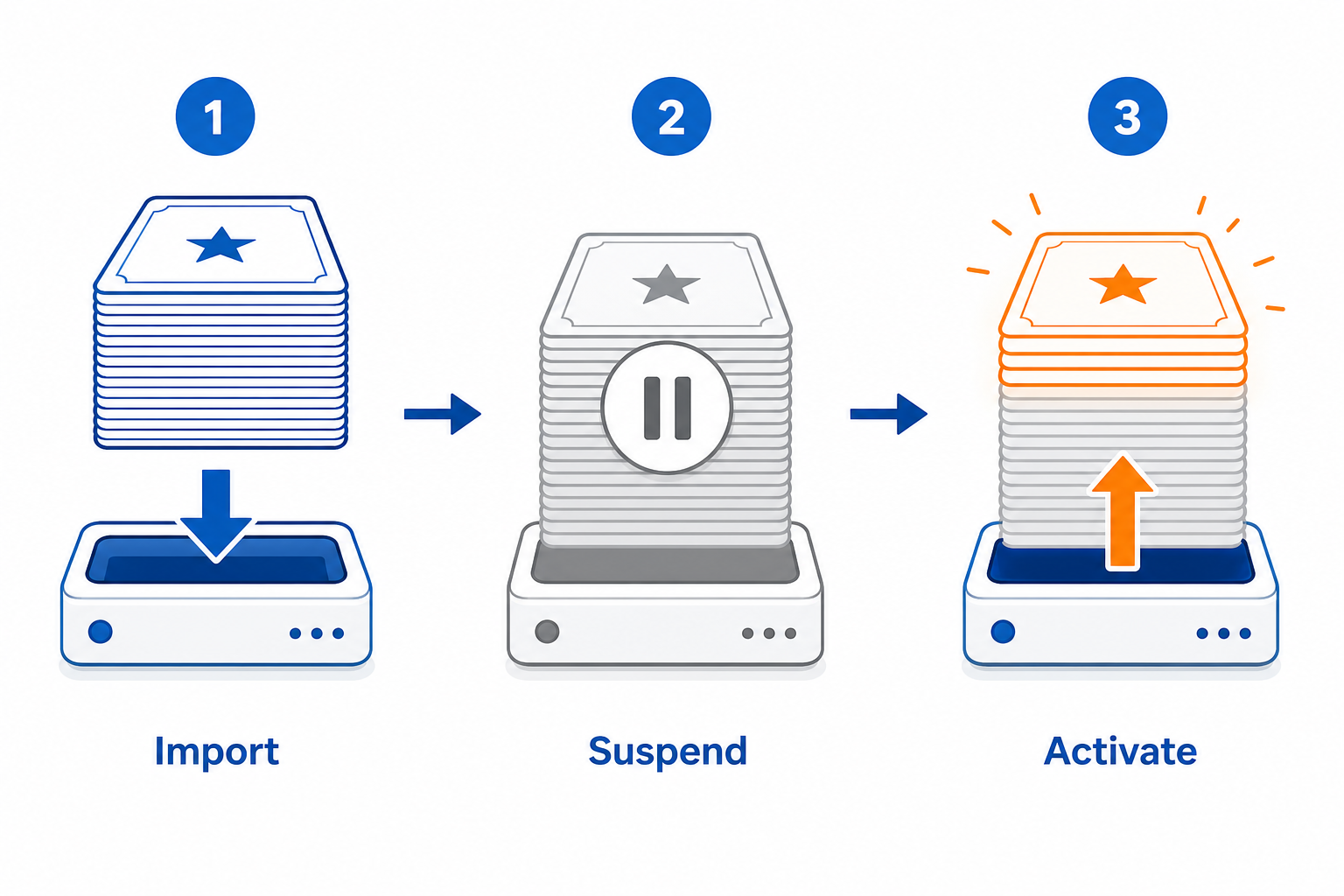
If you import a large deck and start reviewing immediately, you will encounter cards on topics you have not studied. You will either fail them repeatedly (creating a false leech backlog) or guess your way through them (creating false retention signals). The suspend-first approach ensures that every card you review is anchored to something you already understand.
2. Daily Card Limits and the Anki Wall
The sustainable range for new cards per day is 20–50. Below 20, you will not make meaningful progress through a large deck. Above 50, your daily review load grows faster than you can manage it.
The "Anki Wall" is what happens when students ignore this limit. Reviews accumulate because each new card generates multiple future review sessions. Students who push 80–100 new cards per day for two weeks often find themselves facing 500+ daily reviews by week four — a load that takes 2–3 hours to clear and crowds out every other study activity. Once you hit the wall, the only recovery is to stop adding new cards entirely and wait for the backlog to shrink, which can take weeks.
3. FSRS Algorithm
Anki's default algorithm as of 2025–2026 is FSRS (Free Spaced Repetition Scheduler), which outperforms the older SM-2 algorithm for long-term retention. FSRS models your individual forgetting curve rather than applying a fixed interval schedule, which means it schedules reviews more efficiently as your deck grows. Verify that your Anki version has FSRS enabled in the deck settings — the algorithm defaults and settings UI change across versions, so check the Anki documentation for your current version.
4. The Hybrid Approach
Pre-made decks cover standard content. They do not cover your specific gaps. The hybrid approach treats a pre-made deck as your base and adds custom cards only for material you missed on AAMC practice exams and UWorld questions.
When you miss a question, do not just note the correct answer. Create a card that captures why you missed it — the specific reasoning gap, the concept you confused, or the detail you did not retain. These custom cards address the exact failure modes that will cost you points on test day. Keep the custom card count modest; the goal is targeted repair, not a second comprehensive deck.
5. The UWorld QID Loop
If you are using the AnKing MCAT deck, the UWorld QID tagging system enables a closed feedback loop. After completing a UWorld block, identify the questions you got wrong, find the corresponding QID tags in your Anki deck, and unsuspend those cards. This means your Anki review queue is directly shaped by your actual practice question performance rather than a generic content schedule.
The loop is simple: do UWorld questions → identify wrong answers → unsuspend matched Anki cards → review those cards until retention is solid → repeat. This approach is more efficient than unsuspending by topic alone because it prioritizes the specific knowledge gaps your practice data has revealed.
Common Mistakes to Avoid
- Starting a new deck without suspending all cards first. This is the single most common Anki mistake. Reviewing cards on unlearned material creates confusion, false leeches, and early burnout.
- Choosing a deck by popularity rather than timeline fit. The most downloaded deck on a forum thread was right for someone with a different schedule and different weaknesses. Run the feasibility math before committing.
- Using Anki as your primary content source. Cards reinforce what you have already learned. They do not teach you the underlying concepts. Students who skip content review and rely on Anki alone often find they can reproduce isolated facts but cannot reason through passages.
- Ignoring the daily card limit until the backlog is unmanageable. The Anki Wall is not a hypothetical. It is the most common reason students abandon their deck entirely during the dedicated phase.
- Applying Anki to CARS. CARS tests reading comprehension and analytical reasoning. No flashcard deck improves these skills. Time spent making CARS Anki cards is time not spent doing CARS passages.
- Starting a new deck in the final four weeks. Adding a large new deck close to your test date generates more review load than it can possibly return in retention gains. Use what you already have.
Frequently Asked Questions
Which deck should a complete beginner start with?
MileDown. It has a manageable card count, excellent organization for the suspend-first workflow, and built-in Khan Academy links that support content review alongside card review. It is the most forgiving deck for students who are still building their Anki habits.
Can I use more than one deck?
Technically yes, but it is usually not a good idea. Running two large decks simultaneously doubles your review load and introduces duplicate cards that waste review time. The exception is combining a comprehensive deck (MileDown or AnKing) with a specialized P/S deck (Mr. Pankow or Cubene) — the content overlap is minimal and the P/S depth is meaningfully different.
How long should I spend on Anki each day?
Most students find 20–40 minutes of reviews plus 10–15 minutes of new cards is a sustainable daily routine. Do your reviews first — clearing your review queue is non-negotiable. New cards are added only after reviews are complete. If your review queue is consistently taking more than 45–60 minutes, you are adding new cards too fast.
What is AnkiHub and do I need a paid account?
AnkiHub is a platform for collaborative Anki deck maintenance. It allows the AnKing MCAT deck to be updated weekly with community contributions. A free account lets you explore decks; a paid membership is required for full sync access, which is what delivers the weekly updates and UWorld QID tagging. Whether the paid tier is worth the cost depends on whether you are actively using UWorld and want the update cadence. Verify current pricing directly on AnkiHub — it has changed before and may change again.
Should I make my own cards or use pre-made ones?
Use pre-made cards as your base and make custom cards only for your specific missed-question gaps. Creating a full custom deck from scratch takes hundreds of hours that most students do not have. The hybrid approach — pre-made foundation plus targeted custom additions — gives you the best of both: broad coverage without the time cost, plus personalized repair for your actual weaknesses.
Does Anki help with CARS?
No. CARS performance depends on reading speed, comprehension, and the ability to reason from a passage — none of which are improved by flashcard review. The consensus across MCAT prep communities and resources is consistent on this point. Do not use Anki for CARS preparation. Practice with passages instead.
Related case links
No matching exam hub found
Browse the exam hubs directory to find the study plan for this exam.
Did a similar plan work for you?
Share whether a comparable timeline and starting point produced a similar result — this is verification discussion, not general commentary.
Comments
Join the discussion with an anonymous comment.