
Flashcards vs Practice Tests: What the Evidence Says and How to Use Both
Wondering whether flashcards or practice tests are more effective for exam prep? This article breaks down the scientific evidence behind both methods and explains how combining them produces the best learning outcomes.
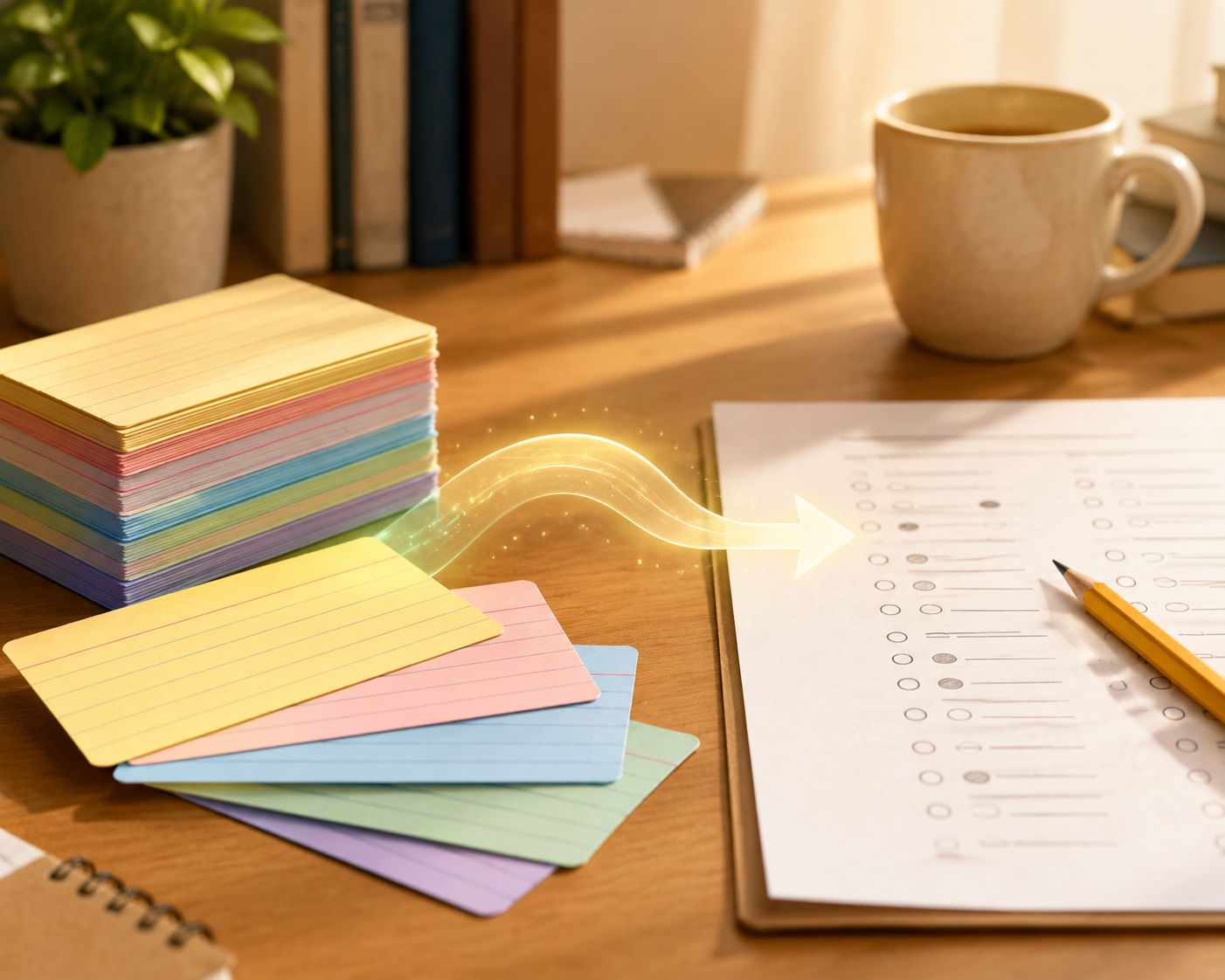
A student can do everything that looks responsible—open the app every day, clear the due cards, protect the streak—and still discover on a practice exam that the real test is asking for something the deck never made them do. That is the useful place to start the question about flashcards vs practice tests. The issue is not whether flashcards are “active” and practice tests are “serious.” Both are forms of retrieval practice. Both ask the brain to produce an answer instead of simply rereading one. That shared mechanism matters because retrieval practice has repeatedly outperformed restudying across a large evidence base, including a meta-analysis covering 217 studies.[1]
The harder question is what kind of retrieval you are practicing. A flashcard usually asks for a compact answer: a definition, a term, a formula, a translation, a step, a mechanism. A practice test asks for retrieval under a format closer to the exam: mixed topics, distractors, timing pressure, longer prompts, partial information, and decisions about which knowledge applies. That difference is why practice tests tend to look stronger in the research, even though flashcards are still doing something real.
What the evidence actually compares
The cleanest answer would come from a large trial that randomly assigns students to a full “flashcards only” study regimen or a full “practice tests only” regimen across the same course, with the same time on task and the same final exam. The available evidence does not give us that exact comparison. What it gives us is overlapping evidence: broad retrieval-practice research, practice-testing meta-analyses, flashcard and item-level retrieval studies, and studies on feedback, repetition, and transfer.
Within that evidence, practice testing has the larger reported learning effect. Hattie and Donoghue’s synthesis reports practice testing at d = 0.74 across 374 effects from 242 studies, placing it near distributed practice, which is reported at d = 0.85.[2] That is a strong result, but it needs its caveat attached: 93% of the outcomes in that analysis were surface-level factual outcomes, so the number should not be stretched into “practice tests automatically teach deep reasoning in every subject.”[2]
Flashcard-style retrieval also has a meaningful effect. Rowland’s meta-analysis reports testing over restudy at about d = 0.50.[3] That is not weak. It is the kind of effect that explains why students who move from highlighting notes to daily cards often feel less blank when a course starts piling up vocabulary, pathways, formulas, dates, grammar forms, or prerequisite terms. The problem starts when that improvement is treated as the same thing as exam readiness.
| Study method | Best-supported strength | Main limitation |
|---|---|---|
| Flashcards | Efficient retrieval of facts, terms, formulas, vocabulary, and prerequisite knowledge | Can overtrain recognition or isolated recall if cards never resemble exam demands |
| Practice tests | Stronger average learning effect and better match to exam format, timing, and transfer | Can reinforce errors or false confidence when answers are not reviewed |
| Combined use | Flashcards prepare the knowledge base; practice tests reveal whether it transfers | Requires time set aside for feedback, not just completion |
So the fair evidence-based answer is narrower than the usual internet argument. Practice tests appear to produce the stronger average learning benefit, especially when the goal is performance on an exam-like task. Flashcards remain a strong method for building the knowledge that makes those exam-like tasks possible.
Why practice tests often transfer better
Practice tests do more than ask, “Can you remember this?” They ask, “Can you remember the right thing in this situation?” That extra demand is easy to underestimate. In a real exam, the topic is not always labeled. The question may combine two chapters. The answer choices may include a definition that is true but irrelevant. A lab scenario may require a concept learned three weeks ago and a graph-reading skill practiced yesterday.
This is where transfer-appropriate processing matters. Memory tends to perform better when practice conditions resemble later use, and practice tests can activate the kinds of context-dependent representations students need on exam day.[4] A deck that asks “What is operant conditioning?” may build a useful base. A practice question that describes a behavior change, adds a reward schedule, and asks which principle explains the result requires the student to select and apply that base under pressure.
Practice tests also mix retrieval. Mixed retrieval is uncomfortable because it removes the cue that says, “We are in the meiosis section now” or “This is a past-tense verb card.” That discomfort is part of the diagnostic value. A student who can answer ten enzyme cards in a row may still miss an enzyme question when it appears after genetics, before a graph, and inside a time limit.
Timing is another difference. Flashcards can be paused, repeated, and rescued by familiarity. Practice tests expose whether retrieval is fast enough. That matters for exams where a correct answer after six minutes is still a problem because the student has six more questions waiting.
Where flashcards earn their place
Flashcards are at their best when the course contains building blocks that must become easy to retrieve. Biology students need the vocabulary before the pathway question makes sense. Language learners need words, forms, and sound-spelling links before conversation practice can move. Psychology students need terms precise enough that “negative reinforcement” does not collapse into “punishment.” Admissions-test students need formulas and grammar rules available without digging through memory for every item.
Repetition helps here. Huang and colleagues found that the retrieval-practice advantage increased from three to four rounds in a digital flashcard-learning study.[5] That is a useful signal for students who quit a card too early because it felt familiar once. The boundary matters, though: the study used Swahili–Chinese word pairs with bilingual participants, so it should not be generalized as proof that four rounds is the magic number for calculus, organic chemistry, or essay exams.[5]
Flashcards also do not have to be shallow. Lin and colleagues found that conceptual-level flashcards improved short-answer performance, especially for learners described as low structure-building learners.[6] That finding is a useful correction to the idea that a flashcard must always be a term on one side and a definition on the other. A stronger biology card might ask, “Why would blocking this enzyme change the product level downstream?” A stronger literature card might ask, “What claim would this quote support, and what would it not support?”
The card format is not the enemy. The weak version is the deck that only trains clean prompts and clean answers when the exam will ask messy questions. If you want help choosing tools for that daily system, a practical app comparison can be useful; the tool decision belongs in the background, not at the center of the study plan.
Feedback is the hinge
A completed practice test is not automatically a good study session. A cleared flashcard deck is not automatically a good study session either. Both methods depend on feedback because retrieval can strengthen the wrong thing when the learner never corrects it.
Feedback is one reason practice tests should not be treated only as final checkpoints. Butler and Roediger found that feedback after testing improved later retention, and broader reviews of effective learning techniques also identify practice testing as stronger when students receive corrective information.[7][8] Without that review, a student may remember the confidence of choosing an answer more than the fact that the answer was wrong.
The same applies to flashcards. If a student flips a card, thinks “close enough,” and moves on, the deck becomes a confidence machine. The fix is not complicated: mark missed cards honestly, edit vague prompts, add the missing distinction, and make an error card only when the original card failed to train the needed decision.
A practical division of labor
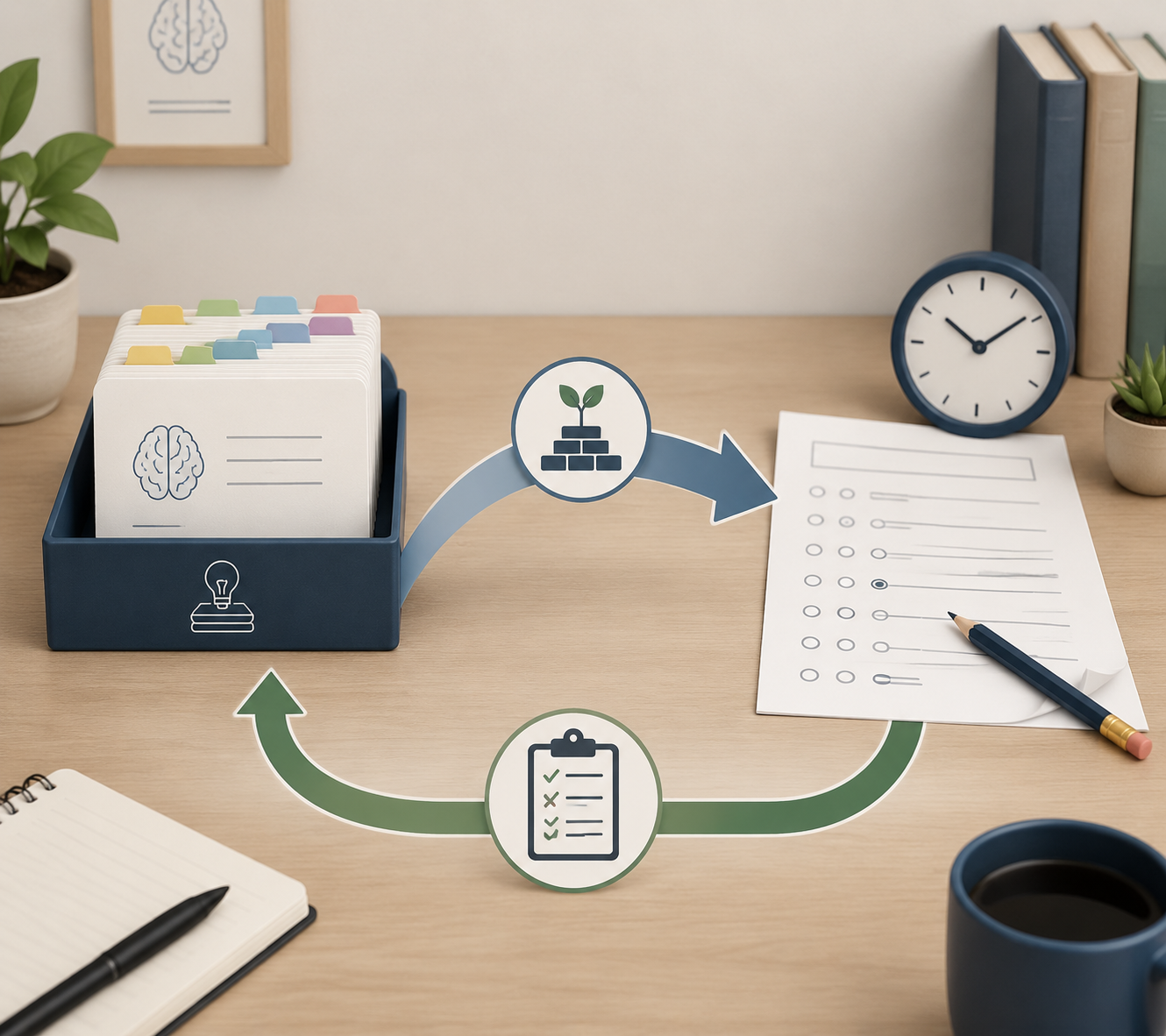
The best use of the evidence is not to replace every flashcard session with a practice exam. That sounds rigorous until the student spends a full-length test guessing at basic vocabulary and learns very little from the errors. A better system gives each method a job.
- Use flashcards daily for core knowledge: terms, definitions, formulas, vocabulary, rules, steps, mechanisms, and distinctions that must be available quickly.
- Upgrade some cards into conceptual prompts: ask for comparisons, causes, consequences, examples, non-examples, or the reason an answer would change.
- Use practice questions and practice tests regularly for mixed retrieval, timing, application, and format transfer.
- Review errors immediately enough that you still remember why the wrong answer was tempting.
- Send recurring practice-test errors back into the flashcard system only when they reveal missing knowledge, not when they simply require more exam-style practice.
That last distinction saves time. If you miss a question because you did not know the definition of “allosteric,” make a card. If you miss it because you knew the term but failed to apply it in a pathway diagram, another definition card will not solve the problem. You need more diagram-based questions, not a larger deck.
How this looks across a study week
A workable rhythm is simple enough to survive a crowded week. Flashcards handle the daily contact with the material. Practice questions or practice tests handle the check on whether the material can move.
| When | Main task | What to watch |
|---|---|---|
| Most study days | Review due flashcards and add a small number of high-value cards from current material | Cards should become clearer and more exam-relevant, not just more numerous |
| After a lecture, chapter, or topic block | Do a short set of mixed or exam-style questions | Look for prompts that require application, not only recognition |
| Once enough content has accumulated | Take a timed practice set or full practice test when appropriate | Track pacing, skipped questions, careless errors, and topics that collapse under mixed retrieval |
| Immediately after testing | Review every missed or guessed item | Separate missing knowledge from misapplied knowledge |
| Next flashcard session | Edit or add cards based on real errors | Avoid adding cards for every missed question if the issue was strategy, timing, or transfer |
Practitioner test-prep advice often recommends multiple full-length tests before an exam, and that can be useful for endurance and pacing. But those numbers should be treated as experience-based guidance unless they are tied to peer-reviewed evidence. The research-supported point is more basic and more important: practice tests become learning tools when they are followed by feedback and correction.
When to lean harder on each method
Early in a unit, flashcards usually deserve more space. Students need enough vocabulary and structure to make practice questions productive. A first-week anatomy student who cannot name the structures yet will not learn much from a full clinical-style question set except that the course feels impossible.
As the exam approaches, practice tests and exam-style questions should take up more study time. This is where the student finds out whether the deck knowledge survives mixed topics, unfamiliar wording, diagrams, data, answer choices, and time pressure. The point is not to abandon flashcards. It is to stop letting flashcards be the only place where success is measured.
For vocabulary-heavy language learning, flashcards may remain central for longer because the tested material often includes direct recall of word meanings or forms. For biology, psychology, chemistry, statistics, admissions exams, and other application-heavy settings, the balance usually needs to shift sooner toward questions that force selection and use. The exact timing depends on the exam format, not on loyalty to a tool.
The mistake that makes good students look unprepared
The most painful pattern is not laziness. It is a student with a large, mature deck who has trained one kind of success too well. They can define the terms. They can recognize the card. They can finish the review queue. Then the exam asks for a comparison, a prediction, a graph interpretation, or a case application, and the smooth recall does not know where to go.
That is why the better question is not “flashcards or practice tests?” It is “What failure would this method reveal?” Flashcards reveal whether the building blocks are retrievable. Practice tests reveal whether those building blocks can be selected, combined, paced, and corrected under exam-like conditions.
The evidence gives practice tests the stronger claim for exam performance, but flashcards often make practice tests useful in the first place. Use the deck to build the floor. Use the test to find out whether the floor holds.
References
- Rethinking the Use of Tests: A Meta-Analysis of Practice Testing, Review of Educational Research
- The Power of Testing for Learning, Frontiers in Education
- The Effect of Testing Versus Restudy on Retention: A Meta-Analytic Review of the Testing Effect, Psychological Bulletin
- Repeated Testing Produces Superior Transfer of Learning Relative to Repeated Studying, Journal of Experimental Psychology: Learning, Memory, and Cognition
- Retrieval practice effect in digital flashcard learning, PMC, 2025
- Conceptual-level flashcards and short-answer performance, Lin et al., 2018
- Feedback enhances the positive effects and reduces the negative effects of multiple-choice testing, Memory & Cognition
- Improving Students’ Learning With Effective Learning Techniques: Promising Directions From Cognitive and Educational Psychology, Psychological Science in the Public Interest
Related Resources
- The 6 Best Free Flashcard Apps in 2026 — A No-Nonsense Comparison for Students on a Budget →
Not all free flashcard apps are created equal. This guide ranks the top 6 free options by what you actually get without paying, helping budget-conscious students choose between genuinely capable free tiers and heavily paywalled alternatives.
- The Best AI Flashcard Generator for Lecture Notes: Which One Should You Use? →
A head-to-head comparison of AI flashcard generators based on how well they convert lecture notes, PDFs, slides, and recordings into flashcards. Find which tool matches your note format and study needs.
- The Science-Backed Way to Use Flashcards for English Vocabulary: What Research Actually Says About Paper vs. Digital, Spaced Repetition, and Self-Made Cards →
This article synthesizes peer-reviewed research — including a 32-study meta-analysis — to give intermediate-to-advanced English learners and teachers evidence-based guidance on how to use flashcards effectively for vocabulary acquisition. It covers spaced repetition, paper vs. digital trade-offs, card construction principles, and practical systems like the Leitner method and Anki settings.
Comments
Join the discussion with an anonymous comment.