
SAT
Struggling with the digital SAT Reading & Writing section? This guide breaks down all 11 question types, reveals how often each appears based on official practice tests, and shows you how to use that frequency data to target your practice for the fastest score gains.
Updated:
If the digital SAT Reading and Writing section feels huge, start by shrinking it to its real shape: 54 questions, 64 minutes, two 32-minute adaptive modules, and one short passage per question. Each passage is only 25 to 150 words, and each one asks exactly one question, so you are not trying to survive a long reading test so much as identify the small task in front of you 54 times in a row. [1]
That matters because sat sample questions are not all testing the same skill. A vocabulary question, a punctuation question, and a paired-text question may all sit in the same Reading and Writing section, but they ask you to do different jobs. The fastest way to make practice less chaotic is to learn the 11 question types, then spend more time on the ones that show up most often.
College Board publishes the structure of the section, but not guaranteed exact counts for every question type on every test form. The frequency estimates below come from PrepScholar’s analysis of all six official digital SAT practice tests available at the time of its analysis. Treat them as useful planning averages, not a promise that your test will match the table question for question. [2]
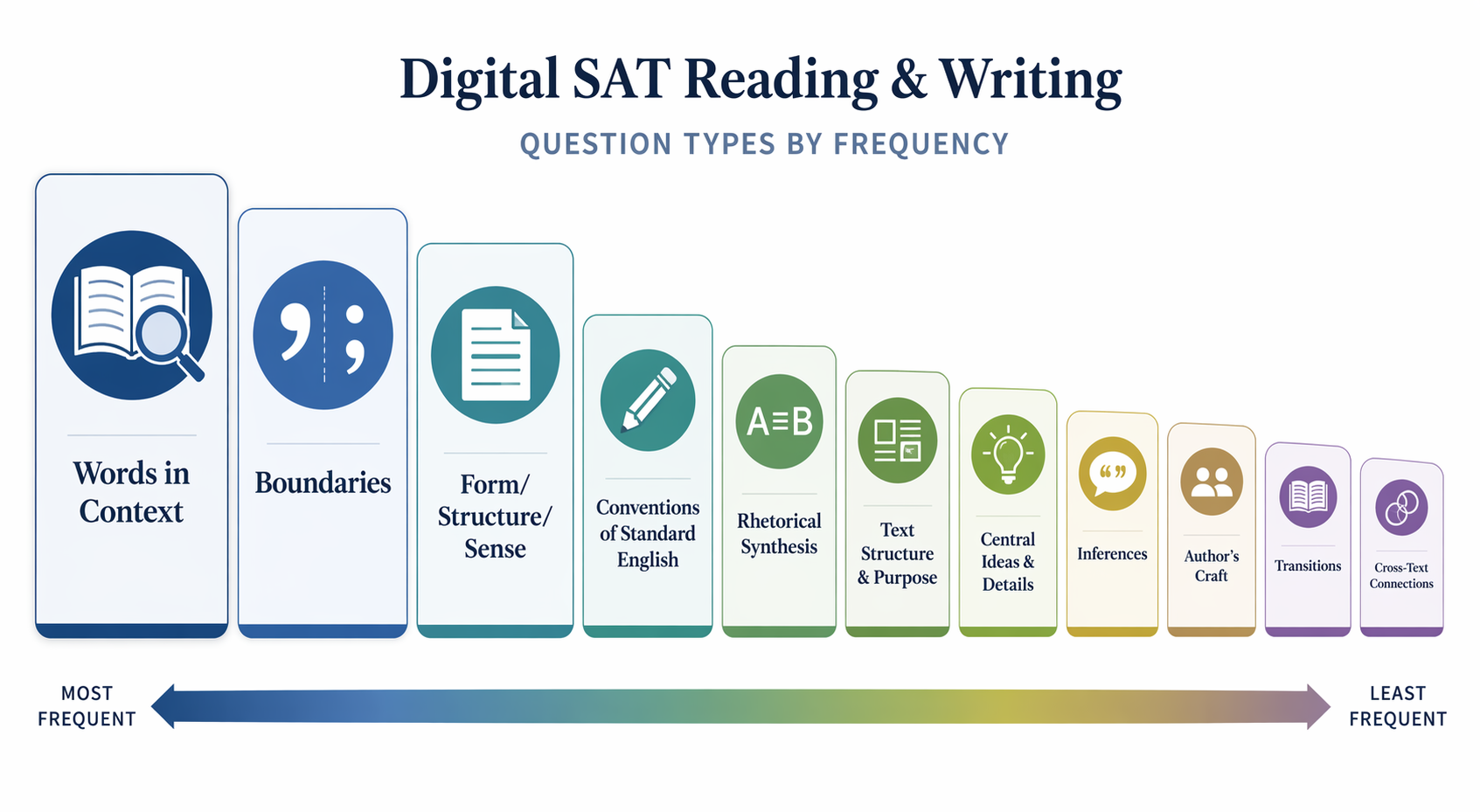
The 11 Digital SAT Reading and Writing Question Types
| Question type | What it asks you to do | Frequency signal from the six-test analysis | How to treat it in practice |
|---|---|---|---|
| Words in Context | Choose the word or phrase that best fits the meaning and logic of a short passage. | About 10.6 questions per test, roughly 19.6%. | Highest priority. Practice this early and often. |
| Form, Structure, and Sense | Choose the grammatically correct version of a sentence or phrase. | About 14.4% when averaged in the cited analysis. | High priority. Drill rule patterns, not whole passages. |
| Boundaries | Use punctuation to join, separate, or complete clauses and phrases correctly. | About 10.4% when averaged in the cited analysis. | High priority. This is one of the most learnable areas. |
| Rhetorical Synthesis | Use notes to accomplish a specific writing goal. | Appears regularly in the six-test analysis. | Practice the task wording first; the notes are usually more than you need. |
| Transitions | Choose the transition that shows the right logical relationship. | Appears regularly in the six-test analysis. | Practice by naming the relationship before looking at choices. |
| Central Ideas and Details | Identify the main point or a directly supported detail. | Appears regularly in the six-test analysis. | Practice finding the sentence that proves the answer. |
| Command of Evidence: Textual | Select the statement that best supports or completes a claim using text evidence. | Appears regularly in the six-test analysis. | Practice matching claims to exact wording in the passage. |
| Command of Evidence: Quantitative | Use a table, graph, or data description to support a claim. | Appears in the six-test analysis, but less often than the biggest categories. | Do not skip it, but keep practice focused on what the numbers prove. |
| Inferences | Choose what must be true based on the passage. | Appears in the six-test analysis. | Practice staying close to the text; avoid answers that merely sound plausible. |
| Text Structure and Purpose | Identify the role a sentence, phrase, or whole passage plays. | Appears in the six-test analysis. | Practice labeling function: introduce, contrast, explain, qualify, conclude. |
| Cross-Text Connections | Compare two short texts and identify how one author would respond to the other. | About 1 question per test, roughly 1.9%. | Respect it, but do not let it take over an early study plan. |
The table gives you permission to stop treating every weakness as equally urgent. If you have two weeks, Words in Context deserves more attention than Cross-Text Connections because it appears about ten times as often in the cited analysis. Grammar and conventions deserve even more combined attention: Boundaries plus Form, Structure, and Sense make up roughly one-quarter of the section. [2]
This does not mean the lower-frequency types are fake, easy, or safe to ignore. It means your first study block should not be organized around fear. If punctuation, sentence structure, and vocabulary-in-context keep showing up, they get first claim on your practice time.
What Words in Context Is Really Testing
Words in Context questions are not asking whether you have memorized the fanciest definition of a word. They are asking which meaning fits the sentence’s logic. A common trap is choosing a word because it is a real synonym in some other setting. The right answer has to work inside this passage, with this tone, this contrast, and this sentence structure.
In a hypothetical sample question, the passage might say that a scientist’s early results appeared to “challenge” an older theory. If the answer choices include “question,” “attack,” “invite,” and “compete,” the job is not to admire all possible meanings of challenge. The job is to ask what the scientist’s results are doing to the theory. If the sentence is about evidence creating doubt, “question” is the fit. If the sentence describes direct conflict between two teams, a different choice might work. Context decides.
A useful Words in Context review routine is short and strict:
- Cover the answer choices and predict the job of the missing or underlined word.
- Mark whether the sentence is showing contrast, cause and effect, continuation, emphasis, or qualification.
- Test each answer in the sentence instead of asking whether the word sounds familiar.
- When you miss one, write down the clue you ignored, not just the definition you forgot.
Because Words in Context averages about one-fifth of the Reading and Writing section in the cited analysis, this skill should appear in nearly every study session, especially at the beginning of prep. [2]
Grammar and Conventions Are Too Frequent to Practice Randomly
The grammar side of the digital SAT is where vague studying wastes the most time. “I need to get better at grammar” is too broad to act on. The more useful version is: “I keep missing comma splices, modifier placement, and subject-verb agreement.”
The two convention-heavy categories in the frequency table are Boundaries and Form, Structure, and Sense. Together, they account for roughly 25% of the section in PrepScholar’s six-test average. Boundaries alone averages about 10.4%, while Form, Structure, and Sense averages about 14.4%. [2]
Most students get more from drilling a small set of repeatable grammar decisions than from reading long explanations once. Start with these nine rule areas:
- Subject-verb agreement
- Punctuation boundaries
- Pronoun agreement
- Verb tense
- Dangling modifiers
- Logical comparisons
- Transitions
- Sentence construction
- Redundancy
Boundaries questions are especially good for targeted practice because the decision is often visible: comma, semicolon, colon, dash, period, or no punctuation. The sentence either has two independent clauses, a dependent clause, a list, an explanation, an interruption, or a phrase that should not be split. Once you can name the structure, the punctuation choice becomes much less mysterious.
For Form, Structure, and Sense, slow down at the part of the sentence that changes across the answer choices. If every option changes the verb, check subject and tense. If every option changes a pronoun, find the noun it refers to. If every option moves a descriptive phrase, ask what that phrase is logically modifying. The answer choices tell you what rule is being tested before you even finish reading the passage.
Students who want a deeper grammar-by-skill plan can move from this overview to How to Practice SAT Writing by Skill Domain. The important part is to keep the categories separate while you are learning. Mixing every grammar rule into one giant worksheet too early makes mistakes harder to diagnose.
How to Recognize the Other Question Types Without Overstudying Them
Once the high-frequency categories are in motion, learn the remaining types well enough to recognize the task quickly. Recognition matters because many wrong answers come from playing the wrong game: summarizing when you were supposed to infer, checking tone when you were supposed to identify evidence, or reading every note when the question only asks for one writing goal.
| Type | Fast recognition cue | Practice move |
|---|---|---|
| Rhetorical Synthesis | The question gives notes and asks you to accomplish a goal. | Read the goal first, then use only the note or notes that serve it. |
| Transitions | The blank needs a logical connector. | Name the relationship before checking choices: contrast, addition, result, example, or sequence. |
| Central Ideas and Details | The question asks for the main idea or a directly stated detail. | Find the line or sentence that proves the answer. |
| Command of Evidence: Textual | The question asks what best supports, weakens, or completes a claim. | Separate the claim from the evidence, then match them tightly. |
| Command of Evidence: Quantitative | A graph, table, or data description is involved. | Say what the data show before reading the answer choices. |
| Inferences | The question asks what can reasonably be concluded. | Choose what must follow, not what could be interesting. |
| Text Structure and Purpose | The question asks why the author included something or how the passage is organized. | Label the function of the sentence or passage part. |
| Cross-Text Connections | Two short texts appear, usually with a question about agreement or response. | Summarize each author’s position separately before comparing. |
Cross-Text Connections is the clearest example of why frequency should shape your plan. At about one question per test in the cited analysis, it deserves practice, especially if paired texts make you nervous. But if you are missing punctuation and vocabulary questions every day, spending a whole week mainly on Cross-Text Connections is probably not the best first move. [2]
For a wider map across both SAT sections, use Know Every SAT Prep Question Type on the Digital SAT. For Reading and Writing alone, the main job is simpler: know the label, know the task, and review misses by skill instead of by mood.
Where to Find the Best SAT Sample Questions
The best free source for targeted Reading and Writing practice is the College Board Student Question Bank. It contains thousands of official questions and lets students filter by domain, skill, and difficulty. Access requires a College Board account, which is mildly inconvenient but worth it because the questions come from the test maker. [3]
Do not use the Question Bank like a junk drawer. If you simply collect random questions, you recreate the same problem that made the section feel overwhelming in the first place. Filter deliberately. A student who keeps missing Boundaries should not spend the first 30 minutes of practice bouncing between graphs, paired texts, and note-synthesis questions.
A clean practice block can look like this:
- Choose one question type or one grammar rule area.
- Filter official questions by that skill and an appropriate difficulty level.
- Do a small set without rushing.
- Review every miss by naming the exact skill, clue, or rule.
- Repeat the same skill before switching categories.
Difficulty matters too. If every question is too easy, you may feel productive while learning very little. If every question is too hard, you may start guessing and calling it practice. Use Choose SAT Practice Questions by Difficulty, Not Volume when you need help matching practice to your current level, and The Best SAT Practice Problems for Your Score Level if you want a score-tier approach.
Turn Practice Questions Into a Review System
A pile of completed questions is not the same thing as improvement. The review is where the score change usually begins, because review turns “I got this wrong” into “I know what to watch for next time.”
After each practice set, sort misses into concrete labels. “Careless” is usually too vague. Better labels sound like “missed contrast clue,” “chose familiar vocabulary instead of contextual meaning,” “used comma between two independent clauses,” “did not check the graph title,” or “answered a stronger claim than the passage supported.”
A simple mistake log only needs four columns:
| Question type | Why I missed it | Clue or rule I should have used | What I will do next time |
|---|---|---|---|
| Words in Context | Picked a familiar meaning. | The previous sentence showed contrast. | Predict the word’s job before reading choices. |
| Boundaries | Used a comma between two complete sentences. | Both sides had a subject and verb. | Check whether each side can stand alone. |
| Command of Evidence: Quantitative | Chose an answer that sounded scientific. | The table only supported a narrower claim. | State what the data prove before choosing. |
For a fuller review cycle, use How to Use SAT Practice Questions to Actually Raise Your Score. The short version is that each wrong answer should create one next action. If the next action is always “do more passages,” the review is not specific enough.
When to Move From Sample Questions to Full Timed Modules
Targeted sample questions are best when you are still learning the question types or repairing a repeated weakness. Full timed modules are best when you need to practice switching tasks, managing pacing, and staying accurate after several different question types appear back to back.
A good sign that you are ready for more timed work is not perfection. It is pattern improvement. If you used to miss most Boundaries questions and now you can explain the punctuation rule on your misses, start adding timed mixed sets. If Words in Context mistakes are dropping because you are using sentence clues instead of instinct, begin folding that skill into full modules.
When you are ready for full practice, use How to Use SAT English Practice Tests to Boost Your Score. If you are comparing free resources, check Which Free SAT Practice Tests Actually Boost Your Score in 2026 before you invest hours in a test that may not match the digital SAT well.
Start with the question types that appear most often. Practice them with official filtered questions. Review mistakes by skill, not by passage. Then move into timed modules once the patterns are improving. The digital SAT Reading and Writing section is not random, so your practice should not be random either.
References
- How the SAT Is Structured, College Board
- Breakdown of Every Question Type in SAT Reading and Writing by Percent, PrepScholar
- Student Question Bank, College Board
Supporting Resources
- How to Use Anki for the MCAT Without Wasting Hours: A System-First Approach →
Stop treating Anki like a learning tool. This guide reframes Anki as a time-capped retention system for premed students, with a repeatable daily routine, concrete card-type benchmarks, and strict study ratios to keep you in the 30–40 minute sweet spot.
- Should You Choose Kaplan SAT Prep Over Princeton Review or Khan Academy? →
Deciding between Kaplan, Princeton Review, and Khan Academy for SAT prep? This hub breaks down Kaplan's offerings, pricing, and drawbacks, compares them to Princeton Review's practice volume and score guarantees, and explains how Khan Academy's free resources fit in, so you can choose based on your budget, score goal, and learning style.
- How to Decide Between SAT and ACT Prep in 2026 →
This guide helps you decide whether to prep for the SAT, ACT, or both by comparing the 2026 format changes, your personal strengths, and the current college admissions landscape.
Comments
Join the discussion with an anonymous comment.