
SAT and ACT
Wondering if your SAT or ACT score is strong enough for college? This guide shows how to find your personal target score using real Common Data Set data, so you can set a clear goal based on your specific reach and match schools.
Updated:
If your SAT diagnostic says 1250, the honest answer is: maybe. A 1250 can be comfortably above average, a useful scholarship starting point at some colleges, too low to submit at others, or simply a sign that your SAT and ACT test prep needs a sharper target. The number does not mean much until it is placed next to the colleges on your list.
For 2026 admissions planning, a good SAT or ACT score is the one that strengthens your actual applications. The cleanest working target is to meet or beat the highest 75th percentile score among your reach and match schools. That sounds less satisfying than being told “1400 is good,” but it is much harder to misread.

Start With National Context, Then Move On
National averages are useful for calming down after a first practice test. They are not useful enough to build an application strategy around. The average SAT is roughly in the 1040–1060 range, while recent ACT data puts the average around 19.4, down from 20.7 in 2019.[1][2] So yes, a 1250 SAT is above average nationally.
But colleges do not admit a national average. They admit from their own applicant pools. That is why the same score can play very differently at a less selective in-state public university, a popular merit-aid school, and a highly selective private university.
At the far end of the range, the benchmarks get very high very quickly. Reported 2025–2026 score ranges put Harvard around 1500–1580 SAT, MIT around 1510–1580, and Stanford around 1500–1570; a 1500+ SAT or 33+ ACT sits around the top 1–2% nationally.[2] Those numbers are real reference points, but they should not hijack the process unless those schools are actually on your list.
Build Your Target Score From the Colleges, Not the Other Way Around
The document you want is the Common Data Set. Most colleges publish one every year, and Section C9 reports the score ranges for enrolled first-year students. That matters because enrolled-student data is closer to the real admissions market than a promotional sentence on a testing page.
Here is the basic process:
- Make a working list of reach and match colleges. Do not start with every college you might someday consider.
- Search the college name plus “Common Data Set.” Use the most recent year you can find.
- Open Section C9 and record the 25th and 75th percentile SAT Evidence-Based Reading and Writing, SAT Math, ACT Composite, and ACT section scores when available.
- Estimate the 50th percentile as the midpoint between the 25th and 75th if the school does not publish it directly.
- Mark the highest 75th percentile score among your reach and match schools. That becomes your main target.
Summit Prep recommends using Common Data Set score ranges this way because they let students compare their scores against each school’s actual enrolled class rather than against a generic national scale.[3] This is the part that turns a vague question into a decision.
| College | SAT 25th | SAT 50th | SAT 75th | ACT 25th | ACT 50th | ACT 75th | Your note |
|---|---|---|---|---|---|---|---|
| Reach School A | From CDS C9 | Midpoint if needed | From CDS C9 | From CDS C9 | Midpoint if needed | From CDS C9 | Submit? Target? |
| Match School B | From CDS C9 | Midpoint if needed | From CDS C9 | From CDS C9 | Midpoint if needed | From CDS C9 | Submit? Target? |
| Match School C | From CDS C9 | Midpoint if needed | From CDS C9 | From CDS C9 | Midpoint if needed | From CDS C9 | Submit? Target? |
A student with a 1250 SAT may discover that the score is already above the 75th percentile at several likely schools, near the 50th at two match schools, and below the 25th at a reach. That is three different decisions, not one verdict on the student.
How to Read the 25th, 50th, and 75th Percentiles
The percentiles are not cutoffs. A student below the 25th percentile can still be admitted, and a student above the 75th can still be denied. They are better understood as positioning markers.
| Where your score falls | What it usually means | Common action |
|---|---|---|
| Below the 25th percentile | Your score is lower than most enrolled students who submitted scores | Think carefully before submitting at a test-optional school |
| 25th to 50th percentile | Your score is within range but not a clear strength | Submit only if the rest of the application context supports it |
| Above the 50th percentile | Your score is stronger than the middle of the enrolled range | Generally worth submitting |
| At or above the 75th percentile | Your score is in the stronger end of the enrolled range | Use as the competitive target |
Groza Learning Center’s 2025–2026 scoring guide uses this same practical rule: submit scores above a school’s 50th percentile, aim for the 75th percentile for a competitive advantage, and be cautious about sending scores below the 25th percentile.[2]
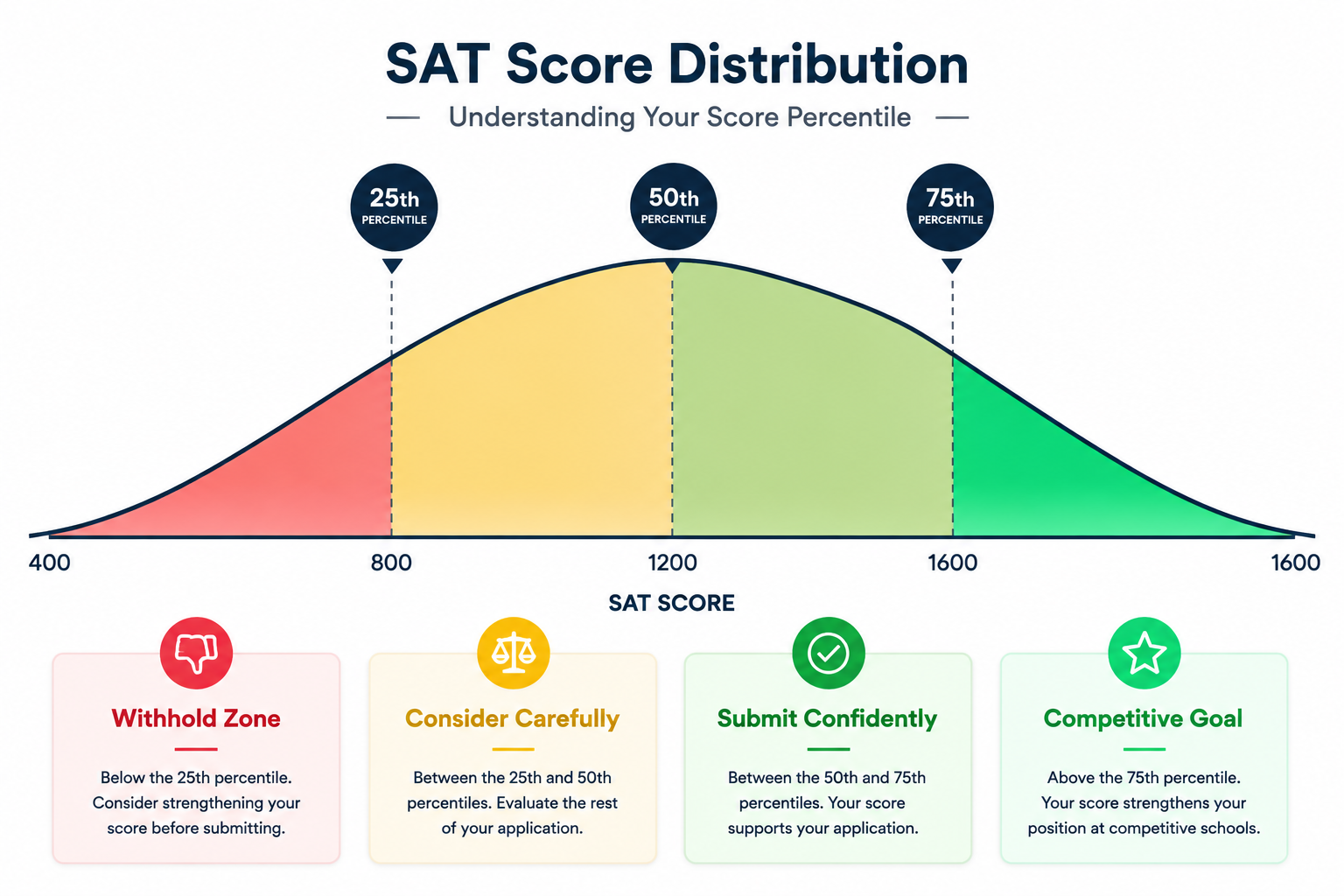
The 50th percentile is especially useful at test-optional schools. If your score is above that line, it is more likely to function as positive evidence. If it is below the 25th, the question becomes whether the score adds anything the transcript, essays, recommendations, activities, and course rigor are not already saying.
Test-Optional Does Not Mean Scores Do Not Matter
Test-optional policies give students a choice. They do not make every choice equally strong. If a college says scores are optional, the question is not “Will they read it?” The question is “Does this score help my file compared with the students this college usually enrolls?”
The University of Southern California is a useful caution against assuming that withholding is neutral. Summit Prep’s analysis of USC Common Data Set information found a 14.2% admit rate for applicants who submitted scores versus 7.7% for applicants who did not.[4] That is close to double in that one published pattern.
That USC comparison is not a universal law of test-optional admissions. It does not prove that submitting any score causes admission chances to double, and it does not tell us everything else about the students in each group. It does show why a strong submitted score should not be casually withheld just because the college says it is optional.
For a practical submit-or-withhold decision, use this order:
- Check the college’s current testing policy. Required, recommended, test-optional, and test-free are not the same thing.
- Compare your score to that college’s Section C9 range.
- Submit if your score is above the 50th percentile unless the college gives a specific reason not to.
- Treat the 75th percentile as the score that makes the testing part of the file feel settled.
- Pause before submitting below the 25th percentile, especially at a reach school where the rest of the applicant pool is already very strong.
What If Your SAT and ACT Scores Point in Different Directions?
Do not keep prepping for both tests just because both exist. Use an official concordance or the college’s reported score ranges to compare your SAT and ACT performance, then lean into the test where your percentile position is stronger. Colleges generally care more about the strength of the submitted score than about which test produced it.
A student sitting near a 1250 SAT should not automatically assume the ACT will be easier, but one timed ACT diagnostic can be worth taking if the SAT score has plateaued or if the student’s profile suggests the ACT format may fit better. After that, choose. Splitting prep time too long often creates two unfinished scores instead of one usable one.
When Scholarships Change the Target
Admission is not the only reason to test. Some merit scholarships still use SAT or ACT scores as part of the review, and the target can be higher than the score needed to feel admissible.
As a rough planning point, Groza Learning Center identifies about 1300 SAT or 28 ACT as an entry-level scholarship starting point, with 1400+ SAT or 32+ ACT more typical for more competitive awards and full-ride programs.[2] Those are not universal cutoffs. A public university honors college, a private college merit grid, and a named full-tuition scholarship may all treat scores differently.
If merit aid is part of the plan, add one more column to the spreadsheet: scholarship threshold. The right target may be the higher of two numbers: the 75th percentile for admission positioning or the score level attached to the scholarship program you actually care about.
Deciding Whether More Prep Is Worth It
Once the spreadsheet exists, the prep decision gets much cleaner. A junior with a 1250 and a target of 1320 is in a different situation from a junior with a 1250 and a target of 1500. Both may keep studying, but the amount of time, test dates, and stress budget should not be treated as the same.
Use the target score to sort your next move:
- If your current score is already above the 75th percentile for your reach and match schools, shift energy to applications, grades, essays, and fit.
- If you are near the 50th percentile at important schools, a focused prep cycle may be worth it because a modest increase can change the submit decision.
- If you are below the 25th percentile at several schools, decide whether those schools are true priorities before committing months of prep to chase a number.
- If the score is mainly for scholarships, check the scholarship rules before assuming one more test date will matter.
This is also where families should be careful with score-report dashboards. A national percentile badge can feel encouraging or discouraging, but the college list should decide the next test date. If the next 60 points changes three schools from “maybe withhold” to “submit confidently,” that prep has a clear purpose. If it changes nothing on the list, the student may have better work to do elsewhere.
The Score Is Good When It Has a Job
Before making final testing decisions, verify each college’s current Common Data Set and admissions testing policy. Score ranges can shift each year, and test-optional language can change from one cycle to the next. The 2026 answer is not a universal number. It is the score that strengthens your actual applications and justifies the prep time needed to reach it.
References
- SAT Suite Annual Report, College Board
- What Is a Good SAT Score? 2025–2026 Guide, Groza Learning Center
- How to Use the Common Data Set to Build a College List, Summit Prep
- Test Optional at USC: What the Common Data Set Shows, Summit Prep
Supporting Resources
- How to Choose Between Local SAT Prep and Online Courses →
A practical roadmap for high school students and parents deciding between local SAT classes and online prep. Learn how to build a personalized study plan starting with a baseline diagnostic, then match format to your timeline, learning style, and budget.
- GRE Vocabulary Flashcards That Actually Stick: A Science-Backed Study System →
Struggling to retain GRE vocabulary? This guide explains why rote memorization fails and how to build a daily study system using spaced repetition, active recall, and multi-link memory hooks — backed by cognitive science and proven by top GRE tutors.
- Which SAT Prep Course Fits Your Budget and Learning Style? →
Compare the top SAT prep courses for 2026 — from free Khan Academy to premium tutoring — and find the best fit based on your budget, learning style, and target score.
Comments
Join the discussion with an anonymous comment.