
SAT
Only official College Board Bluebook tests replicate the digital SAT's adaptive algorithm and scoring—third-party free tests are useful for extra practice but can mislead on score predictions. This guide explains which free online SAT practice tests are accurate and how to use them without hurting your prep.
Updated:
If you have already burned through a few Bluebook exams and you are now searching for a free online SAT practice test, the first thing to protect is not your study schedule. It is your trust in the number that comes back at the end.
For score prediction, official College Board Bluebook tests are in a different category from every free third-party test. They run in the official testing app, follow the digital SAT’s adaptive structure, use College Board scoring logic, and include the built-in Desmos calculator environment students will see on test day. College Board currently provides full-length digital SAT practice tests through Bluebook, with eight official practice tests identified in the available guidance as Tests 4–11.[1][2]
That does not make Princeton Review, Kaplan, Mometrix, Magoosh, Test Ninjas, 4Tests.com, or AI-generated practice useless. Some of them can be perfectly reasonable places to get more reps. The problem starts when a free test hands a student a score that looks as official as a Bluebook score but was not produced by the same machinery.
This distinction matters most for students who are already serious. Ambitious scorers may want more than the official supply can comfortably provide; one prep analysis notes that high-scoring students typically need 10 or more practice tests, while only eight official digital SAT practice tests are available.[3] So the question is not whether to use anything besides Bluebook. The question is what job each resource is allowed to do.
The Score Is Only as Trustworthy as the Test Behind It
A practice-test score feels clean: 620, 710, 1450. It looks like a measurement. But on the digital SAT, that number depends on more than how many questions you got right. It depends on which questions you saw, which adaptive path you entered, how those questions were calibrated, and how the test converted performance into a scaled score.
That is why “the questions felt hard” is a weak accuracy test. A third-party exam can feel punishing and still be badly calibrated. It can look polished and still miss the way College Board builds Reading and Writing questions. It can produce a score report with percentile graphics, subscores, and bright colors, and still be guessing.
When judging a free online SAT practice test, accuracy has layers. If one layer is missing, the test may still be useful. It just stops being a reliable score predictor.
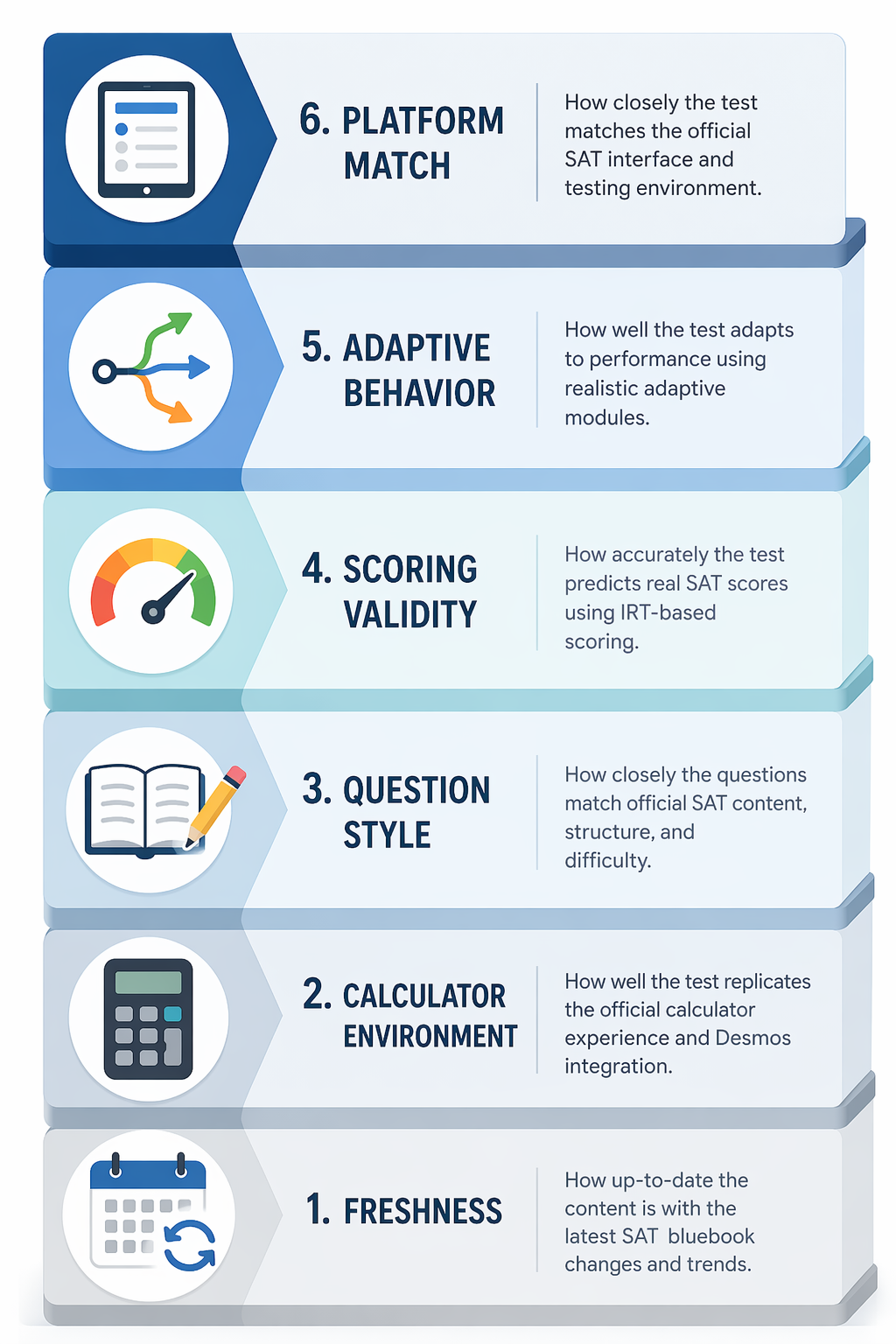
| Accuracy layer | What to check | Why it matters |
|---|---|---|
| Platform match | Does it run like the real digital SAT? | Students need practice with the actual pacing, layout, navigation, and test-day feel. |
| Adaptive behavior | Does performance in Module 1 affect Module 2? | A nonadaptive test cannot reproduce one of the defining features of the digital SAT. |
| Scoring validity | Is the score produced by official or independently validated scoring? | A precise-looking estimate is not the same as a validated prediction. |
| Question style | Do questions match current digital SAT wording, logic, and difficulty? | Old-style or loosely similar questions can train the wrong habits. |
| Calculator environment | Does Math practice include the built-in Desmos experience? | Calculator strategy is now part of the test, not a side tool. |
| Freshness | Is the material current, unrecycled, and clearly labeled? | Repeated or outdated material can inflate scores or misdirect review. |
Why Bluebook Is the Only Real Benchmark
Bluebook earns its special status for boring reasons, which are exactly the reasons that count. It is the official app. It uses the digital SAT format. It includes the built-in Desmos graphing calculator. It is tied to College Board’s own practice-test ecosystem.[1][2]
Most importantly, it reflects the adaptive design that changes what your score means. On the digital SAT, each section has two modules. Your performance on Module 1 determines whether you see the easier or harder Module 2. A deep dive on digital SAT scoring reports that students generally need about two-thirds of Module 1 correct to reach the harder Module 2, which is necessary for section scores above 600.[4]
That one detail explains a lot of the damage unofficial score predictions can do. If a third-party test does not reproduce the adaptive branch accurately, then a student aiming for a 700 Math score may be practicing under the wrong scoring conditions. A few missed early questions are not just a few missed questions; they may change the ceiling implied by the path. If the practice platform does not model that correctly, the final number can become more confidence trick than measurement.
Bluebook also protects students from a subtler problem: interface drift. A student who practices Math without Desmos, or practices Reading and Writing in a browser layout that does not resemble the real app, may still learn content. But they are not rehearsing the exact decisions they must make on test day: when to flag, when to move on, when to use the calculator, and how fast the module actually feels inside the official environment.
There is one catch: the official supply is not unlimited, and some official tests are more valuable than others. Strategic Test Prep notes that Bluebook Tests 8, 9, and 10 include recycled questions from retired Tests 1–3, while Tests 11 and 7 are among the newest and most representative.[3] That does not make the recycled tests bad. It does mean students who have already seen old material can accidentally overestimate progress if they treat a familiar official test as a clean diagnostic.
What Third-Party Free Tests Can and Cannot Tell You
The fair way to judge third-party tests is not “accurate” or “trash.” That is too crude. A free test can be useful for endurance and still untrustworthy for scoring. It can expose a weak grammar pattern and still miss the official curve. It can be worth taking on a Saturday morning and still not deserve a place in your score chart.
PrepMaven’s evaluation of digital SAT practice tests describes third-party materials as useful supplements while still separating them from official tests for accuracy.[5] Strategic Test Prep similarly warns that third-party tests can have minor flaws or stylistic differences, making them better for additional reps than precise prediction.[3] That is the lane they belong in.
| Resource | Best practical use | Score-trust level |
|---|---|---|
| College Board Bluebook | Benchmarks, diagnostics, final score prediction | Highest; this is the official standard |
| College Board Question Bank | Official skill practice between full tests | Not a full-test predictor by itself |
| Princeton Review free test | Format practice and extra timed work | Useful, but not a Bluebook-equivalent score |
| Kaplan free test | Extra practice and broad diagnostic signals | Treat the score cautiously |
| Mometrix free SAT test | Topic review and additional questions | Useful as practice, not validated prediction |
| Magoosh free resources | Skill review, drills, and study support | Not a substitute for official scoring |
| Test Ninjas | Browser-based digital SAT practice with adaptive-style experience | Helpful format practice; do not equate with official scoring |
| 4Tests.com | Very limited extra exposure | High outdated-style risk |
| Gemini + Princeton Review AI-generated tests | On-demand extra practice with careful review | Too new and variable for score prediction |
Princeton Review is one of the closer free options in the sense students usually mean: it is trying to resemble the current exam rather than handing you a pile of generic old SAT questions. That makes it reasonable for pacing, stamina, and seeing more digital-style items. But “closer in format” is not the same as “officially calibrated.” If the score comes back higher or lower than expected, the useful response is to inspect the missed questions, not rewrite your college list.
Kaplan fits a similar role when available as a free practice option: worth using for extra timed work, especially after you have protected your remaining Bluebook tests. The caution is the same. Unless the provider can match the official adaptive path and scoring model, the number is at best an estimate.
Mometrix offers a free SAT practice test for 2026, which makes it a useful example of a common third-party offering: accessible, structured, and potentially helpful for review.[6] Use it to find topics that slow you down. Do not use it to decide that your official Reading and Writing score has risen 60 points.
Test Ninjas deserves a slightly different note because it presents digital SAT practice in a browser-based adaptive platform.[7] That can be valuable for students who need more experience moving through a digital test rather than working from a PDF. Still, browser-based adaptive practice is not the same claim as College Board-equivalent adaptive scoring. Keep the distinction clean.
Magoosh’s free SAT resources are better thought of as a support library than a final benchmark. Their value is in review, explanations, and extra study structure rather than in replacing Bluebook.[8] If you are trying to rebuild a weak domain, that can help. If you are trying to predict Saturday’s score, go back to official material.
4Tests.com is the resource I would handle fastest. Its main risk is not that it is free; it is that older-style practice can quietly train outdated instincts. If a question set does not resemble current digital SAT wording, timing, and interface demands, it may still give you something to do, but “something to do” is a low bar for a student with limited prep time.
The newest and most tempting category is AI-generated practice. Strategic Test Prep reports that Google Gemini can generate on-demand practice tests through a Princeton Review partnership, while also noting that question quality varies and does not perfectly match official style.[3] That is exactly the kind of tool that can be useful and dangerous at the same time: useful when you need another passage set, dangerous when the machine’s confidence makes the output look more vetted than it is.
When Official Tests Are Running Low
The best solution is not to take all eight Bluebook tests in a panic and then go hunting for a ninth “accurate” free test. Use the official tests as benchmarks. Put enough time between them that the result can reflect learning, not just another Saturday of effort.
Between those benchmarks, use official questions. The College Board Question Bank contains more than 1,000 official questions filterable by skill, making it one of the strongest free resources for targeted practice.[3] It will not give you the same full-test score prediction as Bluebook, but it gives you something many third-party full tests cannot: official question style in small, controllable sets.
That is especially useful if your Bluebook result tells you something specific. If you missed transition questions, isolate transition questions. If advanced algebra ate your time, drill that. A full unofficial test is often a very inefficient way to fix a narrow official weakness.
- Use Bluebook for baseline scores, mid-prep checkpoints, and final readiness checks.
- Use the College Board Question Bank for official skill practice between full-length tests.
- Use third-party free tests for timing, endurance, extra repetitions, and rough topic diagnosis.
- Record third-party missed-question patterns, not third-party scaled scores.
- Save the newest or least familiar official tests for moments when you genuinely need a clean benchmark.
If you want a broader map of where these tools fit, start with the SAT exam prep guide. If you want a more direct ranking of free options, use the companion guide, which free SAT practice tests actually boost your score. For a closer look at paid and free digital formats, compare them in which digital SAT practice tests are most accurate.
How to Read an Unofficial Score Without Letting It Hurt Your Prep
The worst use of an unofficial test is emotional accounting: “I dropped 80 points, so I’m getting worse,” or “I jumped 100 points, so I’m done.” Both reactions give too much authority to a number that may not deserve it.
Instead, read the result in three parts. First, ignore the exact scaled score unless the test is Bluebook. Second, separate misses caused by content from misses caused by timing or interface friction. Third, ask whether the question itself looked like current digital SAT work. If the item feels old, oddly worded, or far outside the official style, do not build your study plan around it.
A hypothetical example: suppose a student scores much lower on a free third-party Math test than on the last Bluebook exam. The useful conclusion is not automatically “Math is collapsing.” The useful questions are narrower: Did the test include Desmos in a realistic way? Did the module difficulty adapt? Were the algebra questions testing official-style reasoning, or were they simply longer? Did the student run out of time because the platform felt different? Those answers decide whether the test revealed a real weakness or just produced noise.
The reverse is also true. A high unofficial score is pleasant, but it is not a permission slip to stop. If you want to know whether a score increase is real, confirm it with Bluebook after enough targeted practice has happened to make the retest meaningful.
A Practical Order for Free SAT Practice
For most students, the order matters more than the brand debate. Official material should not be treated as disposable warm-up. Third-party practice should not be treated as a final verdict.
- Take one Bluebook test early enough to get a real baseline.
- Review it deeply, sorting misses by skill, timing, and avoidable decision errors.
- Use the College Board Question Bank for official targeted practice.
- Add third-party free tests only when you need more full-length stamina, extra drills, or another way to expose weak topics.
- Return to Bluebook when you need a score estimate that should actually guide decisions.
Students who want help turning practice-test results into a week-by-week plan should use a separate strategy process, not just keep taking exams. The follow-up guide on how to use SAT practice tests to raise your score is the better place for that work.
The Rule to Use in July 2026
If you need a score prediction, use Bluebook. If you need more practice after official materials, use third-party free tests as drills and ignore the score estimate.
That rule is not anti-prep-company. It is pro-student. A well-designed unofficial drill set can absolutely help you improve. A shaky unofficial score prediction can send you into the wrong week of studying, the wrong level of panic, or the wrong sense of comfort.
Also verify current access before you build a plan around any free test. Free tiers, test counts, and platform features can change, and as of July 2026 they are still worth checking before you rely on them.
References
- Full-Length SAT Suite Practice Tests, College Board
- Bluebook Practice Tests, College Board
- 10 Free SAT Prep Tools to Score Over 1500 in 2026, Strategic Test Prep
- Deep Dive on Digital SAT Practice Tests, MyTutor / Summit Educational Group
- Best Digital SAT Practice Tests, PrepMaven
- Free SAT Practice Test 2026, Mometrix
- Digital SAT Practice Tests, Test Ninjas
- Best Free Resources for SAT Prep, Magoosh
Supporting Resources
- Which Free SAT Practice Tests Actually Boost Your Score in 2026 →
There are more than a dozen free SAT practice tests for the digital SAT, but they vary widely in quality and accuracy. This guide ranks the best sources and shows the optimal sequence to use them for real score improvement.
- How to Build a Daily Bible Study Habit Using an App: A Science-Backed Guide for Students →
This guide shows Christian students how to apply habit-science principles—cues, routines, and rewards—to build a consistent daily Bible reading habit using apps like YouVersion, Olive Tree, and Dwell. Learn four app-powered hacks, a 7-day starter challenge, and how to connect spiritual discipline with academic study habits.
- Is the Free Official ACCUPLACER Study App Enough? What You Get vs. What You Miss Without a Paid App →
Wondering if the free College Board ACCUPLACER study app is enough to help you place out of remedial courses? This guide breaks down what the official app offers, what it lacks, and provides a self-assessment quiz to help you decide if you need a paid app — plus a cost-benefit analysis comparing app subscriptions to the cost of remedial courses.
Comments
Join the discussion with an anonymous comment.