
GRE Exam Hub
How the New Visa Ruling Reshapes International Students' Study Plans
The July 2026 DHS final rule eliminates Duration of Status for F-1 students, capping admission at four years with no guaranteed extension. This article explains how that timing conflict with standard US degree completion must reshape when and how you plan your exam dates, program choice, and post-graduation timeline.
- gre
- mcat
- asvab
- sat
- act
- digital-adaptive
- official-material
- section-strategy
- test-date-timeline
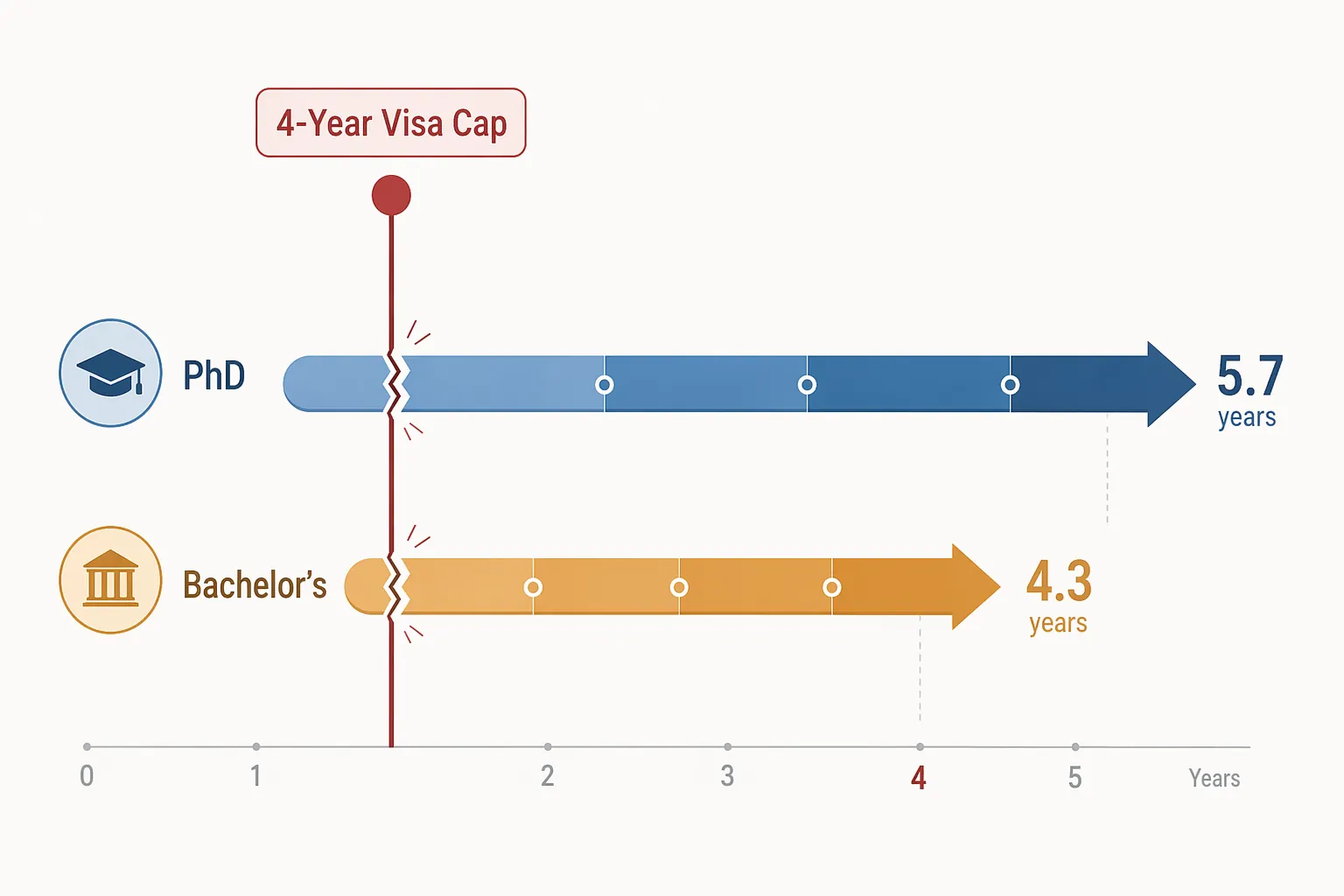
The new visa ruling affects international students' study plans because it puts a four-year admission clock against degrees that often do not finish in four years. The sharpest conflict is in doctoral study: the median PhD completion time is 5.7 years. Even the median bachelor's timeline is 52 months, or about 4.3 years, which already sits beyond a four-year boundary before a student changes majors, retakes a course, loses a semester to transfer credit, or waits for a required class sequence. [1][2]
That is why this is not only a visa story. It is an exam calendar story, an application timing story, a program-selection story, and a funding-risk story. If the normal length of the degree already exceeds the period of authorized stay granted at admission, the student has to decide before applying whether the plan depends on at least one Extension of Status filing.
Vanderbilt University's provost made the problem concrete in a formal public comment, saying that nearly every one of the institution's 528 international doctoral students would face the real possibility of an interrupted education under the rule. The International Medical Graduate Taskforce was even more categorical, telling DHS it would be impossible for physicians to complete general surgery, geriatrics, cardiology, and other critical programs within four years. [1]
Those are not edge cases created by poor planning. They are standard academic paths colliding with a fixed immigration clock.
What actually changes under the July 2026 rule
The core change is the end of Duration of Status for F-1 students. Instead of being admitted for the duration of an academic program, students would generally receive a fixed admission period of up to four years. This is not best described as a four-year visa; it is a four-year authorized stay per admission, with continued study beyond that depending on an Extension of Status process rather than automatic continuation through the program. [3][4]
The rule is effective September 15, 2026, but its timetable is not perfectly settled. DHS has said it could change because of Congressional Review Act review and likely litigation, and legal analyses have warned that transition provisions are complex. Students already in Duration of Status generally retain it until program end or four years from the effective date, whichever comes first, while travel and re-entry after September 15 can place a student under the new fixed admission framework. [3]
That uncertainty should not be converted into fake certainty in either direction. It is too early to treat every individual case as resolved. It is also too late to build a US study plan that assumes the visa clock can be handled after arrival.
| Planning item | Why it now matters earlier |
|---|---|
| GRE, SAT, or MCAT timing | A delayed score can push applications, I-20 issuance, travel, and enrollment into a tighter rule environment. |
| Degree length | A PhD or longer professional program may require Extension of Status before completion. |
| Major certainty | Graduate-level F-1 students cannot change major at any point under the rule. |
| Transfer assumptions | Undergraduate transfer flexibility is reduced, especially during the first year. |
| Post-completion planning | The grace period drops to 30 days, compressing OPT, transfer, or change-of-status decisions. |
Exam timing is no longer only about the best possible score
For a GRE, SAT, or MCAT student, the old question was usually whether another attempt could raise the score enough to improve admission or scholarship odds. That question still matters. But under a fixed admission period, an extra test attempt also has to be priced against the calendar it moves.
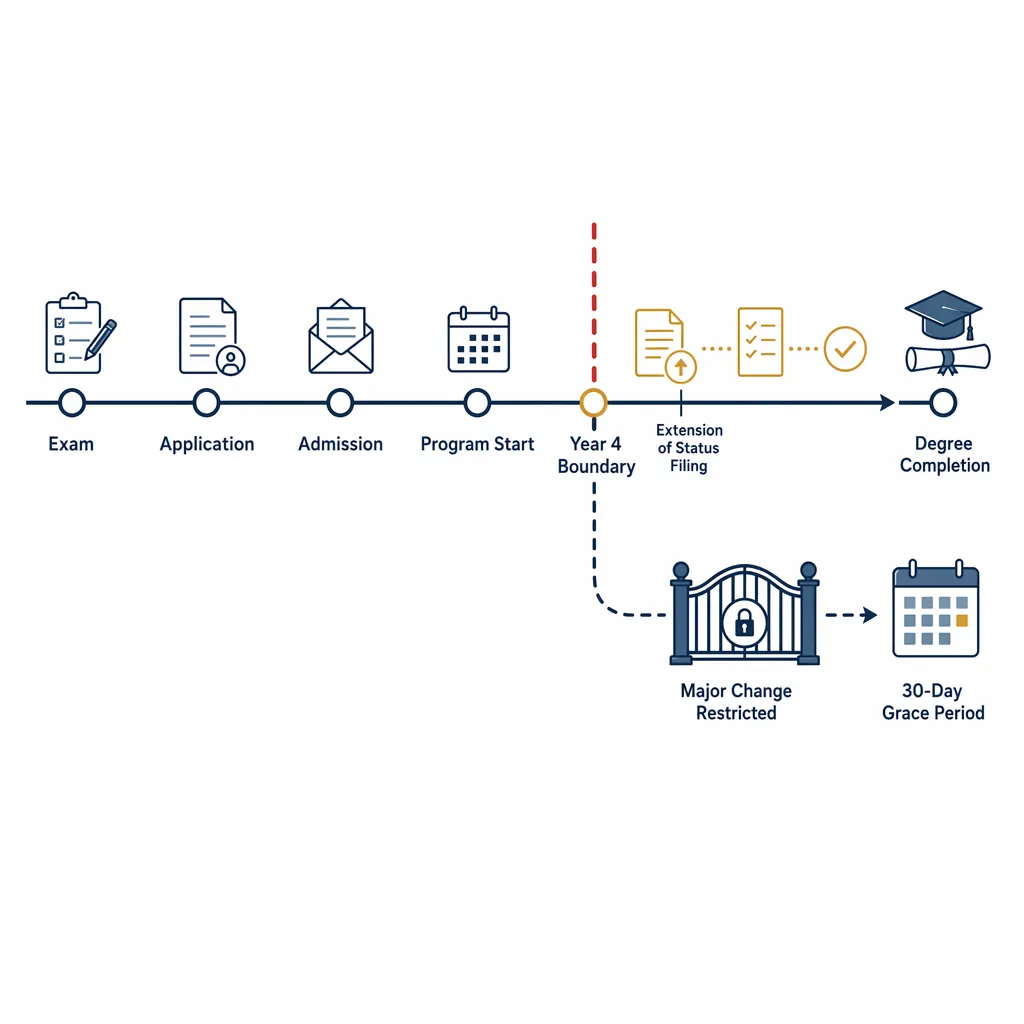
A late GRE result can mean a later application round. A later application round can mean delayed admission, delayed funding review, delayed I-20 issuance, and a narrower travel window. If the student then enters a program whose normal completion time already approaches or exceeds four years, the lost months at the front end are not harmless. They become part of the same chain as the Year 4 boundary.
This does not mean every student should rush into a weak score. A low score can reduce admission options or funding, which may be worse than a delayed application. The practical change is that a retake now needs two calendars beside it: the admissions calendar and the immigration calendar.
- If the target program is a four-year bachelor's path with little room for transfer credit loss, treat a delayed SAT plan as a degree-completion risk, not just an admissions choice.
- If the target program is a PhD, ask whether the department's typical international students finish inside four years or commonly require a fifth or sixth year.
- If the target path is medicine or another long professional training sequence, do not assume a four-year admission period is administratively adjustable just because the curriculum requires more time.
- If a retake moves the application to a later intake, check whether that also changes the likely rule environment at entry or re-entry.
The harder decision is usually not whether one more exam attempt is useful. It is whether that attempt still fits a degree plan that may need immigration permission before the degree is done.
Program choice now has to include the Year 4 question
A student comparing two admits used to weigh ranking, advisor fit, cost, internship access, and long-term immigration prospects. Those are still real variables. The new variable is more mechanical: what must be true for this degree to finish before the fixed admission period ends?
For doctoral applicants, that question belongs near the beginning of the school list, not after admission. A 5.7-year median PhD timeline means a four-year plan is not a conservative assumption. It is an aggressive one. Students should ask departments about typical time to candidacy, typical time to defense, funding beyond year four, advisor-change procedures, and whether international students commonly need additional administrative filings to finish. [1]
This also connects with funding. If a department funds five or six years but the student's admission period is capped at four, the funding promise and the immigration clock are not aligned by default. A funded offer can still be strong, but the student should understand who helps with the Extension of Status packet, when the school starts preparing it, and what happens if adjudication does not arrive quickly.
For students already worried about funded PhD availability, this overlaps with the grant environment covered in How Grant Freeze Cuts PhD Slots and What GRE Test-Takers Should Do. A smaller funded-seat market and a tighter status clock are separate pressures, but they meet in the same student file.
Bachelor's applicants need more certainty than they may be used to having
The bachelor's conflict is quieter but still serious. A 52-month median completion time is only a few months beyond four years, which can make the problem look manageable. But undergraduates are the students most likely to discover late that they chose the wrong major, lost credits, need an extra prerequisite sequence, or cannot enter a capped program on the first attempt. [2]
The rule also restricts transfer flexibility. Undergraduate students cannot transfer during the first year; after that, they must obtain a new I-20 and may need to depart and re-enter. Graduate-level students face an even stricter rule: they cannot change their major at any point during the program. [3][4]
That does not mean a 17-year-old must know the rest of life before taking the SAT. It does mean that an applicant choosing between a flexible liberal arts path, a direct-entry engineering program, a pre-med track, or a transfer-heavy community college route should look at how each path behaves if the first choice does not work. A plan that depends on exploring for two years and then switching late is weaker under this rule than it was under Duration of Status.
Extension of Status is possible, but it is not a safety blanket
The Extension of Status process is the valve DHS leaves open for students who need more time. But the criteria matter. Extensions can be based on a compelling academic reason, such as a change of major or documented research problems, documented illness, or circumstances beyond the student's control. Academic probation, slow progress, or exploratory study are not enough. [3]
That distinction matters most for students in programs where delay is normal but not always cleanly documentable. A research problem may be a compelling academic reason when the file is built properly. A vague statement that the dissertation is taking longer is not the same thing. A required clinical training path longer than four years creates a different kind of problem from a student who repeatedly postpones coursework.
The filing burden is also not trivial at scale. DHS estimates more than 400,000 additional Extension of Status applications per year, while Brookings points to a USCIS backlog of more than 11 million pending cases and average processing times exceeding a year. [5][2]
A timely-filed extension can provide a 240-day automatic stay window, but legal analyses warn that if USCIS cannot adjudicate within that period, the student must depart. The minimum filing cost is $420 for Form I-539 plus $85 for biometrics, or $505 per filing, before attorney fees or other costs. [4]
For a family deciding whether to pay for another test attempt, application round, or deposit, this is the place to be precise. The question is not simply whether extensions exist. The question is whether the degree plan can survive a filing requirement, a possible backlog, a 240-day limit, and a denial risk at the point when the student is already years into the program.
Post-completion planning gets compressed into 30 days
The post-completion grace period drops to 30 days, not 60. That gives students less room to correct paperwork problems, line up OPT timing, transfer, or move toward another status. [2][3]
This is where the degree timeline meets the career timeline. A student who finishes close to the edge of the four-year admission period cannot casually wait until the final semester to understand OPT filing, H-1B timing, or longer-term green-card options. The post-study path does not need to determine the entire school choice, but it has to be visible before the student enters a program likely to run longer than four years.
Students comparing post-study work routes can use H-1B Fee Block: What It Means for International Students for the F-1-to-H-1B side and Is EB-2 NIW Still an Option for International Students in 2026? for self-petition planning. For GRE applicants watching green-card backlogs while choosing programs, What the 2026 Visa Bulletin Means for Your GRE Timeline is the more direct companion.
Enrollment data shows uncertainty, not a single-cause collapse
The visa ruling arrives in a larger climate of uncertainty. A NAFSA and Institute for Progress survey reported that 54% of current international students said they would not have chosen the United States if OPT were not available, and 49% of international graduate students and postdocs said they would not have enrolled if they had known the Duration of Status rule would be in place. [1]
Other numbers point in the same direction but should be handled carefully. TIME reported that spring 2026 international enrollment was down 20% in a NAFSA survey of 149 schools, fall 2025 new enrollment was down 17%, and F-1 visa issuances fell 36% from May through August 2025 compared with 2024. Those declines predate the final D/S rule and include other pressures, including travel bans, visa processing disruptions, and enforcement concerns. They show a stressed market; they do not isolate the effect of this one rule. [6]
Economic-loss projections and destination shifts are useful background, not a substitute for student-level planning. A national estimate cannot tell a GRE student whether to test in August or October. A report on students choosing Malaysia or Thailand cannot decide whether a specific PhD offer is worth the risk. If you are comparing destinations, tools like Study Abroad Platform Apps Compared: GradRight vs. LeapScholar vs. Leverage Edu vs. Edvoy may help organize alternatives, but the US decision still has to be checked against the program calendar.
A practical way to rebuild the study plan
The useful planning move is to draw the timeline before committing to the exam strategy. Start with the intended intake, then place the test date, score-release date, application deadline, admission decision, I-20 issuance, program start, Year 4 boundary, expected degree completion, OPT filing window, and any likely transfer or change-of-status step. If the degree completion date lands after Year 4, mark the first Extension of Status as part of the plan rather than an emergency.
- For PhD applicants: ask departments for typical completion time, not advertised minimum time.
- For bachelor's applicants: test whether the plan still works after one major change, one lost semester, or one transfer-credit problem.
- For MCAT and medical-pathway students: separate programs that are merely difficult within four years from programs that institutions describe as impossible within four years.
- For students retaking an exam: decide what score gain would justify the calendar delay.
- For families comparing admits: ask who prepares EOS documentation, when preparation starts, and whether the school has a process for USCIS delays.
Under the July 2026 rule as described, visa duration becomes a pre-admission constraint alongside score targets, deadlines, funding, and degree length. The rule may still face legal and congressional challenges, and individual cases need advice from a licensed immigration attorney. But students planning for US study cannot wait until arrival to understand a four-year cap that may arrive before the degree is done.
References
- DHS final rule analysis, NSF/NCES/NAS data, NAFSA survey results, Vanderbilt and IMG Taskforce public comments, Forbes, July 17, 2026
- Rule mechanics, NCES bachelor's completion data, USCIS backlog analysis, Brookings, July 17, 2026
- Legal analysis of rule mechanics, EOS criteria, transition provisions, Fisher Phillips, July 20, 2026
- Detailed F-1 rule guide, fee structure, major-change restrictions, RN Law Group/Reddy Neumann Brown PC, July 21, 2026
- DHS Official Announcement, DHS, July 16, 2026
- Enrollment decline data and Asia-Pacific shift data, TIME, May 12, 2026
Related exhibits & inventory
Verified outcomes
Planners
No planner filed for this exam yet
A downloadable timeline template for this exam hasn't been published yet.
Tool verdicts
AI-tool cautions
No AI tools tested for this exam yet
No hands-on AI-accuracy logs have been filed for this exam.
Questions about this plan
Ask a question about a specific section, timeline, or citation in this plan — or flag something that needs correcting.
Comments
Join the discussion with an anonymous comment.