
ASVAB Exam Hub
Master Tornado Watch vs Warning for the ASVAB General Science
Learn the critical difference between a tornado watch and a warning for the ASVAB General Science subtest. This guide covers NWS definitions, proven mnemonics, and practice questions to help you master this high-yield weather concept.
- SAT
- ACT
- GRE
- MCAT
- ASVAB
- digital-sat
- adaptive-testing
- registration-fee
- content-outline
- score-target
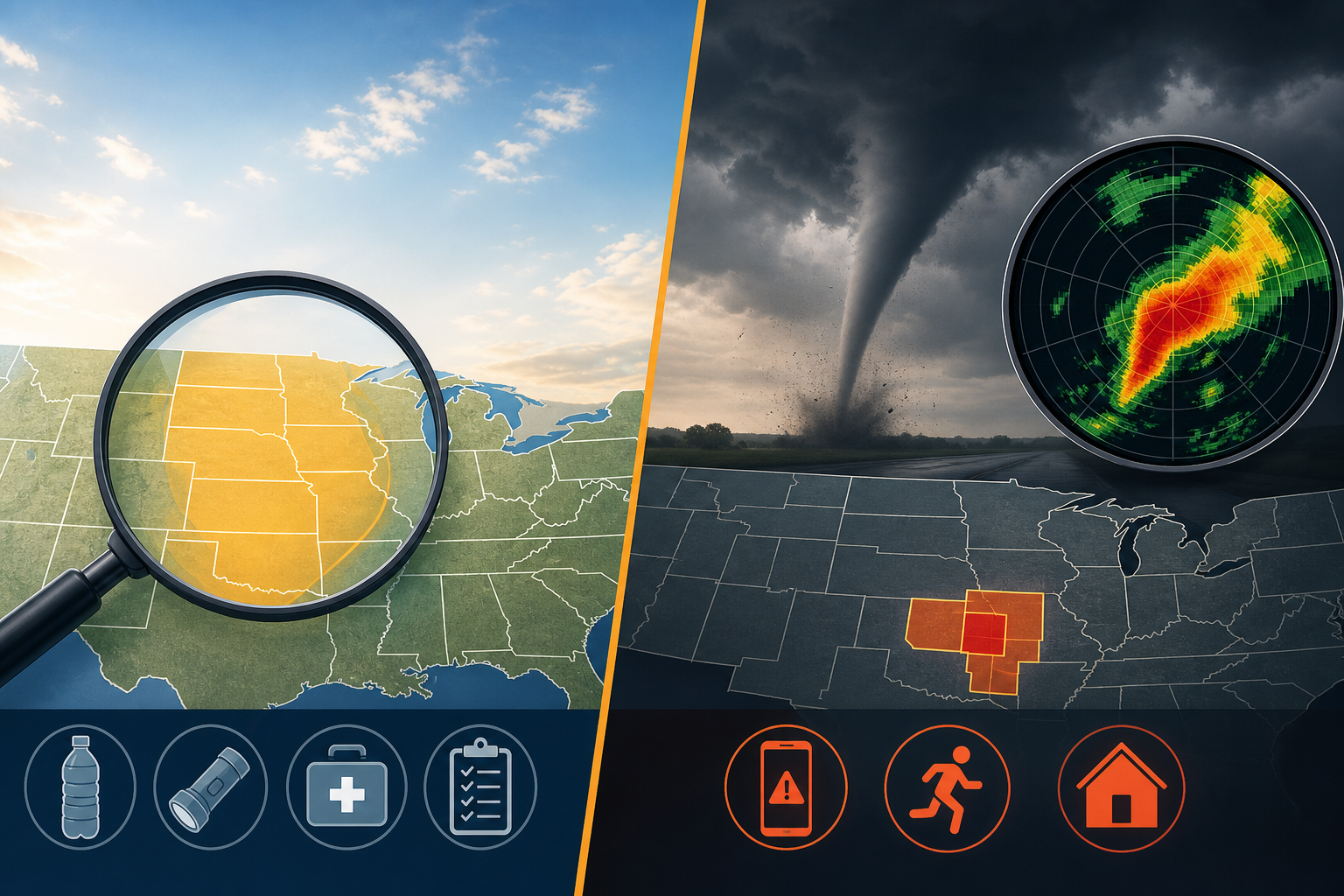
On the ASVAB, the trap is not usually a dramatic tornado scene. It is usually one word in the question stem. A tornado watch means conditions are favorable for tornadoes. A tornado warning means a tornado has been sighted or indicated by radar, and people in the warned area need to act immediately.[1]
That is the tornado watch vs warning difference to study: watch = possible; warning = happening or strongly indicated. If a test question says “conditions are favorable,” the answer is watch. If it says “sighted,” “spotted,” or “radar indicated,” the answer is warning.
Why This Belongs in ASVAB General Science Prep
The official ASVAB General Science page describes the subtest as covering life science, earth and space science, and physical science.[2] It does not promise that “tornado watch vs warning” will appear as a named topic. That matters. Good ASVAB prep should not pretend the outline lists every weather phrase a question writer might use.
Still, this distinction fits naturally inside Earth Science and weather questions. Storm formation, weather fronts, severe-weather conditions, and radar-based observation can all lead to a vocabulary item where one answer choice is a watch and another is a warning. For a test-taker working after school, after a shift, or with a ship date getting closer, this is a small topic with a clean payoff.
It is also not as “common sense” as it feels. A University of Nebraska-Lincoln study summarized by PreventionWeb reported that roughly half of U.S. adults could not accurately define a tornado warning.[3] That finding is about public understanding, not ASVAB performance, but it is a useful warning of its own: familiar words can still cost points.
The Official Difference: Watch vs Warning
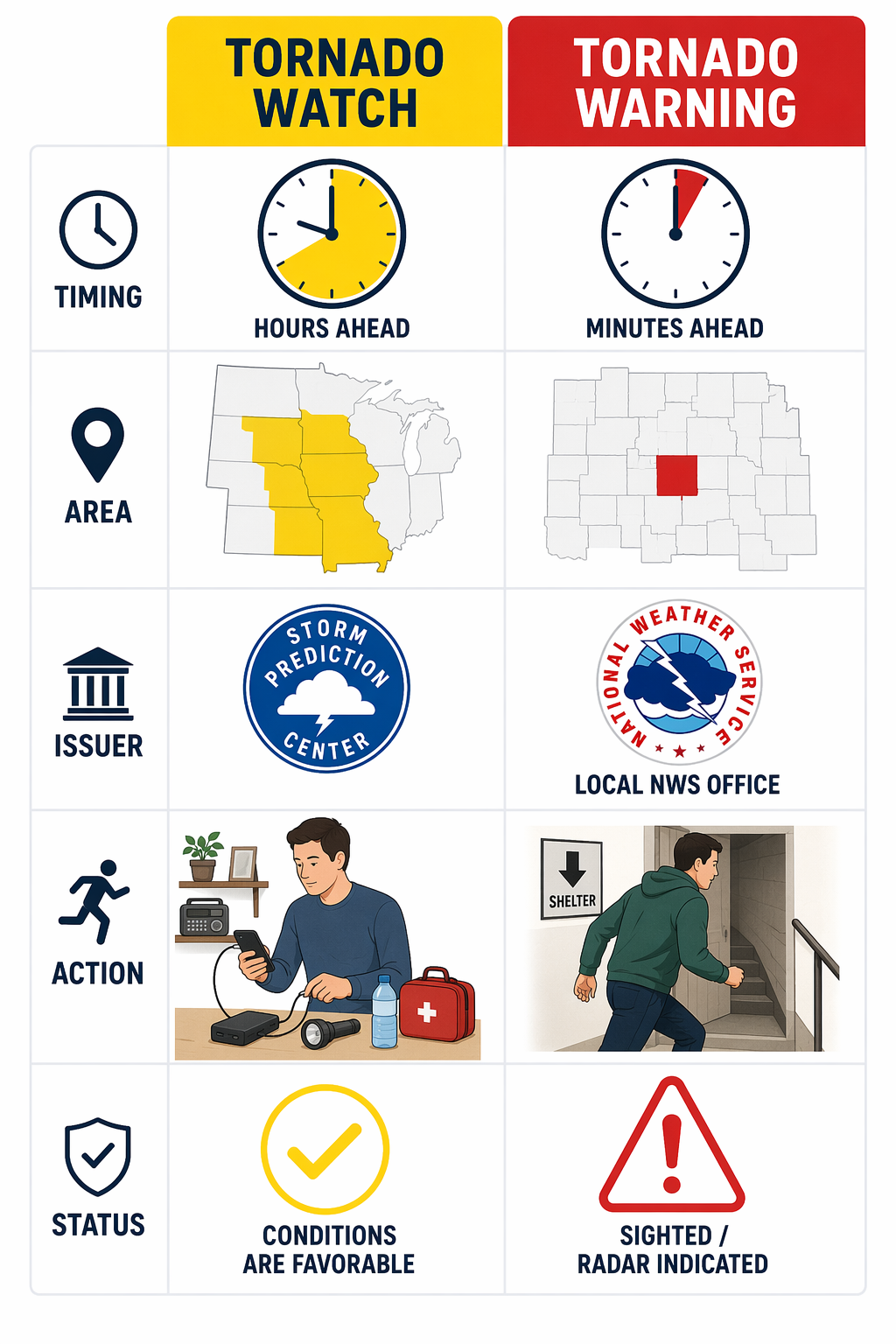
Start with the National Weather Service language, not a meme. The NWS says a tornado watch means tornadoes are possible in and near the watch area, while a tornado warning means a tornado has been sighted or indicated by weather radar.[1] Those two definitions are enough to answer many ASVAB-style questions.
| Feature | Tornado Watch | Tornado Warning |
|---|---|---|
| Basic meaning | Conditions are favorable for tornadoes | A tornado has been sighted or indicated by radar |
| Issuer | Storm Prediction Center | Local National Weather Service office |
| Timing | Usually issued before severe weather develops nearby | Issued when the threat is immediate |
| Typical area | Broad region, often covering parts of multiple states | Smaller, more focused area, often county-scale |
| ASVAB keyword | Favorable conditions | Sighted, spotted, radar indicated |
| Plain action idea | Prepare and stay alert | Take shelter or immediate protective action |
The size and timing clues are helpful, but they are not promises. Watch areas are often broad; one commonly cited average is about 25,000 square miles and can include parts of multiple states.[1] Warnings are more localized and urgent; Illinois Extension, citing NWS data, describes the average tornado warning lead time as about 13 minutes.[4] On a test, use those as “usually larger and earlier” versus “usually smaller and immediate,” not as exact cutoffs.
The ASVAB Version of the Rule
For timed recall, compress the official definitions into this rule:
- Watch: conditions are favorable, so tornadoes are possible.
- Warning: tornado seen or radar indicated, so the threat is immediate.
- If the question asks what comes earlier or covers a broader area, choose watch.
- If the question asks what requires immediate protective action, choose warning.
Do not rank the words by how scary they sound. “Warning” sounds like someone is warning you that something may happen later, which is why people miss it. In weather terminology, a tornado warning is the more urgent product.
Memory Hooks That Actually Help Under Time Pressure
Mnemonics come after the real definitions. They are not the authority; they are the retrieval handle. Pick one that makes you faster without changing the meaning.
The Taco Analogy
The taco version is popular because it is sticky: a tornado watch is like having the ingredients for tacos; a tornado warning is like the taco has been made.[5][6] Ingredients mean the setup exists. A made taco means the thing is here.
Use it for the first-pass decision. If the stem says the atmosphere has the ingredients for severe storms, think watch. If the stem says the tornado is observed or radar indicated, think warning. Then move on; the ASVAB is not asking you to admire the analogy.
The TIME Rule
The fastest wording is: Watch = Time to prepare; Warning = time’s up.[5] This helps when answer choices are short and you are trying not to overthink. A watch gives advance notice that conditions could produce tornadoes. A warning means the threat has moved from possible to immediate.
The Ingredients and Kitchen Version
If you like the science behind the words, use the kitchen version. A watch means the atmospheric “kitchen” has the ingredients that can produce tornadoes. A warning means the tornado has actually been detected, either by sighting or radar. This version keeps the meteorology clear without dragging you into a full storm-formation lesson.
For more study-method work later, connect this routine to an evidence-graded study-methods library rather than collecting ten more cute sayings. One good cue plus retrieval practice beats five mnemonics you never test.
ASVAB-Style Practice Questions
Answer these the way you would on the General Science subtest: read the stem, identify the keyword, choose the weather product, and do not rewrite the question into a disaster movie.
- A weather office reports that atmospheric conditions are favorable for tornado development across a broad region. Which term best describes this situation? A. Tornado warning B. Tornado watch C. Tornado emergency D. Hurricane advisory
- Radar indicates rotation associated with a possible tornado near a town. Which alert is most appropriate? A. Tornado watch B. Tornado warning C. Flood watch D. Winter storm warning
- Which statement correctly compares a tornado watch and a tornado warning? A. A watch means a tornado has been sighted; a warning means conditions are favorable. B. A watch is issued for favorable conditions; a warning is issued for a sighted or radar-indicated tornado. C. A warning always covers a larger area than a watch. D. A watch requires immediate shelter because a tornado is confirmed.
- A severe-weather product is issued hours before storms may develop and covers a large area crossing state lines. Which term is most likely? A. Tornado watch B. Tornado warning C. Tornado emergency D. Local evacuation order
- A question says a tornado has been spotted by trained observers. Which word in the answer choices should you look for? A. Watch B. Warning C. Forecast D. Climate
Answers and Why They Work
- B. Tornado watch. “Conditions are favorable” is the watch clue.
- B. Tornado warning. “Radar indicates” points to a warning, even if the tornado has not been visually seen.
- B. This is the official distinction in ASVAB-friendly wording.
- A. Tornado watch. “Hours before” and “large area” support watch, but the strongest clue is still favorable conditions.
- B. Warning. “Spotted” means the threat has moved beyond favorable conditions.
Notice the repeated pattern. The test can change the setting, the map size, or the wording around the storm, but the decision point stays narrow: favorable conditions versus sighted or radar indicated.
Common Traps in the Answer Choices
The easiest miss is choosing “warning” because the situation sounds serious. Severe-weather potential can be serious before a tornado exists, but the term for favorable conditions is still watch.
| Question wording | Correct thought | Likely answer |
|---|---|---|
| Conditions are favorable | The setup exists | Watch |
| Possible tornadoes later | Prepare and monitor | Watch |
| Large region, hours ahead | Usually a broader advance product | Watch |
| Tornado sighted | Observed threat | Warning |
| Radar indicated | Detected threat | Warning |
| Immediate protective action | Threat is happening or indicated now | Warning |
Another trap is treating area size as the main definition. It is not. Watches are generally broader and warnings are generally more focused, but the definition comes from the threat status: favorable conditions for a watch, sighted or radar-indicated tornado for a warning.[1][4]
Advanced Note: Tornado Emergency
You may also see the phrase “tornado emergency.” Treat it as an advanced, higher-impact wording used for especially dangerous situations, not as a coequal third basic category for ASVAB study. If the choice is between watch and warning, the emergency wording still belongs on the warning side of the decision tree because the threat is immediate.
A Compact Study Routine
Spend a short, focused block on this instead of rereading weather notes passively. The goal is fast recognition under timed conditions.
- Read the NWS definitions once: watch means tornadoes are possible; warning means sighted or radar indicated.[1]
- Pick one memory hook: taco ingredients, TIME rule, or ingredients/kitchen.
- Cover the definitions and say them from memory.
- Do five to ten short stems where the clue word is “favorable,” “sighted,” or “radar indicated.”
- Missed one? Write the exact clue that fooled you, not a long explanation.
When the planned ASVAB General Science study hub is available, place this topic with the rest of your Earth Science review. It is not a huge meteorology unit. It is one high-yield distinction where one word changes the answer.
References
- Tornado Watch vs. Warning, National Weather Service, https://www.weather.gov/safety/tornado-ww
- General Science (GS), Official ASVAB, https://www.officialasvab.com/general-science-gs/
- Study: Many people misunderstand tornado warnings, PreventionWeb, 2024, https://www.preventionweb.net/
- What is the Difference Between a Tornado Watch and Warning?, Illinois Extension, June 25, 2021, https://extension.illinois.edu/blogs/all-about-weather/2021-06-25-what-difference-between-tornado-watch-and-warning
- Tornado Watch Vs. Warning, The Weather Channel, April 5, 2023, https://weather.com/safety/tornado/news/2023-04-05-tornado-watch-vs-warning
- Tacos help explain difference between tornado watch, warning, KCTV5, April 17, 2026, https://www.kctv5.com/2026/04/17/tacos-help-explain-difference-between-tornado-watch-warning
Related exhibits & inventory
Verified outcomes
No verified outcomes on file for this exam yet
See Methodology for how outcome evidence is disclosed once logged.
Planners
No planner filed for this exam yet
A downloadable timeline template for this exam hasn't been published yet.
Tool verdicts
AI-tool cautions
No AI tools tested for this exam yet
No hands-on AI-accuracy logs have been filed for this exam.
Questions about this plan
Ask a question about a specific section, timeline, or citation in this plan — or flag something that needs correcting.
Comments
Join the discussion with an anonymous comment.