
GRE Exam Hub
Title IX Explained for College Students
This study guide breaks down what Title IX is, what rights it gives college students, and the step-by-step process from reporting through appeal — giving you a clear, neutral reference to understand your protections and navigate the system.
- gre
- mcat
- asvab
- sat
- act
- digital-adaptive
- official-material
- section-strategy
- test-date-timeline
Last reviewed: July 24, 2026. This guide reflects the federal Title IX rules in effect nationwide as of July 2026. The 2024 federal rules were vacated on January 9, 2025, so colleges are operating under the 2020 regulations unless state law or campus policy gives students broader protections. A new federal rule is expected in late 2026 or early 2027, which means this process may need another update soon.[1][2]

Title IX, in One Sentence
The full statutory text of Title IX is only 37 words: "No person in the United States shall, on the basis of sex, be excluded from participation in, be denied the benefits of, or be subjected to discrimination under any education program or activity receiving Federal financial assistance."[3]
For a college student, the translation is simpler: if your college receives federal funding, it cannot block you from classes, housing, athletics, campus jobs, programs, or other educational benefits because of sex-based discrimination. That includes certain forms of sexual harassment and sexual violence when they meet the federal standard or a broader state or campus standard.
Title IX is not just a discipline rule. It is an education-access rule. The point is not only whether someone is punished. The point is whether a student can still attend class, live safely, meet deadlines, use campus spaces, and continue toward a degree while the school responds.
Who Is Protected and Where Title IX Applies
Title IX protects "no person," which means the rule is not limited to women, athletes, full-time students, undergraduate students, or U.S. citizens. In a college setting, it can apply to students of any gender when the issue involves sex-based discrimination under a covered education program or activity.
The law reaches a large part of U.S. education because it applies to institutions that receive federal financial assistance. One legal overview describes Title IX as covering about 17,600 school districts and more than 5,000 postsecondary institutions.[4]
Under the 2020 federal regulations now in effect, schools are required to investigate conduct that occurs in the school’s education program or activity. That usually includes campus property, school-sponsored programs, and settings where the college has substantial control over both the respondent and the context. Off-campus conduct can be more complicated, so students should check the school’s written policy instead of assuming the answer either way.[1][2]
What Counts as Sex-Based Discrimination or Harassment
Sex-based discrimination can include different treatment because of sex, exclusion from programs, pregnancy-related discrimination, sexual harassment, and sexual violence. Colleges may use additional policy language, and some state laws require broader coverage than the federal minimum.
For federal Title IX sexual harassment under the 2020 rules, the conduct must meet the "severe, pervasive, and objectively offensive" standard, not the broader "severe or pervasive" standard that appeared in the vacated 2024 rule. That difference matters because one word changes how schools screen some complaints under federal rules.[1][2]
That does not mean a student should try to decide alone whether an experience fits the legal definition before asking for help. A report can lead to information, supportive measures, and a policy explanation even when a student is not ready to file a formal complaint.
A Short Glossary Before the Process Starts
Title IX offices use a small set of terms over and over. Learning them early prevents the process from sounding more mysterious than it is.
| Term | Plain meaning |
|---|---|
| Title IX coordinator | The campus official responsible for coordinating the school’s Title IX response and explaining reporting options. |
| Complainant | The person alleged to have experienced conduct that could violate Title IX. |
| Respondent | The person alleged to have engaged in the conduct. |
| Supportive measures | Non-disciplinary services or adjustments meant to help a student keep accessing education. |
| Formal complaint | The written document that starts the school’s formal grievance process. |
| Advisor | A person who supports a party during the process; under the 2020 rules, advisors conduct cross-examination at the live hearing. |
| Investigation report | The investigator’s written summary of relevant evidence gathered during the investigation. |
| Preponderance of the evidence | A decision standard meaning the claim is more likely than not to be true. |
| Sanctions | Consequences imposed on a respondent if the school finds responsibility. |
| Appeal | A request by either party for review of the outcome on allowed grounds. |
The Title IX Process, Step by Step
The exact forms, deadlines, and office names vary by campus, but the federal grievance process follows a recognizable sequence. The most useful thing to know is where you are in the sequence and what decision is being made at that point.
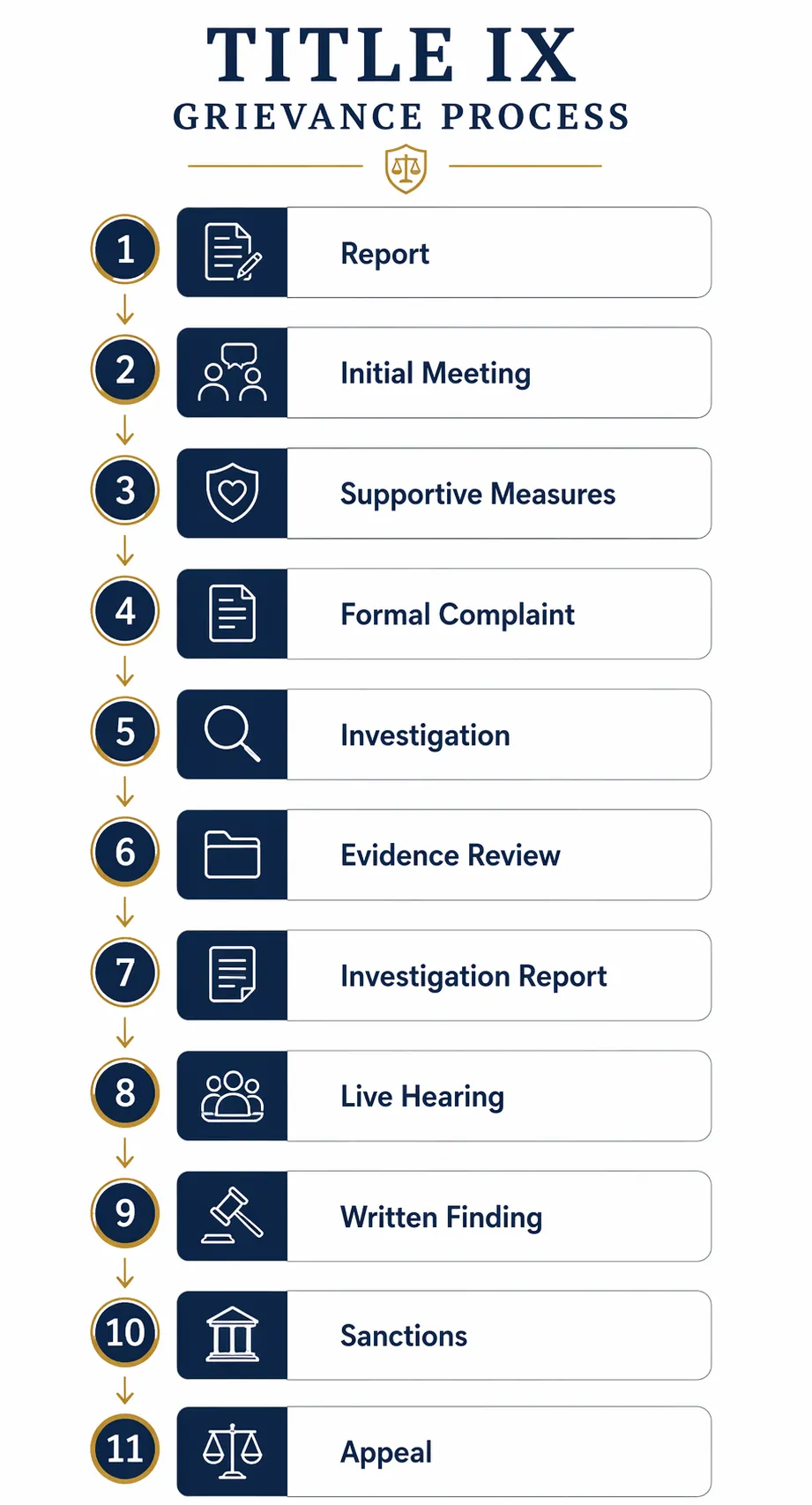
| Step | What happens |
|---|---|
| 1. Report | A student or another person contacts the Title IX office or another reporting channel. |
| 2. Initial meeting | The coordinator explains rights, options, supportive measures, and the formal complaint process. |
| 3. Supportive measures | The school considers non-disciplinary help such as schedule changes, housing changes, or academic adjustments. |
| 4. Formal complaint | The complainant or Title IX coordinator files the document that starts the formal grievance process. |
| 5. Respondent notice | The respondent receives written notice of the allegations and process. |
| 6. Investigation | An investigator gathers evidence and interviews parties or witnesses. |
| 7. Evidence review | Both parties get a chance to review and respond to evidence. |
| 8. Investigation report | The school issues a report summarizing relevant evidence. |
| 9. Live hearing | A decision-maker conducts a hearing, with advisor-conducted cross-examination under the 2020 rules. |
| 10. Written finding | The decision-maker issues a written determination using the school’s stated evidence standard. |
| 11. Sanctions, if applicable | If the respondent is found responsible, the school decides remedies and sanctions. |
| 12. Appeal | Either party may appeal on grounds allowed by the school’s policy. |
1. Making a Report
A report is the first contact that tells the school something may have happened. It is not the same thing as a formal complaint. A student might report to the Title IX coordinator directly, use an online reporting form, speak with a resident assistant or faculty member, or be referred by another campus office.
The practical goal at this stage is information. The Title IX office should explain what the school can offer, what choices remain with the complainant, what confidentiality limits exist, and what would happen if the student later chooses to file a formal complaint.
2. The Initial Meeting
At the initial meeting, the Title IX coordinator usually asks enough questions to understand the situation, explain the school’s policy, and discuss immediate needs. A student does not need to arrive with legal language. It is enough to describe what happened, where it happened, who was involved, and what is making school harder right now.
This meeting should also cover retaliation, supportive measures, reporting to law enforcement if the student wants that information, and the difference between informal help and the formal grievance process. If the student is worried about grades, housing, a shared lab, a campus job, or seeing the other person in a dining hall, those are not side issues. They are exactly the kinds of access problems Title IX offices are supposed to consider.
3. Supportive Measures Can Start Before a Formal Complaint
This is the part many students miss: supportive measures may be available even if no formal complaint has been filed. A student can ask about help without committing to an investigation or hearing.[7][8]

Examples include schedule changes, housing reassignment, no-contact orders, academic extensions such as incomplete grades or deadline extensions, tutoring, and counseling referrals.[7][8] The measure should be connected to the access problem. If a student cannot safely attend a class section, the useful measure may be a section change. If a student missed work because of medical care or an investigation meeting, the useful measure may be a deadline extension.
Supportive measures are not supposed to punish the respondent before a finding. They are meant to preserve access to education while the school responds. That distinction matters. A no-contact order, for example, may tell both students not to communicate; it does not by itself decide whether the respondent violated policy.
- If class attendance is affected, ask about schedule changes, excused absences, remote participation options, or deadline extensions.
- If housing is affected, ask whether a room change, building change, or emergency housing option is available.
- If contact is the issue, ask how a no-contact order works and who enforces it.
- If coursework has slipped, ask about tutoring, academic advising, incomplete grades, or communication with instructors.
- If immediate emotional support is needed, ask for counseling referrals and crisis resources.
4. Filing a Formal Complaint
A formal complaint is the document that starts the formal grievance process. Under the process described by Equal Rights Advocates, it comes after the report, initial meeting, and offer of supportive measures.[5]
Once a formal complaint is filed, the school moves from support and option-setting into a more structured procedure. The complainant should ask what allegations are being investigated, what policy definitions apply, what timeline the school expects, and whether informal resolution is available or appropriate under the campus policy.
5. Notice to the Respondent
The respondent must receive notice of the allegations and the process. This is not a finding. It is the start of a process where the respondent has an opportunity to respond, identify evidence, name witnesses, have an advisor, and participate in later stages.
For both parties, written notice matters because it defines what is actually being investigated. If the notice is confusing, too vague to understand, or different from what a party expected, that is the time to ask the Title IX office for clarification.
6. Investigation
During the investigation, the investigator gathers information. That may include interviews with the complainant, respondent, and witnesses; messages or emails; campus records; photos; video; class or housing information; and other relevant material.
The Equal Rights Advocates process guide describes investigations as often taking about 2 to 12 months.[5] That is a wide range, and it is one reason supportive measures matter. A student may need academic or housing help while the formal process is still unfinished.
A useful habit during this stage is to keep a simple process folder: emails from the Title IX office, meeting dates, names of people contacted, documents submitted, and questions still unanswered. That folder does not need to be fancy. It just prevents the process from becoming a blur.
7. Evidence Review
After evidence is gathered, both parties get a chance to review evidence and respond before the investigation report is finalized.[5] This is one of the most important checkpoints in the process because it lets each side identify missing context, correct errors, and point out information the investigator may not have fully understood.
A response at this stage should be specific. Instead of writing only that the evidence is unfair or incomplete, identify the document, message, date, witness, or statement that needs attention. If a timeline is wrong, correct the timeline. If a screenshot is missing part of a conversation, explain what is missing and, if possible, provide it.
8. Investigation Report
The investigation report summarizes relevant evidence. It is not usually the final decision. It prepares the case for the decision-maker and hearing process.
Students should read the report for three things: whether the allegations are stated correctly, whether key evidence is included, and whether any important facts are described in a way that changes their meaning. If the policy allows a written response to the report, use that opportunity carefully.
9. Live Hearing
Under the 2020 federal rules in effect as of July 2026, colleges must use a live hearing with advisor-conducted cross-examination in covered Title IX grievance processes.[1][2] Equal Rights Advocates describes the hearing stage as often lasting about 1 to 3 days.[5]
The word "hearing" can make the process sound like a courtroom. It is not a criminal trial, but it is formal. A decision-maker hears from the parties, advisors ask permitted questions, and the school applies its policy and evidence standard. The complainant and respondent should both receive information about hearing rules, advisor roles, technology or room setup, and how questions are screened.
If a student does not have an advisor for the hearing, the school’s policy should explain how an advisor is provided for cross-examination. This is a detail to confirm early, not the night before the hearing.
10. Written Finding
After the hearing, the decision-maker issues a written determination. The process guide identifies the preponderance of the evidence standard as the standard used for the written finding in its walkthrough.[5] In plain English, that means the decision-maker decides whether it is more likely than not that the policy violation occurred.
The written finding should tell the parties what was decided, why it was decided, what policy provisions were applied, whether remedies or sanctions follow, and how to appeal. This is the document to read slowly, even if the result is upsetting or relieving. It controls what happens next.
11. Sanctions and Remedies, if There Is a Finding of Responsibility
If the respondent is found responsible, the school may impose sanctions. Sanctions can vary by institution and by the seriousness of the violation. The school may also provide remedies for the complainant to restore access to education.
Sanctions and supportive measures are different. Supportive measures can exist before any finding and are not supposed to be punitive. Sanctions come after a responsibility finding and are consequences for a policy violation.
12. Appeal
Either party may appeal under the grounds allowed by the school’s policy.[5] Appeals are not usually a full restart. They are typically limited to specific issues such as procedural errors, new evidence, or conflicts of interest, depending on the policy.
The appeal deadline matters. If a student is considering an appeal, the first step is to find the deadline, allowed grounds, page or word limit, submission method, and whether the other party gets to respond.
Why Academic Protections Matter
Campus sexual harassment and assault are not separate from school performance. The AAU 2019 Campus Climate Survey found that approximately 13% of undergraduate students experienced nonconsensual sexual contact since enrolling; the often-cited "1 in 5 women" figure comes from that survey and similar campus surveys.[9]
The academic consequences can be concrete. Student survivors of sexual assault are reported as facing a higher dropout rate, 34.1% compared with a 29.8% baseline.[7][9] Those numbers do not tell any one student what will happen. They do explain why a deadline extension, housing change, tutoring referral, or no-contact order is not a courtesy extra. It can be the difference between staying enrolled and losing the semester.
Where the Process Can Vary
Federal rules set a floor, not always the whole system. State laws and campus policies may give students broader protections than the 2020 federal regulations. California, New York, and Illinois are examples of states where state-level rules may exceed federal minimums.[1][2]
That means two students at different colleges may both be in a Title IX-related process but face different timelines, definitions, informal-resolution options, evidence standards, or appeal rules. The federal sequence is still useful, but the campus policy is the document that answers operational questions: who receives the report, how many days a response period lasts, whether extensions are allowed, and what appeal grounds exist.
The most efficient move is to search your school’s website for "Title IX coordinator," "sexual misconduct policy," or "grievance procedures." If the policy is hard to understand, ask the Title IX office to point to the specific section that answers your question. Students should not have to decode a 40-page policy alone just to know where they are in the process.
Retaliation Can Be Reported Separately
Retaliation is its own Title IX problem. Intimidation, coercion, discrimination, or discipline against a student because they reported, filed a complaint, participated in a process, or opposed sex discrimination can be reported separately to the school and to the Office for Civil Rights.[3]
Retaliation concerns should be documented as specifically as possible: what happened, who did it, when it happened, where it happened, who saw it, and how it affected school access. If the retaliation involves safety concerns, threats, or urgent contact, do not wait for the next scheduled Title IX meeting to ask for help.
What to Do First if You Need to Use This
If you or someone you know needs help now, start with the nearest practical contact point.
- Find your campus Title IX coordinator and ask what reporting, supportive-measure, and formal-complaint options exist.
- Check your school’s Title IX or sexual misconduct policy, then check whether your state law gives broader protections.
- If immediate confidential support is needed, contact RAINN at 800.656.HOPE or use its online resources.[9]
- If you want outside rights information, review Know Your IX or Equal Rights Advocates’ student materials.
- If the school is not responding or retaliation is occurring, consider the U.S. Department of Education Office for Civil Rights complaint process.[3]
The main thing to track is the sequence: report, meeting, supportive measures, formal complaint, notice, investigation, evidence review, report, hearing, finding, sanctions if applicable, and appeal. Once you know which step you are in, the next question gets smaller: what choice is available now, what deadline applies, and who is responsible for answering?
References
- Title IX in 2026: What's Changing, What's Coming, and What Families Should Watch, Brown Education Law Group, April 2026
- Students' Title IX Rights Without 2024 Biden Rule, National Women's Law Center, September 2025
- Title IX and Sex Discrimination, U.S. Department of Education
- What is Title IX?, Thomson Reuters
- The Title IX Process, Equal Rights Advocates
- Survivor Toolkit Glossary, Equal Rights Advocates
- Title IX Right Now, CAASE
- Navigating the Title IX: A Guide for Student Survivors of Sexual Violence in College & University Settings, Public Counsel, June 2026
- Title IX: How It Affects Survivors of Campus Assault, RAINN
Related exhibits & inventory
Verified outcomes
Planners
No planner filed for this exam yet
A downloadable timeline template for this exam hasn't been published yet.
Tool verdicts
AI-tool cautions
No AI tools tested for this exam yet
No hands-on AI-accuracy logs have been filed for this exam.
Questions about this plan
Ask a question about a specific section, timeline, or citation in this plan — or flag something that needs correcting.
Comments
Join the discussion with an anonymous comment.