
LAW-SCHOOL Exam Hub
How to Study the ADA for Law School Exams Using Its Five Titles
Law students often struggle to apply the ADA's complex five-title structure under timed exam conditions. This guide presents a systematic attack plan that uses each title's distinct coverage triggers and obligation standards as an issue-spotting and IRAC framework.
- gre
- mcat
- asvab
- sat
- act
- digital-adaptive
- official-material
- section-strategy
- test-date-timeline
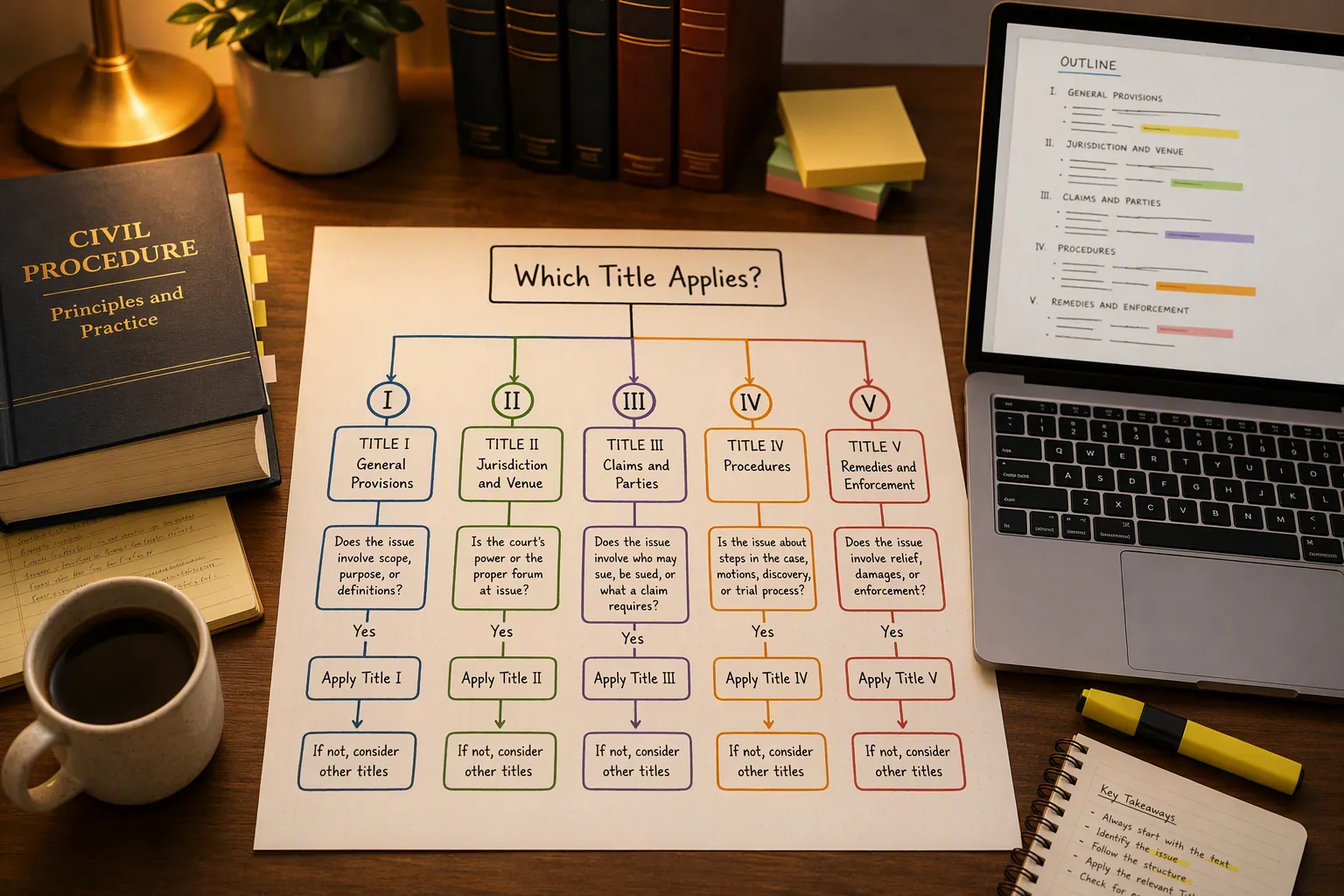
The fastest way to lose points on an ADA exam is to start writing about “reasonable accommodation” before deciding whether the fact pattern is actually about employment, a city service, a restaurant, a licensing exam, telecommunications, or retaliation. So the first line of an ADA attack outline should not be a definition. It should be a routing question: which title applies?
That is the practical answer to how to study the Americans with Disabilities Act for law school exam purposes. Study the ADA as five related regimes, not as one giant fairness rule. First identify the covered actor. Then match the title. Then use that title’s obligation standard, defenses, and enforcement frame. ADA.gov and ADATA both organize the statute around this five-title structure, and that structure is exactly what an issue-spotter tries to scramble.[1][2]
Start With the Title, Not the Remedy
On an exam, the same disability fact can point to different rules depending on who is being sued. A wheelchair user denied access to a courthouse is not in the same doctrinal box as an employee requesting modified work equipment or a customer trying to enter a privately owned theater. The disability definition may overlap, but the duty does not.
| Exam trigger | Likely ADA title | Covered actor | Obligation frame to write about |
|---|---|---|---|
| Job application, hiring, firing, promotion, workplace rules, accommodation at work | Title I | Employer with 15 or more employees | Qualified individual, reasonable accommodation, interactive process, undue hardship |
| Police, courts, public schools, public transit, city recreation, state licensing, municipal services | Title II | State or local government entity | Program access, reasonable modifications, effective communication, fundamental alteration |
| Hotel, restaurant, store, theater, private school, testing center, professional office, website or facility access facts | Title III | Private place of public accommodation | Nondiscrimination, reasonable modifications, auxiliary aids, barrier removal, testing accommodations |
| Telecommunications relay services, closed captioning-type facts | Title IV | Telecommunications providers and related regulated services | Telecommunications access rules |
| Retaliation, coercion, attorney’s fees, relationship to other laws, insurance, miscellaneous provisions | Title V | Actors covered through ADA enforcement or miscellaneous provisions | Retaliation/interference and statutory cleanup issues |
The table is not a replacement for doctrine. It is the pre-doctrine filter. If the defendant is an employer with fewer than 15 employees, Title I’s employment-discrimination framework is not the right starting point. If the defendant is a city, Title III public-accommodation language is not the right starting point. If the facts involve a private testing entity, Title III may matter even though the exam feels “education-adjacent.”
A clean exam answer can still discuss more than one title when the facts genuinely call for it. A mixed paragraph about a city employee who requests workplace accommodation and also cannot access a public city meeting may require both Title I and Title II. The point is not to force one title onto every fact pattern. The point is to stop importing the wrong duty into the wrong regime.
Use Disability Definition as a Gateway, Not a Swamp
After routing the title, ask whether the plaintiff has a disability when that issue is actually disputed. The statutory definition has three prongs: a physical or mental impairment that substantially limits one or more major life activities; a record of such an impairment; or being regarded as having such an impairment.[3]
The ADA Amendments Act changed how much energy this gateway deserves. The amendments became effective on January 1, 2009, and were designed to broaden coverage after courts had read the disability definition too narrowly.[4] For exam purposes, that means the disability prong often should be handled efficiently unless the professor has built the question around it.
Several ADAAA rules are especially exam-useful. The phrase “substantially limits” is not supposed to demand an extensive analysis. Mitigating measures generally are ignored when deciding whether an impairment substantially limits a major life activity. Episodic conditions or conditions in remission count if they would substantially limit a major life activity when active. And under the regarded-as prong, the plaintiff does not need to show that the perceived impairment substantially limits a major life activity.[3][4]
There is one trap worth writing into the margin of your outline: regarded-as coverage does not create a reasonable-accommodation duty. If the plaintiff only proceeds under the regarded-as prong, do not automatically launch into an accommodation analysis. That distinction is exactly the kind of small doctrinal switch that can separate a controlled answer from a rule dump.[4]
For some impairments, the individualized assessment should be brief. DOJ regulations discussed in the NCBE Bar Examiner identify impairments that will “virtually always” constitute disabilities, including deafness, blindness, cancer, diabetes, HIV infection, and major depressive disorder; the article describes the analysis for those impairments as “particularly simple and straightforward.”[5] That does not erase the need to connect rule to fact. It tells you not to spend half the answer proving the obvious while the real issue is the requested modification or defense.
Title I: Employment Is Where the Accommodation Sequence Matters Most
Title I covers employment discrimination by employers with 15 or more employees.[1][2] In a timed exam, the 15-employee threshold is not decorative. It is a coverage fact. If the professor gives the size of the business, use it. If the professor omits it, flag the issue rather than silently assuming the statute applies.
Once Title I is properly triggered, the core plaintiff-side sequence is usually: covered employer, qualified individual with a disability, discrimination, and then the specific employment theory. For accommodation facts, slow down. This is where many answers become mushy because they jump from “employee has disability” to “employer must give what employee wants.” That is not the rule.
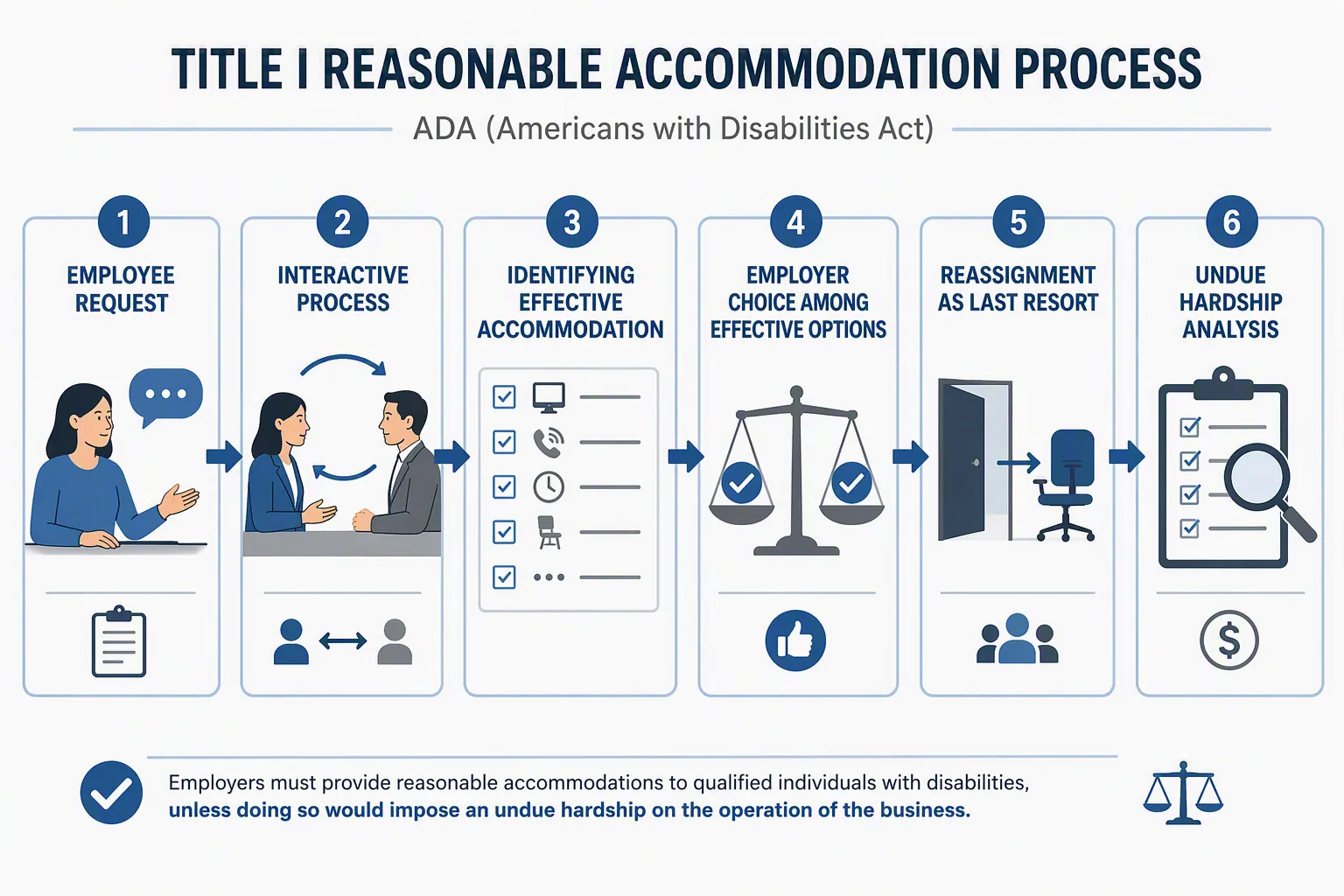
The Accommodation Workflow to Memorize
- Request: the employee or applicant must let the employer know that an adjustment or change is needed because of a medical condition; no magic words are required under EEOC guidance.[6]
- Documentation: if the disability or need for accommodation is not obvious, the employer may request reasonable documentation about the disability and functional limitations.[6]
- Interactive process: employer and employee should communicate to identify the precise limitations and possible accommodations.[6]
- Effective accommodation: the accommodation must enable the person to perform essential job functions or enjoy equal employment opportunities; it does not have to be the employee’s preferred option if another effective option exists.[6]
- Employer choice: when more than one effective accommodation is available, the employer may choose among effective accommodations, though the employee’s preference should receive primary consideration.[6]
- Undue hardship: the employer may defend by showing significant difficulty or expense, evaluated case by case.[6]
Reassignment deserves its own warning because it looks simple on an exam and is not. EEOC guidance treats reassignment as an accommodation of last resort: consider it when the employee cannot be accommodated in the current position or when accommodation in that position would create undue hardship.[6] If a fact pattern jumps straight from a medical restriction to “give the employee a different job,” write the missing steps. Could the essential functions of the current job be performed with an accommodation? Is there a vacant position? Is the employee qualified for it? Those questions earn more than a sentence announcing reassignment.
Also keep “qualified individual” separate from “reasonable accommodation.” A plaintiff can be disabled and still not qualified if, even with reasonable accommodation, the essential functions cannot be performed. Conversely, an employer cannot define essential functions so aggressively that every requested adjustment disappears before the accommodation analysis begins. The exam answer should show the sequence rather than collapse it.
One source-boundary matters here. The EEOC Enforcement Guidance on Reasonable Accommodation was issued in 2002, before the ADAAA.[6] It remains central for the accommodation process, but do not use its older framing to narrow the disability-definition gateway after the ADAAA. Use the amended statutory definition for coverage, then use the EEOC guidance for the accommodation mechanics.
Title II and Title III: Stop Calling Everything an Accommodation
Title II and Title III often blur together in student outlines because both can involve ramps, interpreters, eligibility rules, service animals, and access to buildings or programs. The dividing line is the defendant. Title II covers state and local government entities. Title III covers private places of public accommodation.[1][2]
The vocabulary then changes. Under Title II, think in terms of public entities, services, programs, activities, reasonable modifications, effective communication, and program access. Under Title III, think in terms of public accommodations, goods and services, reasonable modifications, auxiliary aids and services, removal of architectural barriers when readily achievable, and accessible testing where applicable.[1][2]
| If the fact says... | Do this first | Then analyze... |
|---|---|---|
| A city recreation program excludes a participant because of disability-related eligibility criteria | Route to Title II | Whether the public entity must reasonably modify policies unless doing so would fundamentally alter the service, program, or activity |
| A privately owned restaurant has an inaccessible entrance | Route to Title III | Whether the restaurant is a public accommodation and whether barrier removal is required under the applicable standard |
| A state court refuses an interpreter | Route to Title II | Effective communication and reasonable modification issues for a public entity |
| A private testing organization denies disability-related testing adjustments | Route to Title III | Testing accommodation rules rather than employment accommodation rules |
The word “reasonable” appears across the ADA, but it does not do identical work everywhere. In Title I, reasonable accommodation is tied to a job and the essential functions of that job. In Title II, reasonable modification asks whether a public entity must adjust policies, practices, or procedures so a person can access a public service, program, or activity. In Title III, reasonable modification and auxiliary-aid duties sit alongside a barrier-removal framework for public accommodations.[1][2]
That distinction matters when writing defenses. “Undue hardship” is the familiar Title I employment defense. Title II and Title III questions more often turn on fundamental alteration, direct threat, effective communication limits, or the specific barrier-removal standard. If an exam answer says “undue hardship” for a courthouse-access issue without explaining why Title I is involved, it has probably crossed the wires.
Program Access Is Not the Same as One Perfect Door
For Title II, avoid treating every physical-access fact as if the statute always demands the exact architectural fix the plaintiff names. Public entities are judged through access to services, programs, and activities. That does not make access optional; it changes the frame. The exam question is whether the public entity’s service, program, or activity is accessible under the governing standard, not whether the student can imagine a nicer building.
Barrier Removal Belongs in the Title III Box
For Title III, “barrier removal” is a term of art, not a general vibe. When the facts involve an existing private business open to the public, ask whether the defendant is a public accommodation, whether there is an architectural barrier, and whether removal is required under the applicable standard. Do not replace that analysis with Title I’s interactive process just because both involve disability access.
Titles IV and V: Brief, but Not Invisible
Titles IV and V usually do not need the same outline space as Titles I through III, but they should not disappear. Title IV addresses telecommunications access, including relay-service rules. Title V contains miscellaneous provisions, including anti-retaliation and coercion protections and attorney’s-fee provisions.[1][7]
For studying, the move is simple: create a short “don’t forget” box. If the fact pattern includes retaliation after an ADA request, interference with ADA rights, fee-shifting, or telecommunications access, do not try to squeeze the issue into the nearest accommodation framework. Route it to the provision that actually governs.
Build the Attack Outline You Will Actually Use
A useful ADA outline should be shorter at the top and deeper only where the exam is likely to demand depth. The top page should be a routing system. The later pages can hold the Title I accommodation sequence, the ADAAA disability-definition notes, and the Title II/Title III comparison.
- Circle the defendant: employer, public entity, public accommodation, telecommunications provider, or retaliation actor.
- Write the title next to the fact: Title I, II, III, IV, or V.
- Ask whether disability status is disputed; if yes, apply the three-prong statutory definition and ADAAA rules.
- Use the title-specific plaintiff status: qualified individual, participant in a public program, customer/client/patron of a public accommodation, or other protected person.
- Name the correct duty: accommodation, modification, program access, effective communication, barrier removal, telecommunications access, or anti-retaliation.
- Apply the correct defense or limit: undue hardship, fundamental alteration, direct threat, readily achievable barrier removal limits, or another title-specific rule.
For practice exams, force yourself to write the routing line before the rule paragraph. For example: “This is a Title II claim because the defendant is a city agency providing a public service.” Or: “This is a Title I issue only if the employer has 15 or more employees.” That line feels almost too basic until it saves the rest of the answer.
For multiple-choice questions, the same habit works faster. Before reading the answer choices, identify the title. If two choices use employment-accommodation language for a public-library fact pattern, they are suspect. If an answer choice ignores the ADAAA mitigating-measures rule in a disability-definition question, it is suspect. If a choice treats regarded-as status as enough to demand accommodation, it is suspect.
A Final Exam-Room Version
When the ADA appears in a long issue-spotter, do not start with everything you know. Start with the actor. Employer with 15 or more employees: Title I. State or local government: Title II. Private public accommodation: Title III. Telecommunications: Title IV. Retaliation, coercion, fees, and miscellaneous provisions: Title V.
Then decide whether the disability definition is actually contested. If it is, use the statutory three-prong definition and the ADAAA’s broadened coverage rules. If it is not, move quickly to the obligation standard. Title I accommodation analysis needs the request, documentation if appropriate, interactive process, effective accommodation, employer choice among effective options, reassignment only as a last resort, and undue hardship. Title II and Title III need their own language: modification, program access, effective communication, public accommodation, barrier removal, testing accommodation, fundamental alteration.
That is why the five-title decision tree is the best study investment. The ADA is not one rule waiting to be recited. It is five related regimes that have to be routed before they can be analyzed.
References
- Introduction to the Americans with Disabilities Act, ADA.gov, https://www.ada.gov/topics/intro-to-ada/
- An Overview of the Americans with Disabilities Act, ADATA.org, https://adata.org/factsheet/ada-overview/
- 42 U.S. Code § 12102 - Definition of Disability, Cornell Legal Information Institute, https://www.law.cornell.edu/uscode/text/42/12102
- Summary of the ADA Amendments Act, The ADA Project, https://www.adalawproject.org/summary-of-the-adaaa
- New Regulations Under Titles II and III of the ADA Address Disability Standards Under the ADA Amendments Act, The Bar Examiner, https://thebarexaminer.ncbex.org/article/ada-accommodations/new-regulations-under-titles-ii-and-iii-of-the-ada-address-disability-standards-under-the-ada-amendments-act-2/
- Enforcement Guidance on Reasonable Accommodation and Undue Hardship under the ADA, EEOC, https://www.eeoc.gov/laws/guidance/enforcement-guidance-reasonable-accommodation-and-undue-hardship-under-ada
- A Guide to Disability Rights Laws, ADA.gov, https://www.ada.gov/resources/disability-rights-guide/
Related exhibits & inventory
Verified outcomes
No verified outcomes on file for this exam yet
See Methodology for how outcome evidence is disclosed once logged.
Planners
No planner filed for this exam yet
A downloadable timeline template for this exam hasn't been published yet.
Tool verdicts
AI-tool cautions
No AI tools tested for this exam yet
No hands-on AI-accuracy logs have been filed for this exam.
Questions about this plan
Ask a question about a specific section, timeline, or citation in this plan — or flag something that needs correcting.
Comments
Join the discussion with an anonymous comment.