
GRE Exam Hub
How the College Student Loan Bill Changes Graduate School Funding
The One Big Beautiful Bill Act eliminated Grad PLUS loans and set new hard caps on graduate borrowing starting July 1, 2026, creating funding gaps for many applicants. This article breaks down the changes, who is affected, and why a competitive GRE or MCAT score now directly impacts your ability to pay for graduate or professional school.
- SAT
- ACT
- GRE
- MCAT
- ASVAB
- digital-sat
- adaptive-testing
- registration-fee
- content-outline
- score-target
The New Ceiling
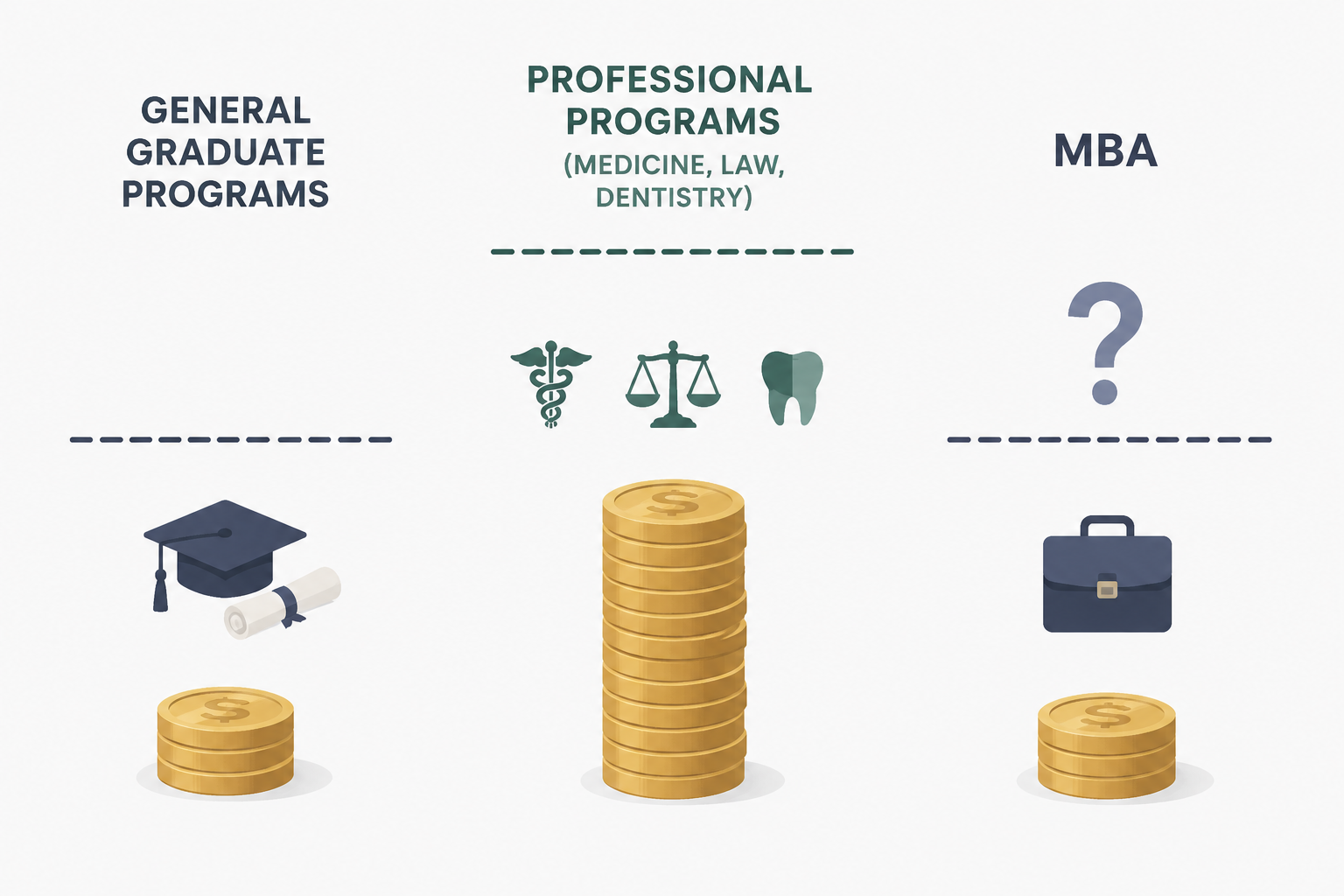
After July 1, 2026, graduate borrowing runs into hard federal ceilings: $20,500 a year and $100,000 total for general graduate programs, $50,000 a year and $200,000 total for professional programs, plus a $257,500 combined lifetime cap across undergraduate and graduate borrowing. Students who were continuously enrolled in the same program and already borrowed before July 1 can keep the older rules for up to three more years. [1]

| Program type | Annual cap | Lifetime cap | What that means |
|---|---|---|---|
| General graduate | $20,500 | $100,000 | Most master's and doctoral students hit the wall here. |
| Professional graduate | $50,000 | $200,000 | Medicine, law, dentistry, and similar programs get more room, but not unlimited room. |
| MBA | $20,500 | $100,000 | ETS classifies the MBA as general graduate, not professional. [3] |
Who Gets Squeezed First
General graduate programs feel the first squeeze because $20,500 a year does not go far in many high-cost master's and doctoral programs. Professional programs get more borrowing room, but the cap still leaves plenty of applicants short when tuition and living costs run high. AEI estimates that about 40% of current medical students borrow more than $50,000 a year, which means the new professional cap would already bind for a large share of that group. [2]
The MBA is the trap inside the exception. It looks like the kind of degree that should sit with medicine or law, but ETS says MBA programs are treated as general graduate, not professional, so MBA applicants face the lower ceiling unless they qualify for the narrow legacy rule. That matters because the classification decides whether a student gets the $20,500 annual cap or the $50,000 one. [3][1]
Why GRE and MCAT Scores Matter Now
This is where test prep stops being only an admissions game. ETS explicitly ties stronger GRE performance to merit-aid opportunities under the new loan rules, which matters because merit aid is the cleanest way to fill the gap once federal borrowing stops at the cap. For MCAT applicants, the same math applies at schools that use scholarship money to shape offers: a stronger file can change how much of the bill gets covered before loans enter the picture. [3]
The practical shift is not that scores suddenly decide everything. It is that the score now has a budget effect. If a stronger GRE or MCAT helps move an applicant into a better aid band, that score can reduce the amount that has to be borrowed from the first place.
Repayment Is The Secondary Story
Repayment rules changed too, with new graduate borrowers being steered toward the Repayment Assistance Plan or the Tiered Standard Plan while older options like SAVE, PAYE, and ICR wind down. That affects the long-term cost of borrowing, but it does not change the main problem for applicants: the federal package may no longer cover the full cost of attendance. [4]
Students under the cap can treat the change as a different borrowing menu. Students above it need merit aid to close the gap, which is why GRE or MCAT prep now has a budget effect as well as an admissions effect.
References
- New student loan rules take effect July 1. Here's what borrowers should know — CBS News
- An Analysis of the One Big Beautiful Bill Act's Effect on Student Loans — AEI
- New Federal Student Loan Rules Took Effect: What Grad Students Need to Know — ETS
- Guide: Student loan options change July 1. What you need to know — NPR
Related exhibits & inventory
Verified outcomes
Planners
No planner filed for this exam yet
A downloadable timeline template for this exam hasn't been published yet.
Tool verdicts
AI-tool cautions
No AI tools tested for this exam yet
No hands-on AI-accuracy logs have been filed for this exam.
Questions about this plan
Ask a question about a specific section, timeline, or citation in this plan — or flag something that needs correcting.
Comments
Join the discussion with an anonymous comment.