
USMLE Exam Hub
How to Study Statin Eligibility Guidelines for USMLE Step 1
Statin eligibility on USMLE Step 1 requires knowing the ACC/AHA four benefit groups. This framework helps you memorize which patients qualify and which statin intensity to choose, so you can consistently answer vignettes correctly.
- gre
- mcat
- asvab
- sat
- act
- digital-adaptive
- official-material
- section-strategy
- test-date-timeline
A practice block gives you five patients and asks who should be started on a statin today. One is 34 with LDL 156 mg/dL and no diabetes. One is 52 with LDL 201 mg/dL. One is 38 with diabetes and LDL 145 mg/dL. One is pregnant with LDL 220 mg/dL. One is 60 with LDL 150 mg/dL and a calculated 10-year ASCVD risk of 6%.
If your first move is “statins lower LDL,” you are already too slow. The Step 1 move is to sort the vignette into the right eligibility branch: clinical ASCVD, LDL ≥190, diabetes age 40–75, or primary prevention that actually needs a 10-year risk calculation. In that set, the clean exam answer is the 52-year-old with LDL 201 mg/dL: LDL ≥190 is an automatic high-intensity statin clue, with no risk calculation needed. The pregnant patient is the trap, not the bonus.
The four branches you should have ready before the vignette starts
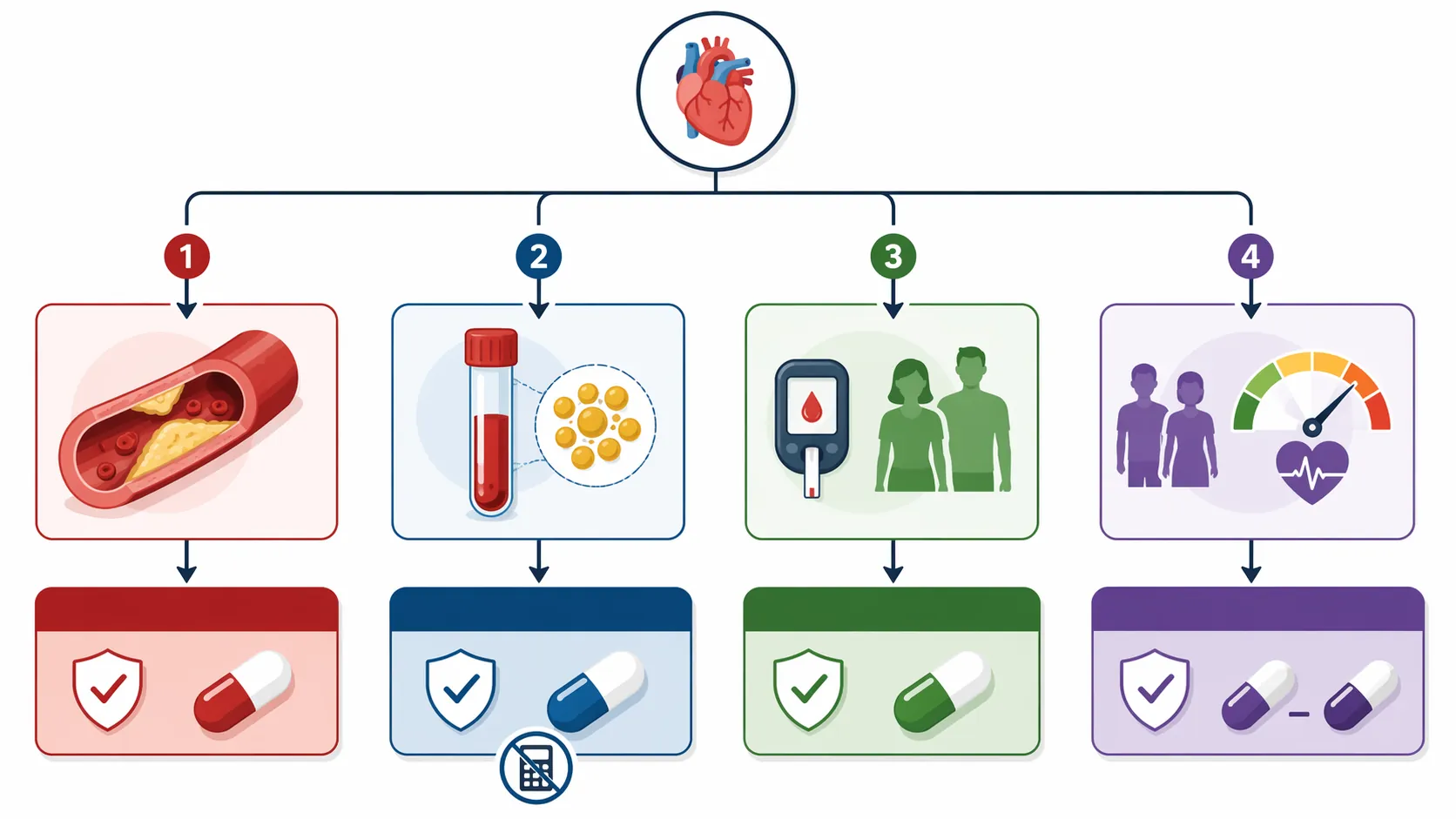
For current USMLE Step 1 prep, the most usable statin eligibility framework is still the 2018 ACC/AHA “four statin benefit groups” approach: clinical ASCVD, LDL ≥190 mg/dL, diabetes age 40–75 with LDL 70–189 mg/dL, and primary prevention age 40–75 with LDL 70–189 mg/dL plus sufficient calculated 10-year ASCVD risk.[1][2]
A Step 2 CK-labeled hyperlipidemia guide is not an official Step 1 content outline, but the crossover here is real: these are foundational prevention and pharmacology rules that Step 1 can test through clinical vignettes, drug intensity, contraindications, and toxicity clues.[2]
| Branch | What the vignette gives you | Exam action |
|---|---|---|
| Clinical ASCVD | Prior MI, stroke/TIA, symptomatic PAD, coronary revascularization, or similar established disease | Secondary prevention: statin indicated; usually high-intensity unless contraindicated or not tolerated |
| LDL ≥190 mg/dL | Very high LDL, often without any risk percentage provided | High-intensity statin; do not calculate 10-year risk first |
| Diabetes age 40–75 | Diabetes, age 40–75, LDL 70–189 mg/dL | At least moderate-intensity statin; high-intensity if risk is high enough |
| Primary prevention risk group | Age 40–75, LDL 70–189 mg/dL, no ASCVD, no diabetes | Use 10-year ASCVD risk; risk ≥7.5% supports moderate-to-high-intensity statin in the classic tested framework |
The mnemonic can be ugly if it works: ASCVD, 190, Diabetes 40–75, Risk 7.5. That is the exam skeleton. Everything else—mechanism, lipid pathway, shared decision-making language, nonstatin therapy—comes after the branch is chosen.
First split the vignette into secondary prevention or primary prevention
Clinical ASCVD is the branch students underuse because the vignette may spend more words on today’s LDL than on the old event. If the patient has established ASCVD, the question is no longer “does this person’s risk score justify treatment?” The event already happened. That is secondary prevention.
On Step 1, established ASCVD may appear as prior myocardial infarction, ischemic stroke, transient ischemic attack, symptomatic peripheral artery disease, or prior coronary revascularization. Once you see that history, do not wander into primary-prevention risk math. The 2018 benefit-group framework treats clinical ASCVD as a statin benefit group, with high-intensity statin therapy emphasized for appropriate patients.[1][2]
This matters because NBME-style answer choices often include a risk calculator, lifestyle counseling alone, or a lower-intensity drug that looks safer. If the patient is not pregnant and has no major contraindication, a prior ASCVD event pushes you toward statin therapy. The risk calculator belongs later, in a narrower primary-prevention branch.
LDL ≥190 is the override
The fastest high-yield statin eligibility clue is LDL ≥190 mg/dL. In the four-group framework, severe primary hypercholesterolemia at that level qualifies for high-intensity statin therapy without calculating 10-year ASCVD risk.[1][2]
That “without calculating risk” part is the testable part. A 45-year-old with LDL 196 mg/dL does not need a risk score to earn a statin. A 32-year-old with LDL 205 mg/dL is not excluded just because the usual primary-prevention risk branch focuses on age 40–75. LDL ≥190 is its own branch.
Do not turn every elevated LDL into this rule. LDL 160 mg/dL is not LDL ≥190 mg/dL. If the patient is young, has no ASCVD, has no diabetes, and has LDL below 190 mg/dL, the classic Step 1 answer is often not “start a statin now.” It may be lifestyle modification, evaluate risk factors, or simply not the patient who qualifies among the choices.
Diabetes is age-gated in the classic framework
Diabetes does not mean “statin at any age” in the memorized Step 1 version. The benefit group is diabetes in adults age 40–75 with LDL 70–189 mg/dL. The default is moderate-intensity statin therapy; high-intensity therapy is used when the calculated risk is high enough, including the commonly tested ≥7.5% threshold in this framework.[1][2]
So the 38-year-old with diabetes and LDL 145 mg/dL is not the same clean answer as the 52-year-old with diabetes and LDL 145 mg/dL. That does not mean real clinicians ignore younger patients with diabetes. It means the exam branch you memorized has an age condition, and Step 1 questions are happy to punish you for shaving it off.
Only one group needs the 10-year ASCVD risk calculation
The calculated 10-year ASCVD risk branch is for primary prevention in adults age 40–75 with LDL 70–189 mg/dL who do not already have clinical ASCVD and do not fall into the LDL ≥190 or diabetes branch. In the classic ACC/AHA framework, a 10-year ASCVD risk ≥7.5% is the threshold that supports moderate-to-high-intensity statin therapy in this group.[1][3]
That is why “risk percentage provided” is not automatically the answer. If a patient has prior MI, you do not need the percentage. If LDL is 203 mg/dL, you do not need the percentage. If the patient is 34 with LDL 155 mg/dL and no diabetes, the classic 40–75 primary-prevention risk branch is not where you start.
- Ask: does the patient have clinical ASCVD? If yes, treat as secondary prevention.
- If no ASCVD, check LDL. If LDL ≥190 mg/dL, high-intensity statin; no risk calculation.
- If LDL is 70–189 mg/dL, check for diabetes and age 40–75.
- If no diabetes, age 40–75, LDL 70–189 mg/dL, then use the 10-year ASCVD risk threshold.
- Before choosing the drug, scan for pregnancy and major interaction/toxicity clues.
Map eligibility to statin intensity after the branch is settled
Students often memorize the drug doses first because they look like pharmacology. That is backwards for eligibility questions. First decide whether the patient qualifies. Then choose intensity.
| Intensity | LDL-C reduction | High-yield examples |
|---|---|---|
| High-intensity | ≥50% | Atorvastatin 40–80 mg; rosuvastatin 20–40 mg |
| Moderate-intensity | 30–49% | Atorvastatin 10–20 mg; rosuvastatin 5–10 mg; simvastatin 20–40 mg |
| Low-intensity | <30% | Simvastatin 10 mg; pravastatin 10–20 mg |
High-intensity statins lower LDL-C by at least 50%, and the two dose pairs worth having instantly available are atorvastatin 40–80 mg and rosuvastatin 20–40 mg. Moderate-intensity examples lower LDL-C by about 30–49%, including atorvastatin 10–20 mg, rosuvastatin 5–10 mg, and simvastatin 20–40 mg. Low-intensity examples lower LDL-C by less than 30%.[2][4]
For exam purposes, LDL ≥190 mg/dL and clinical ASCVD usually point toward high-intensity therapy. Diabetes age 40–75 with LDL 70–189 mg/dL starts at moderate intensity, with high intensity if the risk profile crosses the tested threshold. Primary prevention with sufficient calculated risk can justify moderate-to-high-intensity therapy depending on the stem and answer choices.[1][2]
If an answer choice asks for a specific medication, do not pick simvastatin 10 mg for the LDL 201 mg/dL patient just because it is a statin. That is a low-intensity answer attached to a high-intensity indication.
Pregnancy and toxicity clues can override an otherwise easy eligibility answer
Pregnancy is the clean contraindication to keep next to the eligibility tree. A pregnant patient with very high LDL may satisfy the LDL number, but the statin door is closed in the vignette. Step 1 can test that as a prevention question or as a drug safety question.[4][5]
The adverse-effect list should stay compact. Statin-associated myalgias are common enough to be familiar, with sources summarizing a 5–10% range; creatine kinase testing is mainly for severe symptoms rather than every mild ache. Rhabdomyolysis is rare but becomes the answer when the stem gives severe muscle pain, marked CK elevation such as greater than 10 times the upper limit of normal, and dark urine. Statins are also associated with a slight increase in new-onset diabetes risk.[4][5]
The interaction to recognize is gemfibrozil plus a statin. If the question adds fibrate therapy and then describes severe muscle injury, do not stay trapped in the eligibility algorithm. The question has moved from prevention to toxicity.[4][5]
How to drill this so it survives a timed block
Use the same order every time. Do not let the stem decide your order for you. Vignettes are written to pull your eyes toward whichever number is loudest, not whichever fact is most decisive.
- If you see prior MI, stroke/TIA, PAD, or revascularization, label it “secondary prevention” before reading the LDL twice.
- If you see LDL ≥190 mg/dL, write “automatic high-intensity” mentally before wondering about the risk calculator.
- If you see diabetes, immediately check age 40–75 and LDL 70–189 mg/dL.
- If none of those apply, only then ask whether the patient fits primary prevention age 40–75 with LDL 70–189 mg/dL and 10-year ASCVD risk ≥7.5%.
- Before committing, scan for pregnancy, severe myopathy clues, or gemfibrozil.
For spaced repetition, make cards that force branch selection, not cards that merely ask “What do statins do?” A good card gives an age, LDL, diabetes status, ASCVD history, pregnancy status, and maybe a risk percentage. The answer should name the branch and the intensity. If the card only asks you to recite “HMG-CoA reductase inhibitor,” it is not training the decision that loses points on this topic.
A hypothetical card could read: “46-year-old, no ASCVD, LDL 193 mg/dL, no diabetes, not pregnant. Need 10-year ASCVD risk first?” The answer is no: LDL ≥190 mg/dL is the branch, and high-intensity statin therapy is the expected move. Another could read: “35-year-old, LDL 162 mg/dL, no diabetes, no ASCVD.” The expected Step 1 move is not to force the primary-prevention risk branch onto a patient outside the classic age range.
Where the 2026 guideline changes fit for Q3 2026 Step 1 prep
The 2026 ACC/AHA dyslipidemia guideline is real, current, and worth being aware of. It moves risk estimation toward PREVENT-ASCVD equations, expands the relevant age range to 30–79 years, uses newer risk categories including low risk <3%, borderline 3–5%, intermediate 5–10%, and high ≥10%, restores LDL-C treatment goals, and recommends universal Lp(a) screening.[6][7][8]
The PREVENT shift is not cosmetic. The 2026 materials describe PREVENT-based estimates as substantially lower than pooled cohort equation estimates, with summaries noting roughly 40–50% lower risk estimates than PCE in relevant comparisons.[6][7]
That does not mean you should answer a Q3 2026 Step 1 vignette using the 2026 thresholds unless the question explicitly teaches them in the stem. Step 1 content usually behaves conservatively, and current prep should not trade a compact, heavily taught 2018 framework for a newer clinical guideline that has not yet become the standard exam reflex. Treat 2026 as future-testable awareness. Treat the four benefit groups as your current answering system.
The highest-yield distractor remains the young primary-prevention patient with mildly elevated LDL: no ASCVD, no diabetes, LDL below 190 mg/dL, and age under 40. Prevention does not always mean immediate statin therapy in the tested framework. If you can classify prevention type, apply the four groups, choose intensity, and flag pregnancy or toxicity, you have an answer process—not just a loose memory that statins lower LDL.
References
- Top 10 Things to Know About the ACC/AHA Cholesterol Guideline — AHA
- Hyperlipidemia — USMLE Step 2 CK Guide 2026 — iatroX
- Cardiovascular Risk Assessment & Prevention — USMLE Step 2 CK Guide 2026 — iatroX
- Statin Medications — StatPearls via NCBI
- Lipid Lowering Drugs - Cardiovascular - Medbullets Step 1 — Medbullets Step 1
- 2026 ACC/AHA Guideline on the Management of Dyslipidemia — Circulation
- Prioritizing Health | Lower Sooner — ACC
- Starting Sooner, Targeting Lower — AJMC
Related exhibits & inventory
Verified outcomes
No verified outcomes on file for this exam yet
See Methodology for how outcome evidence is disclosed once logged.
Planners
No planner filed for this exam yet
A downloadable timeline template for this exam hasn't been published yet.
Tool verdicts
AI-tool cautions
No AI tools tested for this exam yet
No hands-on AI-accuracy logs have been filed for this exam.
Questions about this plan
Ask a question about a specific section, timeline, or citation in this plan — or flag something that needs correcting.
Comments
Join the discussion with an anonymous comment.