
SAT Exam Hub
Sports Documentaries as a History Study Supplement
Sports documentaries can strengthen contextual history knowledge when used with active-viewing strategies. This evidence-graded method shows how to select historically substantive docs and pair them with recall prompts for exam prep.
- SAT
- ACT
- GRE
- MCAT
- ASVAB
- digital-sat
- adaptive-testing
- registration-fee
- content-outline
- score-target
Evidence grade: Moderate for sports documentaries as a history study supplement when they are paired with active recall, timeline work, and exam-style explanation. Limited for documentary watching by itself as a way to raise test scores.
The honest answer is that sports documentaries can help with learning history, but only after the viewing becomes work. A documentary can make Reconstruction, apartheid, Cold War nationalism, race, policing, migration, or mass media feel less abstract. It can give you faces, pacing, conflict, geography, and emotional stakes that a textbook paragraph may not supply. But if the film ends and you cannot place the episode on a timeline, explain what changed, name what stayed the same, or answer a prompt without looking back, then you mostly had a good night in front of a screen.
That distinction matters because documentary film and television are not fringe study materials. The American Historical Association’s national survey reported that documentary film and TV were the most-preferred source Americans used to learn about the past, ahead of books, museums, and college courses; the publicly available summary confirms the finding, though the accessible source material does not provide full survey details.[1] Preference is not the same thing as exam improvement, but it does tell us where many learners already start.
The stronger learning evidence still belongs elsewhere. Dunlosky and colleagues rated practice testing and distributed practice as high-utility learning techniques, while documentary viewing was not directly evaluated as a study method in that review.[2] So the hierarchy is clear: use sports documentaries to build context and motivation, then protect your serious study time for retrieval practice, spaced review, primary-source work, and timed writing.
What Sports Documentaries Can Actually Add
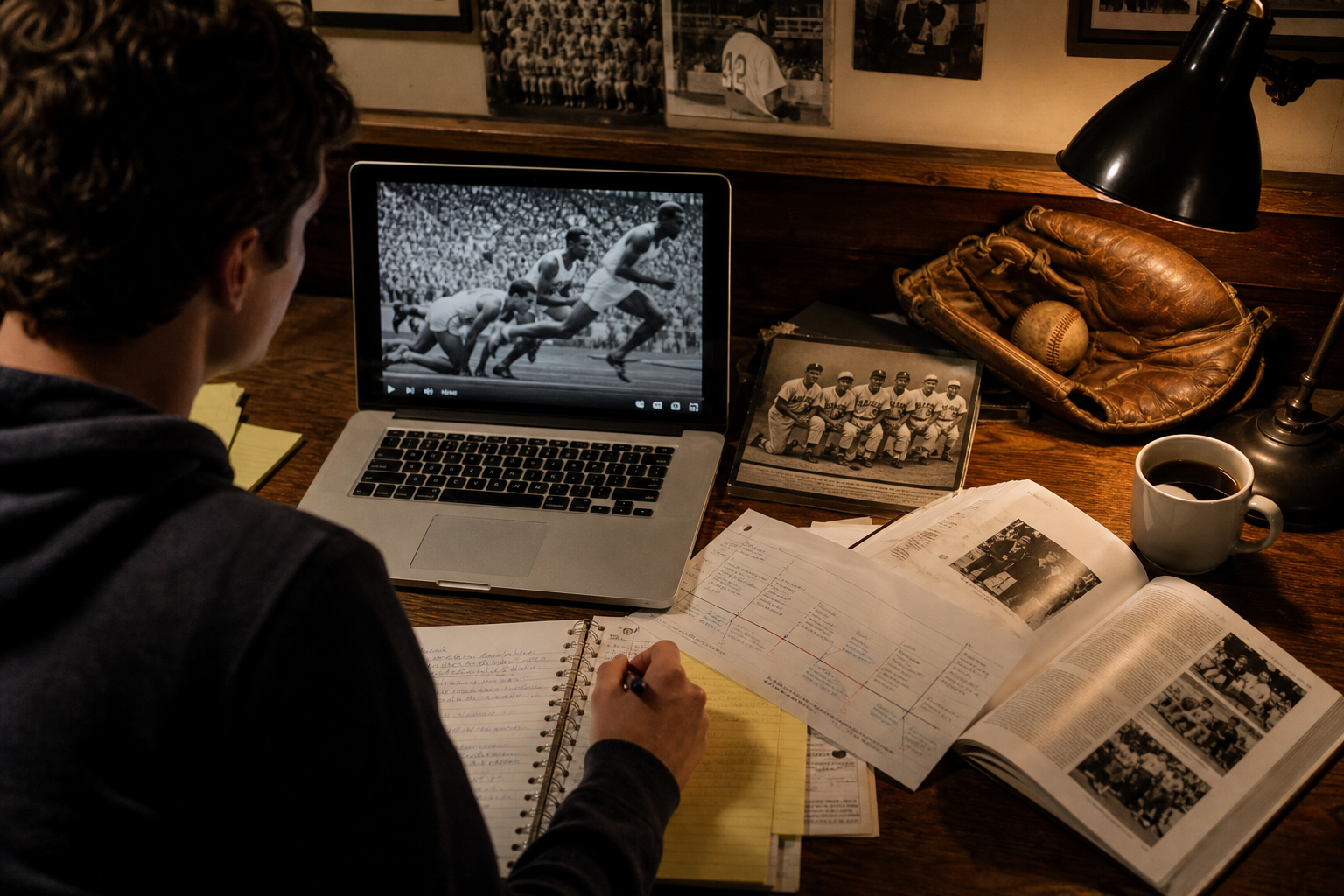
The useful part is not that sports are entertaining. Entertainment may get you to press play, which is not nothing when you are tired, behind, or bored by a chapter outline. The useful part is that certain sports stories sit inside larger historical systems: segregation, empire, nationalism, commercialization, gender rules, labor politics, television, policing, celebrity, and protest.
There is some education-side support for that use. Brugar’s work on ESPN’s 30 for 30 series found that sports documentaries can engage middle and high school students in inquiry-based social studies learning, especially around topics students may find difficult or abstract.[3] The de Beaumont Foundation has also described documentaries as an “easy sell” assignment with lower cognitive load for learners, which can support engagement and potential retention compared with more demanding reading-only tasks.[4] Those claims support documentaries as an entry point and teaching tool, not as a substitute for tested study techniques.
That is the working standard for this method: if a documentary helps you enter the historical problem and then produce recall, it has earned its place. If it only makes you feel informed, it has not.
Choose the Documentary by Historical Weight, Not by Hype
A historically useful sports documentary is not just a film about a famous athlete or an unforgettable game. It needs enough surrounding context that you can connect the sports story to an exam-relevant period, institution, conflict, or social change.
| Selection Question | Why It Matters for History Study |
|---|---|
| Can I place it inside a specific era? | You need dates, sequence, and periodization, not just a dramatic event. |
| Does it connect sports to a larger historical issue? | Useful topics include race, citizenship, nationalism, labor, media, empire, protest, or political transition. |
| Does it show institutions, not only personalities? | Exams often ask about governments, courts, schools, markets, parties, and social movements. |
| Can I turn it into a cause/effect or continuity/change explanation? | If you cannot write from it, it is weak study material. |
| Does it fit something already on my syllabus or test plan? | A good film in the wrong unit is still a detour. |
This is why a title such as Ghosts of Ole Miss can be more than a football story: it routes into the University of Mississippi integration crisis, civil rights, state resistance, federal authority, and the politics of public education. The 16th Man can support study of Nelson Mandela, post-apartheid South Africa, national reconciliation, and the 1995 Rugby World Cup. OJ: Made in America can open questions about race, celebrity, policing, television, and modern U.S. public culture. When We Were Kings can be studied through the politics of race, anticolonial identity, global media, and the 1970s. Ken Burns’ Baseball is especially obvious as cultural history because baseball can be mapped across immigration, segregation, commercialization, regional identity, and twentieth-century American life. These are examples of mapping, not a ranked watchlist.
The broader teaching case is not imaginary. Teaching U.S. History through Sports presents sports content as a way to teach across major eras of U.S. history, which supports the idea that sports can be organized around historical periods rather than treated as trivia beside the “real” curriculum.[5]
The Active-Viewing Protocol
Do not start by opening a streaming app. Start with the exam topic. The documentary should answer to the unit, not the other way around.
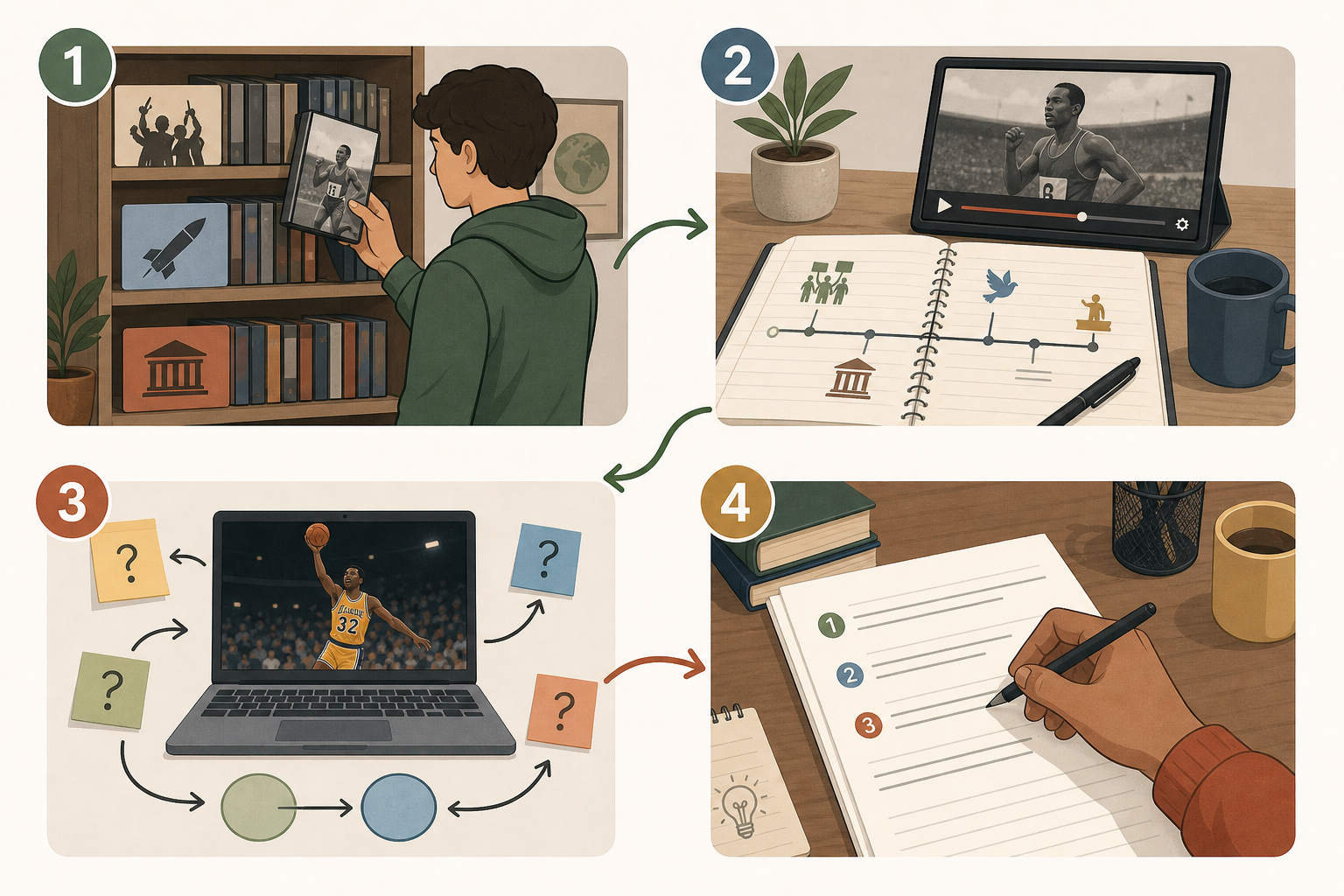
| Stage | Action | Output |
|---|---|---|
| Before watching | Match the documentary to one exam unit, era, or skill. | A one-line purpose statement. |
| During watching | Pause for timeline placement, cause/effect, and continuity/change notes. | A small set of recall-ready notes. |
| Immediately after | Close the video and write from memory. | A short explanation or practice answer. |
| Later review | Return to the material through spaced recall. | Flashcards, a rewritten timeline, or a timed paragraph. |
1. Write the Purpose Before You Watch
Your purpose statement should be narrow enough to grade. Not “learn about civil rights.” Try: “Use Ghosts of Ole Miss to explain how federal authority, state resistance, and university integration collided in the early 1960s.” Not “learn about South Africa.” Try: “Use The 16th Man to connect post-apartheid political transition with national symbolism and reconciliation.”
This keeps the documentary from becoming a mood. You are setting a retrieval target before the story starts doing the emotional work for you.
2. Build a Timeline While the Film Moves
Use a simple three-column page: “Before,” “During,” and “After.” Sports documentaries often compress time because narrative momentum matters. Exams punish that compression. If the film jumps from a childhood scene to a national crisis to a famous game, your job is to slow the sequence down.
- Before: What conditions made the event possible?
- During: What conflict, decision, or public reaction is the documentary emphasizing?
- After: What changed, and what did not change?
- Outside the film: What textbook topic does this belong to?
For APUSH, this protects periodization. For SAT, ACT, and GRE reading, it protects you from treating historical passages as isolated anecdotes. A passage about a boxing match, baseball league, college campus, or national team may really be asking about public memory, identity, institutions, or power.
3. Pause for Cause, Effect, and Continuity
The pause button is where the studying happens. Stop after a major scene and write one sentence for each of these prompts:
- Cause: What earlier condition made this conflict more likely?
- Effect: What did this event change in law, politics, culture, media, or public opinion?
- Continuity: What older pattern survived the event?
- Perspective: Whose viewpoint is centered, and whose is missing?
- Evidence: What would I need from a primary source to support this claim?
The continuity prompt is the one students most often skip because the film itself usually wants movement: crisis, climax, resolution. History exams often want the less cinematic answer: the event mattered, but older structures did not disappear overnight.
4. Convert the Film Into Retrieval Within Ten Minutes
When the documentary ends, do not reward yourself by reading a recap. Close the video and write from memory. The first recall attempt can be rough; rough is useful because it shows you what the film did not actually teach you.
| If You Watched For... | Write This From Memory |
|---|---|
| APUSH contextualization | A four-sentence setup explaining the larger historical situation before the event. |
| Continuity and change | Two changes and one continuity, each tied to a historical cause. |
| Comparison | A short comparison between the documentary’s event and another event in the same era. |
| SAT/ACT reading support | A neutral summary of the author’s likely historical claim, without film emotion. |
| GRE verbal context | A paragraph explaining the political or cultural background a passage might assume. |
This is where the method stops being passive. You are not proving that you watched. You are proving that you can retrieve and explain.
5. Turn Notes Into Practice Questions
Good documentary notes should become questions. If they cannot, they are probably too descriptive.
- Contextualization: What broader historical development helps explain this sports event?
- Causation: Which political, economic, or social conditions shaped the conflict?
- Continuity and change: What changed after the event, and what remained unresolved?
- Comparison: How does this event resemble or differ from another movement, crisis, or media moment?
- Source analysis: What kind of primary source would confirm, complicate, or challenge the documentary’s framing?
A hypothetical example: after watching a documentary segment about an athlete becoming a national symbol, a weak note says, “The athlete brought people together.” A stronger practice question asks, “How did political leaders use sports symbolism to promote national unity after a period of conflict, and what tensions did that symbolism leave unresolved?” The second version can become an exam paragraph. The first version cannot.
Where This Fits by Exam
The same documentary does not serve every exam the same way. Route it to the skill your test actually rewards.
APUSH
For APUSH, sports documentaries are most useful for contextualization, causation, comparison, and continuity/change. They are weaker for memorizing exact testable content unless you convert them into recall and place them inside the College Board’s units. A classroom newspaper article from 2024 reported AP history teachers recommending films as study supplements for contextualization and continuity/change questions, though that source discusses films broadly rather than documentaries specifically.[6]
A practical APUSH use is to assign one documentary to one unit review slot. Watch only after you have read the textbook section or class notes. Then write a timed contextualization paragraph without the film, notes, or transcript open.
SAT and ACT Reading
The SAT and ACT will not ask whether you watched a sports documentary. The benefit is indirect: documentaries can widen your background knowledge for passages about race, citizenship, public institutions, social change, or media. That background may help you orient yourself faster, but the test still rewards close reading. Do not let prior knowledge override the passage.
Use the documentary for pre-reading context, then practice with actual passages. After viewing, write one neutral summary and one author-purpose prediction. Keep both flexible; the passage controls the answer.
GRE Verbal
For GRE verbal, sports documentaries are not content prep in the same way they might be for APUSH. They are background-building tools. A documentary that explains a political transition, a public controversy, or a cultural institution can make dense reading passages less alien, especially when the passage assumes historical context without teaching it.
The conversion task should be verbal, not cinematic: define three abstract terms that appeared in your notes, then write a short paragraph explaining how the documentary’s historical context changes the meaning of one term. Words such as legitimacy, integration, nationalism, spectacle, reform, resistance, and reconciliation become more useful when tied to concrete historical situations.
How to Put It Into a Dated Study Plan
Treat documentary viewing as a supplement with a time box. It belongs after an initial content pass or before a difficult review session, not in place of practice testing.
| Study Moment | Use the Documentary For | Do Not Use It For |
|---|---|---|
| Before starting a hard unit | Motivation and orientation | Claiming the unit is studied |
| After reading a chapter | Context, examples, and memory hooks | Replacing notes or source analysis |
| One week later | Spaced recall from the film-linked timeline | Rewatching the full documentary passively |
| Final review | One quick example for a broader historical theme | Learning new content at the last minute |
A reasonable rule: for every hour of documentary viewing, produce at least one exam-facing artifact. That artifact can be a timeline, a set of practice questions, a contextualization paragraph, a comparison chart, or flashcards for later recall. If there is no artifact, count the time as enrichment, not studying.
The Line Between Studying and Procrastinating
Sports documentaries for learning history are legitimate when they produce three things: retrieval, context, and exam-aligned explanation. Retrieval means you can recall the material without the screen. Context means you can place the story inside a larger historical development. Exam-aligned explanation means you can answer the kind of prompt your test actually asks.
They are weak when they remain passive viewing. A beautifully edited documentary can make you feel close to the past while doing very little for tomorrow morning’s short-answer question. The fix is not to stop watching. The fix is to make the film answer to the timeline, the prompt, and the recall attempt.
References
- History, the Past, and Public Culture: Results from a National Survey, American Historical Association, 2024.
- Improving Students' Learning with Effective Learning Techniques, Psychological Science in the Public Interest, 2013.
- An Inquiry into Sports Documentaries to Engage in Social Studies, The History Teacher, 2016.
- The Documentary as a Teaching Tool, de Beaumont Foundation, 2017.
- Teaching U.S. History through Sports, University of Wisconsin Press, 2019.
- The best movies to watch to study for your AP history exam, The Black and White, May 2024.
Related exhibits & inventory
Verified outcomes
No verified outcomes on file for this exam yet
See Methodology for how outcome evidence is disclosed once logged.
Planners
No planner filed for this exam yet
A downloadable timeline template for this exam hasn't been published yet.
Tool verdicts
AI-tool cautions
No AI tools tested for this exam yet
No hands-on AI-accuracy logs have been filed for this exam.
Questions about this plan
Ask a question about a specific section, timeline, or citation in this plan — or flag something that needs correcting.
Comments
Join the discussion with an anonymous comment.