
MCAT Exam Hub
A Sociology Research Guide to AI Dating App Ethics
Sociology students can design a feasible, evidence-backed research project on AI dating app ethics by adapting three published methodological templates—a national survey, a student-led interview study, and a controlled experiment—all replicable within a single semester.
- SAT
- ACT
- GRE
- MCAT
- ASVAB
- digital-sat
- adaptive-testing
- registration-fee
- content-outline
- score-target
The fastest way to ruin an otherwise promising ai dating app ethics study for sociology students is to start with the biggest possible claim: AI is changing love, intimacy, autonomy, privacy, gender relations, and society. It may be. That still does not tell you what goes on the survey, who sits for the interview, what stimulus changes across experimental conditions, or what you can finish before finals.
A workable project starts smaller. Ask what kind of evidence you can actually collect: attitudes, narratives, or reactions to a controlled stimulus. The current methods record already gives sociology students three usable templates: a national survey model, a student-led interview model, and a controlled experiment model. Each can be adapted to AI dating app ethics, but each answers a different question.
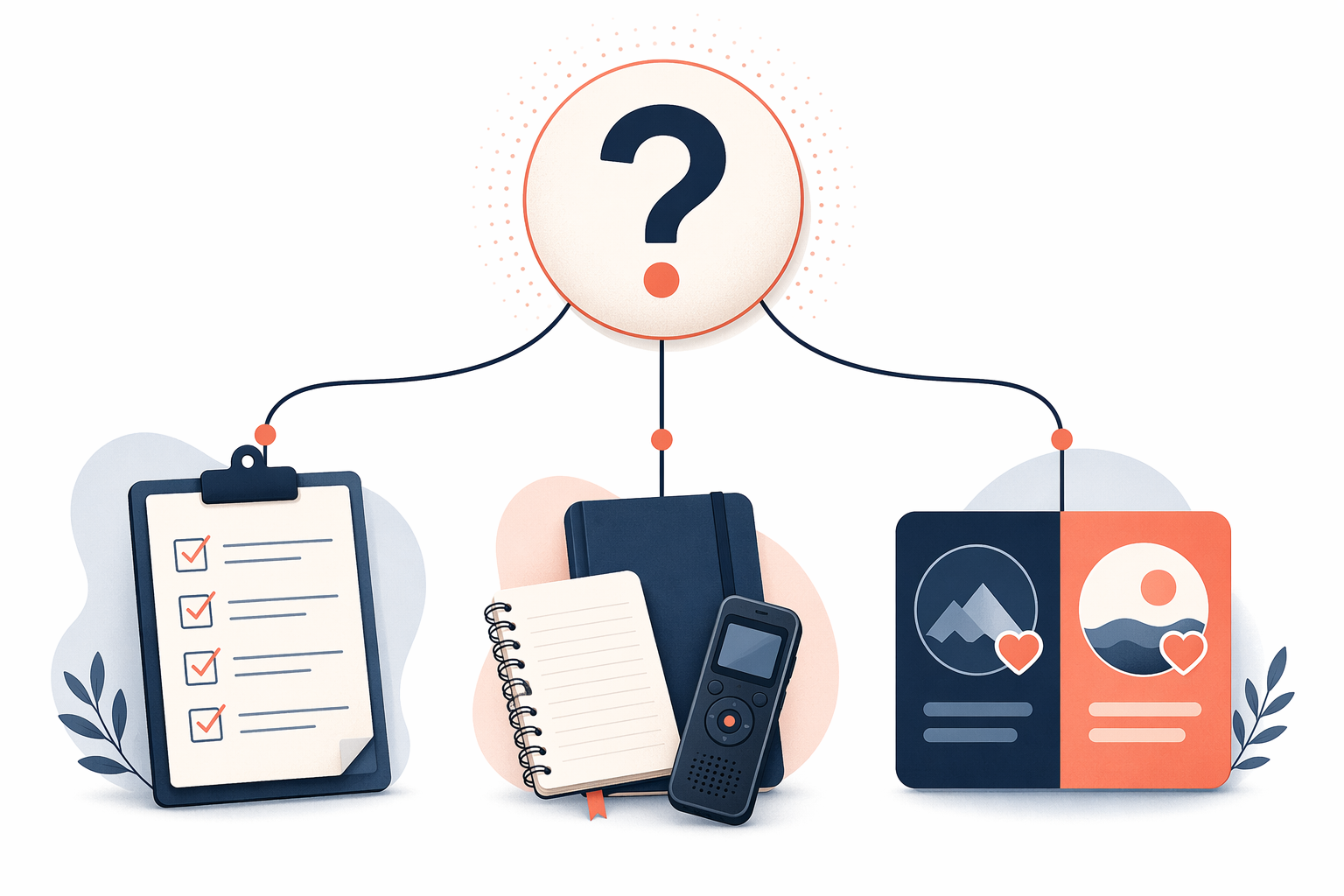
| Template | Best for measuring | What a student can adapt | Main caution |
|---|---|---|---|
| Survey | Attitudes and perceived ethical concerns across groups | Likert items about trust, privacy, autonomy, bias, and consent | Attitudes are not the same as behavior |
| Interviews | How users explain dating app experiences in their own words | Questions about AI-generated profiles, chatbot help, and perceived algorithmic matching | Recruitment, consent, and coding must be realistic |
| Experiment | Whether one manipulated feature changes judgments | AI-written versus human-written profile text, or disclosed versus undisclosed AI assistance | A narrow manipulation cannot prove broad social effects |
Start by deciding what your evidence is allowed to prove
Before choosing a topic sentence, choose a method sentence. A survey can support a claim such as “students who report higher concern about data privacy are less comfortable with AI-written dating profiles.” An interview project can support a claim such as “participants describe AI assistance as helpful for profile writing but uncomfortable when it feels hidden.” An experiment can support a claim such as “profiles labeled as AI-assisted are rated differently on trustworthiness than profiles labeled as human-written.”
Those are not less interesting than “AI is transforming romance.” They are just measurable. They also match the way sociology and social science exams expect you to think about research design: define the construct, operationalize it, sample a population, observe or manipulate something, and keep the conclusion within the evidence.
For MCAT Psych/Soc or GRE social science preparation, this is the useful part: the same topic can become a cross-sectional survey, a qualitative interview study, or a between-subjects experiment. The ethical issue is not the design. The design is how you make the ethical issue observable.
Template 1: Build a survey from the BU/Ipsos model
The cleanest quantitative model is the BU College of Communication / Ipsos poll on skepticism toward AI in dating apps. It used a nationally weighted U.S. panel of about 2,000 respondents, with a margin of error of plus or minus 3.5 percentage points. One finding is especially useful for a student project: only 10% of women, compared with 20% of men, agreed that AI-powered dating apps lead to more successful relationships.[1]
That does not mean a class survey should pretend to be nationally representative. It should do the opposite: state its limits plainly. If you survey students in two large lecture courses, your sample is not “young adults” or “dating app users” in general. It is students reachable through those courses who agreed to answer. That sample can still support a class project if the research question is scoped to match it.
A defensible survey question might be: “Among undergraduate respondents, how are gender, prior dating app use, and privacy concern associated with attitudes toward AI-assisted dating features?” That question does not require platform data. It does not require proving whether AI creates better relationships. It asks respondents what they think about identifiable features.
Turn the ethical concern into variables
The survey version works when “ethics” becomes several measurable constructs. Do not ask one giant question: “Are AI dating apps ethical?” That item will produce opinions, but it will not tell you which ethical concern respondents are reacting to. Split the concept.
- Trust: “I would trust a dating profile less if I knew the text had been generated by AI.”
- Autonomy: “AI match suggestions make users feel they are choosing freely.”
- Privacy: “Dating apps should clearly disclose what personal data are used to generate match recommendations.”
- Consent: “Users should be told when they are chatting with a person who is using AI-generated replies.”
- Bias: “AI matchmaking may reproduce social preferences related to race, class, gender, or attractiveness.”
Those sample items are hypothetical, not validated instruments. In a methods paper, label them as adapted or newly written items, then report the exact wording. If you combine items into a scale, explain how you checked whether they belong together. If your instructor expects psychometrics, this is where tools such as the Problematic Tinder Use Scale or the Tinder Motives Scale can help as measurement starting points, but they do not solve the whole problem. They were not built as validated scales for “AI dating app ethics perceptions,” so AI-specific items need transparent adaptation.
The BU/Ipsos gender-gap finding is a useful model because it points to a comparison that a student can replicate at a smaller scale: do men and women in the sample differ in agreement with statements about AI-assisted dating? But the word “replicate” needs discipline. A classroom sample cannot reproduce a nationally weighted panel. It can test whether a similar pattern appears in a narrower population, using clearly described sampling and item wording.
A student-ready survey design
| Design choice | Feasible version |
|---|---|
| Population | Undergraduates at one campus or students in selected courses |
| Sampling | Convenience sample, described honestly |
| Instrument | Short online questionnaire with Likert items and demographics |
| Independent variables | Gender, dating app experience, comfort with AI tools, privacy concern |
| Dependent variables | Agreement with AI dating app ethics items |
| Analysis | Descriptive statistics, group comparisons, simple correlations |
| Claim allowed | Associations among attitudes in the sampled group |
| Claim not allowed | AI dating apps cause relationship success or failure |
This is usually the safest option for a student with limited time, especially if the assignment asks for a quantitative project. The hard work is not finding a dramatic ethical problem. The hard work is writing items that measure one thing at a time.
Template 2: Adapt the ASU student interview model without pretending it studied AI
The strongest proof that undergraduates can do a dating-related qualitative project in one semester comes from Arizona State University’s SOC 490 Advanced Sociological Research Methods course. In Spring 2025, 13 sociology students interviewed 26 young adults ages 18 to 23 about dating culture. ASU reported the project as student-led and semester-based, and one student, Abhishek Jaiswal, described learning “how to better think about ethics practically, especially as it relates to best representing what participants said.”[2]
That quote matters because interview ethics is not just a consent form. It is also what happens after the recorder stops: how you paraphrase someone’s awkward story, how you remove identifying details, how you avoid turning one participant into a symbol for an entire generation, and how you code disagreement without flattening it.
The ASU project should not be cited as direct evidence about AI dating app ethics. It studied dating culture among young adults, not AI-generated profiles or chatbot-mediated flirting. Its value is methodological: it shows that a small team of students can recruit, interview, and analyze a dating-related topic within a semester if the scope is controlled.
What to add for an AI ethics version
An AI-focused interview project should not ask participants to give a lecture on technology ethics. It should ask them to describe situations. The interview guide can move from concrete experience to ethical interpretation.
- Dating app use: “Which dating apps, if any, have you used, and what role did profile text or match suggestions play?”
- AI-generated profiles: “How would you feel if someone used AI to write their profile bio? Would your reaction change if they disclosed it?”
- AI-assisted messages: “Would it matter to you if a match used AI to draft replies during a conversation?”
- Algorithmic matching: “When an app recommends someone, what do you think the app knows about you?”
- Consent and boundaries: “What kinds of AI assistance should users be told about before interacting?”
- Trust and authenticity: “What makes a dating profile feel authentic or inauthentic?”
Notice the order. Participants first talk about practices they can recognize. Only then do they move toward concepts such as consent, trust, and authenticity. That order usually produces better data than opening with “Do you think AI dating apps are ethical?” because it gives participants something to remember, compare, and explain.
The interview route is especially useful because dating app research has leaned heavily toward non-qualitative methods. Castro and Barrada’s 2020 review of 70 studies on dating apps found that qualitative methods accounted for only 15.7% of the research they reviewed.[5] That gap does not automatically make every interview project important, but it gives a student a legitimate reason to choose interviews when the research question concerns meaning, interpretation, and boundary-setting.
A student-ready interview design
| Design choice | Feasible version |
|---|---|
| Participants | A small sample of young adults or undergraduates who are eligible and willing to discuss dating app perceptions |
| Recruitment | Course announcements, student networks, or campus flyers, depending on IRB approval |
| Data collection | Semi-structured interviews, recorded only with consent |
| Core topics | AI-written profiles, AI-assisted messaging, match algorithms, disclosure, privacy, and trust |
| Analysis | Thematic coding with a codebook revised during early coding |
| Evidence quality | Rich accounts of how participants interpret ethical boundaries |
| Main limit | Findings are not generalizable frequency estimates |
If you choose this design, protect your time. A semester interview project can collapse under transcription and coding. Fewer interviews, better questions, and a clear coding plan beat an ambitious sample that nobody finishes analyzing.
Template 3: Use Wu and Kelly for a controlled experiment, but keep the claim narrow
Wu and Kelly’s 2020 “Online Dating Meets Artificial Intelligence” is the most direct experimental template. The study used 48 participants and manipulated whether dating profile text was AI-generated or human-written. The key result was bounded and useful: perceived AI involvement significantly reduced trustworthiness ratings, but not attractiveness ratings.[3]
That distinction between trustworthiness and attractiveness is exactly the kind of thing a methods rubric likes. The outcome is not “people hate AI” or “AI ruins dating.” The outcome is more precise: one kind of judgment changed, another did not. For a student project, that is a good model of how to separate dependent variables that are often casually blended together.
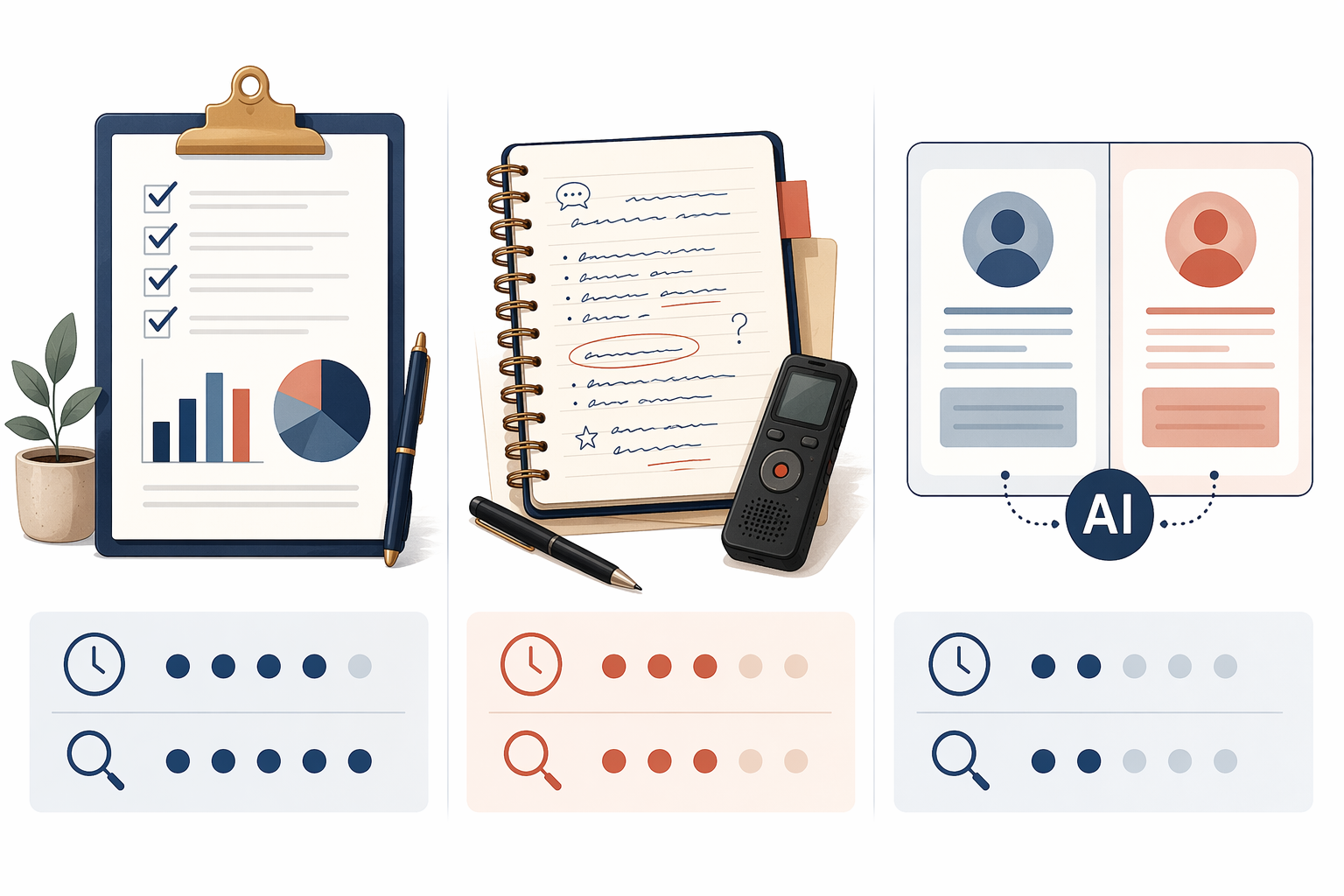
The caution is just as important. A 48-participant experiment published in 2020 came before the current wave of more visible AI tools in dating contexts. It is a strong classroom template, not a final verdict about how contemporary users respond to every form of AI-assisted dating.
A feasible experimental version
The simplest classroom adaptation is a between-subjects design. Participants see one dating profile. In one condition, the profile is described as written by the user. In another, it is described as AI-assisted. Then participants rate the profile on separate outcomes.
| Element | Example for a class experiment |
|---|---|
| Manipulation | Profile labeled human-written versus AI-assisted |
| Stimulus | Same profile content across conditions, with only the label changed |
| Dependent variables | Trustworthiness, attractiveness, authenticity, willingness to message |
| Control question | Whether the participant noticed how the profile was described |
| Ethical focus | Disclosure, authenticity, and trust |
| Allowed conclusion | Whether the label affected ratings in this sample |
| Not allowed | Whether AI dating apps improve or damage real relationships |
The experiment is attractive because it looks tidy. It is also easy to overclaim. If all you manipulate is a label, then your evidence concerns reactions to a label. If you manipulate profile text quality, then you need to avoid accidentally comparing a polished profile with a clumsy one. The cleaner the manipulation, the narrower the conclusion.
For an 8–12 week project, do not try to build a dating app simulation unless the course explicitly supports that kind of work. A one-page stimulus, randomized condition assignment, and short outcome scale are enough. The experiment’s strength is control, not realism.
Use reviews to justify the design, not to replace one
Systematic reviews are useful at the front of a student paper because they show where the literature has already been organized. Ho and colleagues’ 2025 review of 23 peer-reviewed articles on romantic AI companions identified risks including over-reliance, data misuse, erosion of human relationships, and perpetuation of biases.[4] That gives students a defensible ethical issue menu.
Castro and Barrada’s review, meanwhile, helps place dating app research in a broader sociological and psychosocial context. Its finding that qualitative methods made up only 15.7% of the 70 reviewed dating app studies is especially helpful if your project uses interviews or mixed methods.[5]
A literature review, though, is not a method unless the assignment is specifically a review paper. If the professor expects original data, do not submit a long discussion of AI romance risks and call it a study. Use the reviews to explain why trust, privacy, autonomy, bias, or consent is worth measuring, then state how you will measure it.
Pick the template that matches your deadline
The best design is not the one that sounds most current. It is the one that survives recruitment, IRB review, data collection, analysis, and a skeptical question about measurement.
| If your situation is... | Choose... | Because... |
|---|---|---|
| You need numbers quickly and can distribute a questionnaire | Survey | It gives clean attitude measures and simple group comparisons |
| You can recruit participants responsibly and have time to code | Interviews | It captures how people explain authenticity, disclosure, and boundaries |
| You can randomize stimuli and keep the manipulation simple | Experiment | It tests whether a specific AI cue changes a specific judgment |
| You cannot collect data this term | Systematic or structured literature review | It can still be rigorous if the search, inclusion rules, and coding categories are explicit |
Some topics are better left out of the centerpiece for a semester project. Platform-level auditing, proprietary recommendation systems, state-level policy comparisons, and real behavioral outcome data usually require access students do not have. They can appear in the discussion section as limitations or future research, but they should not be the thing your whole design depends on.
Research questions that are small enough to finish
A good research question names the population, the ethical construct, and the evidence type. It also avoids smuggling in a causal claim unless the design can support one.
- Survey: “Among undergraduates in this sample, how is prior dating app use associated with comfort toward AI-generated profile text?”
- Survey: “Do men and women in this student sample differ in agreement that AI-powered dating apps can lead to more successful relationships?”
- Interviews: “How do young adults describe the boundary between acceptable writing help and deceptive AI use in dating profiles?”
- Interviews: “How do dating app users interpret algorithmic match suggestions in relation to autonomy and trust?”
- Experiment: “Does labeling a dating profile as AI-assisted reduce perceived trustworthiness compared with labeling it human-written?”
- Experiment: “Does disclosure of AI assistance affect willingness to message a profile, holding profile content constant?”
The second survey question borrows its comparison logic from the BU/Ipsos finding, but a student paper would still need to say that its sample, timing, and measurement are different from the national poll.[1] The first experiment question borrows the logic of Wu and Kelly, but the conclusion should remain limited to the stimulus and participants actually used.[3]
What not to promise
Do not promise to find out whether AI dating apps make relationships better. The BU/Ipsos poll measured attitudes toward whether AI-powered dating apps lead to more successful relationships; it did not measure relationship success itself.[1] Do not promise to describe all young adults’ dating behavior from a small interview sample. The ASU project is valuable because it shows semester feasibility, not because 26 interviews can stand in for a whole age cohort.[2] Do not promise to prove how all users react to AI from one small experiment. Wu and Kelly’s result is a useful manipulation effect, not a universal law.[3]
Promise something better: a transparent study of a defined ethical perception, in a defined sample, using a method that matches the claim. That is the version of the project that can make it through a methods rubric.
References
- Plenty of Skepticism of AI in Dating Apps, Especially among Women, Survey Says, BU College of Communication, February 2025.
- Sociology students study dating culture among young adults, ASU News, 2025.
- Online Dating Meets Artificial Intelligence, ACM Digital Library, 2020.
- Potential and pitfalls of romantic AI companions, Computers in Human Behavior Reports, 2025.
- Dating Apps and Their Sociodemographic and Psychosocial Correlates, 2020.
Related exhibits & inventory
Verified outcomes
Planners
No planner filed for this exam yet
A downloadable timeline template for this exam hasn't been published yet.
Tool verdicts
Questions about this plan
Ask a question about a specific section, timeline, or citation in this plan — or flag something that needs correcting.
Comments
Join the discussion with an anonymous comment.