
SAT Exam Hub
Princess Eléonore Proves SAT Scores Work for European Universities
Princess Eléonore of Belgium's 2026 university choice highlights how over 60 European programs now accept SAT/ACT scores, often with lower thresholds and tuition than US schools. This article breaks down score requirements, costs, and application strategy for US students considering Europe.
- gre
- mcat
- asvab
- sat
- act
- digital-adaptive
- official-material
- section-strategy
- test-date-timeline
Searches for “princess eleonore university plans 2024” are already a little out of date. The useful news happened on July 23, 2026: Princess Eléonore of Belgium announced that she will attend University College Utrecht after studying at the International School of Brussels and going through UCU’s standard selection process, according to Town & Country’s report on the palace statement.[1]
That does not mean her case proves that an SAT score gets a student into Europe. It does point to something more practical for US families: at some European universities, SAT or ACT results can help a US high school diploma clear an admissions-equivalency gate. UCU is one of the clearest examples because its stated route for US high school diploma holders includes SAT >1400 or ACT >29 with GPA ≥3.5, while English proficiency remains a separate requirement.[2]

That distinction matters. A US student with a 1400 SAT may hear, in a domestic admissions conversation, that the score is solid but not elite. In a European equivalency conversation, the same score may change the list of viable programs, especially when the family is comparing four years of US tuition with three-year bachelor’s programs abroad.
What UCU Actually Requires
University College Utrecht is an honours college of Utrecht University. Its program is a three-year Liberal Arts & Sciences degree in which students build a flexible curriculum and graduate with either a BA or a BSc. UCU describes small classes of about 20 students and continuous assessment rather than a model built around a single final exam.[3]

For US families, the admissions fine print is more important than the royal headline. UCU does not require SAT or ACT scores from every applicant. Students applying with other qualifications, including the IB, are evaluated under the relevant diploma route. The SAT >1400 or ACT >29 threshold is specifically tied to US high school diploma equivalency, and that figure came from a snippet of UCU’s diploma-equivalency material, so families should verify the current PDF or admissions page before building a plan around it.[2]
| Requirement area | What US families should check |
|---|---|
| Diploma route | Whether the applicant is using a US high school diploma, IB diploma, or another credential |
| US diploma equivalency | SAT >1400 or ACT >29 plus GPA ≥3.5, based on the cited UCU equivalency threshold |
| English proficiency | IELTS 7.0 with no band below 6.5, or TOEFL iBT 100 with minimum subscores |
| What does not count as English proof | SAT, ACT, and Duolingo are not accepted by UCU for this purpose |
| Selection beyond scores | Program fit, academic preparation, motivation, and the standard selection process |
The English requirement is the trapdoor. UCU lists IELTS 7.0 with no band below 6.5, or TOEFL iBT 100 with minimum subscores of Listening 22, Reading 24, Writing 24, and Speaking 25. It also states that SAT, ACT, and Duolingo are not accepted as English proficiency proof.[2]
That means a US applicant cannot simply say, “My SAT Evidence-Based Reading and Writing score is high, so my English is covered.” For UCU, the score may help with diploma equivalency, but the English box still needs its own approved test result unless another stated exemption applies.
The Larger Pattern: SAT Scores Are Becoming Portable
Third-party tracking now identifies more than 60 European universities across 12 countries that accept SAT scores in some form, with reported acceptance growing by more than 40% since 2020.[4] That is useful context, not a substitute for official requirements. These lists are leads. The university page is the rulebook.
The practical value is in the spread of thresholds. European SAT use is not one admissions category. In some places, the SAT acts as an alternative to a national entrance test. In others, it helps a foreign diploma meet an equivalency standard. In selective business or technical programs, a formal minimum may exist, but admitted students often cluster much higher.
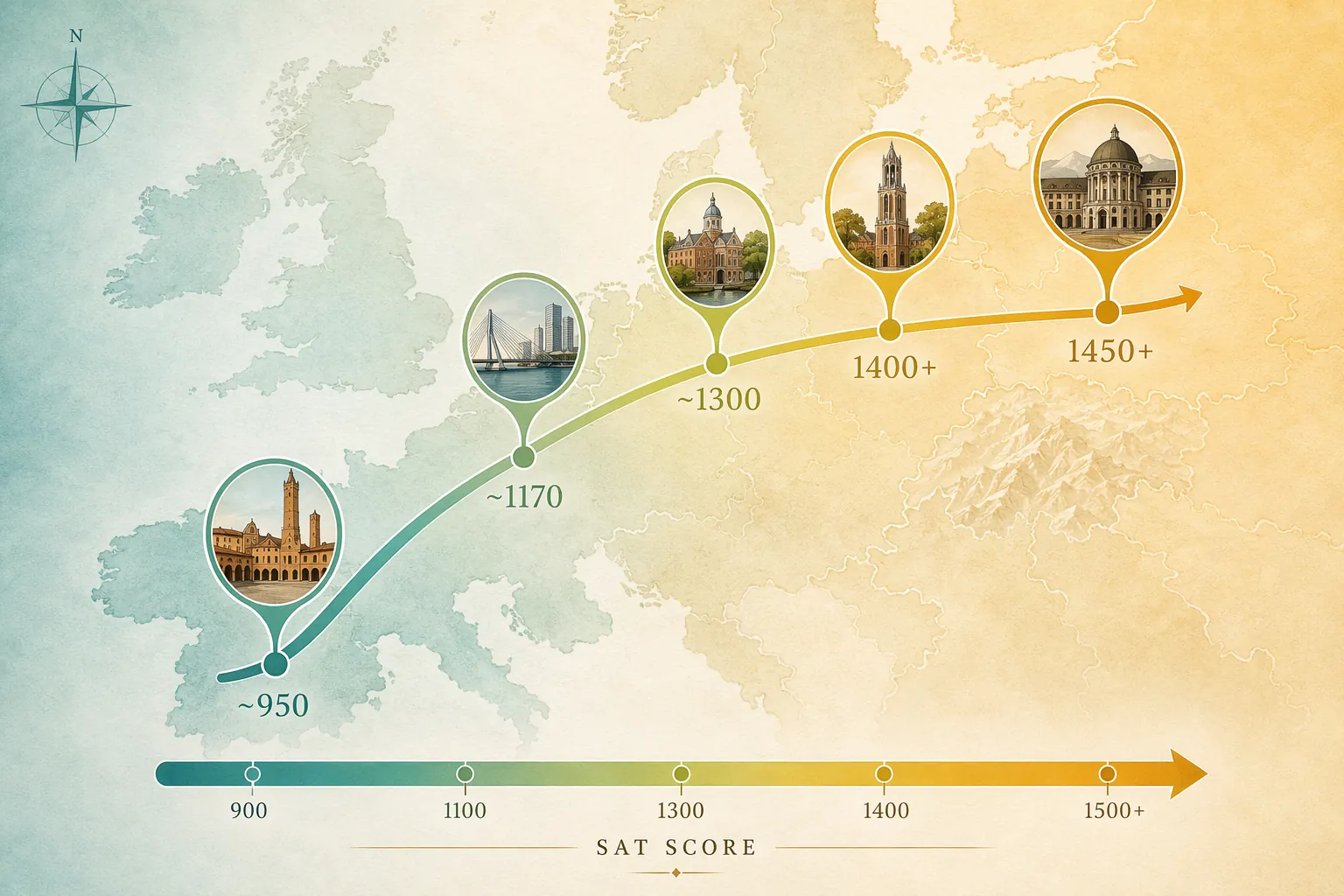
| Reported SAT band | Examples from the 2026 landscape | How to interpret it |
|---|---|---|
| Around 950 | University of Bologna reportedly accepts SAT as low as 950 as a direct TOLC alternative | A lower threshold may open an application route, but program language, selection rules, and seat limits still matter |
| Around 1170 | Erasmus Rotterdam is reported around 1170 | This is the range where a score that feels ordinary in a US prestige chase may still have strategic value abroad |
| Around 1300 | Leiden is reported around 1300; TU Munich is also reported around this level for some routes | This band often requires closer attention to program-specific requirements and non-score criteria |
| Above 1400 | UCU’s cited US diploma route uses SAT >1400 or ACT >29 with GPA ≥3.5 | The score can help establish equivalency, but it does not replace English proof or selection review |
| 1450+ | ETH Zurich is reported at 1450+; Bocconi’s admitted SAT range is reported around 1400–1450 despite a lower formal minimum | Formal minimums should not be confused with competitive admitted ranges |
Those examples come from 2026 SAT-in-Europe roundups and prep-market tracking, not from one centralized European admissions authority.[4][5] A family should therefore read them as a map for where to investigate, then confirm the current requirement on each university’s admissions page, especially if the student is applying for a specific English-taught bachelor’s program.
What a Score Unlocks Depends on the Job It Is Doing
A European university may use an SAT or ACT score in at least three different ways. The distinction is not academic bookkeeping; it changes what the student should prepare next.
- As a diploma-equivalency credential: the score helps show that a US high school diploma meets the academic level required for entry.
- As an entrance-test alternative: the score substitutes for a local test such as Italy’s TOLC in certain routes.
- As a competitive selection signal: the score is not merely a minimum; it sits inside a broader ranking or selection process.
UCU belongs mainly in the first category for US high school diploma holders. Bologna, as reported in the 2026 lists, is closer to the second when the SAT is used as a TOLC alternative.[4] Bocconi illustrates the third problem: a formal minimum can be much lower than the score range of admitted students, so a family looking only at the minimum may overestimate how safe the application is.[5]
This is where US families have to unlearn a domestic reflex. In the US, a score is often discussed as part of a holistic admissions profile. In Europe, it may instead be doing a narrower administrative job: proving level, replacing a test, or qualifying the student for further review. A narrower job can still be valuable. It just should not be mistaken for an admission guarantee.
Cost Changes the Meaning of a 1300 or 1400
The tuition comparison is why this story matters to more than royal-watchers. The research brief reports public European tuition for EU citizens ranging from 0€ in Germany and Scandinavia to about 2,530€ per year in the Netherlands, compared with a typical US range of $45,000–$65,000 per year.[5]
That EU figure needs a warning label. US citizens are usually non-EU applicants, and Dutch universities in particular typically charge higher non-EU tuition than the EU statutory rate. A lower European sticker price may still be meaningful, but the relevant number is the student’s citizenship-based tuition category, not the headline EU fee.
The better way to compare options is not “Europe is cheap.” It is: What does this score let the student apply to, how long is the degree, what tuition category applies, and what non-tuition costs follow? Housing, visa documentation, insurance, travel, and proof of funds can turn a superficially cheap plan into a tight one. They can also make a European program a serious alternative to a US private-college bill.
| Student situation | European strategy to test |
|---|---|
| SAT below 1200 | Look first at reported lower-threshold routes and programs where SAT substitutes for a local exam; verify whether the intended major is included |
| SAT around 1300 | Check mid-range Dutch, Italian, German, or other European programs where the score may satisfy equivalency or initial screening |
| SAT above 1400 | Add selective honours, liberal arts, business, and technical programs, but compare minimums with admitted ranges |
| Strong GPA but no SAT/ACT yet | Decide whether the test is worth taking for a specific European route rather than for a vague admissions boost |
| Strong SAT/ACT but no English test | Book the approved English exam early if the university does not accept SAT, ACT, or Duolingo as proof |
The Application File Has More Gates Than the Test Score
A US applicant trying to use SAT or ACT scores in Europe should build the file in the order an admissions office will read it, not in the order a parent worries about it. The score matters only after the student has the right diploma route, program eligibility, and language proof lined up.
- Identify the exact degree program, not just the university. Requirements often vary by major, language of instruction, and faculty.
- Confirm whether the student is applying with a US high school diploma, IB diploma, AP-heavy transcript, or another credential.
- Check whether SAT or ACT is required, optional, accepted as an alternative, or irrelevant for that route.
- Separate diploma equivalency from English proficiency. UCU is the model warning: SAT/ACT can matter for one and still count for nothing for the other.
- Calculate tuition by citizenship category and degree length, then add housing, visa, insurance, and travel.
- Check dates early. European application calendars, housing deadlines, and visa timing may not match US regular-decision habits.
For a student sitting on a 1350, the next move may not be “retake until 1500.” It may be to find programs where 1350 already clears the test threshold, then decide whether the rest of the file is strong enough. For a student targeting UCU through the US diploma route, the calculation is different: a score under the cited threshold may require another diploma route, another institution, or a serious retake plan.
Students choosing between exams should also treat the ACT as a real European credential where universities name it. UCU’s cited US diploma-equivalency route, for example, lists ACT >29 alongside SAT >1400.[2] The right test is the one that best matches the student’s scoring profile and the universities’ published rules, not the one a US classmate happens to prefer.
Where Princess Eléonore’s Choice Is Useful—and Where It Is Not
Princess Eléonore’s move to UCU is useful because it puts a serious European liberal arts option into a news cycle that many US families will actually notice. UCU is not a backdoor version of a US college. It is a selective three-year international program inside a Dutch research-university system, with a curriculum and assessment model that differ from the standard American pattern.[3]
It is not useful as proof that one famous applicant’s path generalizes to everyone else. Her schooling background, citizenship context, language profile, and application route are not the same as those of a US senior trying to turn an SAT score into an affordable international option. The transferable lesson is the mechanism: European programs may treat US testing as a credential with practical admissions value.
That mechanism is worth taking seriously in 2026. If a student already has a decent SAT or ACT score, Europe may add options rather than simply adding complexity. If the score is close to a known threshold, targeted prep may have a clearer payoff than another generic attempt to become “more competitive” everywhere. If the score is strong but the English requirement is missing, the urgent task is not another SAT section; it is the approved language test.
The clean conclusion is narrower than the headline but more useful: SAT and ACT scores can be repurposed as international admissions assets for US students when they match the right diploma status, GPA, English proof, program fit, tuition category, and verified university requirement. That is enough to justify a closer look at European options—and, for students near a threshold, a more strategic approach to SAT or ACT prep through StudyMethod’s exam-hub resources.
References
- Belgium's Princess Eléonore Announces Her University Plans — Town & Country
- Entry Requirements — University College Utrecht — University College Utrecht
- Study programme — University College Utrecht — Utrecht University
- European Universities Accepting the SAT Exam — 60+ universities, 12 countries — College Council
- Is the SAT Worth It in Europe? A Clear Yes for International Students in 2026 — PrepDrills
Related exhibits & inventory
Verified outcomes
No verified outcomes on file for this exam yet
See Methodology for how outcome evidence is disclosed once logged.
Planners
No planner filed for this exam yet
A downloadable timeline template for this exam hasn't been published yet.
Tool verdicts
AI-tool cautions
No AI tools tested for this exam yet
No hands-on AI-accuracy logs have been filed for this exam.
Questions about this plan
Ask a question about a specific section, timeline, or citation in this plan — or flag something that needs correcting.
Comments
Join the discussion with an anonymous comment.