
SAT Exam Hub
This Checklist Could Prevent Howard's 2026 Unenrollments
Howard University's 2026 mass unenrollment of incoming freshmen over tuition deadlines revealed dangerous gaps in communication and timing. This article breaks down what happened and provides a five-step checklist to help students at any college avoid being unenrolled for missing a payment deadline.
- gre
- mcat
- asvab
- sat
- act
- digital-adaptive
- official-material
- section-strategy
- test-date-timeline
If you searched for “howard university tuition deadline 2025 freshmen unenrolled how to avoid,” the first correction is important: the mass unenrollment happened in July 2026, for students entering in Fall 2026. The “2025” confusion likely comes from Howard’s 2025-2026 cost-of-attendance materials, not from the timing of the unenrollment itself.
The deadline problem was not one clean date on one clean bill. Howard’s bursar page listed August 3 as the Fall 2026 payment due date, while incoming first-time students also faced a separate July 10 deadline to secure their class spot.[1] That is the kind of split that ruins a family’s summer: one date looks like the bill deadline, another date quietly functions like the enrollment-protection deadline.
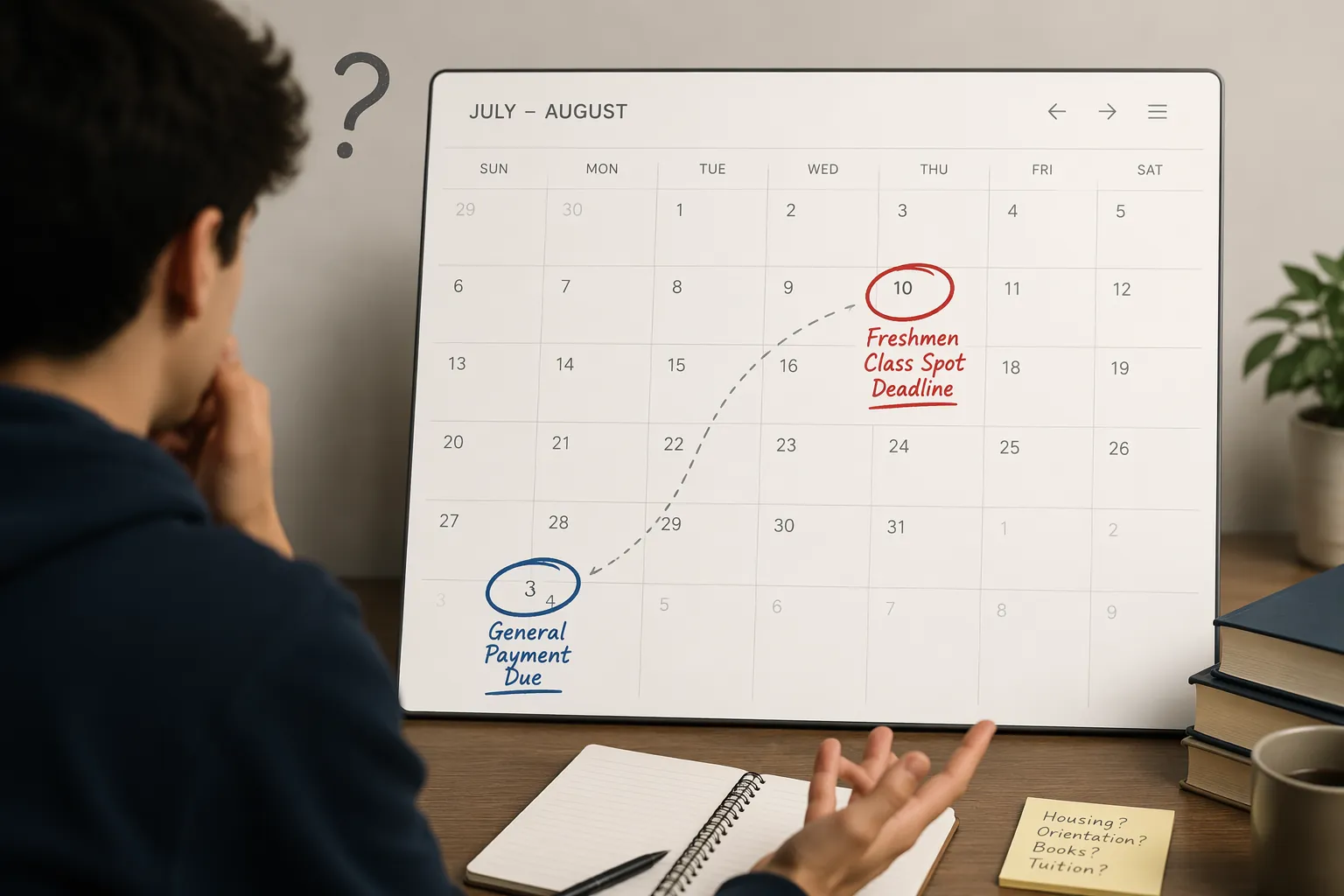
Howard said it had been communicating with students and families through emails, videos, and orientation programming beginning in March 2026. Students and parents, as reported by news outlets, said the warnings did not clearly tell them that missing the July requirement could mean unenrollment rather than late fees or a registration hold.[2] For a student trying to read a portal between scholarship letters, parent loans, housing forms, and orientation messages, that distinction is everything.
The usable lesson is not “never trust a college bill.” It is narrower and more practical: before freshman year, you need written proof of the exact finance action that protects your enrollment, the exact date it must be completed, and whether pending aid actually counts.
The Five-Step Checklist
Use this before move-in, not after the portal turns red. The dates below use Howard’s Fall 2026 situation where Howard published them; the same checks apply at any college.
| Step | What to verify | Proof you want before you relax |
|---|---|---|
| 1. Find the freshman-specific deadline | Whether your class has an earlier seat-protection or enrollment deadline than the general bill due date | A dated email or portal message naming the date, required action, and consequence |
| 2. Enroll in the payment plan yourself | Whether enrollment is active, paid, and accepted by the system | Confirmation of payment-plan enrollment, fee payment, and installment schedule |
| 3. Report outside scholarships in writing | Whether pending scholarship funds are visible to the bursar and financial aid office | Written confirmation that the school has the documentation and how it affects enrollment status |
| 4. Calendar every installment date | Whether the plan has monthly due dates after the first payment | Calendar alerts and a saved copy of the installment schedule |
| 5. Keep the paper trail in one folder | Who said what, when, and through which office | Screenshots, PDFs, email threads, case numbers, and names of offices contacted |
Step 1: Find the Deadline That Actually Protects Your Seat
A general payment due date is not always the same as the date that protects a freshman’s enrollment. Howard’s published Fall 2026 payment due date was August 3, but incoming freshmen were expected to satisfy a July 10 requirement to secure their class spot.[1] A family looking only at the August date could believe they were still inside the official payment window while the system treated the student as already past the enrollment deadline.
That is why the first email you send should not ask, “When is tuition due?” That question is too broad. Ask this instead: “For an incoming first-time freshman, what exact financial action must be completed to prevent unenrollment or loss of class seat, and what is the deadline?”
The answer needs to identify three things in the same place: the date, the required action, and the consequence. “Payment due August 3” is not enough if another office is using July 10 as the point when class seats are reviewed. “Complete your financial clearance” is not enough if the student does not know whether that means paying in full, enrolling in a plan, uploading scholarship proof, accepting loans, or doing all of those before a specific hour.
This is not overreacting. USA Today reported that Howard unenrolled 502 incoming freshmen, while professor Robert Kelchen noted that June and July payment deadlines for freshmen are common but that Howard’s scale was unusual.[3] In other words, the early-deadline structure is not unique to Howard, but the number of students caught by it should make every incoming freshman check for a second deadline.
The Email to Send
Send one message to the bursar or student accounts office, and copy financial aid if aid or scholarships are involved. Keep it boring and specific:
Subject: Incoming freshman enrollment-protection deadline confirmation

Hello,

I am an incoming first-time freshman for Fall 2026. I see the general payment due date listed as [DATE]. Please confirm whether there is any earlier freshman-specific deadline to prevent unenrollment, loss of class seat, housing cancellation, or registration cancellation.

Please also confirm what action satisfies that requirement: payment in full, active payment-plan enrollment, documented pending aid, outside scholarship documentation, loan completion, or another step.

Thank you.
Do not rely on a phone call alone for this. A phone call can help you find the right office, but the protection is the written answer you can forward later if the portal does something different.
Step 2: Enroll in the Payment Plan Before You Need It
A payment plan is not a vibe. It is not “we plan to pay.” It is usually an actual enrollment action in a student system, sometimes with a fee, deadlines, and eligibility rules. Howard’s Fall 2026 payment-plan information said students had to enroll through BisonHub, pay a $45 enrollment fee, and make the first installment by July 15.[1]
The dangerous phrase is “just enroll in the plan.” That sounds simple until the system does not let you. In the Howard case, Kendra Miles said her daughter A’Zariah was locked out of the payment plan because the balance owed exceeded the system’s eligibility parameters.[3][4] That is not a student forgetting to click a button. That is a family reaching the door they were told to use and finding out there is a hidden size limit on the key.
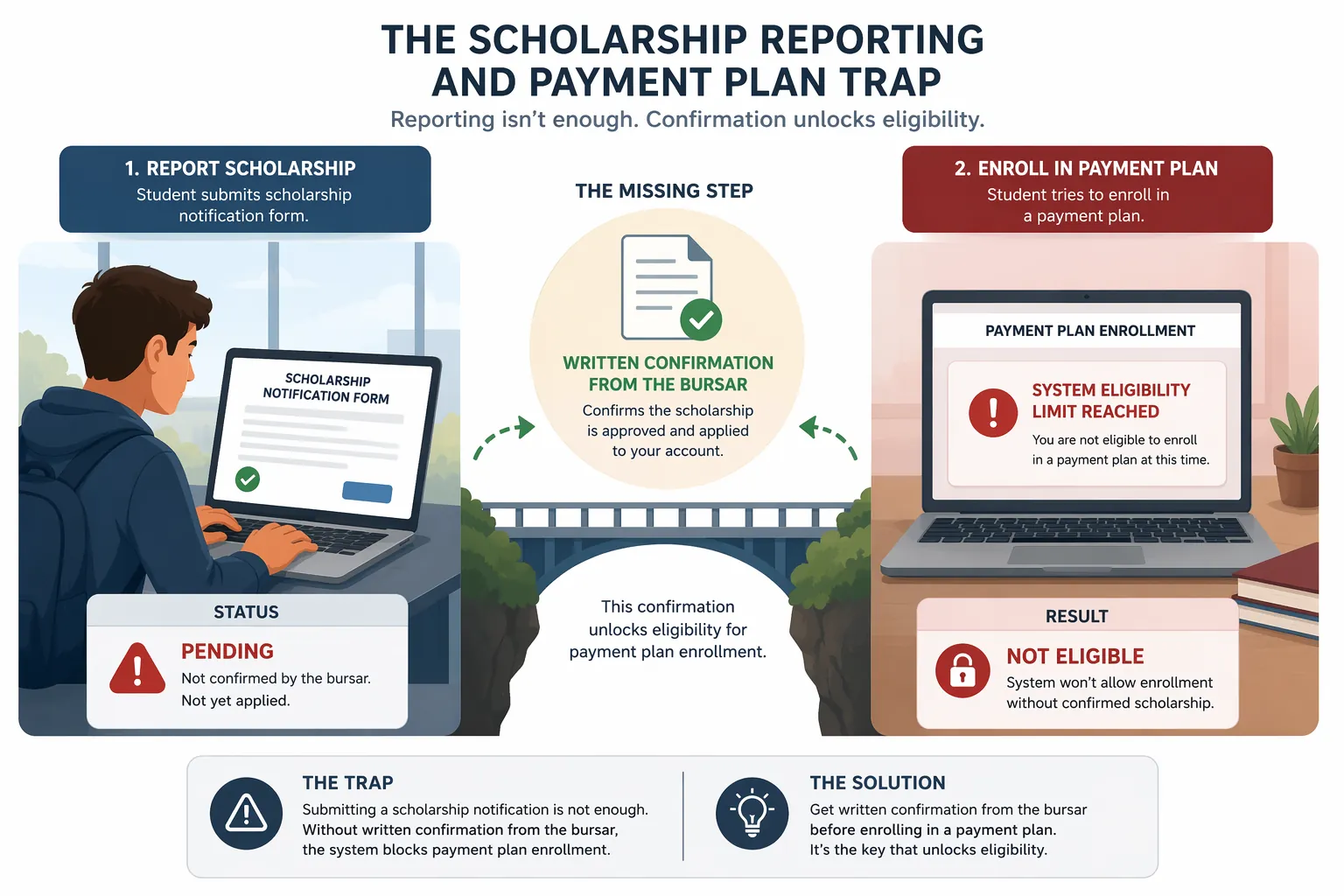
So the task is not only to decide whether your family wants a payment plan. The task is to prove the school’s system has accepted you into one. Save the confirmation page. Save the receipt for the enrollment fee. Save the installment schedule. If the plan says installments are due on the 15th of each month, put every 15th on the calendar with alerts for one week before, three days before, and the morning of the deadline.[1]
If the system blocks you, do not keep refreshing silently. Screenshot the error, email the bursar the same day, and ask what alternative action will protect enrollment while the balance, aid, or scholarship documentation is reviewed. A portal error should become an email thread immediately.
Step 3: Treat Outside Scholarships as Pending Until the School Confirms Them
Scholarship students are especially vulnerable because “I won the money” and “the school has credited the money” are two different states. A foundation may have awarded the scholarship. A church may have mailed the check. A local organization may have promised the funds at a banquet. None of that automatically means the bursar system sees a reduced balance or that the school will protect enrollment while waiting.
The cost numbers explain why this matters. Howard’s 2025-2026 estimated cost of attendance listed $38,000 in annual tuition, $13,600 for housing, and $64,142 as the total on-campus undergraduate cost of attendance.[5] At that scale, a scholarship is not decoration. It can be the difference between a payable balance and an account that looks impossible to clear by a deadline.
But pending money needs a paper trail. Send the award letter. Include the scholarship amount, donor name, expected disbursement date if known, check mailing instructions if provided, and any restrictions. Then ask the office to confirm, in writing, whether that pending outside scholarship will be considered when determining financial clearance, payment-plan eligibility, or enrollment protection.
This is the part many families skip because it feels rude to ask the school to repeat itself. Ask anyway. The question is not whether the student deserves the scholarship. The question is whether the school’s account system has enough documented information to stop an automated balance flag from treating the student as unpaid.
Capital B News reported one case that shows why screenshots matter: MarLae’ Coffield’s account showed a negative balance, meaning Howard owed her money, yet she was still unenrolled.[6] That case does not prove every affected account had the same issue. It does show why students should not assume that the account’s real financial position and the enrollment system’s action will always match cleanly.
The Scholarship Email Should Ask for Confirmation, Not Just Receipt
A receipt only proves someone received your document. Confirmation tells you what the document does. Those are different.
Subject: Outside scholarship documentation and enrollment protection

Hello,

I am an incoming first-time freshman for Fall 2026. I have attached documentation for an outside scholarship of [AMOUNT] from [SCHOLARSHIP ORGANIZATION].

Please confirm that this documentation has been added to my account. Please also confirm whether this pending scholarship will be considered for financial clearance, payment-plan eligibility, and protection from unenrollment while the funds are being processed.

If any additional form, donor instruction, or deadline is required, please identify it in writing.

Thank you.
If the office will not say that pending aid protects enrollment, you have your answer: act as if it does not. That may mean asking the scholarship provider to expedite payment, requesting temporary arrangements from the bursar, or escalating before the deadline instead of after.
Step 4: Calendar the Installments, Not Just the First Payment
Families often focus on the first hurdle: the deposit, the first bill, the first installment. Payment plans keep going after the first click. Howard’s payment-plan information listed installments on the 15th of each month.[1] A student who survives the July enrollment scare can still create a later balance problem if the August, September, or later installment is missed.
- Put each installment due date on the student’s calendar and at least one parent or supporter’s calendar.
- Set reminders before the due date, not only on the due date.
- Check whether payments take time to process before they count in the portal.
- Save each payment confirmation in the same folder as the plan agreement.
- If a scholarship posts later, ask whether the installment amount changes or the plan must be recalculated.
This is the unglamorous work that keeps a student enrolled. Nobody puts it in the acceptance packet photo, but it is often the difference between showing up to class and spending orientation week asking why the schedule disappeared.
Step 5: Build the File Before Something Goes Wrong
Create one folder for enrollment finance. Not three text threads, not a parent’s inbox plus a student’s downloads folder, not “I think I screenshotted that.” One folder.
- Bursar deadline screenshots
- Payment-plan confirmation and fee receipt
- Installment schedule
- Financial aid award letters
- Outside scholarship award letters and donor instructions
- Emails from the bursar, financial aid, enrollment management, housing, and scholarship offices
- Screenshots of portal balances, holds, errors, and negative balances
The point is not to prepare for a lawsuit every time you pay a bill. The point is to make escalation possible. If an automated process unenrolls a student after aid was reported, the family that can send one clean email with attachments is in a stronger position than the family trying to reconstruct six weeks of portal activity from memory.
The volume of confusion at Howard was not tiny. Laverne Mickens of The Scholarship College Mama LLC told Capital B News she received more than 400 emails from affected families within 48 hours, describing them as “frantic and crying.”[6] That does not settle every individual account question. It does show that this was not just a handful of students casually ignoring a bill.
If You Already Missed the Deadline
Move fast, and write everything down. For affected Howard students, the escalation paths reported in the coverage included the bursar at [email protected] and enrollment management at [email protected].[7] Howard also said it was reviewing information related to anticipated scholarship funding and other financial aid.[2]
NBC Washington reported that at least 46 students had been reinstated within 72 hours after review, though that number was still developing as of July 25, 2026.[7] That is not a guarantee for every student. It is evidence that documented case review can matter, especially when the account story is more complicated than “unpaid balance.”
Your escalation email should be short, complete, and easy to forward. Put the student ID in the subject line if the school permits it. Attach the documents instead of describing them vaguely. Ask for a case-by-case review and a written explanation of what action is still required.
Subject: Urgent review request: unenrollment after pending aid/payment documentation

Hello,

I am requesting immediate case-by-case review of my enrollment status. I was unenrolled after the payment/enrollment deadline, but my account includes pending aid, scholarship documentation, payment-plan activity, or other financial documentation attached here.

Attached:
1. Current account balance screenshot
2. Financial aid award or scholarship documentation
3. Payment-plan confirmation or system error screenshot
4. Prior email communication with university offices

Please confirm what action is required to restore enrollment and whether my pending aid or documented payment arrangement can be applied to my case.

Thank you.
If there is a portal balance that looks wrong, include the screenshot. If the portal shows a negative balance, include that. If the payment-plan system blocked you, include the error. If an outside scholarship provider mailed a check, attach the award letter and ask the provider for written confirmation of the mailing or expected payment date.
What the Howard Case Should Change About Your Summer
Howard’s 502 incoming freshmen were caught in a communication-and-timing breakdown around deadlines, scholarship reporting, payment-plan access, and account review. The university’s position was that it communicated through multiple channels; students and families said the consequence was not clear enough before the system acted.[2][3] Both facts can sit in the same room. A notice can exist and still fail the student who cannot tell which date is the real drop-dead date.
For incoming freshmen anywhere, the safest posture is to treat enrollment finance like an exam with hidden prerequisites. The bill is only one page of the test. The other pages are the freshman-specific deadline, the payment-plan confirmation, the outside-scholarship documentation, the installment schedule, and the written answer from the office that can actually clear the account.
Before the semester begins, get the date, get the action, get the consequence, and get it in writing.
References
- Important Deadlines — Howard University Office of the Bursar.
- First-Time College Enrollment Updates — Howard University.
- Howard University unenrolled hundreds of students weeks before the fall semester — USA Today.
- Howard University unenrolled students tuition — AP News.
- 2025-2026 Estimated Cost of Attendance — Howard University.
- Howard Freshmen Unenrolled Tuition — Capital B News.
- Dozens of Howard University students unenrolled weeks before fall semester — NBC Washington.
Related exhibits & inventory
Verified outcomes
No verified outcomes on file for this exam yet
See Methodology for how outcome evidence is disclosed once logged.
Planners
No planner filed for this exam yet
A downloadable timeline template for this exam hasn't been published yet.
Tool verdicts
AI-tool cautions
No AI tools tested for this exam yet
No hands-on AI-accuracy logs have been filed for this exam.
Questions about this plan
Ask a question about a specific section, timeline, or citation in this plan — or flag something that needs correcting.
Comments
Join the discussion with an anonymous comment.