
MCAT Exam Hub
Plague Vaccine as an MCAT Immunology Case Study
Learn how the century-long effort to develop a plague vaccine reveals key MCAT immunology concepts: active vs passive immunity, humoral vs cellular responses, correlates of protection, and trial design. This case study uses real evidence gaps to make immunology stick for exam day.
- gre
- mcat
- asvab
- sat
- act
- digital-adaptive
- official-material
- section-strategy
- test-date-timeline
A plague vaccine effectiveness study for MCAT immunology prep starts with an awkward fact: as of Q3 2026, there is no FDA-approved plague vaccine, even though plague vaccines have been pursued for more than a century.[1] That absence is not a side note. It is the reason this topic works so well as an MCAT immunology case study.
The evidence gap is sharper than most students expect. A 2023 systematic review identified only two randomized controlled trials of plague vaccines, with a combined sample size of 300 participants.[1] A Cochrane review, last updated in 2011, found no randomized trials that met its criteria.[2] So if an exam passage gives you antibody titers after a plague vaccine, the safest first move is not to decide whether the vaccine “works.” The safer move is to ask what the study actually measured.
That question is pure MCAT. It separates immunogenicity from clinical efficacy, active immunity from passive immunity, and a surrogate endpoint from a real-world outcome. In the two small human randomized trials, volunteers were vaccinated and monitored for safety and immune responses; they were not deliberately exposed to live Yersinia pestis.[1] The human data therefore teach you how the immune system responded to vaccine antigens, not whether vaccinated people were protected from plague disease.
If you are building this into your broader MCAT review, keep it next to other passage-style biology examples rather than in a trivia folder. The same habit used in MCAT Study Tools in 2026 applies here: turn each fact into a testable relationship.

The first exam move: separate immune response from protection
The Chu 2016 phase 2a trial in China enrolled 240 participants and tested a recombinant F1/V plague vaccine. The trial reported safety and immunogenicity outcomes, including geometric mean antibody titers and seroconversion rates, rather than clinical protection after exposure to plague.[3] That makes it useful precisely because it forces you to read the endpoint.
Anti-F1 antibody geometric mean titers rose from a baseline of 1.03 to 165.31 in the 15 mcg group and 270.33 in the 30 mcg group at month 6.[3] F1 seroconversion reached 99–100% at day 56 and persisted to month 12.[3] Anti-V titers behaved differently: they peaked at day 56, with geometric mean titers of 2,457–2,761, then dropped by about 50% by month 6 and continued declining.[3] A one-year follow-up confirmed the same pattern: anti-F1 responses persisted better, while anti-V responses waned over 12 months.[4]
Those numbers are not decoration. They are a compact B-cell memory question. A vaccine exposes the immune system to antigen without causing the full disease. Antigen-specific B cells expand, differentiate into plasma cells, and can form memory B cells. Antibody titers then become one measurable output of active immunity. But if one antigen response persists and another wanes, booster logic immediately enters the passage: which immune response is durable enough, which one fades, and what schedule would be needed to keep the target response above a useful threshold?
| Study | Human sample | What was measured | What was not measured |
|---|---|---|---|
| Chu 2016 phase 2a | 240 participants | Safety, anti-F1 and anti-V antibody titers, seroconversion | Clinical efficacy after exposure to Y. pestis |
| Frey 2017 phase 1 | 60 participants | Safety and immunogenicity after dose escalation of a Flagellin/F1/V fusion vaccine | Clinical efficacy after exposure to Y. pestis |
The Frey 2017 phase 1 trial in the United States was even smaller: 60 participants received escalating doses of a Flagellin/F1/V fusion vaccine and were followed for 13 months.[5] Again, the study’s value for an exam passage is not that it proves plague vaccine effectiveness in humans. It shows how early vaccine trials often move: safety first, immunogenicity next, clinical efficacy only if the design and ethics make that possible.
Why F1 and LcrV are better than random antigen names
F1 and LcrV are worth slowing down for because they connect vaccine design to virulence. F1 is a capsular antigen associated with an anti-phagocytic surface structure. If antibodies bind that capsule target, the basic idea is to make the bacterium easier for the immune system to recognize and clear. That is a humoral immunity storyline: extracellular pathogen, antigen-specific B-cell activation, antibodies, opsonization logic, and memory.
LcrV, also called V antigen, sits in a different conceptual neighborhood. It is linked to the Type III secretion system, the needle-like machinery Y. pestis uses to interfere with host immune cells, and it has immune-modulating implications including suppression of IFN gamma and TNF alpha responses.[6] That makes LcrV useful for remembering that a vaccine antigen can be chosen not only because it is visible to antibodies, but because it belongs to a virulence system the pathogen depends on.
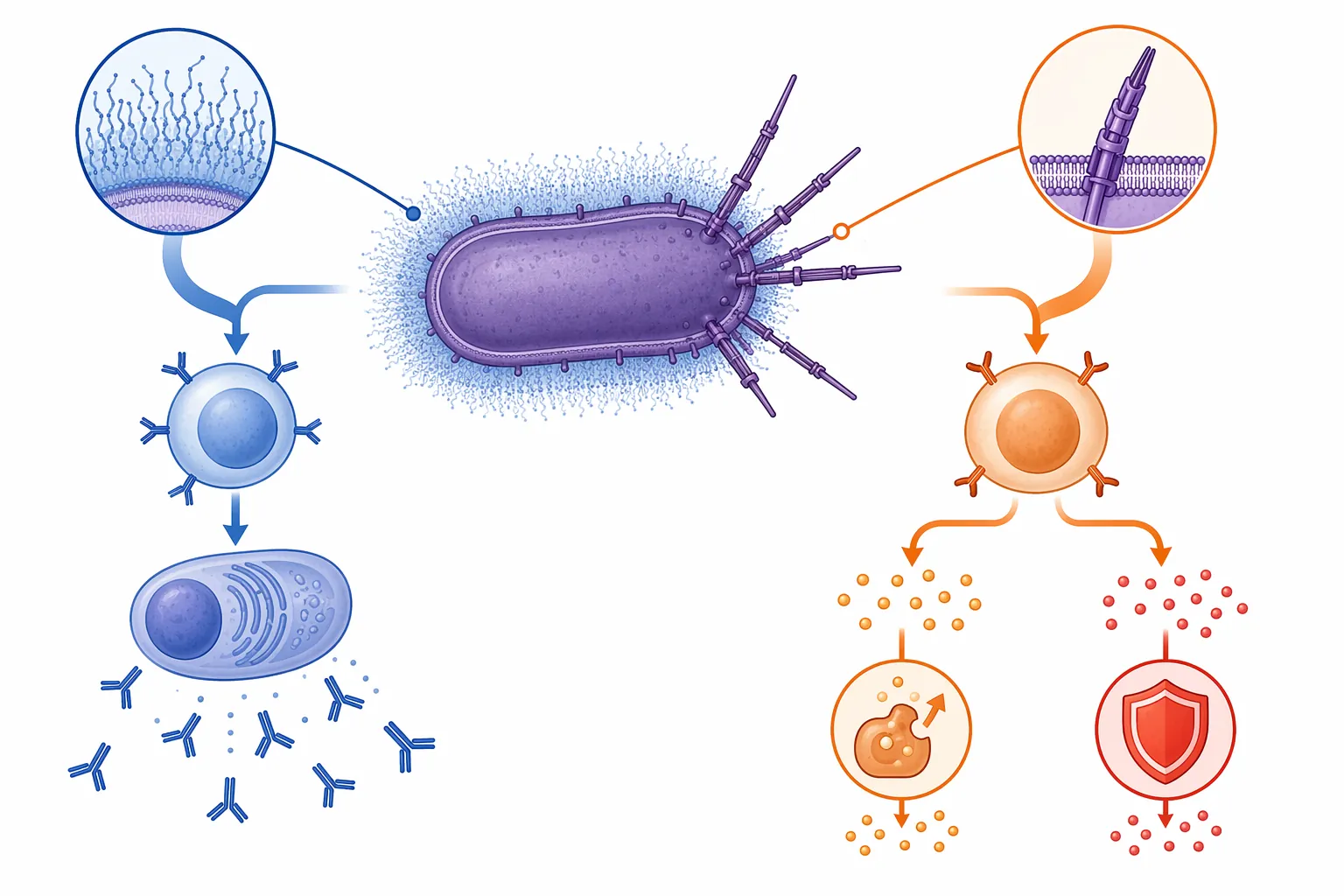
This is where “humoral versus cell-mediated immunity” stops being a pair of flashcard labels. F1 pulls your attention toward antibody-mediated protection against an extracellular bacterial surface. LcrV pulls your attention toward a secretion system, antigen presentation, T-cell help, and cytokine patterns. A good passage could ask which antigen is more directly tied to anti-phagocytic defense, which immune arm is being emphasized, or why a titer alone might not capture the whole protective response.
Y. pestis also gives innate immunity a role that is easy to test. Its lipid A can shift to a tetra-acylated form at 37°C, which acts as a weak TLR4 agonist.[6] For the MCAT, that matters because TLR4 is part of pattern recognition. If a pathogen weakens innate immune detection, then the timing and quality of downstream inflammation, antigen presentation, and adaptive activation may change. That is a much more useful memory than simply writing “TLR4 = LPS receptor” and moving on.
The antibody data are memorable, but they are not the finish line
The Chu and Hu results are tempting because they look tidy: anti-F1 persists, anti-V wanes, therefore boosters may be needed to maintain parts of the response.[3][4] That is a legitimate immunology lesson. It is also where students can overreach. An ELISA titer tells you that antibodies bound the antigen under the assay conditions. It does not automatically tell you whether those antibodies neutralize a virulence mechanism, recruit phagocytes effectively, work at the relevant anatomical site, or coordinate with T-cell responses.
The phrase to keep available is correlate of protection. A correlate of protection is a measurable immune marker that predicts protection against disease. Antibody titer can be a correlate in some vaccine contexts, but it has to earn that role. It cannot be assumed just because the graph goes up after vaccination.
Plague vaccine research makes that point unusually hard to ignore. F1/LcrV vaccines protected cynomolgus macaques at reported levels of 80–100%, but results in African green monkeys ranged from 0–75%, even when antibody titers were comparable.[1] For a student, that is the whole lesson in one uncomfortable comparison: similar ELISA titers did not reliably predict the same protection across animal models.
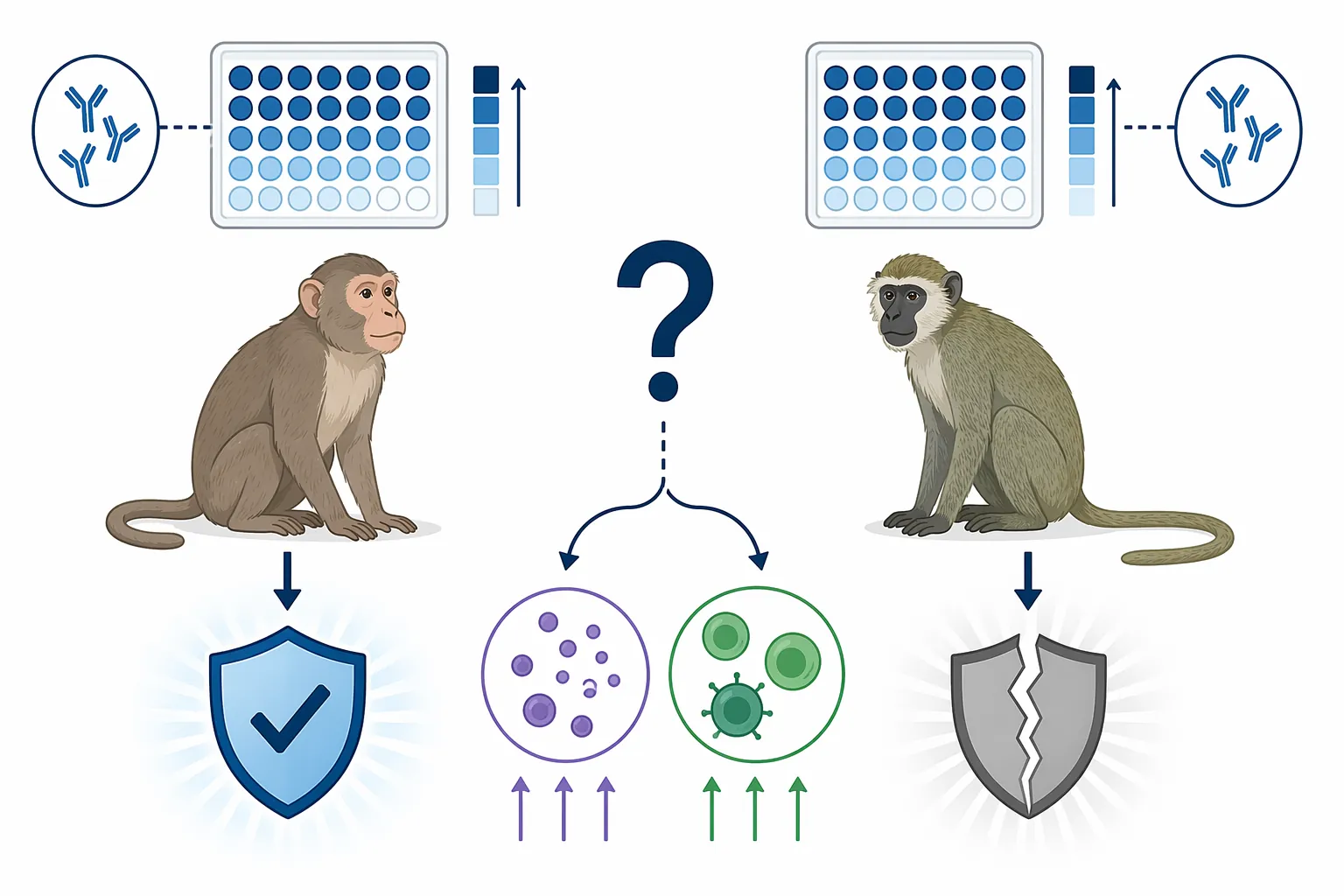
That discrepancy is not an invitation to dismiss antibodies. It is a warning against treating one assay as the whole immune system. If two models show comparable antibody levels but different survival outcomes, then the passage may be pointing you toward antibody quality, Fc-mediated functions, T-cell help, innate immune differences, cytokine balance, route of infection, or species-specific host-pathogen interactions.
Where Th1 cytokines enter the case
IFN gamma and TNF alpha are not random cytokines to sprinkle into an answer choice. They are part of the reason LcrV is interesting. LcrV has been described as having a dual role: it is associated with the injectisome tip of the Type III secretion system and with suppression of IFN gamma and TNF alpha.[6] If a pathogen can blunt inflammatory or Th1-associated responses, then an antibody-only readout may miss an immune function that matters for clearance.
On the MCAT, Th1-style thinking usually means cell-mediated immunity, macrophage activation, intracellular pathogen logic, and cytokines such as IFN gamma. Plague is not a clean “intracellular pathogen only” example, and that is why it is useful. Y. pestis can be extracellular, resist phagocytosis through capsule-associated mechanisms, manipulate innate signaling, and use Type III secretion to disrupt immune cells. The immune response cannot be reduced to one box.
A passage writer can use that complexity without asking you to know plague history. The question might give you antibody titers, survival data in two animal models, and a cytokine panel. The correct answer may depend on noticing that the highest antibody group is not necessarily the best protected group, or that reduced IFN gamma and TNF alpha would weaken cell-mediated coordination even when B-cell responses are measurable.
Modern platforms do not erase the endpoint problem
Newer vaccine platforms make the case more current, but they do not change the logic of the evidence. A 2023 mRNA-LNP plague vaccine report described 100% protection in a bubonic plague animal model after a single dose.[6] That is useful for connecting plague to a platform students already associate with COVID-era vaccine design: deliver genetic instructions, express antigen, induce adaptive immunity. It is not the same as a completed human efficacy trial.
A July 2026 ScienceAlert report described live-attenuated LMA/LMP prime-pull vaccine work that achieved 100% protection in mice using an intramuscular prime plus intranasal adenovirus boost.[7] Treat that as a comparison point, not as a replacement for the central lesson. It illustrates heterologous prime-boost strategy and mucosal targeting, while the cited source available here is a news report rather than the primary paper.
This matters because platform excitement can hide endpoint confusion. A vaccine can be clever, immunogenic, and protective in mice while still leaving open questions about humans, durability, route-specific protection, manufacturing, safety, and the immune marker regulators would accept as predictive. For exam purposes, the platform tells you how antigen is delivered. It does not automatically tell you whether the measured endpoint proves clinical protection.
How to read a plague vaccine passage under time pressure
When a passage gives you plague vaccine data, do not start by trying to remember every candidate name. Start by labeling the evidence. Human immunogenicity trial, animal challenge study, in vitro cytokine assay, ELISA titer, survival endpoint, adverse-event table: these are not interchangeable.
- If the passage reports antibody titers, ask which antigen was measured and whether the titer has been validated as a correlate of protection.
- If the passage reports seroconversion, remember that it shows an immune response, not automatic clinical efficacy.
- If the passage compares animal models, look for a mismatch between immune markers and survival outcomes.
- If the passage discusses LcrV, connect Type III secretion, immune evasion, antigen presentation, and cytokine effects.
- If the passage contrasts prime and boost routes, ask whether the strategy is trying to change magnitude, durability, tissue location, or immune arm.
This is the same reason foodborne-toxin and pharmacology case studies can be more useful than isolated memorization. A case like Bacillus cereus food poisoning on the MCAT or a drug-mechanism article like Tylenol and naproxen pharmacology for MCAT students works only if you keep asking what the experiment measured and what conclusion the data actually support.
The exam payoff
Plague vaccine development is high-yield because the gaps force integration. The two small human randomized trials show safety and immunogenicity, not clinical efficacy. F1 and LcrV show how antigen choice can map onto virulence mechanisms. Anti-F1 persistence and anti-V waning make B-cell memory and booster logic concrete. The monkey-model discrepancy shows why antibody titers alone may fail as correlates of protection. TLR4 evasion, Type III secretion, IFN gamma, and TNF alpha pull innate immunity and cell-mediated immunity into the same passage.
That is stronger than memorizing “humoral immunity uses antibodies” and “cell-mediated immunity uses T cells” as separate facts. On exam day, the better question is: what was measured, which immune arm is being tested, and does the proposed marker actually predict protection?
References
- Plague vaccines: current developments and future perspectives. Current Research in Immunology, 2023.
- Vaccines for preventing plague. Cochrane Database of Systematic Reviews, last updated 2011.
- A randomized, double-blind, placebo-controlled, phase IIa clinical trial of a recombinant plague vaccine. 2016.
- One-year follow-up of the safety and immunogenicity of a recombinant plague vaccine. 2018.
- A phase 1 dose-escalation trial of a Flagellin/F1/V plague vaccine. PubMed, 2017.
- mRNA-LNP plague vaccine. 2023.
- New Plague Vaccines 100% Effective Against The Deadly Disease in Mice. ScienceAlert, July 2026.
Related exhibits & inventory
Verified outcomes
Planners
No planner filed for this exam yet
A downloadable timeline template for this exam hasn't been published yet.
Tool verdicts
Questions about this plan
Ask a question about a specific section, timeline, or citation in this plan — or flag something that needs correcting.
Comments
Join the discussion with an anonymous comment.