
MCAT Exam Hub
Use Pet Immunization Science to Master MCAT Biology Concepts
Discover how studying pet immunization science can reinforce MCAT Biology and Behavioral Sciences concepts while building clinical knowledge for future veterinarians. This article maps vaccine mechanisms, herd immunity data, and vaccine hesitancy behavior to tested MCAT topics, offering a dual-purpose study strategy.
- gre
- mcat
- asvab
- sat
- act
- digital-adaptive
- official-material
- section-strategy
- test-date-timeline
The MCAT immunology chapter can feel strangely weightless when every diagram is clean: antigen, APC, helper T cell, B cell, antibody, memory cell. Then the same ideas walk into a clinic as rabies, distemper, parvovirus, or adenovirus protection for a dog whose owner may or may not come back on schedule. For pre-vet students, that is where a pet immunization importance study veterinary students search can become more than background reading. Used carefully, pet vaccine science gives you a way to rehearse MCAT Biology/Biochemistry and Behavioral Sciences without pretending the exam is a veterinary licensing test.
The key word is carefully. Pet immunization is useful for MCAT review when it sends you back to official concepts: antigen presentation, adaptive immune memory, antibody classes, vaccine type, herd immunity, risk interpretation, and behavior change. It is less useful when it becomes a pile of disease trivia or a comforting story about loving animals. The exam will not reward you for knowing every canine vaccine schedule detail. It will reward you for recognizing what a passage is really testing.
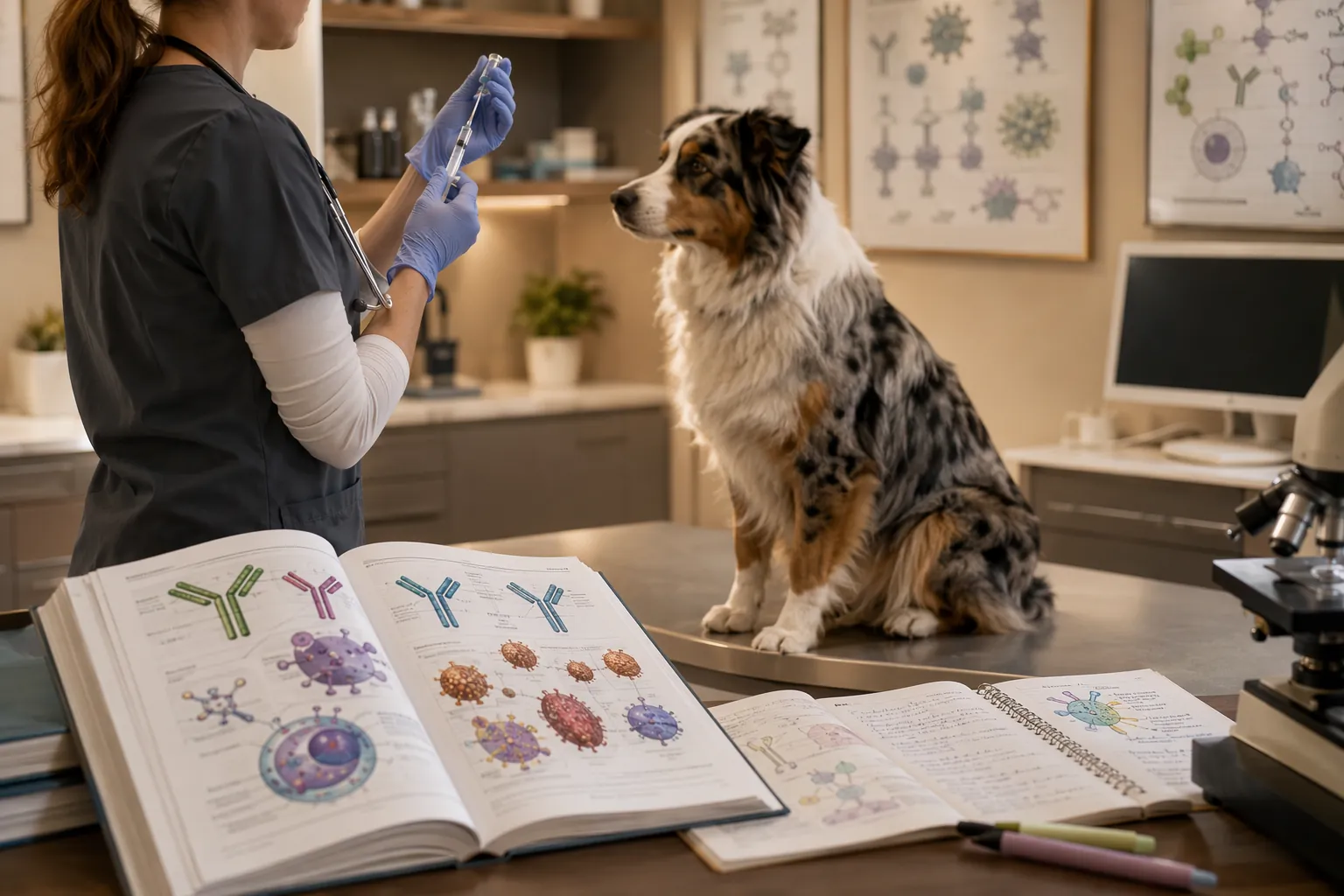
Start With the Mechanism, Not the Pet Disease List
Core pet vaccines such as rabies, distemper, parvovirus, and adenovirus are useful study anchors because they let you compare inactivated and modified-live vaccine types in a real clinical category, not because the MCAT expects veterinary memorization.[1] Once you attach those vaccine types to immune mechanisms, the names stop floating.
| Pet immunization topic | MCAT concept to rehearse | What to ask yourself while studying |
|---|---|---|
| Inactivated vaccine | Antigen exposure without pathogen replication | How would antigen-presenting cells process this material, and what kind of adaptive response follows? |
| Modified-live vaccine | Attenuated replication and broader immune stimulation | Why might limited replication change the strength or breadth of immune memory? |
| Rabies vaccination coverage | Herd immunity and transmission interruption | What proportion of the population must be protected before spread becomes harder to sustain? |
| Adverse event data | Risk, rate, denominator, and proportional reasoning | What does the number measure, and what does it not prove? |
| Owner hesitancy | Health behavior models and social influence | Which belief, barrier, norm, or trust relationship is affecting the decision? |
That table is not a replacement for your official MCAT materials. It is a way to keep the clinical material from pulling you away from the exam. If a pet vaccine example does not help you explain a tested mechanism or interpret a passage-style dataset, it probably belongs in your future veterinary reading, not your MCAT study block.
Inactivated Versus Modified-Live Is an Immune-System Question
An inactivated vaccine gives the immune system antigenic material that cannot replicate. That matters for MCAT reasoning because the antigen still has to be taken up, processed, presented, and connected to lymphocyte activation. A modified-live vaccine contains an attenuated organism that can replicate in a limited way, which changes the immune context: more intracellular processing, more opportunities to involve cell-mediated immunity, and a memory response that may look different from a purely nonreplicating exposure.
Do not stop at the label. Ask what an antigen-presenting cell is doing. Ask whether MHC class I or class II presentation is more relevant in the passage setup. Ask how helper T cells support B-cell activation. Ask what changes between a primary and secondary exposure. The pet vaccine gives the clinical handle; the MCAT point is still the pathway.
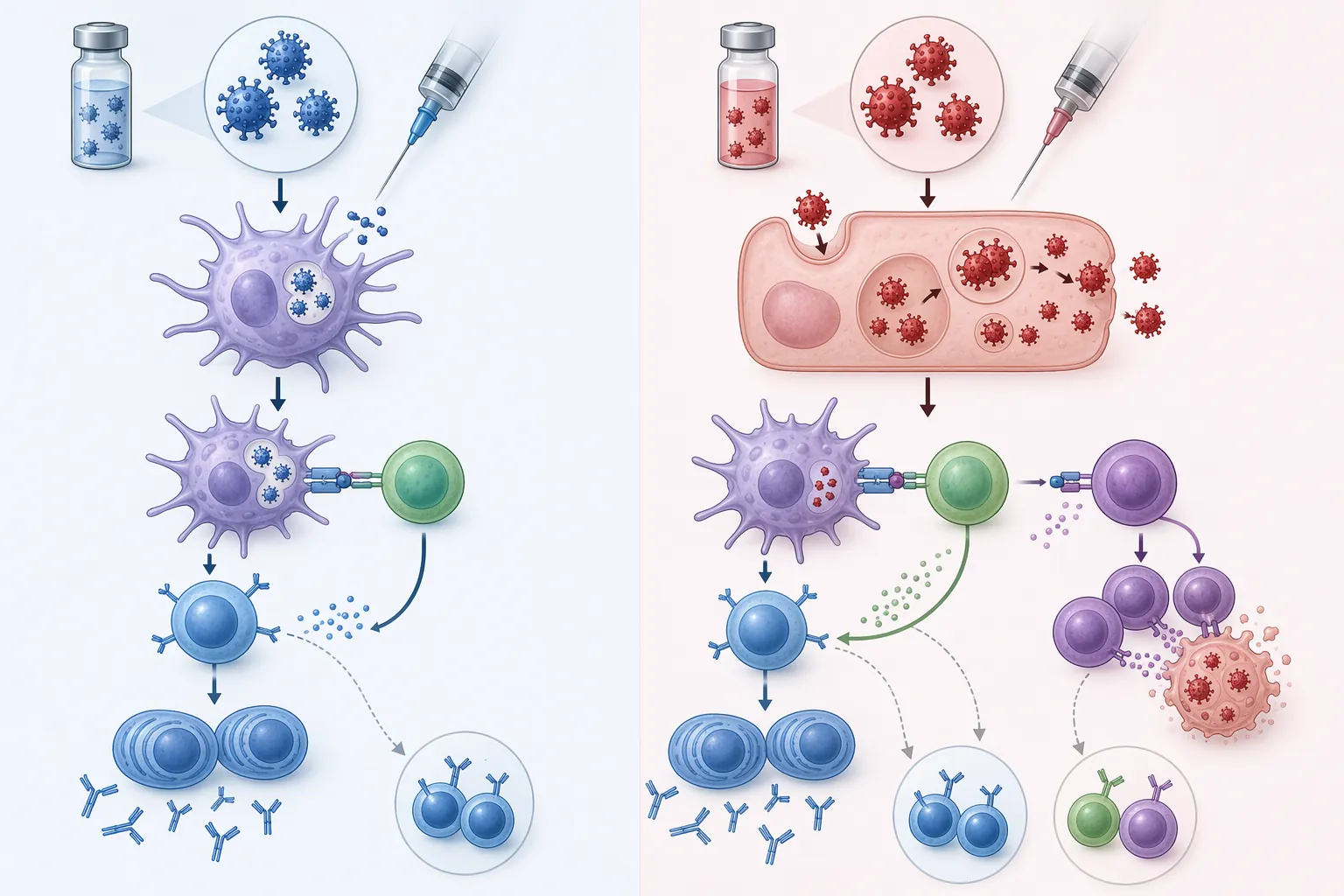
This is also where antibody classes become easier to remember. A vaccine response is not just “antibodies appear.” IgM often marks an early primary response; class switching can produce other antibody classes with different functions; memory B cells make a later response faster and stronger. If a passage describes antibody titers after an initial vaccine and then after a booster, it is asking whether you understand immune memory, not whether you like animals.
Use Rabies Coverage as a Herd Immunity Problem
Rabies vaccination is one of the cleanest bridges between veterinary immunology and MCAT-style population thinking. The World Health Organization recommends 70% canine rabies vaccination coverage to prevent human deaths, as cited in the Texas A&M overview of pet-owner vaccine hesitancy.[1] That number turns “herd immunity” from a phrase into a threshold.
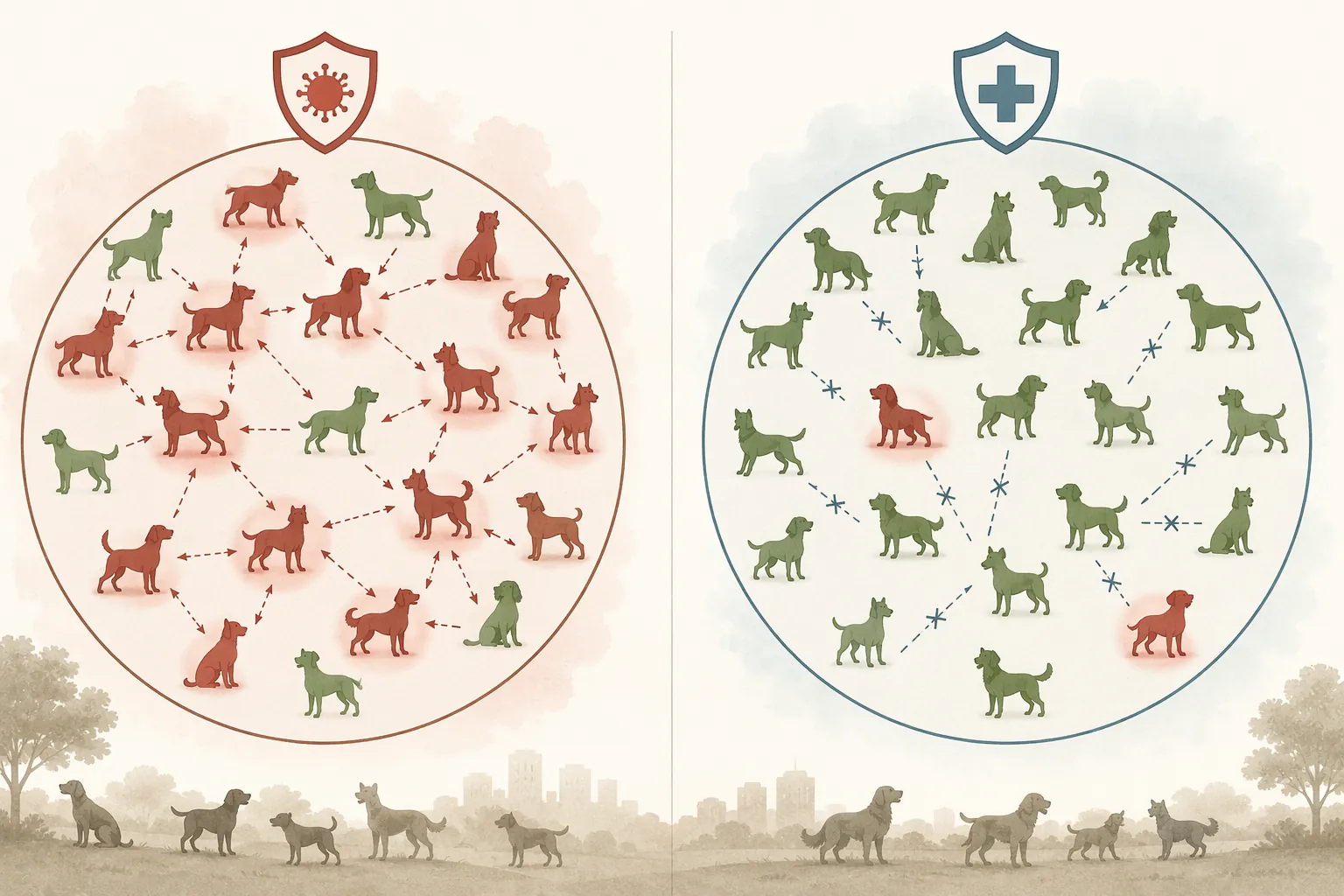
A good MCAT reader notices what the 70% figure means and what it does not mean. It is a coverage recommendation, not a claim that every vaccinated dog is perfectly protected or that every setting has identical transmission dynamics. It also connects animal health to human health without requiring a vague “One Health” paragraph. Dogs are part of the transmission system; vaccination coverage changes the probability that the virus keeps moving through that system.
When you study this, practice translating the sentence into exam language: population-level protection, susceptible hosts, transmission chains, threshold coverage, and indirect protection. If a passage gave you a graph of vaccination coverage by district and human rabies cases over time, your job would be to separate association from causation, identify the denominator, and avoid overreading a single trend line.
Let Safety Data Train Proportional Risk Reasoning
Vaccine safety is where students can get sloppy in two opposite directions. One version says “vaccines are safe” and stops thinking. The other treats any adverse event as though it has the same weight as disease prevention. MCAT passages usually punish both habits because they ask you to read the actual measure.
Large-scale veterinary safety studies cited by Texas A&M reported adverse event rates of 19.4 per 10,000 dog visits and 51.6 per 10,000 cat visits.[1] Those are not zero. They are also not percentages unless you convert them correctly. The dog rate is 0.194%; the cat rate is 0.516%. A passage could easily test whether you notice that both values use the same denominator, whether the cat rate is higher, and whether “per visit” is the same as “per animal over a lifetime.”
That last distinction matters. A rate per visit tells you about events observed in relation to clinical encounters. It does not automatically tell you the risk for every individual pet under every vaccine protocol, nor does it tell you the severity distribution of those events unless the passage provides it. This is the kind of narrow reading that makes biology passages manageable: identify the unit, compare only what is comparable, and do not smuggle in conclusions the data did not give you.
Owner Hesitancy Belongs in Psych/Soc, Not in a Morality Play
The Behavioral Sciences layer is not a chance to sneer at pet owners. It is a chance to practice explaining health behavior when the medically recommended action is clear but the human decision is not automatic. A 2024 study by Haeder reported that 22% of dog owners and 26% of cat owners were vaccine-hesitant, as summarized in the Texas A&M article.[1] A 2023 dog-owner study discussed by AAHA found that 53% of dog owners agreed with at least one statement that canine vaccines were unsafe, ineffective, or unnecessary, and 37% specifically cited safety concerns.[2]
Those numbers map neatly onto health behavior models. Under the health belief model, safety concerns are perceived barriers. Beliefs about rabies or parvovirus risk affect perceived susceptibility and severity. Beliefs about vaccine effectiveness affect perceived benefits. A reminder from a veterinary clinic can function as a cue to action, but only if the owner can access the clinic, pay for the visit, and trust the recommendation.
Protection motivation theory adds another useful split: threat appraisal and coping appraisal. An owner may believe a disease is severe but still doubt that vaccination is effective, affordable, or safe. In theory of planned behavior terms, the decision can involve attitudes toward vaccination, subjective norms from family or online communities, and perceived behavioral control over scheduling and cost. These are not interchangeable labels. They point to different variables a passage might manipulate.
There are limits. Some owner hesitancy research relies on self-report, and owners may not reliably know which vaccines their pets received. That matters for MCAT reasoning because attitudes and reported behavior are not the same measurement. A survey can be highly useful and still require caution about recall, social desirability, sampling, and whether the outcome is belief, intention, or verified vaccination status.
COVID-19 Spillover Is a Pattern to Analyze, Not a Universal Explanation
Research summarized by Texas A&M describes a correlation between human COVID-19 vaccine attitudes and pet vaccine attitudes.[1] For MCAT Psych/Soc, that is a useful opening into cognitive consistency and social influence. People often prefer their beliefs to fit together; communities can reinforce what counts as trustworthy information; a stance formed in one health domain may travel into another.
But correlation is not a license to flatten every hesitant owner into one story. A passage might ask whether COVID-19 attitudes predict pet vaccine attitudes, whether a third variable influences both, or whether the study design can establish causation. The safe answer is usually the narrower one: spillover can be a behavioral pattern worth studying, not proof that one attitude universally causes the other.
Trust in Veterinarians Gives the Behavior Model a Clinical Doorway
Trust is one of the least abstract parts of this topic. Haeder’s 2025 JAVMA study reported that 62.9% of dog owners and 61.2% of cat owners trusted their veterinarian for vaccine information; longer client relationships also correlate with higher vaccination rates.[3] That is exactly the kind of moderator an MCAT passage might hide in a paragraph: the same information can land differently depending on the source and relationship.
For studying, translate that into variables. The veterinarian can affect perceived benefits by explaining protection, perceived barriers by discussing adverse-event risk proportionally, subjective norms by framing vaccination as standard preventive care, and perceived behavioral control by helping the owner plan timing. None of that requires treating the owner as irrational. It treats behavior as behavior: belief, context, relationship, cost, memory, identity, and access all meet in the exam room.
Where Veterinary-Student Studies Fit
If you are searching specifically for pet immunization importance study veterinary students, it is tempting to turn every veterinary-student paper into MCAT evidence. Keep the boundary tighter. A rabies knowledge study from Turkey included 660 students from a single faculty, which makes it useful as a geography-specific educational sample, not a general statement about all veterinary students or all U.S. pre-vet applicants.[4]
That does not make the study irrelevant. It can still remind you that knowledge, perceived risk, and professional training are measurable variables. It can also help you practice the MCAT habit of checking sample, setting, and generalizability before you accept a conclusion. A single faculty sample can support a narrow claim about that setting. It cannot carry a sweeping claim about global veterinary education.
How to Study This Without Drifting Off-Test
A practical study session can be short. Pick one pet immunization topic, then force it through two lenses: mechanism and passage reasoning. For example, if the topic is rabies vaccination, spend the first half on adaptive immunity and the second half on coverage thresholds, denominators, and behavior. If the topic is adverse events, spend less time reassuring yourself and more time converting rates, identifying units, and asking what outcome was actually measured.
- Name the vaccine type and predict how antigen presentation would occur.
- Connect the response to B cells, T cells, antibody class, and immune memory.
- Write one passage-style data question using the real denominator.
- Map one owner decision to a specific behavior model variable.
- State one limitation of the evidence before making a conclusion.
The last step is the one many anxious students skip. Limitations are not decorative. They are where you show that you can distinguish adoption from effectiveness, attitudes from verified behavior, correlation from causation, and a local sample from a general population. That skill matters across Biology/Biochemistry and Psych/Soc because both sections increasingly reward careful interpretation over memorized enthusiasm.
Pet immunization science is a strong review lens for pre-vet MCAT students when it stays tied to official MCAT concepts and real data interpretation. It can make immunology less abstract and behavioral science less smug. It cannot replace a full immunology review, and it cannot substitute for official AAMC practice. Use it as a bridge: clinic-room meaning on one side, testable mechanism on the other.
References
- Vaccine Hesitancy Among Pet Owners Is Growing, Texas A&M Today, January 14, 2025.
- New Study Explores Vaccine Hesitancy in Dog Owners, AAHA.
- JAVMA 263(5), javma.24.08.0551, JAVMA, 2025.
- PubMed 32913169, PubMed.
Related exhibits & inventory
Verified outcomes
Planners
No planner filed for this exam yet
A downloadable timeline template for this exam hasn't been published yet.
Tool verdicts
Questions about this plan
Ask a question about a specific section, timeline, or citation in this plan — or flag something that needs correcting.
Comments
Join the discussion with an anonymous comment.