
SAT Exam Hub
How Permanent Daylight Saving Time Affects Student Study Habits
As the Sunshine Protection Act moves through Congress, many test-takers worry about permanent DST derailing their study schedule and exam scores. This article grades the evidence on sleep loss, SAT performance, and what practical adjustments students can make to protect their prep.
- SAT
- ACT
- GRE
- MCAT
- ASVAB
- digital-sat
- adaptive-testing
- registration-fee
- content-outline
- score-target
Permanent daylight saving time is not yet the daily reality for U.S. students in July 2026, and the honest answer for test-takers is not “your scores are doomed.” The cleaner concern is narrower and more useful: permanent daylight saving time would likely make sleep timing harder, especially for teenagers, and that can make evening study less efficient and school-day vigilance worse.
There is no single peer-reviewed study that isolates the permanent daylight saving time impact on student study habits as its own variable. The best evidence has to be assembled from sleep-tracking studies, time-zone position research, school start-time experiments, and a small set of academic-performance papers. That makes the practical question less dramatic but more important: if the clock policy pushes your body later while school and exams still arrive early, where does the lost attention show up?
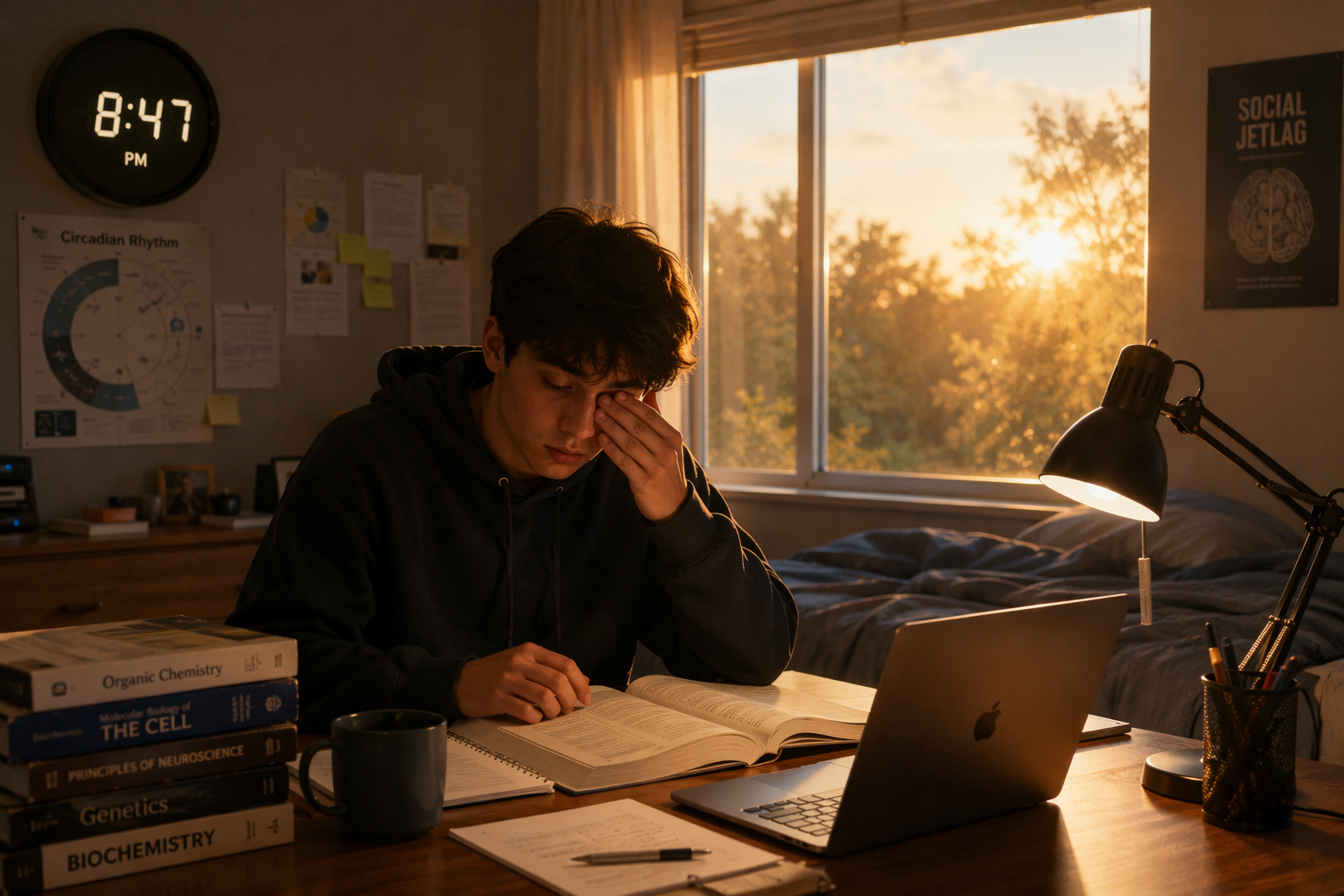
The strongest evidence starts with teen sleep, not test scores
The most solid warning sign is what happens when clocks move forward into daylight saving time. In an actigraphy study cited by the American Academy of Sleep Medicine, teenagers lost an average of 32 minutes of sleep per night on school nights after the spring transition, adding up to 2 hours and 42 minutes of sleep debt in a week.[1] That is not a mood-board complaint about “feeling off.” It is measured sleep loss during the exact part of life when many students are already trying to fit homework, activities, jobs, and test prep into the same evening.
The caveat matters: a one-week transition study is not the same thing as a permanent daylight saving time study. But it does show the direction of the strain. If a teen is already running short on sleep, a clock arrangement that keeps evening light later and morning light delayed is not a neutral backdrop. It changes the conditions under which algebra review, AP reading, SAT practice sections, or GRE vocabulary drills are supposed to happen.
The baseline is already poor. Sleep education materials from the AASM report that fewer than 30% of U.S. high school students get adequate sleep, and more than 90% of teens report sleeping less than the recommended 9 or more hours on school nights.[2] That is why the teen evidence deserves the center of the discussion. For many students, permanent DST would not create sleep debt from scratch; it would add pressure to a schedule that is already underwater.
What the SAT evidence does, and does not, prove
The score evidence is more complicated than the sleep evidence. The study most often cited in this debate is Gaski and Sagarin’s 2011 paper on SAT scores. It reported that counties observing daylight saving time had SAT scores about 16 points lower overall, with a 49-point gap for the lowest-income students compared with an 8-point gap for the highest-income students.[3] If taken at face value, that pattern points to an unequal burden: students with fewer buffers in their schedules and home lives may absorb more of the cost.
But this is moderate evidence, not a verdict. The study has been criticized because structural differences between daylight-saving and non-daylight-saving counties are hard to fully control. A county’s clock rule is tangled with geography, local policy, income, school quality, test-taking populations, and other variables that also matter for SAT performance. The income gradient is worth taking seriously, but it should not be treated as proof that changing the clock directly knocks a specific number of points off a student’s score.
A later study points in the other direction. Herber and colleagues examined the transition into daylight saving time and found no significant short-term performance effects on elementary students.[4] That does not clear permanent DST for high school juniors preparing for the SAT or adults preparing for the GRE. Elementary students are not the same population, and a short-term transition is not a year-round policy. Still, it is enough to stop the lazy version of the claim: sleep disruption is real, but direct score damage is not cleanly established.
| Claim | Evidence grade | What a test-taker should take from it |
|---|---|---|
| Teens lose sleep after the spring DST shift | High for the transition effect | Protect sleep aggressively around clock changes and early exam mornings |
| Permanent DST would worsen circadian mismatch | Moderate, based on mechanism and time-shift evidence | Plan as if mornings may be harder, especially in winter |
| DST directly lowers SAT, ACT, GRE, or MCAT scores | Mixed | Do not panic; adjust study timing and sleep habits instead of assuming score loss |
| Lower-income students may carry more of the burden | Moderate for the SAT association | Unequal schedule flexibility is a real concern, even if the exact score effect is uncertain |
Later light is the mechanism students can actually feel
The mechanism behind the worry is not mysterious. Later evening light tends to push bedtime later. In a time-zone border study, Giuntella and Mazzonna found that evening light from later sunsets shifted bedtimes later by about 19 minutes per night.[5] That is not an exam-score study, and it should not be used as one. It is more useful as a study-habits clue: a later sunset can make the body behave as if the day is not over, even when the assignment list says otherwise.
For a student, 19 minutes is easy to dismiss until it lands in the same place every night. It may not erase a study session. It may simply move the hardest work into a weaker attention window: the last reading passage, the second math set, the careful review of missed questions. That is where study quality often falls apart first. The student is technically at the desk, the laptop is open, the timer is running, but the work has become slower and less accurate.
This is also where permanent DST is different from the comforting argument that more evening light gives students more usable time. Evening light may make sports, commuting, or errands easier. It does not automatically create a better 9 p.m. brain for a teenager who still has to wake for school the next morning.
The school start-time evidence points the other way
One useful counterexample comes from Seattle, where delaying school start times by 55 minutes was associated with 34 more minutes of daily sleep and a 4.5% improvement in median grades.[6] The policy change there did not ask students to become more disciplined at night. It moved the social schedule closer to adolescent biology.
Permanent daylight saving time would not be the same intervention. In winter, it would push sunrise later while many school start times, bus pickups, zero-period classes, jobs, and morning exams stayed fixed. Krishnan and Johnson’s analysis, cited in reporting on DST and school start times, found that under permanent DST, winter sunrises would occur after 8 a.m. for 2 to 4 months across the United States and after 9:30 a.m. in some locations.[7] That matters for students because morning light is one of the strongest signals that anchors the body clock.
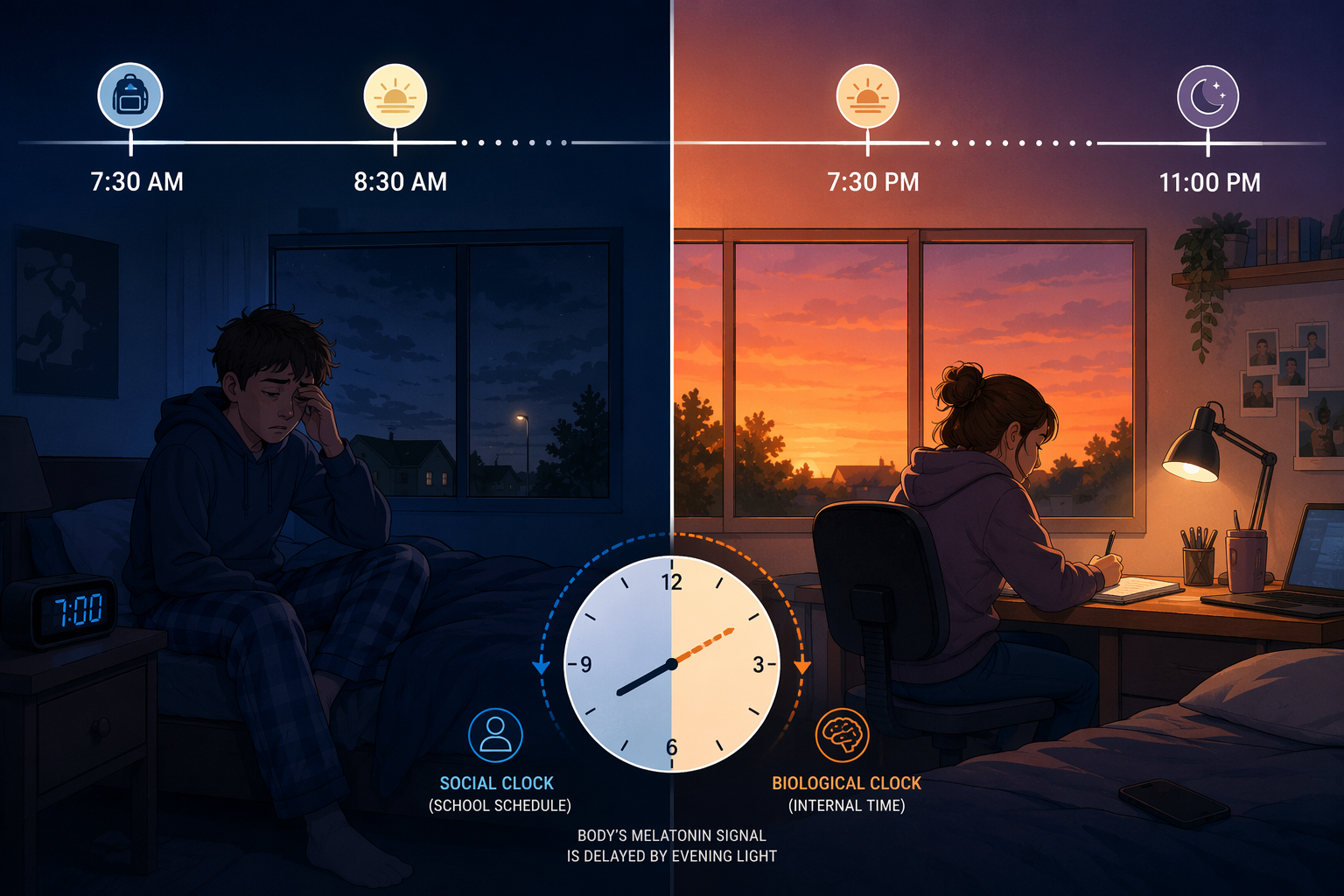
This is the practical mismatch: the day may look generous in the evening while becoming harsher in the morning. A student preparing for the ACT or SAT does not just need total hours. They need alert hours. If permanent DST makes it easier to drift later and harder to wake into light, the study schedule can look intact on paper while losing its best attention blocks.
Adult test-takers are not exempt, but teens are more exposed
GRE, MCAT, LSAT, and professional-exam candidates should not read the teen findings as if they apply with the same force to every adult. Adults may have more control over wake time, work schedule, light exposure, and test date selection. Some have less control, especially shift workers, caregivers, commuters, and students balancing full-time jobs. The mechanism still matters, but the burden depends heavily on schedule flexibility.
Teenagers are the more exposed group because they often have the least control over the morning. A high school student cannot usually move first period, bus time, athletic practice, or a state-mandated test window. If later evening light delays sleep, the teen does not get to negotiate with the bell schedule. The missing sleep is paid for in vigilance the next day.
Health models and seasonal mood research add context, not a score prediction
The broader health literature is one reason sleep-medicine groups tend to prefer permanent standard time over permanent daylight saving time. A Stanford PNAS model reported that permanent standard time would reduce obesity by 2.6 million cases and stroke by 300,000 cases, while permanent DST would achieve about two-thirds of that modeled benefit; the authors also cautioned that real-world behavioral factors such as erratic sleep schedules and indoor time could make outcomes worse than the model projects.[8] That is useful context, but it is not a student score forecast.
Seasonal mood findings point in a similar direction. A 7-year Russian study by Borisenkov and colleagues, discussed in a review of daylight saving time claims, reported the highest rates of seasonal depression in adolescents during permanent DST and the lowest during permanent standard time.[9] Again, that does not tell a GRE student what will happen on test day. It does reinforce the same caution: adolescents appear to be especially sensitive to year-round misalignment between clock time and light.
How to adjust study habits without overreacting
The right response is not to abandon a prep plan because Congress might change the clock. It is to stop treating late daylight as permission to move serious work later. If permanent DST arrives, the students most likely to protect their prep are the ones who defend wake time, morning light, and their best attention window.
- Keep wake time steady, including weekends when possible. A wildly delayed weekend schedule makes Monday morning feel like a time-zone change.
- Get outdoor morning light early. If sunrise is late, use the first available daylight rather than waiting until lunch to give the body clock a clear signal.
- Move the hardest study block earlier than instinct suggests. Put timed math, dense reading, or passage review in the part of the day when attention is usually most reliable.
- Use late evening for lower-risk work. Flashcards, organizing missed questions, packing materials, or planning the next session are safer than learning new content when you are fading.
- Practice at the expected test time when you can. If the real exam starts in the morning, a prep plan made entirely of late-night practice can hide a vigilance problem until test day.
For students already behind, the tempting fix is to stretch the night. Permanent DST may make that feel easier because the evening looks less like evening. That is the trap. A longer-looking day is not the same as a more productive study day, and the cost usually shows up in the next morning’s accuracy, patience, and recall.
The bottom line for exam prep
Permanent daylight saving time would probably increase social jetlag and sleep debt for many students, with teenagers carrying the clearest risk. The direct test-score evidence is mixed: the SAT association is concerning, especially for lower-income students, but it is not clean enough to prove a simple score penalty, and other student-performance research has found no short-term effect.
So the practical answer is measured. Do not panic about a guaranteed score drop. Do take the sleep problem seriously. Protect the morning anchor, keep wake times boringly consistent, and schedule the hardest work for the hours when your attention is actually available, not for the extra daylight that happens to be left on the clock.
References
- Study shows that teens lose sleep after change to daylight saving time, American Academy of Sleep Medicine.
- CDC: 9 out of 10 U.S. high school students are sleep deprived, Sleep Education.
- Detrimental Effects of Daylight-Saving Time on SAT Scores, ResearchGate, 2011.
- Does the transition into daylight saving time affect students' performance?, ScienceDirect, 2017.
- Sunset time and the economic effects of social jetlag: evidence from US time zone borders, Journal of Health Economics, 2019.
- Adolescent sleep health and school start times, Sleep Health.
- How permanent daylight saving time and later school starts could affect health, CNN.
- Permanent standard time would be better for our health than daylight saving time, Stanford Medicine researchers find, Stanford Medicine, 2025.
- Debunking myths about daylight saving time: ten things everyone should know about daylight saving time and sleep health, PMC.
Related exhibits & inventory
Verified outcomes
No verified outcomes on file for this exam yet
See Methodology for how outcome evidence is disclosed once logged.
Planners
No planner filed for this exam yet
A downloadable timeline template for this exam hasn't been published yet.
Tool verdicts
AI-tool cautions
No AI tools tested for this exam yet
No hands-on AI-accuracy logs have been filed for this exam.
Questions about this plan
Ask a question about a specific section, timeline, or citation in this plan — or flag something that needs correcting.
Comments
Join the discussion with an anonymous comment.