
SAT Exam Hub
The Odyssey Movie Differences from Homer – A Student's Study Guide
A scene-by-scene comparison of Christopher Nolan's 2026 film 'The Odyssey' with Homer's original epic, detailing key changes in plot, character, and theme. Ideal for students writing comparative essays or preparing for literature exams.
- SAT
- ACT
- GRE
- MCAT
- ASVAB
- digital-sat
- adaptive-testing
- registration-fee
- content-outline
- score-target
If you are using this as a study guide for the Odyssey movie differences from Homer, start with the sentence your essay will probably need: Nolan keeps the journey shape of The Odyssey but changes its moral engine. Homer’s Odysseus is the brilliant, many-sided survivor whose cunning helps him reclaim home, status, and order. Nolan’s Odysseus is still a survivor, but the film repeatedly asks what survival has cost him and whether the heroic story can survive contact with guilt.
That distinction matters more than the loose complaint that “the movie is different.” A useful comparison names the change, locates Homer’s version, and explains what the change does. The strongest essay points below are not the biggest spectacle scenes; they are the changes that alter character, divine agency, recognition, punishment, and the meaning of homecoming.

The quick comparison frame
Read Nolan’s film as a transformation, not a failed copy. The film preserves enough of Homer’s route to remain recognizably The Odyssey: Troy lies behind Odysseus, Ithaca lies ahead, monsters and temptations interrupt the voyage, Penelope waits, Telemachus is threatened by the suitors, and the return home forces violence. But the film changes what those events mean.
| Area | Homer’s version | Nolan’s version | Essay use |
|---|---|---|---|
| Odysseus | A polytropos hero: resourceful, eloquent, dangerous, and eager for reputation. | A guilt-haunted soldier whose survival is morally stained. | Argue that the adaptation shifts the heroic center from cunning and glory to trauma and moral cost. |
| The gods | Athena actively protects, advises, disguises, and guides Odysseus and Telemachus. | Athena is reimagined as a psychological projection connected to a murdered Trojan girl, rather than Homer’s external divine patron. | Argue that Nolan internalizes divine guidance, turning mythic intervention into trauma memory. |
| Homecoming | Nostos means reclaiming household, wife, son, kingdom, and social order. | The ending moves toward shared exile rather than restored kingship. | Argue that the film doubts whether a violent homecoming can simply restore justice. |
| Recognition | Penelope tests Odysseus through the secret of their marriage bed. | Penelope recognizes him immediately. | Argue that the film reduces the intellectual duel between husband and wife and makes recognition more emotional than strategic. |
Scene-by-scene differences that can become essay claims
Use the table as a claim bank. Do not try to cram every row into one paragraph. Pick two or three changes that share a theme: cunning, guilt, women’s agency, divine absence, household justice, or the meaning of home.
| Film moment or element | In Homer | In Nolan’s film | What the change means |
|---|---|---|---|
| After Troy | The poem begins after the Trojan War and gradually fills in Odysseus’s past through narration, memory, and storytelling. | The film foregrounds the moral burden of Troy more heavily, making the war’s aftermath part of Odysseus’s psychological present. | The adaptation makes the past less like heroic backstory and more like an injury that keeps shaping the voyage. |
| Sinon | Sinon is not an Odyssey character; he belongs to Virgil’s Aeneid tradition, where he is tied to the deception of Troy. | Nolan imports Sinon as a major moral counterweight to Achilles; one report also identifies Antinous as Sinon’s brother, a detail that should be worded cautiously because it is narrowly reported.[2] | This pulls another classical text into the film and makes Troy’s deception echo forward into Ithaca’s domestic violence. |
| The Cyclops | Odysseus defeats Polyphemus through the famous “Nobody” trick, then damages his own safety by revealing his real name. | Nolan removes the “I am Nobody” trick from the Polyphemus episode.[1][2] | This is one of the best essay points: the film weakens the display of verbal cunning and makes the scene less about triumphant intelligence than burdened survival. |
| Lotus-eaters | The Lotus-eaters tempt Odysseus’s men into forgetting home. | The episode is omitted in reported accounts of the film’s cuts.[2][4] | The film spends less time on forgetfulness as a temptation and more on memory as torment. |
| Aeolus and the bag of winds | Aeolus gives Odysseus a bag containing the winds; the crew’s suspicion helps undo their progress. | The bag of winds is omitted.[2][4] | The cut reduces the poem’s recurring pattern of crew error and delayed nostos. |
| The Phaeacians | The Phaeacians host Odysseus, hear his story, and transport him safely to Ithaca. | The Phaeacian episode is omitted.[4] | The film loses one of Homer’s major storytelling frames, so Odysseus is less defined by public narration of his own adventures. |
| Circe | Circe transforms Odysseus’s men into pigs; Hermes helps Odysseus resist her magic, and Odysseus stays with her for a full year. | Nolan’s Circe does not sleep with Odysseus, and the Hermes-moly structure is absent in reported accounts.[3] | The film removes a major erotic delay and trims the divine machinery that protects Homer’s hero. |
| Athena | Athena is a real goddess who intervenes repeatedly: she guides Telemachus, protects Odysseus, and helps arrange recognition and revenge. | Nolan reimagines Athena as a psychological projection of a murdered Trojan girl, a major invention absent from Homer.[3] | This changes the whole mythological system: divine favor becomes internalized guilt. |
| Telemachus | Telemachus has a substantial coming-of-age arc, including his journey to Pylos and Sparta. | His material is condensed.[2] | The film narrows the father-son education plot and concentrates attention on Odysseus’s moral condition. |
| Penelope | Penelope delays the suitors and finally tests Odysseus through the secret of the rooted bed. | Penelope recognizes Odysseus immediately.[2] | The film makes Penelope’s recognition more direct but sacrifices one of Homer’s sharpest scenes of mutual intelligence. |
| The suitors | The suitors violate xenia, consume Odysseus’s household, pressure Penelope, and plot against Telemachus. | The film keeps the suitor threat but connects it more directly to the moral consequences of Troy and Odysseus’s own violence. | The suitors remain villains, but the film makes it harder to treat Odysseus’s revenge as clean moral restoration. |
| Slave-girl punishment | After the suitors are killed, twelve slave girls are hanged for disloyalty. | Nolan condenses this to one treacherous servant, Melantho, whose fate is implied offscreen.[3] | This reduces one of Homer’s harshest household-punishment scenes and changes the scale of Odysseus’s restored authority. |
| Laertes | Odysseus reunites with his father, Laertes, near the end of the poem. | Laertes is omitted.[2] | The ending becomes less about restoring a full patriarchal line and more about what Odysseus and Penelope choose after violence. |
| Ending | Odysseus reclaims Ithaca; the poem closes with order imposed, and later tradition within the poem points toward more raiding and future action. | Nolan ends with Odysseus and Penelope choosing exile together.[1][4] | The homecoming becomes penance rather than triumph. This is the film’s largest final reinterpretation of nostos. |
The Cyclops without “Nobody”: the easiest strong essay point
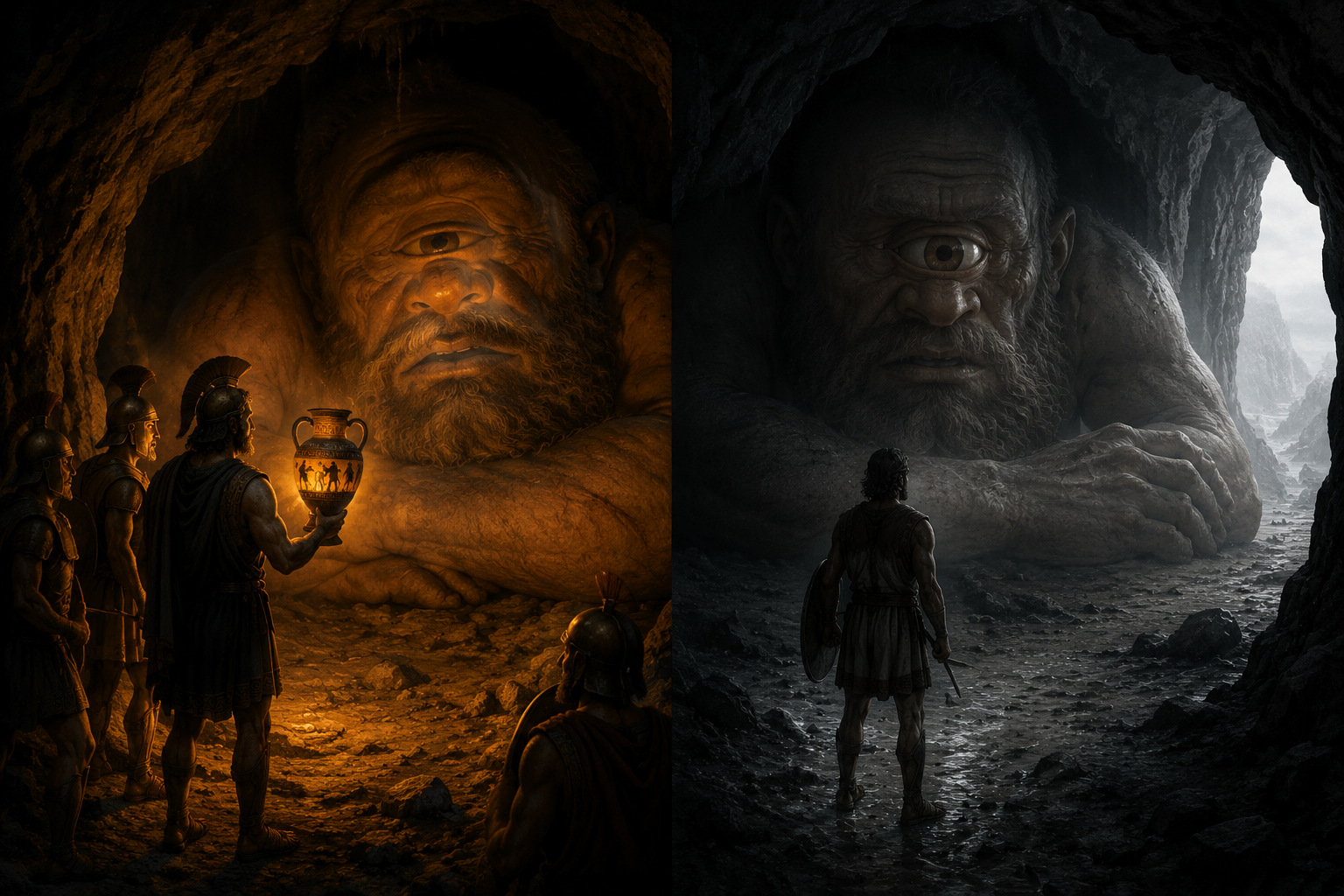
The removal of the “Nobody” trick is not a small plot adjustment. In Homer, the Cyclops episode is practically a laboratory demonstration of Odysseus’s intelligence. He gives Polyphemus wine, tells him his name is “Nobody,” blinds him, and then escapes under the sheep. When Polyphemus cries out that “Nobody” is hurting him, the other Cyclopes fail to understand the danger. The pun is the weapon.
Nolan’s version reportedly removes that defining trick.[1][2] For a student, that means the comparison should not stop at “the movie cut a famous scene.” The better claim is that Nolan cuts the clearest proof of Homeric metis — strategic intelligence — and therefore changes how viewers judge Odysseus. Homer’s hero survives because he can turn language into force. Nolan’s hero survives in a story where the brilliance of the trickster is less central than the residue of violence.
A defendable essay sentence could look like this: By removing the “Nobody” trick from the Cyclops episode, Nolan reduces Odysseus’s most famous display of cunning and recasts the encounter as part of a broader portrait of survival without heroic glamour. That is more precise than saying the film is “darker.” It identifies the scene, the Homeric baseline, and the interpretive effect.
This change also affects Odysseus’s flaw. In Homer, the trick works, but Odysseus later shouts his real name, allowing Polyphemus to curse him through Poseidon. The episode therefore joins intelligence and pride: he is brilliant enough to escape and vain enough to endanger himself. Without the “Nobody” structure, Nolan has less room for that exact Homeric pattern. The film’s Odysseus can still be flawed, but his flaw is not staged through the same dazzling combination of wit and self-advertisement.
Athena as trauma projection changes the rules of the story
Athena is not decorative in Homer. She is one of the poem’s main engines. She protects Odysseus, encourages Telemachus, arranges disguises, manipulates recognition, and helps push the household toward the final confrontation. If she is removed or transformed, the story does not merely lose a goddess; it loses a way of explaining why Odysseus’s return is favored by the cosmos.
Nolan’s Athena is reported as a psychological projection of a murdered Trojan girl, an invention not found in Homer.[3] That is an enormous shift. Homer’s Athena stands outside Odysseus as divine patronage. Nolan’s Athena points inward, toward memory, guilt, and psychic damage. The gods no longer simply authorize the hero’s journey from above; the sacred voice becomes tangled with what the hero has done and cannot forget.
This is where vague language about “modernizing myth” usually wastes a paragraph. The useful version is specific: Nolan modernizes the myth by relocating divine guidance inside the psychology of trauma. That wording gives you something to prove. You can contrast Athena’s active, external intervention in Homer with the film’s internalized apparition and then explain how that changes responsibility. If a goddess tells Homer’s Odysseus what to do, his success appears partly blessed. If a trauma projection accompanies Nolan’s Odysseus, his journey looks less like divine destiny and more like an argument with memory.
The change also affects Telemachus. In Homer, Athena’s guidance helps launch his movement from passive son to active participant in the household’s defense. When the film condenses Telemachus’s journey and reworks Athena, it shifts weight away from the son’s education and toward the father’s damaged consciousness.[2][3]
Circe, Hermes, and the missing machinery of divine protection
Circe is another place where the film changes more than plot. In Homer, Circe turns Odysseus’s men into pigs, Hermes gives Odysseus the protective moly, and Odysseus becomes Circe’s lover, staying with her for a full year. The episode combines danger, sex, delay, hospitality, and divine assistance.
Nolan’s Circe reportedly does not sleep with Odysseus, and the familiar Hermes-and-moly structure is not part of the reported film version.[3] The essay point is not simply that the film is less sexually faithful to Homer. The more useful claim is that the film reduces one of the poem’s major delay episodes and removes a scene where divine help makes Odysseus specially equipped to survive enchantment.
That matters because Homer’s Odysseus often wins through a combination of intelligence, endurance, and supernatural backing. Nolan’s pattern is lonelier. When the film trims Hermes and changes Athena, it steadily reduces the sense that the gods are actively managing the hero’s return.
The structural cuts: what to mention quickly, and what not to overbuild
Some omissions are worth naming but not inflating. A film cannot carry every episode of an ancient epic. The Phaeacians, Lotus-eaters, bag of winds, Laertes, and much of Telemachus’s travel material are reported as omitted or condensed.[2][4] These are useful in an exam answer only if you connect them to a pattern.
| Cut or compression | Why it matters if you use it |
|---|---|
| Phaeacians | Homer gives Odysseus a public audience for his own story. Without them, the film has less interest in Odysseus as narrator of his fame. |
| Lotus-eaters | The poem’s temptation to forget home is reduced. Nolan’s version is more interested in the inability to escape memory. |
| Bag of winds | The crew’s mistrust and error matter less in the film’s structure. |
| Laertes | The restored family line is less complete; the ending focuses more tightly on Odysseus and Penelope. |
| Telemachus’s journey | The son’s coming-of-age plot narrows, while the father’s guilt and return dominate. |
A weak paragraph would list these cuts as if quantity proves interpretation. A stronger paragraph chooses one pattern: Nolan cuts or compresses episodes that make Homer’s poem expansive, socially networked, and orally framed; the film concentrates instead on Odysseus’s moral and psychological line of travel.
Penelope’s immediate recognition changes one of Homer’s smartest scenes
In Homer, Penelope does not simply collapse into recognition. She tests Odysseus through the secret of their bed, which is built from a rooted olive tree. The test matters because it proves identity through shared knowledge. It also shows that Penelope’s intelligence matches Odysseus’s: she has survived through strategy, delay, verbal control, and emotional discipline.
Nolan’s Penelope recognizes Odysseus immediately.[2] That can make the reunion more emotionally direct, but it changes the intellectual texture of the scene. Homer’s recognition is not just romantic; it is epistemological. Penelope needs to know whether the man before her is truly her husband, and the poem lets her control the terms of proof.
For an essay, this becomes a clean comparison about agency: Homer gives Penelope a final test that lets her exercise caution and intelligence; Nolan’s immediate recognition emphasizes intimacy and emotional certainty over strategic verification.
The suitors, Melantho, and the scale of punishment
The suitors are easy to treat as simple villains, and in Homer they do violate the household: they consume Odysseus’s wealth, pressure Penelope, threaten Telemachus, and abuse the laws of hospitality. But the aftermath of their slaughter is one of the poem’s morally difficult places, especially the punishment of the slave girls.
Homer has twelve slave girls hanged for disloyalty. Nolan reportedly condenses this to one treacherous servant, Melantho, with her fate implied offscreen rather than shown as a group execution.[3] The number matters because scale changes judgment. Homer’s restored household order includes collective, gendered punishment carried out under Odysseus’s authority. Nolan’s reduction softens or narrows that brutality, even if the film remains interested in moral cost.
This is a useful place to avoid overclaiming. The change does not make Nolan’s ending gentle, and it does not make Homer’s poem reducible to cruelty. It does, however, alter how the audience experiences the restoration of order. Homer makes the violence of household purification explicit and numerically stark. Nolan condenses the punishment, which shifts attention away from the full social hierarchy of Ithaca and back toward the central moral burden of Odysseus.
Sinon is not from Homer, and that is the point
Sinon is a useful name to know because he helps you avoid a common mistake. If you write as though every classical character in the film comes from Homer’s Odyssey, you will misread the adaptation. Sinon belongs to the Virgilian Trojan War tradition, not Homer’s Odyssey. Nolan’s reported use of him as a major figure and moral counterweight to Achilles imports another classical memory into Odysseus’s story.[2]
The Antinous-Sinon brother relationship has been reported, but the current sourcing is narrow, so phrase it carefully if you use it.[2] A cautious sentence would be: Some reporting describes Nolan as linking Antinous to Sinon as his brother, a choice that would make the violence in Ithaca feel like an aftershock of Troy rather than a separate domestic crisis. That wording lets you use the idea without pretending it is as securely established as the removal of the “Nobody” trick.
The ending: from restored home to chosen exile
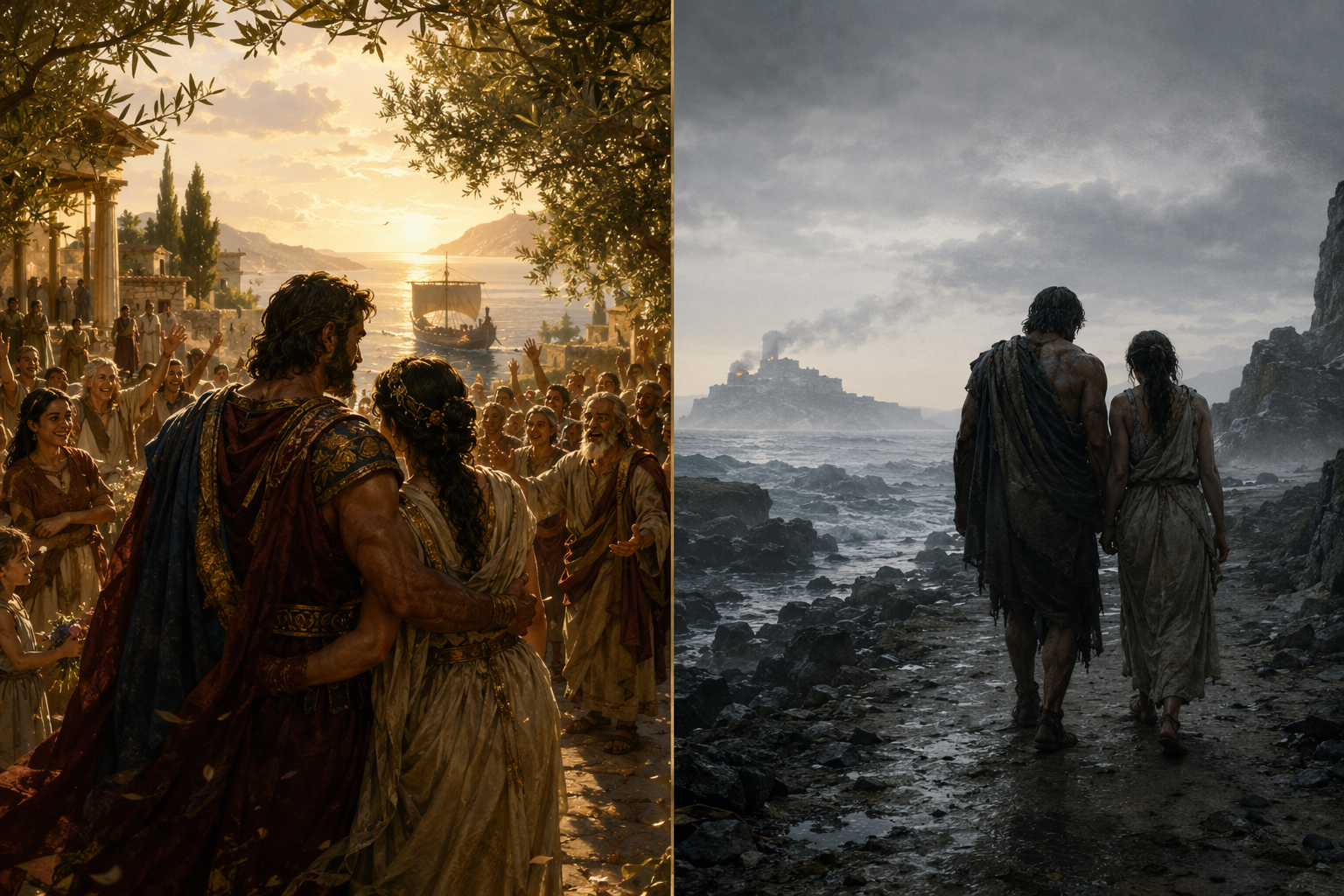
The ending is where Nolan’s transformation becomes impossible to miss. Homer’s poem moves toward restoration: Odysseus returns, defeats the suitors, reunites with Penelope and Laertes, and reasserts order in Ithaca. That restoration is not morally weightless, but it is still restoration. The poem’s logic of nostos depends on the idea that the hero can come home and reclaim what has been violated.
Nolan instead ends with Odysseus and Penelope choosing exile together.[1][4] That is not a decorative twist. It reverses the emotional grammar of the epic. Home is no longer the final cure. Ithaca is no longer enough to absorb the violence that brought Odysseus back to it.
This connects with the film’s broader ethical treatment of Troy. Anthony Macris, writing in The Conversation, frames Nolan’s version as turning Homeric glory into an “Oppenheimer question”: whether victory justified the destruction that achieved it.[4] That is a much stronger framework than calling the film “dark.” It explains why the ending cannot simply celebrate Odysseus’s success. If Troy has morally contaminated the hero, then Ithaca cannot function as a clean reward.
The exile ending also changes Penelope. In Homer, she is restored as queen and wife within the recovered household. In Nolan, she joins Odysseus in leaving. That choice makes the marriage less a symbol of domestic restoration and more a shared acceptance that the old order cannot simply resume. It is a bleaker ending, but it gives an essay something precise to argue: Nolan transforms nostos from successful return into the recognition that return may be morally impossible.
How to turn these differences into a comparative paragraph
A good comparison paragraph does not need six differences. It needs one difference handled cleanly. Use this three-part movement:
- Name Homer’s version: “In Homer, Odysseus defeats Polyphemus through the ‘Nobody’ trick, a verbal strategy that displays his metis.”
- Name Nolan’s change: “Nolan removes that trick from the Cyclops episode.”
- Explain the interpretive effect: “The change reduces Odysseus’s identity as a triumphant strategist and supports the film’s portrait of him as a morally burdened survivor.”
The same method works for Athena: Homer externalizes divine favor through an active goddess; Nolan internalizes guidance as trauma projection; therefore, the film changes the epic’s theology into psychology. It works for Penelope: Homer gives her a test of knowledge; Nolan gives her immediate recognition; therefore, the film shifts the reunion from strategic proof to emotional certainty. It works for the ending: Homer restores Ithaca; Nolan chooses exile; therefore, the film transforms homecoming into penance.
| If your essay topic is... | Use these differences |
|---|---|
| Odysseus as hero | Cyclops without “Nobody”; trauma-centered Athena; exile ending |
| Women in the adaptation | Penelope’s immediate recognition; Circe’s refusal; Melantho replacing the twelve slave girls |
| The gods and fate | Athena as projection; absence of Hermes and moly; reduced divine machinery |
| Justice and violence | Suitor slaughter; condensed slave-girl punishment; exile instead of restored kingship |
| Narrative structure | Omitted Phaeacians; cut Lotus-eaters; cut bag of winds; condensed Telemachus |
The claim worth taking into the essay
Nolan’s The Odyssey is not useful because it matches Homer scene for scene. It is useful because its changes are systematic. Removing “Nobody” weakens the classic display of cunning. Reimagining Athena turns divine favor into trauma. Cutting or compressing major episodes narrows the epic’s social and narrative breadth. Changing Penelope’s recognition alters the marriage scene’s intellectual balance. Condensing the slave-girl punishment changes the scale of restored authority. Ending in exile turns nostos from triumph into moral reckoning.
References
- The Odyssey: Christopher Nolan Changes From Homer, Vanity Fair
- Christopher Nolan’s The Odyssey vs. Homer’s Epic Poem: The Differences, Den of Geek
- Christopher Nolan The Odyssey Changes, GamesRadar+
- Friday essay: I’ve been reading the Odyssey my whole life. Nolan’s film version is exhilarating – but not perfect, The Conversation
Related exhibits & inventory
Verified outcomes
No verified outcomes on file for this exam yet
See Methodology for how outcome evidence is disclosed once logged.
Planners
No planner filed for this exam yet
A downloadable timeline template for this exam hasn't been published yet.
Tool verdicts
AI-tool cautions
No AI tools tested for this exam yet
No hands-on AI-accuracy logs have been filed for this exam.
Questions about this plan
Ask a question about a specific section, timeline, or citation in this plan — or flag something that needs correcting.
Comments
Join the discussion with an anonymous comment.