
GRE Exam Hub
How the Obama Doctrine Defined U.S. Iran Policy
This article provides a structured analytical framework for the Obama Doctrine's application to U.S. Iran policy, covering diplomatic outreach, multilateral sanctions, the Stuxnet operation, and the JCPOA. Political science students gain an exam-ready understanding of how the doctrine's realist tenets shaped the most consequential foreign policy decision of the Obama era.
- gre
- mcat
- asvab
- sat
- act
- digital-adaptive
- official-material
- section-strategy
- test-date-timeline
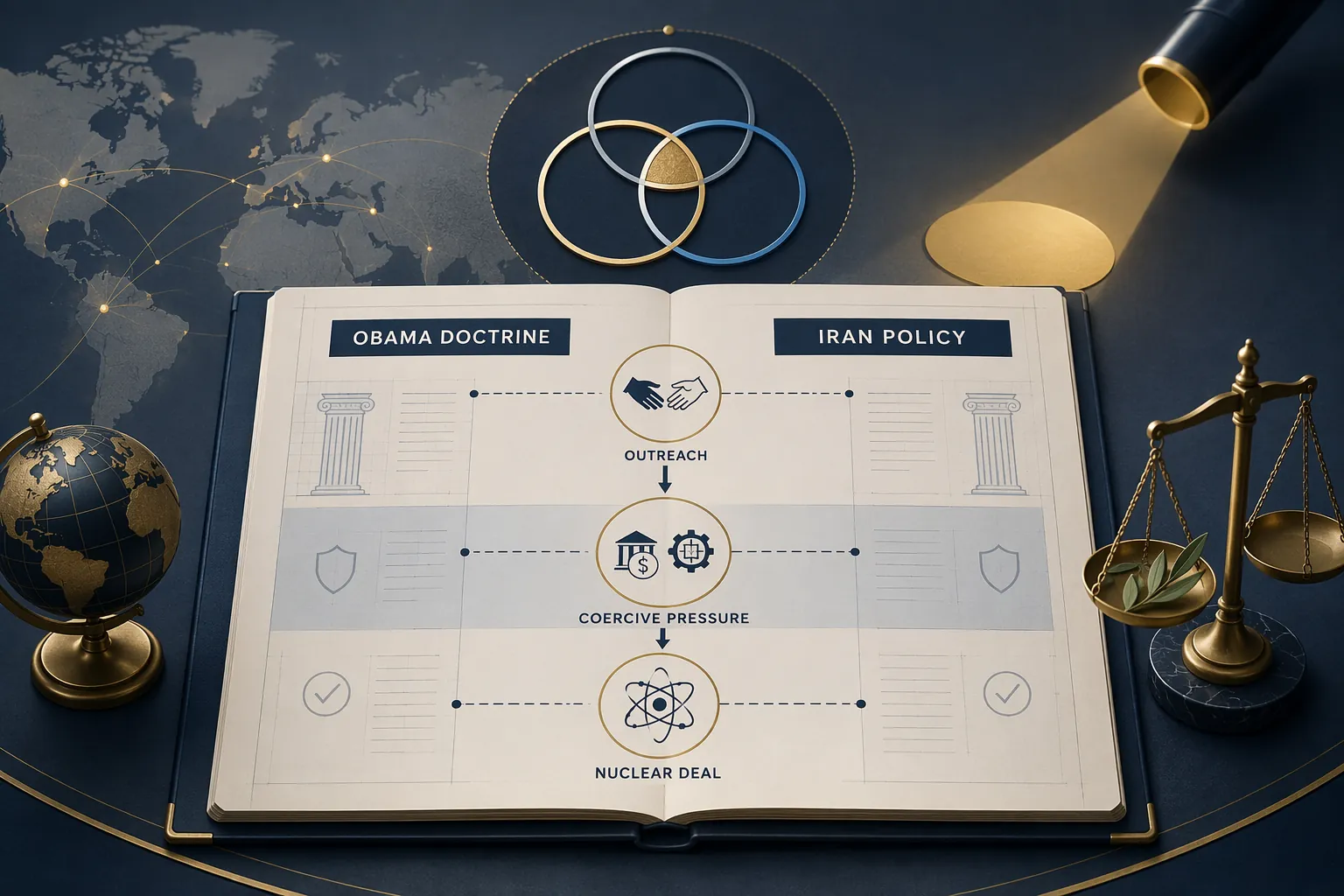
For a political science exam, start with the distinction that keeps many essays from going soft: the Obama Doctrine was not a formally announced doctrine in the way students often treat the Bush Doctrine. It is an analyst-made label for a pattern of foreign policy judgment. In the Iran case, that pattern is unusually clear: define the U.S. interest narrowly, avoid a large ground war, work through partners when possible, and use pressure and diplomacy together until the nuclear issue can be limited by agreement.
That means Iran policy was not simply "engagement," and it was not simply "appeasement" or "sanctions." From 2009 to 2015, the Obama administration moved through outreach, multilateral economic pressure, covert cyber sabotage, and finally the Joint Comprehensive Plan of Action, or JCPOA. The useful exam claim is not that every part succeeded forever. It is that Iran shows the doctrine in motion: coercion without regime-change war, diplomacy without abandoning U.S. security interests, and multilateralism used as a tool rather than as a moral ornament.
Define the Doctrine Before You Apply It
Gary Sick's POMEPS framing is one of the cleanest ways to keep the doctrine analytically usable. He describes the Obama Doctrine as "minimalist, multilateral when possible, and unabashedly self-centered," and organizes it around a five-part framework often summarized as POMEBS: pragmatic, oriented toward multilateralism when possible, minimalist, centered on essential U.S. interests, and broadly averse to large-scale military intervention.[1]
The value of that framework is that it separates doctrine from mood. A doctrine is not the president's temperament. It is a recurring logic for choosing instruments. On Iran, the recurring logic was to ask what the United States most needed to prevent, what tools could raise pressure without starting another major Middle Eastern war, and whether an agreement could lock in limits more reliably than open-ended coercion.
CSIS's discussion of Jeffrey Goldberg's Atlantic interview adds a second exam-ready anchor: Obama described himself as both a "realist" and an "internationalist."[2] Do not treat those as opposites. In this case, realism meant ranking threats and avoiding maximalist goals; internationalism meant using institutions, partners, and negotiated rules when they served U.S. interests.
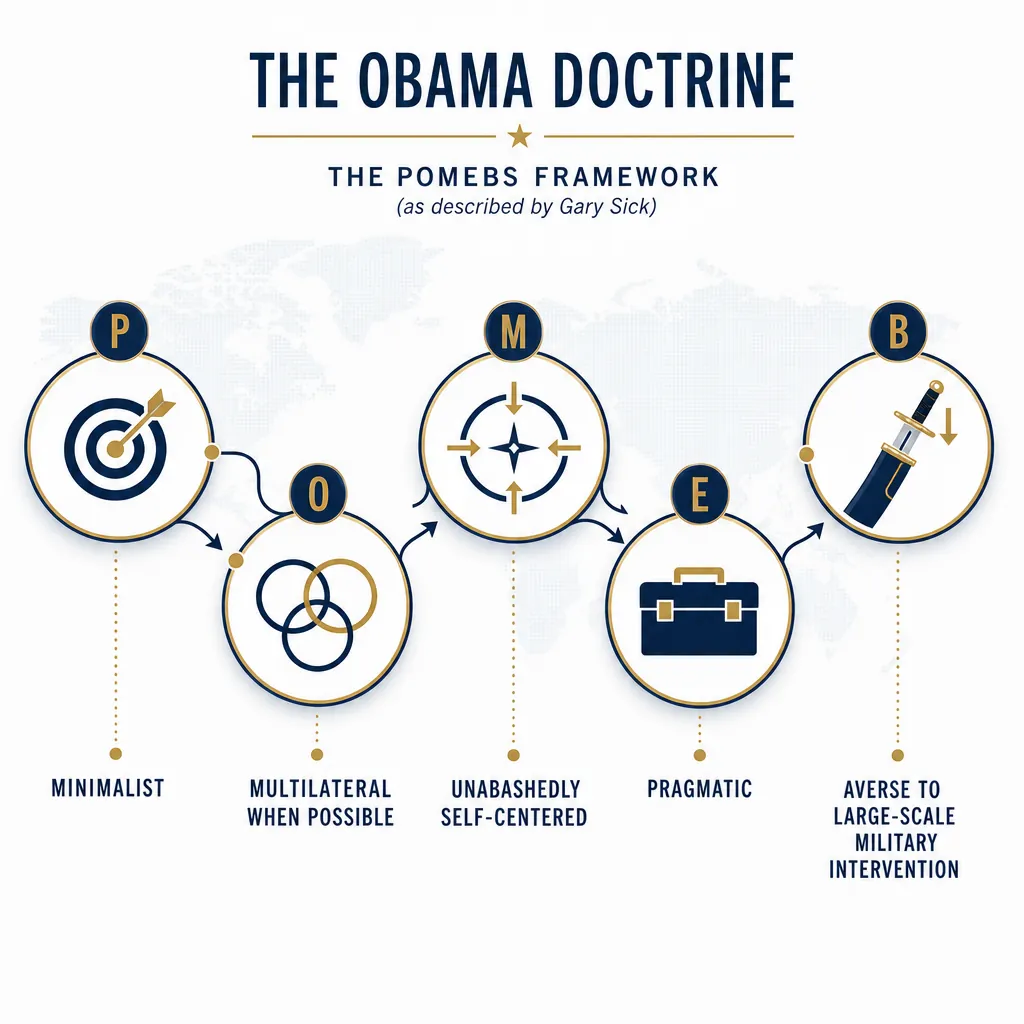
| Doctrine Element | Exam Meaning | Iran Application |
|---|---|---|
| Minimalist | Limit the objective instead of trying to remake the regional order | Focus on constraining Iran's nuclear program rather than overthrowing the regime |
| Multilateral when possible | Use partners and institutions to increase legitimacy and leverage | Build sanctions pressure with other states and negotiate through a multilateral framework |
| Self-centered | Prioritize defined U.S. security interests | Treat nuclear proliferation as the core U.S. concern |
| Pragmatic | Mix tools instead of treating diplomacy and coercion as mutually exclusive | Combine outreach, sanctions, cyber operations, and negotiation |
| Averse to large-scale military intervention | Avoid another major war unless core interests demand it | Pursue nuclear restraint without an Iraq-style invasion or regime-change campaign |
Why Iran Became the Signature Case
Amin Tarzi's FPRI analysis gives students a sentence worth remembering, though not worth repeating without explanation: the Iran nuclear deal was "the best-applied example of what is now known as the Obama Doctrine."[3] That claim works because Iran forced all of the doctrine's major tensions into one policy problem. The United States wanted to stop or slow a nuclear threat. It did not want another large war in the region. It needed pressure strong enough to matter. It also needed an exit from pressure that did more than punish.
That is why the case is better than a generic paragraph about Obama's speeches. A student can show doctrine, instrument, and outcome in sequence. The doctrine supplied the logic. The instruments were outreach, sanctions, covert disruption, and negotiation. The outcome was the JCPOA's nuclear-limitation bargain. Those are not the same thing, and timed essays often lose points when they blur them.
The Short Timeline
| Period | Policy Move | What It Shows |
|---|---|---|
| 2009 | Diplomatic outreach to Iran | Engagement as an instrument, not a concession |
| 2010-2012 | Multilateral sanctions and Stuxnet-era coercion | Pressure without a large-scale military intervention |
| 2012-2014 | Oil-revenue pressure intensifies | Economic coercion becomes leverage for negotiation |
| 2015 | JCPOA concluded | Narrow nuclear objective translated into concrete limits |
| 2016-2017 and after | Implementation, later political backlash, and eventual collapse under the next administration | A strong illustration of doctrine, not proof of permanent settlement |
Use the timeline as a spine, not as a substitute for analysis. Presidential doctrine analysis works like any good political-science timeline exercise: events matter because they reveal a governing pattern. The same habit is useful in democratic-backsliding cases, such as this Ortega election-cancellation study guide, where the point is not to memorize dates for their own sake but to turn sequence into argument.
Stage One: Outreach Did Not Mean Idealism
The 2009 opening toward Iran is easy to misread. In an exam, do not present it as Obama simply believing adversaries would moderate if spoken to politely. The stronger interpretation is more disciplined: outreach tested whether the United States could pursue its nuclear objective through negotiation before moving fully into coercive pressure.
This is where the realist-internationalist combination matters. Engagement was internationalist in method because it treated diplomacy as a serious tool. It was realist in purpose because the goal was not reconciliation for its own sake. The core issue was Iran's nuclear program and the regional risks attached to it. A doctrine that narrows the U.S. objective does not require friendly relations; it requires clarity about what problem the policy is actually trying to solve.
For exam purposes, the safest wording is this: Obama used diplomatic outreach to create a possible negotiated path while keeping the nuclear issue at the center of U.S. policy. That avoids the two lazy answers - that diplomacy was either naive softness or proof of pure liberal internationalism.
Stage Two: Sanctions Turned Multilateralism Into Leverage
The sanctions phase is the part that keeps the Iran case from becoming a sentimental story about dialogue. Brookings reported that sanctions starved Iran of more than $100 billion in oil revenues during 2012-2014.[4] That number is not a decoration. It tells you what kind of diplomacy was being attempted: negotiation under pressure.
Multilateralism mattered because sanctions work differently when they are broadly coordinated. A unilateral U.S. gesture can signal disapproval; a wider sanctions regime can change the target state's economic environment. In Obama Doctrine terms, this is multilateralism serving a realist objective. It is not multilateralism as a seminar virtue word.
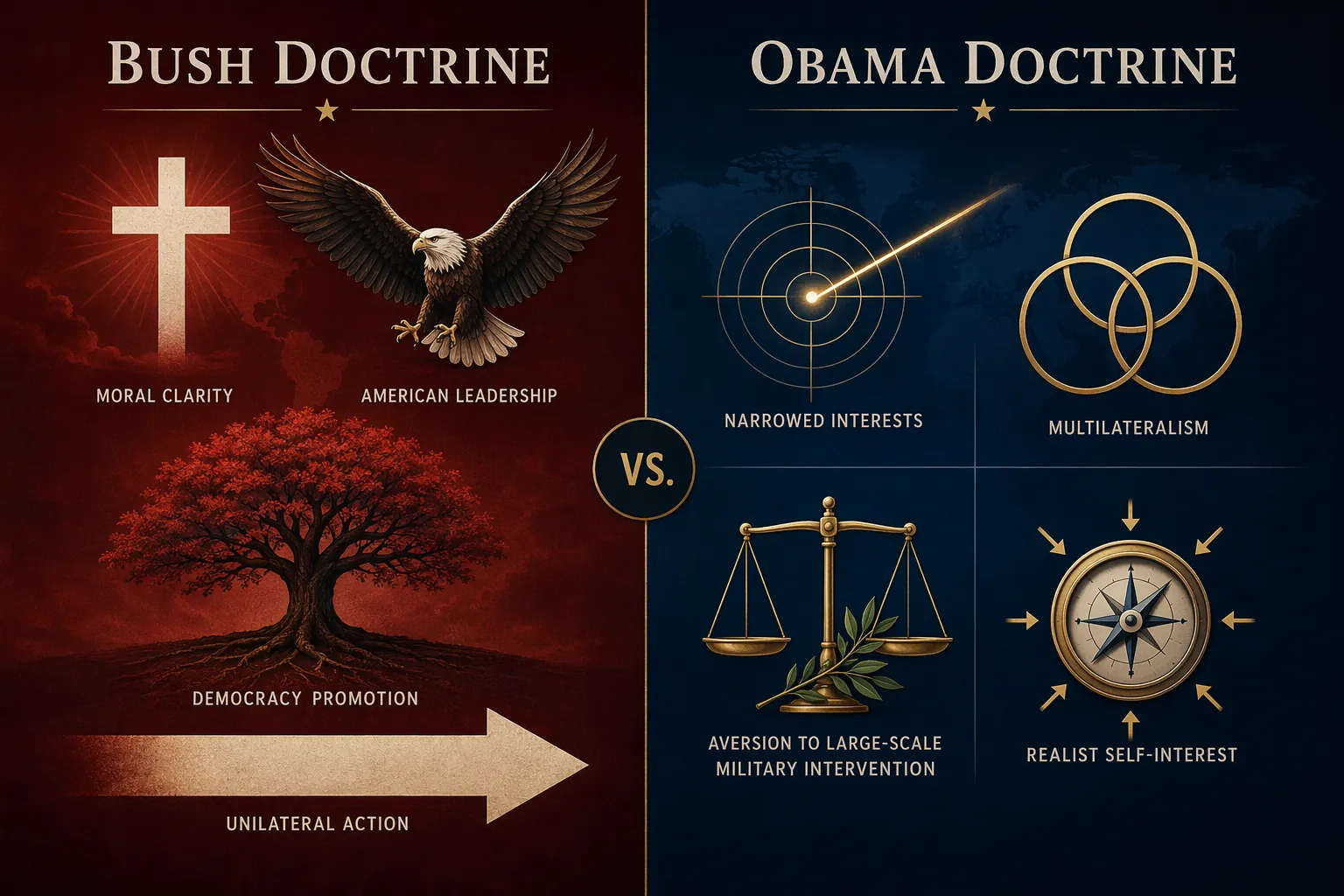
The exam contrast with the Bush Doctrine is sharp here. The Bush Doctrine is commonly associated with preventive war, unilateral willingness, and democracy-promotion-by-force after 9/11. Obama's Iran policy did not make forced democratization a core objective. It treated Iran's nuclear capacity as the central U.S. security problem and used sanctions to create bargaining leverage rather than to prepare an invasion.
Stage Three: Stuxnet Complicates the No-Force Shortcut
Students often compress the Obama Doctrine into "no military force." That is too crude. The better formulation is aversion to large-scale military intervention. The Stuxnet episode matters because it shows coercion and sabotage operating below the threshold of open war. The commonly cited chronology of U.S.-Iran relations during the Obama administration describes Stuxnet as disabling about 1,000 Iranian centrifuges.[5]
Do not overclaim from that single episode. It does not prove that cyber operations replaced military power in general, and the public record around covert action is necessarily incomplete. But it does stop a bad essay from saying the Obama approach was purely diplomatic or passive. Iran policy used pressure across economic, diplomatic, and covert domains while still avoiding the defining feature Obama wanted to avoid: another large Middle Eastern war.
This is also where instrument and doctrine must stay separate. Stuxnet was an instrument. The doctrine was the logic that made a below-war instrument attractive: constrain a specific threat without assuming that regime change, occupation, or full-scale attack would produce a better strategic result.
Stage Four: The JCPOA Translated Doctrine Into Rules
The JCPOA is the reason the Iran case remains the cleanest application of the doctrine. It turned a general Obama-era preference - manage the nuclear threat without a large war - into verifiable constraints. CFR's backgrounder describes core provisions including a 98 percent reduction in Iran's uranium stockpile, a 3.67 percent enrichment cap, and IAEA inspections.[6]
| JCPOA Provision | What the Number Measures | Doctrine Connection |
|---|---|---|
| 98 percent uranium stockpile reduction | The size of Iran's uranium stockpile after the agreement's required reduction | Narrowed objective: reduce nuclear breakout capacity rather than transform Iran's regime |
| 3.67 percent enrichment cap | The permitted enrichment level under the deal | Concrete restraint: diplomacy produces technical limits |
| IAEA inspections | Monitoring and verification arrangements | Internationalism: rely on institutional inspection rather than unilateral trust |
These details are the difference between saying "Obama preferred diplomacy" and proving how the doctrine operated. The stockpile reduction addressed material capacity. The enrichment cap addressed technical progression. Inspections addressed verification. None of those provisions required claiming that Iran had become a friendly state, a liberal democracy, or a permanent partner.
That is why the JCPOA fits realist retrenchment rather than idealist transformation. It did not try to solve every dispute between Washington and Tehran. It did not settle Iran's regional behavior, the character of the Iranian regime, or the broader rivalry between Iran and U.S. partners. It narrowed the problem to the nuclear file and judged success by whether that file could be constrained.
The 2016 Hague settlement, including a $1.7 billion payment connected to an older dispute, belongs in the supporting chronology rather than at the center of the doctrine analysis.[5] It can matter for political controversy and sequencing, but it is not the main evidence for the Obama Doctrine. The main evidence is the strategic architecture: pressure, negotiation, nuclear limits, and avoidance of a major war.
What to Contrast With the Bush Doctrine
A contrast paragraph should be brief and precise. The Bush Doctrine is useful because it highlights what Obama did not make central: preventive regime-change war and democracy-promotion-by-force. The Obama Doctrine, as applied to Iran, treated the nuclear question as the core interest and accepted that a hostile regime might still be bargained with if the result constrained a defined security threat.
- Bush Doctrine contrast: broader willingness to use force preventively and to link U.S. security with regime transformation.
- Obama Doctrine contrast: narrower definition of core interests, preference for multilateral pressure, and reluctance to use large-scale military intervention.
- Iran application: contain or roll back nuclear risk through sanctions, diplomacy, and verification rather than by overthrowing the Iranian regime.
The mistake to avoid is turning the contrast into a morality play. The exam question is not asking whether Bush was reckless and Obama was wise, or the reverse. It is asking how doctrines define interests, choose tools, and accept risks. In Iran, Obama accepted the risk of a limited bargain with an adversary because the alternative tools - especially large-scale war - carried costs the doctrine was designed to avoid.
How to Evaluate the Outcome Without Rewriting the Case
Evaluation is where strong essays become careful. The JCPOA's later fragility matters, but it should not be projected backward as if Obama-era analysts already knew the full post-2017 path. CFR's updated backgrounder covers the agreement and its later unraveling, while RAND argued in 2025 that by late 2024 Iran had reached enrichment for five-to-six bombs.[6][7] That later context complicates claims about durability. It does not erase what the 2015 agreement was designed to do.
A fair evaluation has two sentences, not one. First, the Iran case strongly illustrates the Obama Doctrine because it narrowed the U.S. objective to nuclear restraint, built multilateral pressure, used coercive tools short of major war, and produced a negotiated inspection regime. Second, later developments show that a doctrine can generate a coherent policy without guaranteeing that the policy will survive domestic reversal, adversary adaptation, or changed strategic conditions.
That distinction matters because "best illustration" is not the same as "uncontested success." FPRI's claim about the nuclear deal as the best-applied example of the doctrine is a claim about fit between doctrine and policy.[3] RAND's later warning is a claim about what happened after the deal's erosion and Iran's subsequent nuclear advances.[7] Those are different analytical tasks.
An Exam-Ready Thesis
A usable thesis would read like this: Although the Obama Doctrine was never formally declared, analysts use the term to describe a realist, selective, multilateral, and anti-large-war approach to U.S. foreign policy. Iran policy from 2009 to 2015 was its clearest application because the Obama administration moved from outreach to sanctions and covert pressure, then to the JCPOA, in order to constrain Iran's nuclear program without pursuing regime-change war.
From there, the body of an essay can follow four moves: define the doctrine with POMEBS and the realist-internationalist pairing; show outreach as a test of negotiation; show sanctions and Stuxnet as coercion short of large-scale war; and show the JCPOA's nuclear limits as the concrete policy outcome. The evaluation should then add the necessary caution: the Iran case is the doctrine's most complete expression, but later collapse and Iranian nuclear advances mean it cannot be treated as an uncomplicated permanent success.
References
- The Obama Doctrine, POMEPS
- Is There an Obama Doctrine?, CSIS
- Iran's Nuclear Deal and the Obama Doctrine: An Analysis, FPRI
- Progress of the Obama Administration's Policy toward Iran, Brookings
- Iran-United States relations during the Obama administration, Wikipedia
- What Is the Iran Nuclear Deal?, Council on Foreign Relations
- The Revenge of the JCPOA, RAND, 2025
Related exhibits & inventory
Verified outcomes
Planners
No planner filed for this exam yet
A downloadable timeline template for this exam hasn't been published yet.
Tool verdicts
AI-tool cautions
No AI tools tested for this exam yet
No hands-on AI-accuracy logs have been filed for this exam.
Questions about this plan
Ask a question about a specific section, timeline, or citation in this plan — or flag something that needs correcting.
Comments
Join the discussion with an anonymous comment.